


Personal Injury Lawyer in Greensboro, NC
At Garrett, Walker, Aycoth & Olson, Attorneys at Law, we provide dedicated personal injury representation grounded in decades of plaintiff-side trial work.
If an accident in Greensboro or the surrounding area has resulted in significant physical harm, the financial and medical consequences tend to compound within weeks. An attorney can help pursue the compensation that may be available under North Carolina law. Garrett, Walker, Aycoth & Olson, Attorneys at Law has represented injured clients across the Piedmont Triad for more than fifteen years, bringing over 50 years of combined legal experience to personal injury matters. Our Greensboro, NC personal injury lawyer provides consultations at no cost and accepts cases on a contingency fee basis.
Personal Injury Lawyer Greensboro, NC
North Carolina is one of a handful of states that still applies pure contributory negligence. That single legal doctrine shapes every personal injury case filed in this jurisdiction. If the injured party is found even partially at fault, recovery can be barred completely.
A personal injury claim holds the responsible party accountable for harm caused by negligent or reckless conduct. The losses at stake are real and specific: hospital bills, physical therapy, time away from work, and the lasting effects an injury leaves on someone’s quality of life. A Greensboro personal injury attorney accounts for all of these when evaluating a claim, identifying every liable party, and calculating the full measure of damages before approaching insurers.
Types of Personal Injury Cases We Handle in Greensboro
Not every accident produces the same legal questions. The facts matter. So does the type of collision, the parties involved, and the insurance coverage in play. These are the categories of personal injury matters handled at the firm’s Greensboro office.
- Car accidents. In 2024, more than 39,000 people died and 2.42 million were injured in traffic crashes across the country, according to NHTSA crash data. Guilford County sees a high volume of motor vehicle claims each year. Rear-end collisions, intersection crashes, and multi-vehicle pileups each raise different questions about fault and damages.
- Truck accidents. The weight difference between a commercial tractor-trailer and a passenger vehicle makes these crashes unusually destructive. Pursuing a claim often means pulling the trucking company’s maintenance history, driver logs, and federal safety records.
- Motorcycle accidents. A motorcycle offers almost no structural protection in a collision, which is why rider injuries tend to be severe. Hidden consequences like delayed soft tissue damage can surface weeks after the crash and complicate both treatment and claim value.
- Pedestrian accidents. A pedestrian struck by a vehicle frequently suffers catastrophic or fatal harm. North Carolina imposes duties on both drivers and pedestrians, and the question of who bears fault is almost always contested in these cases.
- Bicycle accidents. Cyclists hit by motor vehicles commonly sustain fractures, road rash, and head injuries, even at relatively low speeds. In some situations, a municipality’s failure to maintain safe road conditions or adequate signage may also create liability.
- Premises liability. A property owner in Greensboro who knows about a dangerous condition and fails to address it can be held responsible when someone is hurt. Slip and fall incidents, security failures, and hazardous worksite conditions are among the most common scenarios.
- Wrongful death. North Carolina gives the personal representative of a deceased person’s estate two years to bring a wrongful death action. Truck-related fatalities and other fatal collisions often involve layered insurance coverage and more than one liable party.
- Work-related injuries. A workplace injury may open claims beyond workers’ compensation when a third party contributed to the accident. Sorting out insurance coverage limits and distinguishing third-party liability from employer immunity is often where these cases begin.
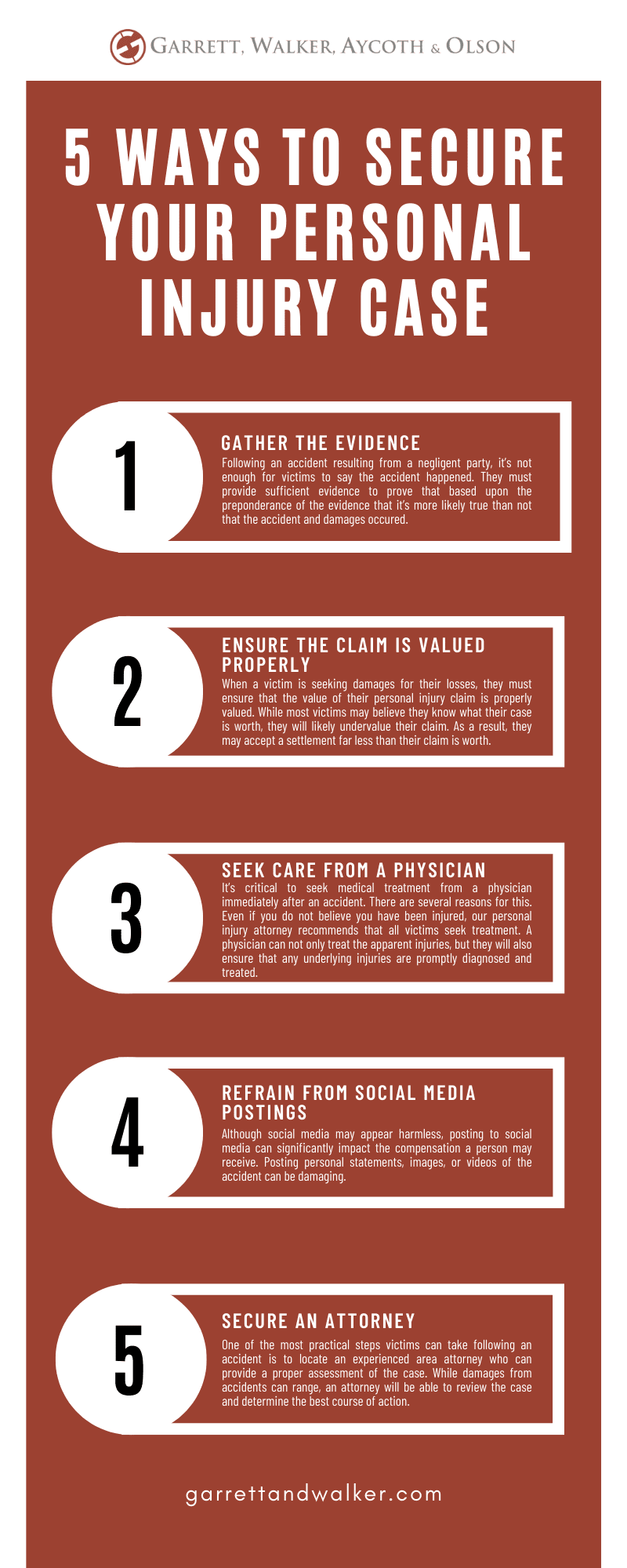
Greensboro Personal Injury Infographic
Why Choose Garrett, Walker, Aycoth & Olson as My Personal Injury Attorney in Greensboro, NC?
Local Experience and Plaintiff-Side Commitment
Brian Walker co-founded the firm alongside Chad Garrett in 2010 and has handled personal injury claims throughout North Carolina since. He earned his undergraduate degree with honors from Wake Forest University and his law degree from NC Central University School of Law before beginning his career at a Greensboro litigation firm. He went on to serve as an Assistant District Attorney in the Guilford County District Attorney’s Office, accumulating significant trial experience before transitioning to plaintiff-side representation.
The firm holds an AV Preeminent peer review rating from Martindale-Hubbell, the highest designation available for legal ability and ethical standards. Brian maintains active membership in the Greensboro Bar Association, the Guilford County Bar Association, and the North Carolina Bar Association.
Garrett, Walker, Aycoth & Olson has helped clients across Greensboro and the Piedmont Triad recover millions of dollars in personal injury settlements and verdicts. Representation is provided on a contingency fee basis, meaning no attorney fees are owed unless and until compensation is recovered. Initial consultations are free.
What Is Important to Understand About a Personal Injury Case?
Damages, Liability, and Compensation for Personal Injury Cases
Damages in a North Carolina personal injury case generally fall into three categories. Economic damages cover the financial losses a jury can verify with documentation: medical bills, the cost of ongoing rehabilitation, wages lost during recovery, and any long-term reduction in earning capacity. Non-economic damages address what the numbers cannot capture. Pain and suffering, emotional distress, and the loss of activities or quality of life that the injury permanently altered are all compensable, even though no invoice exists for them.
Punitive damages serve a different purpose entirely. They are not about making the plaintiff whole. North Carolina courts award them to penalize defendants whose conduct was willful or wanton, and the state caps them at three times the compensatory damages or $250,000, whichever amount is higher. That cap does not apply in every case, and impaired driving is one of the recognized exceptions.
Liability in personal injury matters depends on whether the defendant owed a duty of care, whether that duty was breached, and whether the breach caused the plaintiff’s injuries. Third-party liability, such as a bar’s responsibility for serving visibly intoxicated patrons who then cause a crash, can expand the range of parties against whom a claim may be brought.
What Are Important Aspects of a Personal Injury Case?
Several factors influence both the outcome and value of a personal injury claim in Greensboro, NC. Understanding these considerations early in the process allows for more effective preparation.
- Evidence preservation, including photographs of the scene, medical records, witness contact information, and any available surveillance footage, is critical in the days and weeks following an incident
- Contributory negligence is one of the most consequential elements of any North Carolina personal injury case; if the injured party is found to bear any degree of fault, recovery may be barred entirely
- Timely medical treatment creates a documented connection between the incident and the injuries claimed, and gaps in treatment can undermine a claim’s credibility
- Insurance company tactics, including early settlement offers and recorded statements, often result in denied claims or reduced payouts when handled without legal counsel
What Is the Personal Injury Case Timeline?
Personal injury cases in Greensboro do not follow a single fixed schedule. Duration depends on the severity of injuries, the number of liable parties, and whether the case proceeds to litigation. The general progression includes the following phases.
- Medical treatment and stabilization, during which the injured party reaches maximum medical improvement
- Investigation and evidence collection, including police reports, medical records, and any available analysis from retained professionals
- Demand and negotiation with the at-fault party’s insurer
- Filing of a lawsuit if a fair settlement cannot be reached through negotiation
- Discovery, depositions, and pretrial motions, which can extend several months depending on the court’s calendar in Guilford County
- Trial or final settlement, which may occur at any point once both sides have fully evaluated the evidence
While each case varies, some crash-related claims resolve within months. Others, particularly those involving disputed liability or catastrophic injuries, may take two years or longer.
What Should You Bring to Your Personal Injury Consultation?
Gathering available documentation before a consultation helps an attorney evaluate a potential personal injury claim efficiently.
- The police report or incident report, if one was filed
- Medical records and bills related to the injury, including emergency room visits, imaging, and follow-up appointments
- Photographs of the accident scene, property damage, and visible injuries
- Insurance correspondence, including any letters or emails from the at-fault party’s insurer
- Documentation of lost wages, such as pay stubs or a letter from an employer
An initial consultation at Garrett, Walker, Aycoth & Olson covers the facts of the incident, the strength of the potential claim, and the firm’s approach to representation. There is no fee and no obligation.
What Are Important North Carolina Legal Resources for Personal Injury Cases?
North Carolina has specific statutes governing personal injury claims, including limitations periods, negligence standards, and damages rules. The following resources provide access to the relevant laws and related information.
- The NC General Statutes maintained by the General Assembly contain all current statutory provisions, including the three-year statute of limitations for most personal injury actions under N.C. Gen. Stat. § 1-52
- The NC Department of Insurance provides consumer resources regarding auto and vehicle insurance requirements, coverage types, and the claims process
- The CDC’s injury database offers national and state-level data on fatal and nonfatal injuries, useful for understanding the scope of accident-related harm
- North Carolina law generally caps punitive damages at the greater of three times the compensatory award or $250,000, with limited exceptions for specific categories of misconduct
Reach Out to Garrett, Walker, Aycoth & Olson to Schedule a Consultation
Garrett, Walker, Aycoth & Olson, Attorneys at Law represents injured clients on a contingency fee basis. No attorney fees are charged unless compensation is recovered. Initial consultations are provided at no cost and cover the facts of the potential claim, the applicable legal standards, and the firm’s recommended approach. The firm’s Greensboro office is available to discuss personal injury cases during regular business hours, with prompt attention given to new inquiries. Contact us to schedule a confidential case review.
Personal Injury Statistics in Greensboro
 Greensboro sits at the junction of I-40 and I-85, two of North Carolina’s busiest interstate corridors. That convergence, combined with dense commuter traffic across Guilford County, places the area consistently among the state’s most crash-heavy jurisdictions. According to NCDOT crash data, North Carolina recorded more than 284,000 reportable traffic crashes in 2024, resulting in 1,732 fatalities statewide. The figure marked a 2.7 percent increase over the prior year. For a Greensboro personal injury attorney, these numbers are not abstract. They represent individuals and families navigating medical treatment, insurance disputes, and uncertain financial futures.
Traffic collisions account for the largest share of personal injury claims in the area, but they are not the only source of harm. The Bureau of Labor Statistics reported 196 fatal workplace injuries across North Carolina in 2024, a 10.7 percent increase from 2023. Transportation-related incidents were responsible for 77 of those deaths.
- North Carolina recorded approximately 113,600 nonfatal traffic injuries in 2024, according to the NC Division of Motor Vehicles
- Pedestrian fatalities in North Carolina surged by 12 percent in 2024, and speeding contributed to 21.4 percent of all crash-related deaths
- Guilford County averaged 72 traffic deaths and roughly 7,774 traffic-related injuries per year between 2019 and 2023
- Transportation incidents were the leading type of fatal workplace injury in North Carolina in 2024
- The NC Injury Prevention Branch tracks motor vehicle crash hospitalizations and emergency department visits at the county level, with Guilford County consistently among the state’s most affected areas
Factors That Affect the Outcome of Your Personal Injury Case
The value of a personal injury claim in Greensboro, NC depends on a set of legal, medical, and factual variables that interact differently in every case. A personal injury lawyer evaluates all of them before recommending a strategy.
- Severity and permanence of injuries. Claims involving traumatic brain injuries, spinal cord damage, or permanent impairment carry substantially more serious potential damages than soft tissue cases. Whether an injury resolves fully or leaves a lasting disability changes the medical evidence required and the calculation of future losses.
- Medical documentation and treatment consistency. Gaps between the date of the incident and the start of treatment give insurance adjusters grounds to question causation. A documented, continuous treatment record strengthens a personal injury claim at every stage.
- Clarity of liability. North Carolina’s contributory negligence rule means that even a small question about whether the injured party contributed to the incident can jeopardize recovery entirely. Cases with clear evidence of fault on the other side, such as a confirmed distracted driving scenario, stand on firmer ground.
- Available insurance coverage. The at-fault party’s policy limits place a practical ceiling on what can be recovered. When those limits are insufficient, a personal injury attorney identifies additional sources of coverage, including umbrella policies and underinsured motorist provisions.
- Preservation of evidence. Photographs, surveillance footage, and witness accounts lose value or disappear over time. Early investigation by a Greensboro injury lawyer often determines whether a critical piece of evidence is still available when it matters most.
- Credibility of the plaintiff. Inconsistencies between what someone reports and what the medical or factual record shows can weaken a case substantially. Insurers and defense counsel look for contradictions in statements, social media activity, and prior medical history.
- The defendant’s resources. Claims against commercial carriers, large corporations, or government entities involve defense teams with more resources and more aggressive tactics. Truck accident cases in Greensboro, NC are a common example. Multiple layers of insurance, federal regulations, and retained defense firms all complicate and extend the process.
- Jurisdiction and local court dynamics. Guilford County’s court docket, sitting judges, and jury composition all influence how a case is evaluated strategically. Familiarity with the local legal landscape matters when deciding whether to settle or proceed to trial.
Greensboro, NC Personal Injury Lawyer FAQs
How long do I have to file a personal injury claim in North Carolina?
The general statute of limitations for most personal injury actions is three years from the date of injury. Wrongful death claims carry a separate two-year limitations period. Missing either deadline typically eliminates the right to pursue compensation. Certain circumstances, including the age of the injured party or the involvement of a government entity, can shorten or toll the deadline. Consulting a personal injury lawyer in Greensboro early in the process helps protect these rights.
What does contributory negligence mean for my case?
North Carolina is one of a small number of states that follows pure contributory negligence. If the injured person is found to share any percentage of fault for the incident, recovery may be barred entirely. This standard is significantly more restrictive than the comparative fault systems used in most other jurisdictions. Defense attorneys and insurance adjusters will investigate thoroughly for any evidence suggesting the plaintiff contributed to the accident.
How much does a personal injury attorney in Greensboro cost?
Garrett, Walker, Aycoth & Olson handles personal injury cases on a contingency fee basis. No attorney fees are collected unless compensation is recovered. Initial consultations are provided at no cost and carry no obligation. This fee structure allows injured individuals to pursue claims regardless of their current financial situation.
What types of compensation can I recover in a personal injury case?
North Carolina law allows recovery of economic damages, including medical expenses, lost wages, and reduced earning capacity. Non-economic damages cover pain, suffering, emotional distress, and diminished quality of life. Where the defendant’s conduct was willful or wanton, punitive damages may also be available, subject to the statutory caps discussed elsewhere on this page.
Should I accept the first offer from an insurance company?
Initial settlement offers are typically calculated to close the claim quickly and at the lowest amount possible. Accepting before reaching maximum medical improvement risks leaving future medical costs, ongoing treatment needs, and long-term wage losses uncompensated. A Greensboro personal injury lawyer evaluates the full scope of damages before advising on whether an offer is adequate.
How long does a personal injury case take in Greensboro?
Timelines depend on injury severity, the number of liable parties, and whether the case proceeds to litigation. Some claims involving car accident injuries resolve through negotiation within several months. Others, particularly those with disputed liability or catastrophic harm, may extend two years or longer. Guilford County’s court calendar also influences scheduling for cases that go to trial.
What if the at-fault driver was uninsured?
North Carolina law requires drivers to carry liability insurance, but compliance is not universal. In uninsured motorist situations, the injured party may recover through their own policy’s uninsured or underinsured motorist coverage. A personal injury attorney can identify all available insurance avenues and pursue recovery through each.
Do I need a lawyer for what seems like a minor injury?
Injuries that appear minor after an accident can develop into more serious conditions over weeks or months. Delayed-onset conditions, including certain head and neck injuries, may not be fully apparent immediately. Early consultation with a personal injury attorney helps document the claim properly and prevents premature resolution before the true cost of the injury becomes clear.
Important Resources for Greensboro Personal Injury Cases
Most Dangerous Locations for Personal Injury in Greensboro
Motor vehicle collisions in Greensboro are concentrated along several high-traffic corridors. The following areas appear frequently in local crash reports.
Dangerous Streets
- W. Market Street, particularly between Holden Road and Guilford College Road
- Gate City Boulevard from S. Elm-Eugene Street to Groometown Road
- Battleground Avenue between Cone Boulevard and Pisgah Church Road
- E. Wendover Avenue near the I-40 interchange
Dangerous Highways
- I-40 through central Greensboro, including the interchange at I-85
- I-85 from the Greensboro city limits toward Burlington
- US-29 (O. Henry Boulevard) through northern Guilford County
- I-73/I-840 (Greensboro Urban Loop), particularly along its southern sections
What Are Important Local Resources for Greensboro Personal Injury?
Individuals involved in an accident in Greensboro may need to contact the following agencies and facilities. This list is provided for informational purposes only and does not constitute an endorsement of any organization listed.
- Greensboro Police Department (Non-Emergency: 336-373-2222)
- Guilford County Sheriff’s Office (336-641-3694)
- Moses Cone Hospital Emergency Department (1121 N. Church Street, Greensboro)
- NC State Highway Patrol — Collision Information
- Guilford County Clerk of Court (336-412-7300)
About Garrett, Walker, Aycoth & Olson, Attorneys at Law
Garrett, Walker, Aycoth & Olson was founded in 2010 and has grown into one of the Piedmont Triad’s most established multi-practice law firms. Brian Walker leads the firm’s personal injury and workers’ compensation practice and also represents businesses, corporations, and municipalities in contract disputes and civil litigation across North Carolina. The firm brings over 50 years of combined legal experience to its practice areas and serves clients from its offices at 317 S. Greene Street in downtown Greensboro.
What Our Clients Say
★★★★★
“My Dad, Mom, and Sister were in a car accident, my mom got hurt real bad. Thankfully she is doing mostly well now. I’m glad it didn’t work out with another lawyer, we were dealing with at first. I think it was just God’s will. Everybody worked to help us get as good as possible settlement. They were easy to work with and very informative. I don’t think anyone could have done any better, we were thankful for their help in a very stressful time for my family. If you need an injury lawyer, I fully recommend them.”
Read more reviews on our Google Business Profile.
Additional Resources for Greensboro Personal Injury Cases
- The Most Common Mistakes People Make in Personal Injury Cases in North Carolina
- Single Car Accidents From a Greensboro Personal Injury Lawyer
- Car Accidents and Vision
- Greensboro Personal Injury Attorney Gives Update on Wrongful Death
Contact Garrett, Walker, Aycoth & Olson, Attorneys at Law
Garrett, Walker, Aycoth & Olson represents injured individuals across Greensboro and the Piedmont Triad on a contingency fee basis. No fees are charged unless compensation is recovered. The firm provides confidential case evaluations at no cost, with prompt attention given to new inquiries during regular business hours. Contact us to discuss the details of a potential personal injury claim with a Greensboro, NC personal injury attorney.