


AWDWIKISI stands for assault with a deadly weapon with intent to kill inflicting serious injury, a Class C felony under G.S. 14-32(a). The sentencing chart calls for active prison time at every record level, which is why the intent and injury elements matter so much.
With no prior record, the presumptive minimum is 58 to 73 months. One narrow exception, called extraordinary mitigation, exists, but it is up to the judge.
Key point: “Intent to kill” does not mean you planned anything. A specific intent to kill can form without premeditation, so the State argues it from the facts, and your lawyer can test it the same way.
Charged with AWDWIKISI in Guilford County? Call (336) 379-0539 today, before you explain anything to police, because bond and the first look at the evidence happen early.
What AWDWIKISI Stands For, Letter by Letter
AWDWIKISI packs a whole felony charge into nine letters. Each part names something the State must prove.
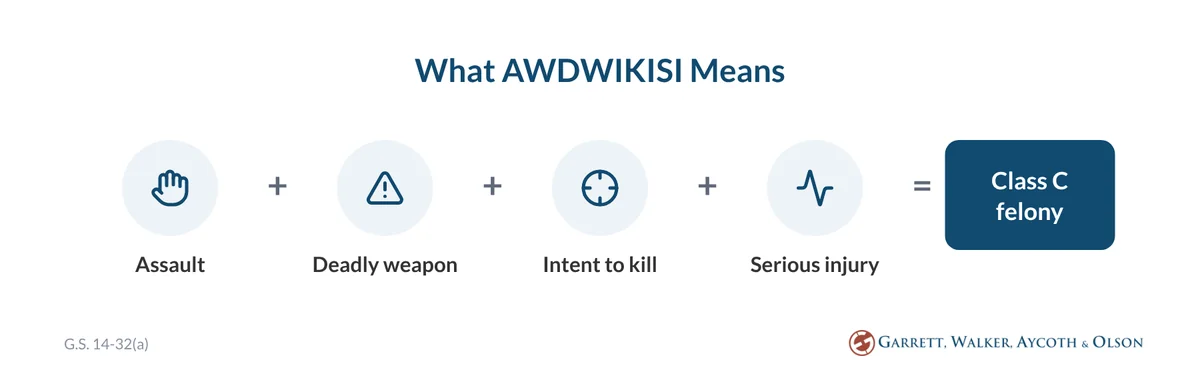
AWDW means assault with a deadly weapon. IK means with intent to kill, and ISI means inflicting serious injury.
Put together, the letters name the most serious charge in G.S. 14-32, the North Carolina law on felony assault with a deadly weapon. Take away any one of those four parts and the charge is no longer AWDWIKISI.
Two other spellings show up in searches. AWDWWITKISI spells out “with intent to kill” and points to the same Class C charge.
AWDWIK leaves off the injury. It means assault with a deadly weapon with intent to kill, a Class E felony under G.S. 14-32(c).
The AWDWIKISI Statute and What the State Must Prove
For AWDWIKISI, four elements have to be proved beyond a reasonable doubt, and intent to kill is the one that sets this charge apart.
“Any person who assaults another person with a deadly weapon with intent to kill and inflicts serious injury shall be punished as a Class C felon.” G.S. 14-32(a)
North Carolina’s pattern jury instructions break that sentence into four parts. The jury hears each one before it decides.
An assault: The State must show the act was intentional and done without justification or excuse. Self-defense goes straight to this element.
A deadly weapon: Under the pattern instruction, that means an object “likely to cause death or serious bodily injury.” Whether an object qualifies turns on what it is, the way it was used and the size and strength of each person.
Specific intent to kill: The State must prove you meant to kill, not only to hurt. That intent can form without premeditation, so it is argued from facts like the weapon, the wounds and what was said.
Serious injury: Courts define it as an injury that causes “great pain and suffering.” No hospital stay is required, and whether an injury is serious is usually a question for the jury.
Note: Serious injury is a lower bar than “serious bodily injury” under G.S. 14-32.4. That is a separate charge with its own elements.
Every element is a place where the case can be tested. See what our assault defense lawyers do first after a felony assault arrest.
What Happens to the Charge if One Element Is Missing
If the State proves three elements but not the fourth, the case can step down to a lesser charge. The intent and injury elements decide most of these steps.
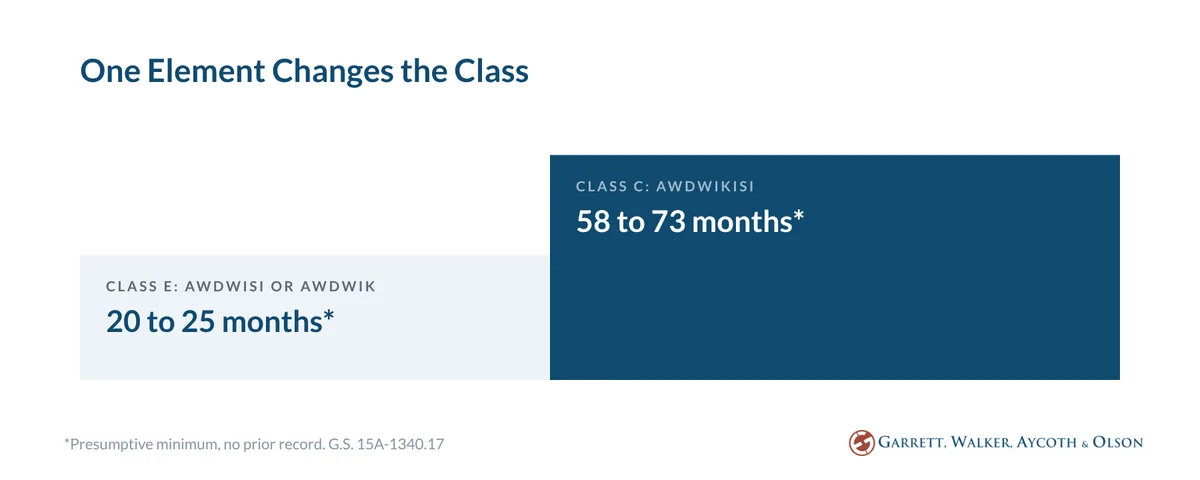
Without intent to kill, the charge is assault with a deadly weapon inflicting serious injury, a Class E felony. Without serious injury, it becomes AWDWIK, also Class E.
At Level I, Class E carries a presumptive minimum of 20 to 25 months, compared with 58 to 73 for Class C. The Class E chart also allows intermediate punishment, which is probation, at Levels I and II only.
That one missing element is often the difference between Class C and Class E. Showing that one element is missing is the work of your defense lawyer, depending on the facts of your case.
Talk to a defense lawyer before you talk to anyone else
What you say and sign in the first days often decides what is possible later. The earlier we see your paperwork, the more options you usually have.
Call (336) 379-0539Free consultation with a Greensboro attorneyAWDWIKISI Penalties and Jail Time in NC
AWDWIKISI is punished on the Class C row of the felony grid in G.S. 15A-1340.17, and every cell on that row calls for active prison time.
Your prior record level comes from points under G.S. 15A-1340.14. The judge then sets a minimum term from the presumptive, mitigated or aggravated range.
| Prior Record Level | Points | Presumptive Minimum (Months) | Mitigated Minimum (Months) | Aggravated Minimum (Months) |
|---|---|---|---|---|
| Level I | 0 to 1 | 58 to 73 | 44 to 58 | 73 to 92 |
| Level II | 2 to 5 | 67 to 83 | 50 to 67 | 83 to 104 |
| Level III | 6 to 9 | 77 to 96 | 58 to 77 | 96 to 120 |
| Level IV | 10 to 13 | 88 to 110 | 66 to 88 | 110 to 138 |
| Level V | 14 to 17 | 101 to 127 | 76 to 101 | 127 to 159 |
| Level VI | 18 or more | 117 to 146 | 87 to 117 | 146 to 182 |
The maximum term follows the minimum. A 58-month minimum carries an 82-month maximum, and a 73-month minimum carries a 100-month maximum.
Note: You may see “44 to 231 months” online. That mixes the lowest minimum with the highest maximum, which goes with a 182-month minimum at Level VI.
The chart authorizes only active time on the Class C row. One narrow exception exists under G.S. 15A-1340.13(g): a judge may impose an intermediate punishment on written findings of extraordinary mitigation.
Those factors must substantially outweigh any aggravation and make active time a manifest injustice. The factors must be “significantly greater than in the normal case,” and the decision is in the judge’s discretion.
Important: Extraordinary mitigation is not available with five or more prior record points, under G.S. 15A-1340.13(h). On the Class C row it can reach only 0 to 4 points: Level I, or Level II with 2 to 4 points.
Building toward it is your lawyer’s work from day one.
See how the felony sentencing chart works and when a judge can deviate from it.
You may also hear about a 72-month firearm or deadly weapon add-on in section 15A-1340.16A. That add-on is excluded when the weapon evidence is needed to prove an element, and your lawyer checks how the indictment is written.
A conviction also means losing your gun rights after a felony under G.S. 14-415.1.
No conviction expunction path exists for AWDWIKISI under G.S. 15A-145.5. It leaves out Class A through G felonies and any offense with assault as an element.
First Steps in a Guilford County AWDWIKISI Case
An AWDWIKISI case starts in District Court and moves to Superior Court, where a Class C felony is tried under G.S. 7A-271. The first weeks are when the intent and injury evidence takes shape.
A magistrate sets release conditions after the arrest. A lawyer can start asking a judge to lower a bond right away.
In this charge, a probable cause hearing can be the first time witnesses describe the injury and what was said, under oath. The State can skip it by indicting first, so your lawyer asks for it early under G.S. 15A-606.
If one is held, learn how a probable cause hearing tests evidence. Once a grand jury returns an indictment under G.S. 15A-641, plea talks and any trial on the Class C charge happen in Superior Court.
Read what happens when a grand jury indicts you on a felony.
Warning: Statements about “what you meant” are what intent cases are built on. Talk to a lawyer before you explain anything to police or to the other person.
Bond, the hearing request and any mitigation work all start in the first days. See every criminal charge we defend in Guilford County.
Defenses to an AWDWIKISI Charge
The main defenses attack one element at a time. Each one can change the charge or the result, depending on the facts of your case.
Self-Defense or Defense of Others
Under G.S. 14-51.3, deadly force is justified when you reasonably believe it is necessary to prevent imminent death or great bodily harm to yourself or another. When the evidence supports self-defense, the judge must instruct the jury on it.
Earlier threats can matter too. Under G.S. 14-33.1, threats the other person made and you heard about before the fight can be used to show your fear was reasonable.
No Intent to Kill
The State must prove you meant to kill, not just that someone was hurt. If that proof fails, the charge can drop to the Class E charge under G.S. 14-32(b).
The Object Was Not a Deadly Weapon as Used
Many objects are deadly only because of how they are used. Your lawyer can argue that the object, the way it was used and the size of each person point away from a deadly weapon.
That argument can lead to a lesser assault charge instead of a felony under G.S. 14-32.
The Injury Was Not Serious
Medical records, photos and recovery time decide this element. If the injury was not serious, the charge can become AWDWIK, a Class E felony under G.S. 14-32(c).
Weak or Conflicting Evidence
The State must prove who did it and every element beyond a reasonable doubt. Conflicting witness accounts, missing video or unclear injuries can create that doubt.
Any of these outcomes depends on the facts of your case and on the work your lawyer does early. If the State says you meant to kill someone, call a Greensboro assault defense lawyer before you explain anything.
Worried about what the State will say you intended? Call (336) 379-0539 before your next court date.
Frequently Asked Questions
What does AWDWIKISI stand for?
AWDWIKISI stands for assault with a deadly weapon with intent to kill inflicting serious injury, a Class C felony under G.S. 14-32(a). Class C sits below only Classes A, B1 and B2 on the felony chart. It is two classes above the Class E assault charges, and the case is tried in Superior Court.
What is AWDWWITKISI?
AWDWWITKISI is another abbreviation for the same Class C charge, with extra letters for “with intent to kill.” It is the same charge whichever abbreviation appears on paperwork or in a search. What matters is the subsection cited, G.S. 14-32(a), because (b) and (c) carry lower Class E sentences.
How much jail time is AWDWIKISI in NC?
With no prior record, the presumptive minimum is 58 to 73 months under G.S. 15A-1340.17. The mitigated range starts at 44 months, and the range rises with each prior record level. The chart calls for active time at all six levels, subject to one narrow exception.
Can you get probation for AWDWIKISI?
The chart calls for active time at every level. The only route is extraordinary mitigation under G.S. 15A-1340.13(g), which needs written findings by the judge. It is up to the judge and can reach Class C only at 0 to 4 prior record points. Otherwise, your lawyer works on the charge itself.
What is AWDWIK?
AWDWIK means assault with a deadly weapon with intent to kill, a Class E felony under G.S. 14-32(c). It can be charged even when no one was hurt. At Level I its presumptive minimum is 20 to 25 months, and the Class E chart allows probation at Levels I and II.
Does intent to kill mean I planned it?
No. A specific intent to kill can form without premeditation or planning. Your own words after the incident can become the State’s intent evidence. Talk to a lawyer before you explain anything to police, to friends or on social media, because those statements can be used in court.
Can AWDWIKISI be reduced to a lesser charge?
It can be, depending on the facts of your case. If intent to kill or serious injury cannot be proved, the case may move to a Class E charge under G.S. 14-32(b) or (c). Your lawyer raises these points in plea talks and at trial.
Can I get a bond on an AWDWIKISI charge?
A magistrate sets conditions of release after the arrest, and those conditions can include a bond. If the conditions are too high to meet, a lawyer can ask a judge to review them. Bond amounts depend on the case, so there is no set figure for this charge.
Will an AWDWIKISI conviction take away my gun rights?
Yes. Under G.S. 14-415.1, a person convicted of a felony may not buy, own or possess a firearm. Breaking that rule is a separate Class G felony. This is one more reason to fight the charge from the start with a lawyer.
- Former President, Greensboro Criminal Defense Lawyers Association
- Elected member, Criminal Justice Section, North Carolina Bar Association
- Selected to present the Wade M. Smith Award for Top Criminal Defense Lawyer in North Carolina
Talk to a Greensboro criminal defense lawyer today
Bring the warrant, the release order and anything else they gave you.
Garrett, Walker, Aycoth & Olson, Attorneys at Law
317 South Greene St, Greensboro, NC 27401
(336) 379-0539
This article explains North Carolina law in general terms. It is not legal advice about your case, and laws, penalties and court procedures change. Contact an attorney about your specific situation.