


Discharging a firearm into occupied property is a felony in North Carolina under G.S. 14-34.1. It is Class E for an occupied building or vehicle, Class D for an occupied home or a vehicle in operation, and Class C if anyone suffers serious bodily injury.
Nobody has to be hit, and the State does not have to prove you meant to scare or hurt anyone.
This guide is for anyone charged after shots hit a house, apartment or car in Guilford County, and for their families. Court records often shorten the charge name, so a label on your paperwork may not match the statute’s words.
Charged in Greensboro or High Point? Call (336) 379-0539 today to talk with Jason Aycoth’s team.
The chart calls for active prison time at every record level for Class D and C. Early evidence, like shell casings, video and who was there, is where the defense starts.
What G.S. 14-34.1 Says About Shooting Into Occupied Property
G.S. 14-34.1 makes it a felony to fire a gun into a building, home or vehicle while someone is in it. The statute sets three levels.
“(a) Any person who willfully or wantonly discharges or attempts to discharge any firearm or barreled weapon … into any building, structure, vehicle, aircraft, watercraft, or other conveyance, device, equipment, erection, or enclosure while it is occupied is guilty of a Class E felony.”
“(b) A person who willfully or wantonly discharges a weapon described in subsection (a) of this section into an occupied dwelling or into any occupied vehicle, aircraft, watercraft, or other conveyance that is in operation is guilty of a Class D felony.”
“(c) If a person violates this section and the violation results in serious bodily injury to any person, the person is guilty of a Class C felony.”
The law covers any firearm. It also covers a barreled weapon that fires shot, bullets or pellets at 600 feet per second or more.
So some high-velocity air or pellet guns can fall under the statute. Whether a weapon meets that speed is a fact the State has to prove.
The shot has to go “into” the property “while it is occupied.” The list is wide: a building, structure, car, boat, aircraft or other enclosure.
An attempt counts only in subsection (a), the Class E offense. Subsection (b) speaks only of a person who “discharges” a weapon into an occupied dwelling or a conveyance in operation.
Firing a gun inside an occupied building or car to scare someone is a different Class F felony under G.S. 14-34.10, explained with the rules on firing a gun inside city limits.
Pointing a gun at a person is also its own crime. Under G.S. 14-34, it is a Class A1 misdemeanor, loaded or not.
Elements the State Must Prove
The State must prove three things beyond a reasonable doubt. They come from North Carolina’s pattern jury instruction for this charge, number 208.90.
Willful or wanton firing into the property. The instruction calls an act willful or wanton when it is done on purpose, knowing or having reason to believe it would endanger the rights or safety of others.
The property was occupied. At least one person had to be there at the moment the gun was fired.
Property is occupied when someone is actually there, and people on the porch count.
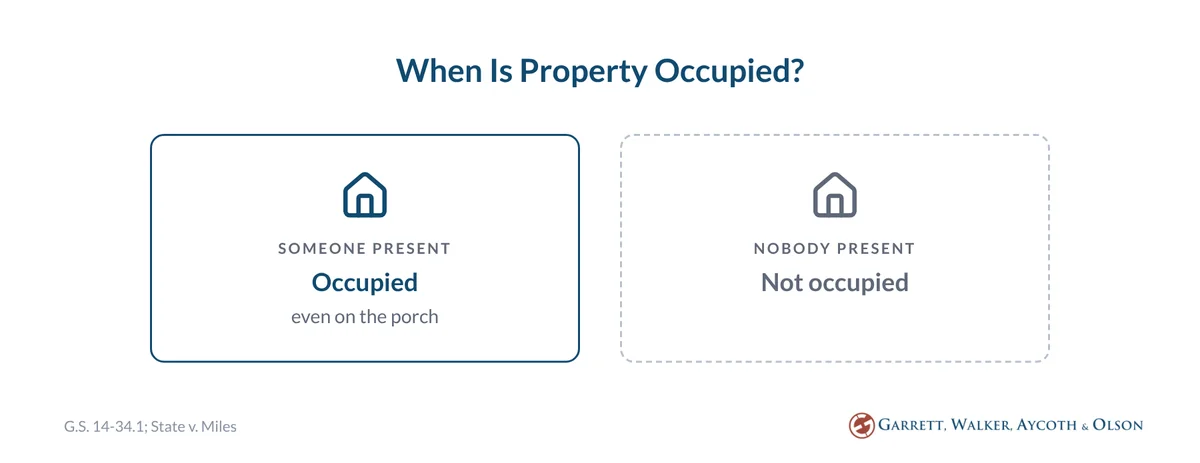
The UNC School of Government explains that rule in its post on people on the porch and occupied property, based on State v. Miles.
Knowing, or having reasonable grounds to believe, someone was there. This is often the center of the case, because a dark house or a parked car can look empty.
In State v. Bryant, the court of appeals approved telling jurors this is a general intent crime: the State only had to prove the defendant fired the gun on purpose.
Each element is a place where the evidence can fall short. See how our felony defense lawyers build a case from the first hearing.
Class E, D or C: How the Charge Level and Sentence Are Set
The class depends on what was hit and whether anyone was seriously hurt. The class then sets the prison range under G.S. 15A-1340.17.
The table shows the presumptive minimum at Prior Record Level I, the lowest record level. Ranges climb at higher levels.
| Class | When It Applies | Level I Presumptive Minimum (Months) | What the Chart Authorizes |
|---|---|---|---|
| Class E | Occupied building, structure, vehicle or other enclosure, or an attempt (G.S. 14-34.1(a)) | 20-25 | Intermediate punishment (probation) or active at Levels I-II; active at Levels III-VI |
| Class D | Occupied dwelling, or an occupied vehicle, aircraft, watercraft or conveyance in operation (G.S. 14-34.1(b)) | 51-64 | Active at every level (narrow extraordinary mitigation exception, G.S. 15A-1340.13) |
| Class C | Serious bodily injury to any person (G.S. 14-34.1(c)) | 58-73 | Active at every level (narrow extraordinary mitigation exception, G.S. 15A-1340.13) |
For Class E, probation is authorized at Levels I and II, not promised. Arguing for it is your lawyer’s job.
For Class D and C, a judge may impose intermediate punishment only on written findings of extraordinary mitigation under G.S. 15A-1340.13(g). That is rare, discretionary, and not available with five or more prior record points, so your lawyer builds it from the start.
Each minimum carries a set maximum. A 20-month minimum carries a 36-month maximum, 51 months carries 74, and 58 months carries 82.
Serious bodily injury is a high bar. It means injury such as a substantial risk of death, coma, serious permanent disfigurement, lasting extreme pain or prolonged hospitalization.
Fines are also possible. For a felony, the amount is in the court’s discretion under G.S. 15A-1340.17(b).
Prosecutors sometimes ask about a gun enhancement. The 72-month enhancement in section 15A-1340.16A does not apply where the weapon is needed to prove an element of the felony, which a lawyer checks in your indictment.
Warning: A felony conviction ends your right to have a gun. Under G.S. 14-415.1, a person with a felony conviction who possesses a firearm commits a Class G felony.
Getting those rights back is hard: the petition in G.S. 14-415.4 excludes felonies with a firearm as an element. See how firearm rights restoration works in NC.
Even before trial, there are rules on buying a gun while a felony is pending.
Talk to a defense lawyer before you talk to anyone else
What you say and sign in the first days often decides what is possible later. The earlier we see your paperwork, the more options you usually have.
Call (336) 379-0539Free consultation with a Greensboro attorneyEach Shot Can Be a Separate Charge
Yes, each shot can be charged as its own count. That is why some paperwork lists two, three or more counts for one incident.
In State v. Rambert, 341 N.C. 173 (1995), the North Carolina Supreme Court upheld three counts for three pistol shots. The opinion notes that “each bullet hit the vehicle in a different place.”
The Court said each shot “required that defendant employ his thought processes each time he fired the weapon.” So the three counts did not violate double jeopardy.
Counts can stack at sentencing. A lawyer looks at which counts the evidence truly supports, such as how many shots can be tied to you, depending on the facts of your case.
Other charges often come with this one. If someone was hurt, the State may also charge assault with a deadly weapon inflicting serious injury.
What Happens After an Arrest in Guilford County
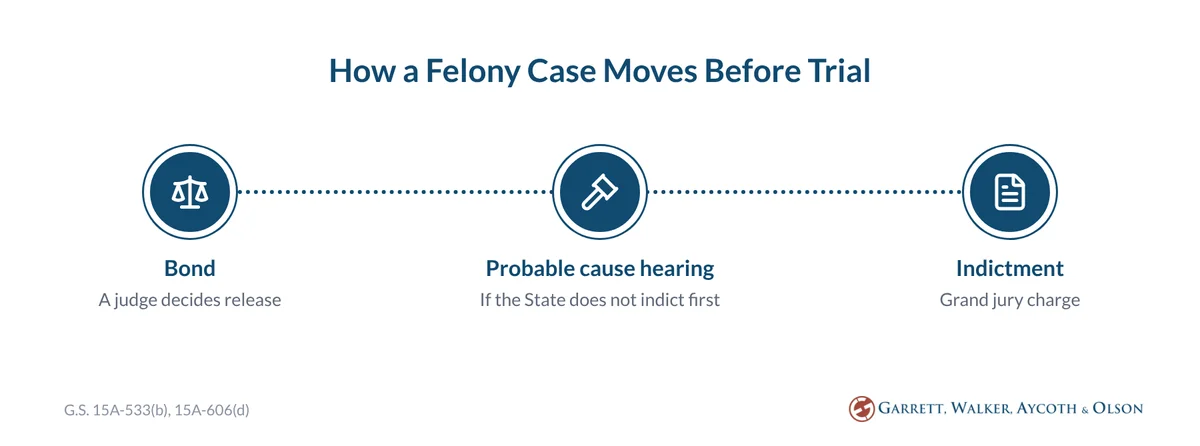
After an arrest, the first fight is often over release. A charge under G.S. 14-34.1 is on a short list in G.S. 15A-533(b) where a judge decides whether you can be released before trial.
For those charges, the law presumes that no release conditions can reasonably make sure you come to court and keep the community safe. The presumption can be rebutted, and your lawyer argues to the judge why release is warranted.
Here is how to ask for a lower bond and what a judge weighs.
The case starts in district court at the Guilford County Courthouse, 201 South Eugene St, Greensboro. You will have a first appearance before a district court judge.
The law calls for a probable cause hearing within 15 working days of your first appearance unless you waive it (G.S. 15A-606(d)). But the State can skip it by getting an indictment first.
If the hearing happens, your lawyer can cross-examine the State’s witnesses under oath (G.S. 15A-611(a)). That can lock in what an officer or witness says early.
The felony itself is tried in Superior Court (G.S. 7A-271(a)).
A lot of the work that shapes a felony case can start before the indictment.
Scene evidence fades fast. Video gets recorded over, and witnesses forget what they could see from where they stood.
Early work can also shape the charge itself, such as whether the facts fit Class E rather than Class D.
That is a reason to call today, not after the indictment arrives. Our main page lists the criminal charges we defend in Guilford County.
How a Lawyer Defends a Discharging Into Occupied Property Charge
A defense starts with the elements and the class. Each point below depends on the facts of your case.
Your lawyer begins by reviewing the State’s evidence: police reports, video and witness statements. Gaps in that evidence often shape the whole strategy.
No Reason to Believe Anyone Was There
The State must prove you knew, or had reasonable grounds to believe, the property was occupied. Lights, time of day, a parked car and what you could see all matter.
Your lawyer tests what the State can actually show about that knowledge.
Not Willful or Wanton
The shot must be willful or wanton, meaning done on purpose with reason to believe it would endanger others. Whether a discharge meets that test is fact-specific.
How the gun went off, and why, is something your lawyer examines closely.
Self-Defense
North Carolina allows deadly force when you reasonably believe it is needed to prevent imminent death or great bodily harm (G.S. 14-51.3).
In State v. McKoy (2019), the court of appeals held it was error to leave self-defense out of the final jury instruction on this charge. When the evidence supports it, your lawyer makes sure the jury hears it.
Identity and the Physical Evidence
The State must prove who fired. Shell casings, video, phone records and witness accounts can point in different directions.
Your lawyer reviews each piece and what it really shows.
The Class Charged Does Not Fit
The class turns on details. Was it a dwelling or another structure?
Was the vehicle in operation, or parked?
Was the injury serious bodily injury, or something less?
A wrong class can mean years of difference on the chart.
Before you answer questions about the shooting, speak with a Greensboro felony lawyer. Call (336) 379-0539 to start on the evidence now.
Frequently Asked Questions
Is shooting into an occupied house a felony in NC?
Yes. Firing into an occupied dwelling is a Class D felony under G.S. 14-34.1(b). Firing into another occupied building or vehicle is Class E, and serious bodily injury makes it Class C. Either way, talk with a lawyer before you speak with police.
What is the sentence for shooting into an occupied dwelling in NC?
At Prior Record Level I, the presumptive minimum is 51 to 64 months, and the chart calls for active time at every level. A narrow extraordinary mitigation exception exists for some defendants. Higher record levels raise the range, so your lawyer reviews your record points early.
Can I be charged if nobody was hurt?
Yes. The charge requires that the property was occupied, not that anyone was hit, and subsection (a) also covers an attempt to fire into occupied property, a Class E felony. Injury matters only for Class C, which requires serious bodily injury to any person. A lawyer checks which class fits.
What if I did not know anyone was inside?
That can be a real defense, because the State must prove you knew, or had reasonable grounds to believe, someone was there. Your lawyer looks at what you could see and what the State can prove, depending on the facts of your case.
What counts as an occupied dwelling?
A dwelling is a house that is someone’s permanent, temporary or seasonal residence. It is occupied when a person is physically present at the time of the shot. People on the porch count. An apartment or rental home where someone lives can qualify, which is why the class charged deserves a close look.
Is a parked car with someone in it “occupied property”?
Yes. An occupied vehicle falls under subsection (a), a Class E felony. Class D applies to an occupied vehicle only when it is “in operation.” Whether a car was in operation is a fact question, and your lawyer can argue the class when the evidence does not support Class D.
Is each shot a separate charge?
It can be. In State v. Rambert (1995), the North Carolina Supreme Court upheld three counts for three pistol shots, because each shot was a new decision to fire. A lawyer looks at how many shots the State can actually tie to you.
What does “dis weap occ dwell moving veh” mean on my paperwork?
Court records use short charge names. The words in this one, weapon, occupied dwelling and vehicle, match the Class D part of G.S. 14-34.1, which covers an occupied dwelling or an occupied vehicle in operation. The label is not the law: the warrant or indictment names the exact subsection and class, which a lawyer can confirm.
Can the charge be reduced?
Sometimes. If the facts do not fit a dwelling, a vehicle in operation or serious bodily injury, the class can be challenged. The prosecutor decides on any plea offer or dismissal. Your lawyer negotiates from the weak points in the evidence, depending on the facts of your case.
Can a discharging into occupied property charge be expunged?
A conviction cannot be expunged as a nonviolent offense, because G.S. 15A-145.5(a)(1) excludes Class A through G felonies. If the charge is dismissed or you are found not guilty, G.S. 15A-146 allows a petition to expunge it. That is one more reason to fight the charge early.
- Former President, Greensboro Criminal Defense Lawyers Association
- Elected member, Criminal Justice Section, North Carolina Bar Association
- Selected to present the Wade M. Smith Award for Top Criminal Defense Lawyer in North Carolina
Talk to a Greensboro criminal defense lawyer today
Bring the warrant, the release order and anything else they gave you.
Garrett, Walker, Aycoth & Olson, Attorneys at Law
317 South Greene St, Greensboro, NC 27401
(336) 379-0539
This article explains North Carolina law in general terms. It is not legal advice about your case, and laws, penalties and court procedures change. Contact an attorney about your specific situation.