



“Indictment issued” means a North Carolina grand jury found probable cause and approved a written felony charge against you, called a true bill. It is a formal accusation in superior court, not a conviction, and at least 12 grand jurors had to agree (G.S. 15A-623(a)).
You may have seen “indictment issued” or “true bill” on eCourts or a court paper. Maybe a notice came in the mail, or a family member was indicted in Guilford County.
An indictment is not a finding of guilt. You also had no right to speak to the grand jury before it voted (G.S. 15A-626(a)).
The case now sits in superior court, and some deadlines can start running the day the bill is returned.
Reading the indictment for defects is work for a felony defense lawyer in Greensboro.
Indicted, or think a sealed indictment is out? Call (336) 379-0539 and talk with Jason Aycoth’s team today.
What Does “Indictment Issued” Mean on Your Case?
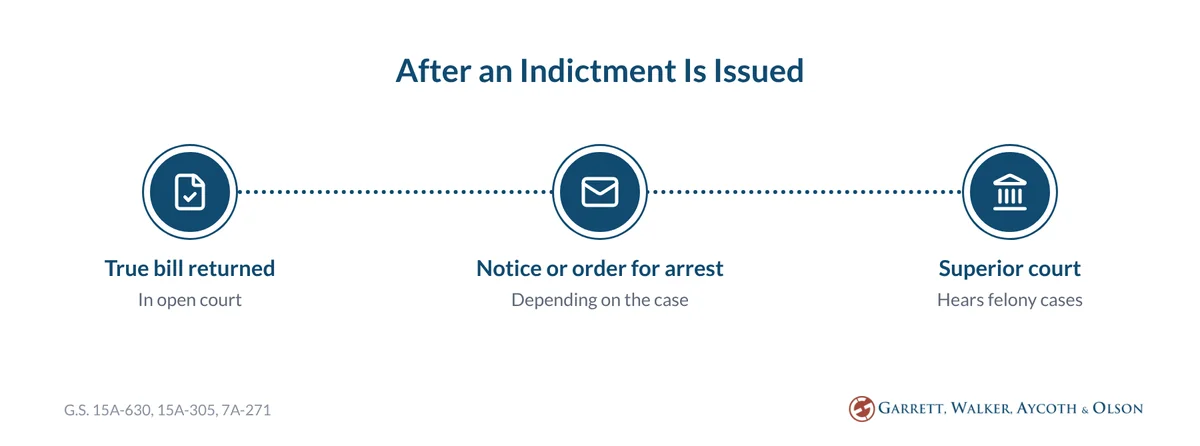
“Indictment issued” on a court record means the grand jury returned the bill as a true bill to the judge in open court (G.S. 15A-628(a)(1), (c)). The clerk must then keep a permanent record of it (G.S. 15A-628(d)).
Next, the judge must have notice mailed or given to you, unless you already have a lawyer of record (G.S. 15A-630). The notice states your time limits for discovery, and a copy of the indictment is attached.
A judge can also order a bill kept secret until you are arrested or appear in court (G.S. 15A-623(f)).
If you are not in custody or on pretrial release, an order for arrest may issue on the true bill (G.S. 15A-305(b)(1)). If you are picked up on that order, your lawyer can start asking a judge to lower your bond.
Tip: Seeing “indictment issued” online with no letter in the mail is a reason to call now.
Indictment Meaning Under North Carolina Law
North Carolina law defines an indictment in one sentence.
“Any indictment is a written accusation by a grand jury, filed with a superior court, charging a person with the commission of one or more criminal offenses.” G.S. 15A-641(a)
Felony cases must go forward on a bill of indictment unless you waive it (G.S. 15A-923(a)). Two other charging papers exist, and each one works differently.
| Document | Who Brings It | When It Is Used | Statute |
|---|---|---|---|
| Indictment | The grand jury | Felony cases in superior court | G.S. 15A-641(a), 15A-623(a) |
| Information | The prosecutor | Only if you waive indictment in writing with your lawyer; never in a capital case | G.S. 15A-641(b), 15A-642(b), (c) |
| Presentment | The grand jury, on its own motion | Starts no case by itself; the district attorney must look into it | G.S. 15A-641(c) |
Not sure your charge is a felony? See what makes a crime a felony in NC.
This guide covers North Carolina state court. Federal indictments follow different rules.
The Grand Jury Process in North Carolina
In North Carolina, a grand jury of citizens decides whether a bill of indictment goes forward.
Who Sits on the Grand Jury
A grand jury has 12 to 18 members and is part of the superior court (G.S. 15A-621). The clerk draws 18 names to serve (G.S. 15A-622(b)).
Nine new grand jurors are chosen at the first criminal session after January 1 and July 1. That gives most members a term of about 12 months.
The grand jury is the only judge of the facts before it. The presiding judge acts as its legal adviser (G.S. 15A-624).
How a Case Reaches the Grand Jury
After a district court judge binds a felony over, the prosecutor must submit a bill to the grand jury (G.S. 15A-627(a)). The only other choices are dismissing the charge or using an information.
A prosecutor may also send a bill straight to the grand jury (G.S. 15A-627(b)). Before that, a district court judge may hold a hearing, so see how a probable cause hearing works.
What Happens Inside the Room
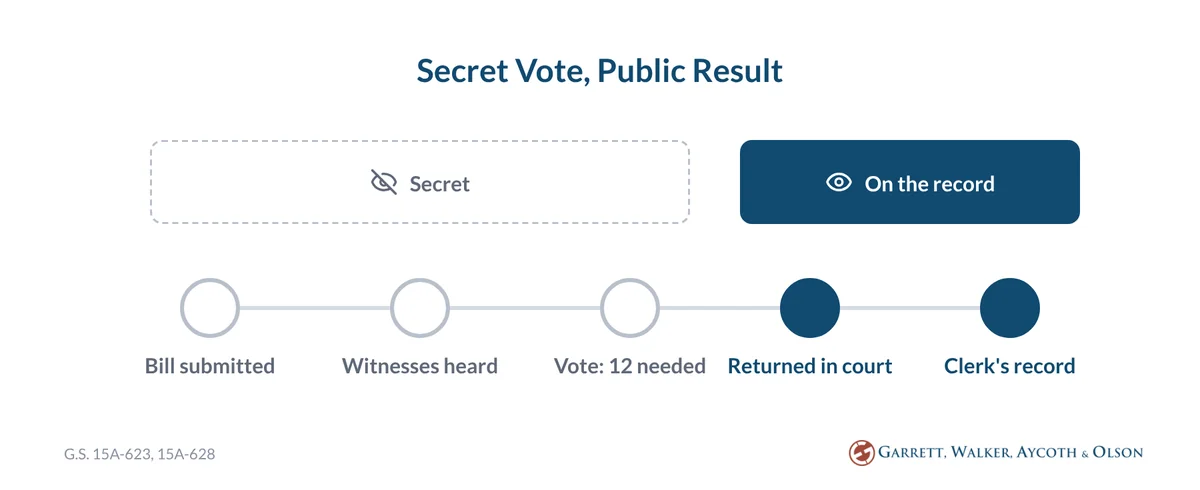
Grand jury proceedings are secret, and everyone present must keep them secret (G.S. 15A-623(e)). Only grand jurors may be in the room while they deliberate and vote (G.S. 15A-623(d)).
The clerk calls the witnesses the prosecutor lists on the bill (G.S. 15A-626(b)). If jurors want another witness, the foreman asks the prosecutor, who may say no.
No one has a right to appear or call witnesses. A person who wants to testify must ask the district attorney or a superior court judge, who may refuse (G.S. 15A-626(d)).
The Vote
Finding an indictment takes the agreement of at least 12 grand jurors (G.S. 15A-623(a)). The foreman signs the bill to attest that 12 or more agreed (G.S. 15A-644(a)(5)).
Every bill the prosecutor submits, true bill or not, is then returned to the judge in open court (G.S. 15A-628(c)).
True Bill, Not a True Bill and Other Grand Jury Results
A grand jury can return a bill of indictment in three ways, and only a true bill moves the case forward.
| Result | What It Means | What Happens Next |
|---|---|---|
| True bill | The grand jury found probable cause | The felony case goes forward in superior court (G.S. 15A-628(a)(1)) |
| Not a true bill | The grand jury did not find probable cause | The judge must order release from custody, bail or release conditions, which can be briefly delayed if a lesser bill is requested (G.S. 15A-629(a)) |
| Unable to act | Witnesses were not available | The bill goes back to the court without a decision (G.S. 15A-628(a)(3)) |
After a not a true bill, the grand jury may ask the prosecutor for a bill on a lesser included or related offense (G.S. 15A-628(a)(2)).
Talk to a defense lawyer before you talk to anyone else
What you say and sign in the first days often decides what is possible later. The earlier we see your paperwork, the more options you usually have.
Call (336) 379-0539Free consultation with a Greensboro attorneyWhat Is Written on a North Carolina Indictment
A North Carolina indictment must contain five parts (G.S. 15A-644(a)).
- The name of the superior court where it is filed
- The title of the action
- The criminal charges
- The prosecutor’s signature (leaving it off is not a fatal defect)
- The foreman’s signature, attesting that 12 or more grand jurors agreed
Each count must also name the county and the date. It must state facts supporting every element of the crime, clearly enough to tell you what conduct is charged (G.S. 15A-924(a)(3)-(5)).
A date error is not grounds for dismissal unless time mattered to the charge and the error misled you to your prejudice (G.S. 15A-924(a)(4)).
A bill of indictment may not be amended (G.S. 15A-923(e)). The State can file a superseding indictment before a guilty plea or trial, and the old count is then dismissed at arraignment on the new one (G.S. 15A-646).
If the indictment leaves out facts you need to prepare a defense, your lawyer can ask for a bill of particulars (G.S. 15A-925). A bill of particulars cannot fix a defect in the indictment itself.
Can an Indictment Be Challenged or Dismissed?
Yes, an indictment can be challenged, but the grounds are narrow and timing matters. A court may dismiss an indictment on three grounds under G.S. 15A-955.
- There is ground for a challenge to the array
- Too few qualified grand jurors agreed to the indictment
- Every witness before the grand jury on that bill was incompetent to testify
The rules for wording mistakes changed in 2024. In State v. Singleton (May 23, 2024), the North Carolina Supreme Court ended the old common law rule on defective indictments, as explained by the UNC School of Government.
Now a defect takes away the court’s power only when the indictment “wholly fails to allege a crime.” For other defects, you must raise them on time and show prejudice, not only an error.
Courts are still deciding these cases one by one, so this area of law is still developing (UNC School of Government, October 2024).
Motions to dismiss have short deadlines. Our guide on whether an indictment means jail time explains the 21-day window and sentencing.
Spotting a real defect and raising it on time is the lawyer’s job, and results depend on the facts of your case.
Warning: A defect raised late can be waived. Call (336) 379-0539 so we can review your indictment now.
What Comes Next Once an Indictment Is Issued
Once an indictment is issued, the case belongs to superior court, which hears felony cases (G.S. 7A-271(a)).
Arraignment, discovery and motions come next, so learn what happens at an arraignment.
How Serious Is an Indictment?
An indictment is serious, because a felony case is now in superior court. Still, it is an accusation, not proof.
A conviction needs your plea or proof beyond a reasonable doubt. The U.S. Supreme Court held that due process requires that proof (In re Winship, 397 U.S. 358, 364 (1970)).
You may plead not guilty, guilty or no contest. A no contest plea needs the consent of the prosecutor and the judge (G.S. 15A-1011).
Here is what a lawyer does with your indictment, depending on the facts of your case.
- Checks the foreman’s signature and the 12-juror attestation
- Compares the facts pleaded with each element and the class charged
- Files motions to dismiss or for a bill of particulars on time
- Watches for a superseding indictment or a new bill
If the true bill names you, get help with a felony charge in Greensboro before the motion deadlines pass. You can also talk with a Greensboro criminal defense attorney about any related charge.
Indicted in Guilford County? Call (336) 379-0539 and ask for a review of your indictment today.
Frequently Asked Questions
What is an indictment hearing?
There is no hearing for you at the grand jury. Its proceedings are secret, and no one has a right to appear (G.S. 15A-623(e), 15A-626(a)). In superior court, your lawyer can request an arraignment in writing (G.S. 15A-941(d)). That request has a short deadline, so call early.
How long does it take to get indicted in NC?
No North Carolina statute sets a fixed time. After a felony is bound over, the prosecutor must submit a bill to the grand jury unless the charge is dismissed or an information is used (G.S. 15A-627(a)). Until a bill is returned, a lawyer can still work the case in district court, so call before it reaches the grand jury.
Will I get a copy of my indictment?
The law builds in two ways to get one. After a true bill, the judge must have notice mailed or given to you, with a copy attached, unless you have a lawyer of record (G.S. 15A-630). If an order for arrest issues on the indictment, a copy must be attached to it (G.S. 15A-305(c)(2)).
Is an indictment public record in North Carolina?
The grand jury’s vote is secret, but the result is not. The foreman returns each bill to the judge in open court, and the clerk keeps a permanent record (G.S. 15A-628(c), (d)). The exception is a sealed indictment, kept secret until arrest or appearance (G.S. 15A-623(f)).
Does an indictment have to name the statute I broke?
Yes, each count must cite the statute it says you violated (G.S. 15A-924(a)(6)). But an error in that citation, or leaving it out, is not a ground for dismissal or for reversing a conviction. Your lawyer checks the facts pleaded for each element, which the law also requires.
Can a misdemeanor be indicted in NC?
Yes, in some cases. A misdemeanor that starts in superior court must also be charged by indictment, unless indictment is waived and an information is used (G.S. 15A-923(a)). Superior court can also try a misdemeanor that is properly joined for trial with a felony (G.S. 7A-271(a)(3)).
What does it mean if the grand jury could not act on my bill?
It means the grand jury sent the bill back to the court without a decision because witnesses were unavailable (G.S. 15A-628(a)(3)). It is neither a true bill nor a not a true bill. Ask your lawyer what it means for your bond and court dates.
What is a presentment in NC?
A presentment is a written accusation the grand jury makes on its own motion (G.S. 15A-641(c)). It does not start a criminal case by itself. The district attorney must look into it and submit a bill of indictment when appropriate, and a presentment cannot serve as the charge (G.S. 15A-923(a)).
- Former President, Greensboro Criminal Defense Lawyers Association
- Elected member, Criminal Justice Section, North Carolina Bar Association
- Selected to present the Wade M. Smith Award for Top Criminal Defense Lawyer in North Carolina
Talk to a Greensboro criminal defense lawyer today
Bring the warrant, the release order and anything else they gave you.
Garrett, Walker, Aycoth & Olson, Attorneys at Law
317 South Greene St, Greensboro, NC 27401
(336) 379-0539
This article explains North Carolina law in general terms. It is not legal advice about your case, and laws, penalties and court procedures change. Contact an attorney about your specific situation.