



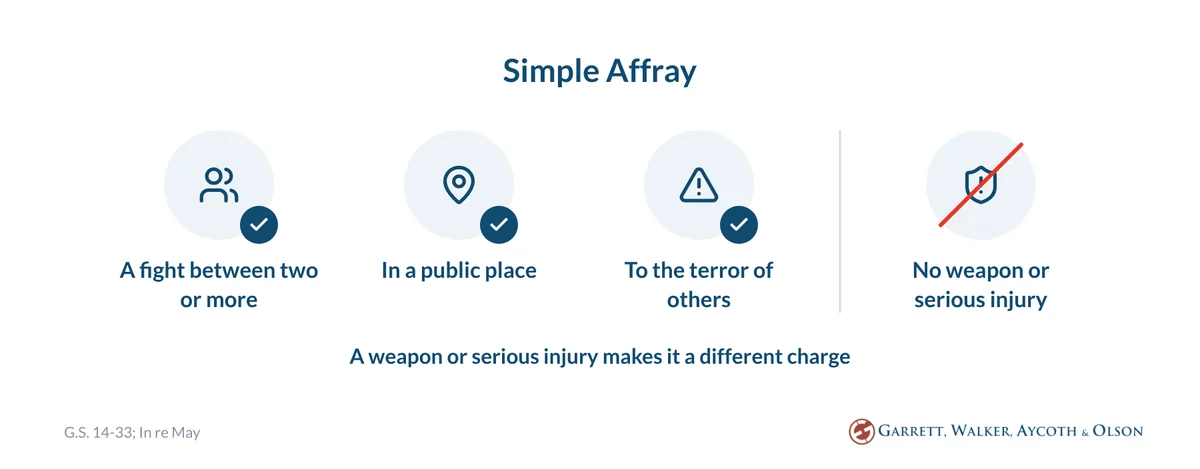
Simple affray is a fight between two or more people in a public place that causes terror to others. G.S. 14-33(a) makes it a Class 2 misdemeanor, with 1 to 30, 1 to 45 or 1 to 60 days allowed depending on your record.
Some pages say North Carolina has no statute for simple affray. G.S. 14-33(a) names it, and “up to 60 days” applies only with five or more prior convictions.
With no prior convictions, the court must suspend the sentence. Keeping you in that band, or pushing for a dismissal, is argued by your lawyer.
This guide is for people charged after a fight at a bar, a parking lot, a party or a school event. Both people in the fight are often charged, and the record it leaves is what lasts.
Charged with simple affray in Greensboro or High Point? Call (336) 379-0539 so a lawyer can look for video and witnesses before they disappear.
What Is Simple Affray in North Carolina?
Simple affray is a fight between at least two people in a public place that puts others present in terror. The fight can be actual force, or a threat to immediately use force.
Every person who takes part can be charged, because the statute punishes anyone who “participates in” a simple affray.
A simple assault is between you and the other person, and it can happen anywhere. If no public place is involved, read how a simple assault charge differs.
For a general look at how affray cases are built and defended, see our wider guide to affray charges. A weapon or a serious injury takes the case out of simple affray altogether.
See how we defend assault and fighting charges in Guilford County.
The Simple Affray Statute: G.S. 14-33(a)
The simple affray statute is G.S. 14-33(a), and it sets the charge as a Class 2 misdemeanor:
“Any person who commits a simple assault or a simple assault and battery or participates in a simple affray is guilty of a Class 2 misdemeanor.” (G.S. 14-33(a))
The statute does not define “affray.” The North Carolina Supreme Court did, in In re May, 357 N.C. 423 (2003): a fight “between two or more persons in a public place so as to cause terror to the public.”
Your lawyer checks the police report against each part of that test.
Elements the State Must Prove for Simple Affray
To convict you of simple affray, the State must prove three elements beyond a reasonable doubt.
First, a fight: you engaged in a fight with at least one other person. North Carolina’s pattern jury instruction defines fighting as “the use of physical force or violence or any threat to immediately use such force or violence.”
Second, a public place: In re May names two kinds. One is places public by their use, such as roads, sidewalks, shopping malls, apartment complexes and parks.
The other is private property near enough to a public road that people using the road could see or hear the fight.
In In re May, the North Carolina Supreme Court held that the State proved neither a public place nor terror for a fight on group home grounds. So the case should have been dismissed.
Third, terror: the fight caused terror to other people present at the scene. In re May found this element was not proved either.
Key point: If the State cannot prove one of these elements, the simple affray charge fails. Finding the weak element is the first job of your lawyer.
Talk to a defense lawyer before you talk to anyone else
What you say and sign in the first days often decides what is possible later. The earlier we see your paperwork, the more options you usually have.
Call (336) 379-0539Free consultation with a Greensboro attorneyPenalties for Simple Affray in NC
Simple affray is punished as a Class 2 misdemeanor, and the range depends on your prior convictions under G.S. 15A-1340.23.
| Prior Convictions | Level | Days Allowed | Sentence Types Allowed |
|---|---|---|---|
| None | I | 1 to 30 | Community |
| 1 to 4 | II | 1 to 45 | Community or intermediate |
| 5 or more | III | 1 to 60 | Community, intermediate or active |
The maximum fine is $1,000. Because community punishment is authorized at every level, the judgment may be a fine only.
At Levels I and II the grid requires community or intermediate punishment, so G.S. 15A-1340.20(c) says the court “shall suspend” the sentence. The one exception is an active term no longer than time already served on the charge.
Which level applies, and which sentence the judge picks, is argued by your lawyer.
Warning: The sentence ends, but a conviction stays on your criminal record, where background checks can find it.
When a Fight Is Charged as More Than Simple Affray
A fight is charged above simple affray when the facts match G.S. 14-33(b), 14-33(c) or a felony statute.
Class 1 misdemeanor: assault and battery on a sports official during the fight, or assault on a utility or communications worker who is on duty and identifiable as a worker. The utility worker rule came from S.L. 2025-71 and applies to offenses on or after December 1, 2025.
Class A1 misdemeanor: inflicting serious injury or using a deadly weapon during the fight. The same class applies to assaulting a female (by a male 18 or older), a pregnant woman or a child under 12.
Class A1 also applies when the person hurt is in a protected group, such as on-duty public employees, school staff, transit or rideshare drivers, or company and campus police.
Class H felony: habitual misdemeanor assault under G.S. 14-33.2. It applies when a G.S. 14-33 violation causes physical injury and you have two or more prior assault convictions, the earlier within 15 years.
If a deadly weapon causes a serious injury, the charge can become a felony under G.S. 14-32. Read when a weapon and injury mean a felony.
A fight can also be charged as disorderly conduct under G.S. 14-288.4, which covers “fighting or other violent conduct.” Learn when a fight is charged as disorderly conduct.
What Happens After a Simple Affray Charge in Guilford County
A simple affray case in Guilford County is heard in District Court, after a citation, a summons or an arrest. In Greensboro, the courthouse is at 201 South Eugene Street.
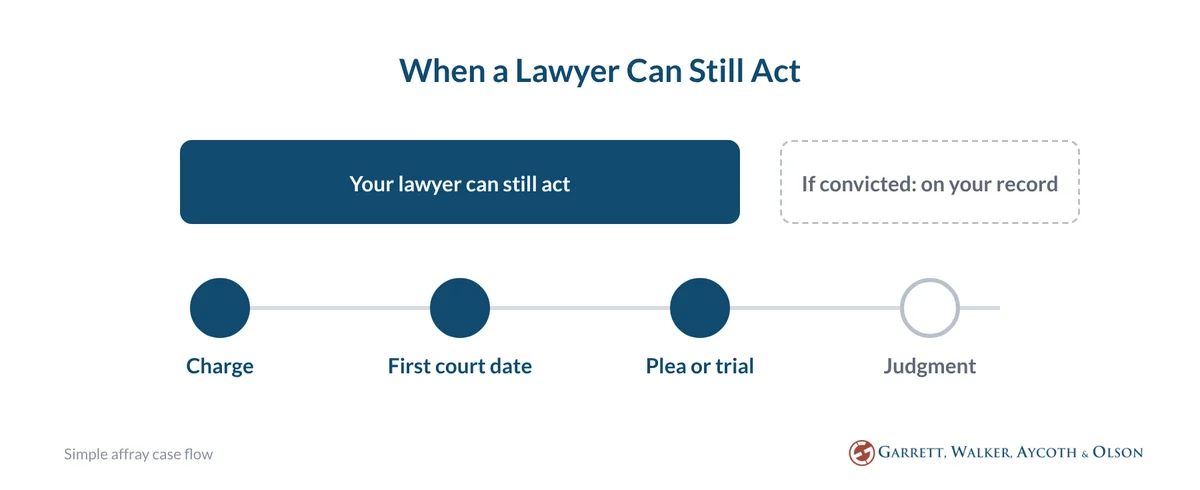
Here is how misdemeanor cases move through Guilford court.
The other person cannot drop the charge. The State brings it, and the prosecutor decides whether to drop it under G.S. 15A-931.
A judge can also dismiss it if the State’s evidence falls short. A lawyer can press for either, depending on the facts of your case.
Video from bars, stores and phones is often overwritten, and witnesses scatter. Collecting that proof before your first court date is a reason to call now.
Until a judgment is entered, your lawyer still has room to change how this case ends.
If every charge in the case is dismissed or ends in not guilty, North Carolina expunges it automatically, 180 to 210 days later, under G.S. 15A-146(a4). Otherwise a dismissed charge can be expunged by petition.
Call and we will check whether yours has cleared, or ask about clearing a dismissed charge from your record.
A conviction is harder. G.S. 15A-145.5 bars Class A1 misdemeanors and offenses that include assault as an essential element, so aggravated affray cannot be expunged under it.
No North Carolina appellate court has decided whether simple affray counts as an assault offense, so the answer is unsettled. Your lawyer checks this before any plea, because the class you plead to can decide whether the record can ever be cleared.
Our criminal defense page covers all the criminal charges we handle.
Defenses Against Simple Affray Charges
Each defense attacks an element, or shows you acted lawfully.
Self-Defense or Defense of Another
The self-defense rule is in G.S. 14-51.3(a):
“A person is justified in using force, except deadly force, against another when and to the extent that the person reasonably believes that the conduct is necessary to defend himself or herself or another against the other’s imminent use of unlawful force.” (G.S. 14-51.3(a))
Under G.S. 14-33.1, threats the other person made that reached you before the fight can show your fear was reasonable.
Self-defense is harder if you started the fight. G.S. 14-51.4 limits it for the person who provoked it, unless that person tried to withdraw, so who started it is often what the video and witnesses decide.
No Public Place or No Terror
Private property counts only if people on a public road could see or hear the fight. Your lawyer looks at where the fight happened and who was there.
People tied to the place or to the fighters, like family at a house party or staff at a facility, may not count as the public, depending on the facts (In re May).
You Were Not Fighting
Breaking up a fight, or trying to walk away, is not fighting. Video and witnesses can show what you did.
Identification
Fights are fast and crowded, and the wrong person is sometimes named.
Depending on the facts, a lawyer may use these defenses to seek a dismissal or acquittal. Before your court date, talk with a Greensboro lawyer for fighting charges.
Facing a simple affray charge? Call (336) 379-0539 to talk with our team today.
Frequently Asked Questions
Can you go to jail for simple affray in NC?
An active jail term is authorized at Level III, with five or more prior convictions, for up to 60 days. Below Level III, active time is limited to time already served on the charge. Your lawyer argues which level applies and how your record is counted.
What is the difference between simple assault and simple affray?
Simple affray needs two things a simple assault does not: a fight in a public place, and terror to the people around it. A simple assault can happen anywhere, even in private. Both are Class 2 misdemeanors under G.S. 14-33(a).
Can both people be charged with affray?
Yes. G.S. 14-33(a) punishes anyone who “participates in” a simple affray, so each person in the fight can be charged. Being charged does not settle who started it. Self-defense and proof that you were not fighting are facts your lawyer can raise.
Can the other person drop a simple affray charge?
No. The State brings the charge, so the prosecutor decides whether to drop it (G.S. 15A-931). A judge can also dismiss it if the evidence falls short. A lawyer can talk with the prosecutor and argue for dismissal, depending on the facts of your case.
Does a fight at a private house count as affray?
Only if it meets the In re May public-place test. Private property counts when people on a nearby public road could see or hear the fight. Family and guests may not count as the public. A fight out of view and earshot may still be charged as simple assault.
Is affray a felony in North Carolina?
Simple affray is not a felony; it is a Class 2 misdemeanor. A fight can still lead to a felony. Habitual misdemeanor assault under G.S. 14-33.2 is a Class H felony, and a weapon with a serious injury can also bring a felony charge.
Will a simple affray conviction show on a background check?
A conviction stays on your criminal record unless it is later expunged, so a criminal background check can show it. A case where every charge is dismissed is expunged automatically after about six months. So the result your lawyer works toward matters for years.
Can a simple affray charge be expunged?
A dismissal or not guilty result on every charge is expunged automatically under G.S. 15A-146(a4). A Class A1 affray conviction is barred under G.S. 15A-145.5. Whether a simple affray conviction qualifies is unsettled, with no appellate ruling. Your lawyer checks this before you accept any plea.
- Former President, Greensboro Criminal Defense Lawyers Association
- Elected member, Criminal Justice Section, North Carolina Bar Association
- Selected to present the Wade M. Smith Award for Top Criminal Defense Lawyer in North Carolina
Talk to a Greensboro criminal defense lawyer today
Bring the warrant, the release order and anything else they gave you.
Garrett, Walker, Aycoth & Olson, Attorneys at Law
317 South Greene St, Greensboro, NC 27401
(336) 379-0539
This article explains North Carolina law in general terms. It is not legal advice about your case, and laws, penalties and court procedures change. Contact an attorney about your specific situation.