


Obtaining property by false pretenses means getting, or trying to get, money, goods or services with a lie you knew was false. In North Carolina it is always a felony under G.S. 14-100: Class H under $100,000 and Class C at $100,000 or more, even if the attempt fails.
This guide is for anyone in Greensboro or Guilford County charged after a pawn sale, a bad check, a contractor job or a loan application.
If your papers say “obtain property false pretense”, this is the charge. The State has to prove what you intended when you made the statement, and that is where a defense starts, depending on the facts of your case.
Talk with a lawyer about Greensboro fraud and white collar defense before you answer the detective. Call (336) 379-0539 today.
What Is Obtaining Property by False Pretenses in NC?
A person commits this crime by knowingly using a false statement to get, or try to get, something of value, intending to cheat or defraud. The statement can be about a past or present fact, or a future event.
The key words of the statute read:
“If any person shall knowingly and designedly by means of any kind of false pretense whatsoever … obtain or attempt to obtain … any money, goods, property, services, chose in action, or other thing of value with intent to cheat or defraud any person …” G.S. 14-100(a)
“Property” is broad: services count, and so does a “chose in action”, a right to collect money such as a debt.
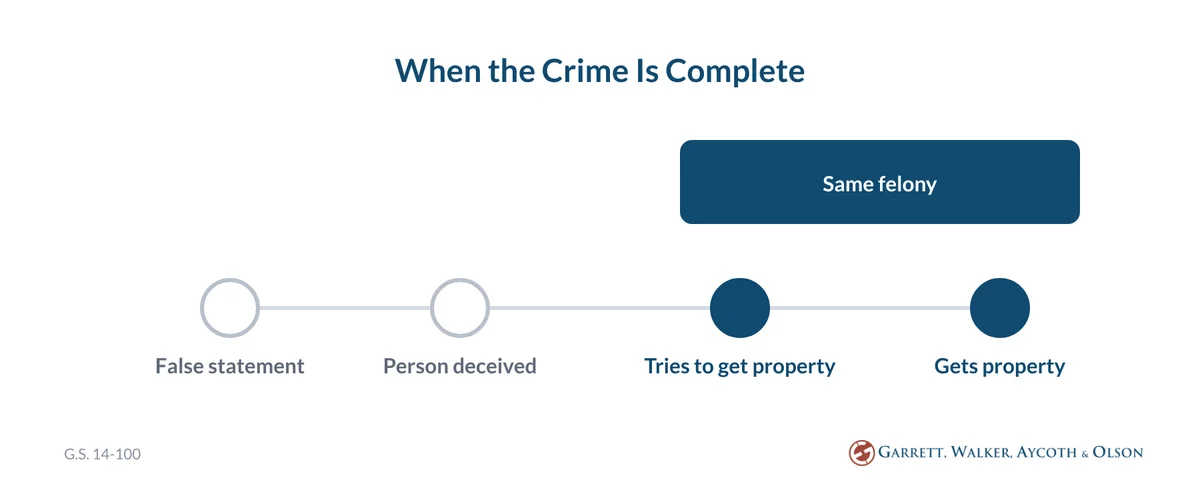
A Failed Attempt Is the Same Felony
The statute covers anyone who “obtain[s] or attempt[s] to obtain” something of value this way.
A failed try is charged the same way as one that worked.
Elements of Obtaining Property by False Pretenses in North Carolina
To convict you, the State must prove five elements beyond a reasonable doubt. They come from North Carolina pattern jury instruction 219.10.
A Representation to Another Person
You made a representation to someone else. This is usually a spoken or written statement.
The Representation Was False
The statement was not true when you made it.
It Was Meant to Deceive
The representation was calculated and intended to deceive.
The Person Was Actually Deceived
The alleged victim was in fact deceived by the representation.
You Got, or Tried to Get, Property
You obtained, or attempted to obtain, property from the alleged victim because of the representation. For Class C, the State must also prove the property was worth $100,000 or more (instruction 219.10A).
Obtaining Property by False Pretenses Examples
Pawning an item you say is yours when it is not can be charged this way.
Paying for goods with a check you know is worthless is another example. The jury instruction notes that a worthless check, “standing alone”, can support a conviction (State v. Rogers, 346 N.C. 262 (1997)).
So can taking a deposit for work you never meant to do. In each example, the State must still prove what you intended at the time.
Is Obtaining Property by False Pretenses a Felony?
Yes. Obtaining property by false pretenses is always a felony in North Carolina, and G.S. 14-100 has no misdemeanor version.
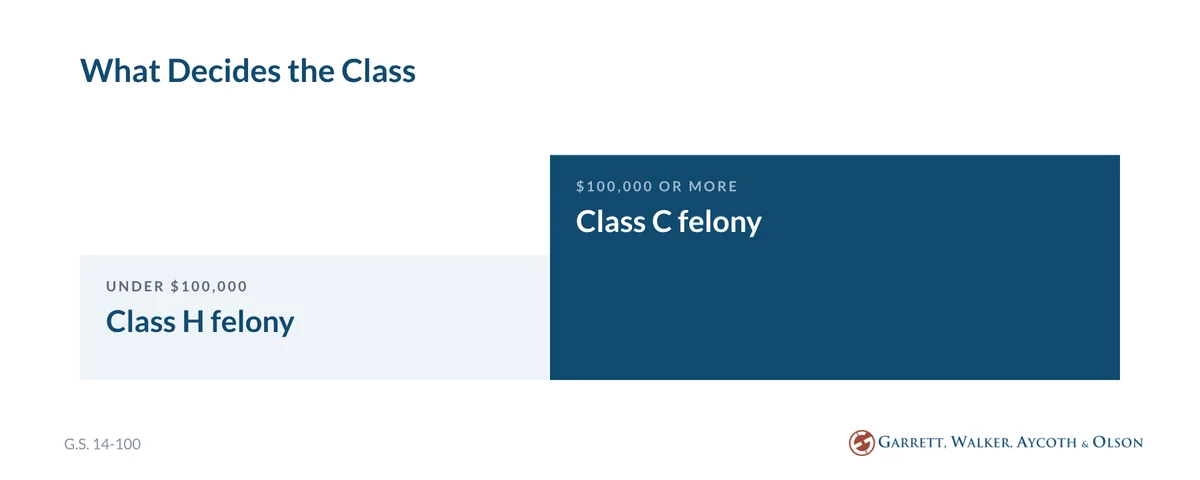
If the property is worth less than $100,000, it is a Class H felony. At $100,000 or more, it is a Class C felony.
So $99,999 is Class H, and $100,000 is Class C.
Class C is the fourth-highest felony class, after A, B1 and B2. The chart calls for active punishment at every prior record level, so see how Class C felonies are sentenced.
One dollar figure decides the class: $100,000.
Can You Get Jail Time for Obtaining Property by False Pretenses?
Yes. Both classes allow prison, and how much depends on the class and your prior record level.
Prior record levels run from I (0 or 1 point) to VI, based on points for past convictions.
| Class | Prior Record Level I | Prior Record Level VI | Highest Maximum Term |
|---|---|---|---|
| Class H (Under $100,000) | Community, intermediate or active authorized; minimum 4 to 8 months, presumptive 5 to 6 | Active only; minimum up to 25 months | 39 months |
| Class C ($100,000 or More) | Active only; minimum 44 to 92 months, presumptive 58 to 73 | Active only; minimum up to 182 months | 231 months |
These figures come from the chart in G.S. 15A-1340.17, subsections (c), (d) and (e).
At Level I, the chart authorizes community, intermediate or active punishment for a Class H. From Level II to Level V it authorizes intermediate or active, and at Level VI active only.
Where your case lands, and whether the value keeps it at Class H, is argued by your lawyer, not assumed. For the full chart row, see what a Class H felony means.
Important: A Class C conviction calls for an active sentence at every level. The court can go below that only if it finds extraordinary mitigating factors in writing, under G.S. 15A-1340.13(g).
That option is never available with five or more prior record points, under G.S. 15A-1340.13(h).
Because false pretenses is a felony property crime, the judge must order restitution to the person or business that lost money. That rule comes from G.S. 15A-1340.34(b) and G.S. 15A-830.
Separately, the owner can sue you for the money lost, consequential damages of $150 to $3,000, punitive damages and attorneys’ fees. Under G.S. 1-538.2, that suit can go forward whether or not you are convicted.
Facing a Class C value, or a business that is also threatening to sue? Call (336) 379-0539 before you sign any repayment agreement.
Talk to a defense lawyer before you talk to anyone else
What you say and sign in the first days often decides what is possible later. The earlier we see your paperwork, the more options you usually have.
Call (336) 379-0539Free consultation with a Greensboro attorneyFalse Pretenses vs Larceny, Uttering and Embezzlement
False pretenses is about a lie that makes the owner hand over the property and its title. Larceny is taking property without the owner’s consent.
The UNC School of Government draws the same line: false pretenses requires a transfer of title.
If the evidence at trial shows larceny or embezzlement instead, G.S. 14-100 lets the jury be given that felony. You cannot later be tried for larceny or embezzlement on the same facts.
Forging or passing a fake check is its own felony; see how uttering a forged check is charged.
Under G.S. 14-120, uttering is a Class I felony, one class lower. Here is what a lower Class I felony carries.
If you were trusted with the money first, the charge may be embezzlement under G.S. 14-90. Read when keeping entrusted money becomes embezzlement.
For goods taken from an employer, see how larceny charges against employees in NC work.
How a Lawyer Defends a False Pretenses Charge
A lawyer defends this charge by testing each element the State must prove.
Intent at the Time You Spoke
The State must prove you meant to cheat or defraud when you made the statement. Under G.S. 14-100(b), “nonfulfillment of a contract obligation standing alone” does not prove intent to defraud.
A broken promise by itself is not the crime.
Was Anyone Actually Deceived?
If the buyer or pawnbroker already knew the truth, element 4 is in question.
Did the Lie Cause the Transfer?
The property must change hands because of the representation, not for another reason.
Who Made the Statement
IDs, signatures, video and account records show who spoke. Your lawyer asks for them early.
The Value Claimed
The $100,000 line decides Class H or Class C. Your lawyer tests how the State reached its number.
A defense lawyer looks at each of these before any plea talk, and any result depends on the facts of your case. Our criminal defense lawyers in Greensboro can start with yours: call (336) 379-0539.
What Happens After a False Pretenses Charge in Greensboro
A false pretenses case starts with an arrest or a summons, then bond and a first appearance in Guilford County District Court. A felony can then move to Superior Court by indictment.
For a Class H charge, North Carolina law allows deferred prosecution for some people with no prior felony and no prior probation, or a conditional discharge after a guilty plea (G.S. 15A-1341(a1), (a4)).
Each one needs a joint motion by you and the prosecutor, so your lawyer has to ask for it and show that you qualify, depending on the facts of your case.
These paths are not available for a Class C charge under that statute.
What you say to the business, the bank or the detective in the first days becomes the State’s proof of intent. That is the main reason to call a lawyer today.
Can a False Pretenses Conviction Be Expunged?
A Class H conviction can qualify, after a long wait. A Class C conviction never qualifies, because Class A through G felonies are excluded under G.S. 15A-145.5.
One Class H conviction can count as a nonviolent felony, with a petition 10 years after the conviction, or 10 years after the sentence and probation end, whichever is later.
Convictions entered in the same session of court count as one (G.S. 15A-145.5(b)).
The judge “may” grant it, so it is not automatic. The petition also needs an affidavit that no restitution is outstanding.
Once the wait is over, read how NC expunction petitions work. The better time to protect your record is before a conviction exists.
Call (336) 379-0539 to talk with our white collar defense team in Greensboro.
Frequently Asked Questions
What does “obtain property false pretense” mean on my charge?
It is the short form of the charge under G.S. 14-100: getting, or trying to get, something of value with a false statement meant to cheat or defraud. It is always a felony, Class H under $100,000 and Class C at $100,000 or more.
Is a failed attempt still a crime?
Yes. G.S. 14-100 covers anyone who “obtain[s] or attempt[s] to obtain” property by a false pretense. A lie that did not work is the same Class H or Class C felony as one that did. The value claimed still sets the class.
What if it was a contract dispute, or I meant to pay it back?
A broken contract alone does not prove intent to defraud, under G.S. 14-100(b). If you are convicted, the judge must order restitution. Talk with a lawyer before you pay or sign anything, because what you put in writing can be used to show intent.
Does the lie have to be spoken or written?
The element is a “representation” to another person, not a set form of words. The jury instruction notes that a worthless check, standing alone, can support a conviction (State v. Rogers). Your lawyer tests exactly what was represented, and when.
What if I lied to one person but someone else lost the money?
That can still be charged. Under G.S. 14-100(a), the State does not have to prove that the person you spoke to is the person who lost money. It also does not have to prove intent to defraud any particular person, but it must still prove intent.
Can I be charged for deceiving a company instead of a person?
Yes. G.S. 14-100(c) defines “person” to include a corporation, association, partnership or other group or entity. So a false statement to a store, bank or insurer can be charged the same way, and the class still depends on the value involved.
What if part of it happened outside North Carolina?
That is not a defense by itself. Under G.S. 14-100(b1), the State does not have to show that all the acts happened in North Carolina, or in one county or city. Your lawyer still checks where and why the case was filed.
I pawned something I did not know was stolen. Is that false pretenses?
The State must prove you made a false representation and meant to deceive. What you knew when you signed the pawn papers is the key question. Pawn records and your messages can show it, and your lawyer tests that proof, depending on the facts of your case.
How long does the State have to charge false pretenses?
North Carolina has no statute of limitations for felonies, according to the UNC School of Government. An old transaction, check or loan can still be charged years later. If you think a charge is coming, call (336) 379-0539 before you talk to anyone.
- Former President, Greensboro Criminal Defense Lawyers Association
- Elected member, Criminal Justice Section, North Carolina Bar Association
- Selected to present the Wade M. Smith Award for Top Criminal Defense Lawyer in North Carolina
Talk to a Greensboro criminal defense lawyer today
Bring the warrant, the release order and anything else they gave you.
Garrett, Walker, Aycoth & Olson, Attorneys at Law
317 South Greene St, Greensboro, NC 27401
(336) 379-0539
This article explains North Carolina law in general terms. It is not legal advice about your case, and laws, penalties and court procedures change. Contact an attorney about your specific situation.