



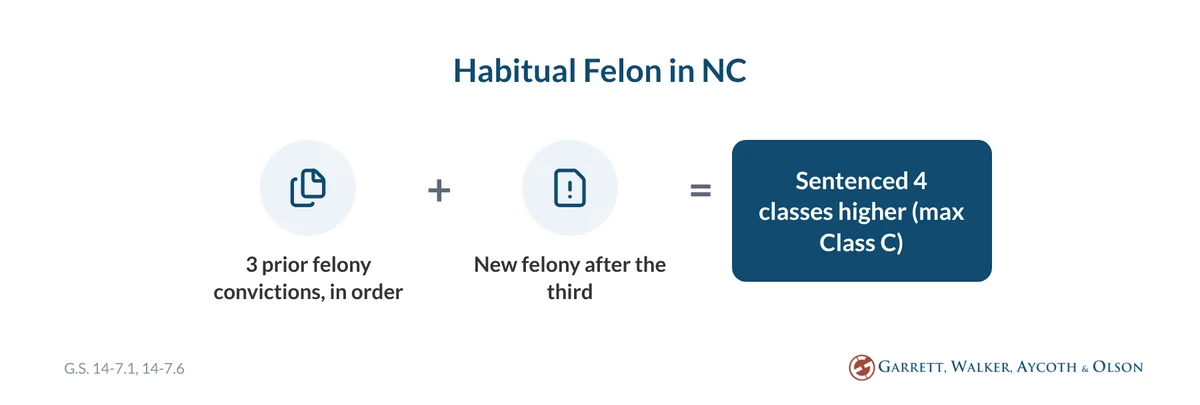
A habitual felon in North Carolina is someone charged with a new felony who has three earlier felony convictions, each committed after the conviction or guilty plea on the one before. Under G.S. 14-7.6, the new felony is sentenced four classes higher, never above Class C.
The status is not automatic, and it is not a new crime. The district attorney decides whether to charge it, and it needs its own indictment under G.S. 14-7.3.
That choice, and every prior felony on the list, is where a defense lawyer goes to work.
Facing a habitual felon indictment, or did a prosecutor mention one? Call (336) 379-0539 to talk with a felony defense lawyer in Greensboro before your next court date.
What can be done depends on the facts of your case.
Understanding Habitual Felon Charges in North Carolina
Habitual felon is a status, not a separate crime. The UNC School of Government says it plainly: “Being an habitual felon is not a crime but is a status.”
No sentence is imposed for the status itself. Instead, the status raises the class of the new felony you are convicted of.
Under G.S. 14-7.2, the status is charged together with a new felony that is charged by indictment. The higher sentence applies only after a conviction or guilty plea on that felony.
If the new charge ends as a misdemeanor, there is no felony for the status to raise.
The district attorney decides whether to seek the status at all. The School of Government also notes that a prosecutor may decide not to pursue it, even after an indictment.
What Makes Someone a Habitual Felon? The North Carolina Habitual Felon Statute
Three prior felony convictions or guilty pleas, from any state or federal court, make someone eligible for habitual felon status.
“Any person who has been convicted of or pled guilty to three felony offenses in any federal court or state court in the United States or combination thereof is declared to be an habitual felon …” G.S. 14-7.1(a)
The order of events matters as much as the count. Your second felony counts only if you committed it after you were convicted of, or pleaded guilty to, the first.
Your third felony counts only if you committed it after the conviction or plea on the second. That order rule is in subsection (c) of the statute.
If felony 2 was committed before you were convicted of felony 1, it does not count as a separate step. Several felonies committed before your first conviction cannot fill more than one step.
The new felony must also be committed after the conviction or plea on the third.
Three earlier felonies, in order, plus a new felony charge, is what the State has to show.
Which Prior Felonies Count, and Which Do Not
Felonies from North Carolina, from other states and from federal court can all count toward habitual felon status. Not every old felony on a record can be used.
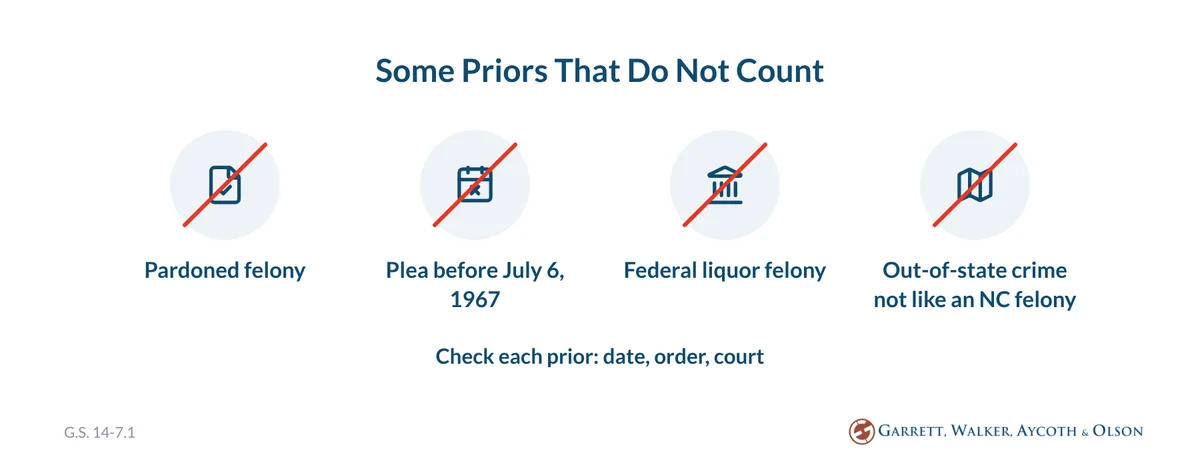
An out-of-state conviction counts only if it is substantially similar to a North Carolina felony. Where a state does not label crimes as felonies, the offense also must have been punishable by more than a year in prison.
A pardoned felony does not count, but you have to prove the pardon. Pleas or convictions entered before July 6, 1967, do not count either.
Federal felonies for liquor offenses are left out as well. And felonies committed before age 18 count as no more than one felony.
A habitual misdemeanor assault conviction cannot be used either, even though it is a felony, under G.S. 14-33.2. Nor can a habitual breaking and entering or armed habitual felon status conviction, under G.S. 14-7.31(c) and 14-7.41(c).
The statute sets no time limit on how old a prior felony can be. A conviction from decades ago can still count.
Key point: every prior on the indictment needs to be pulled and read, not assumed.
Talk to a defense lawyer before you talk to anyone else
What you say and sign in the first days often decides what is possible later. The earlier we see your paperwork, the more options you usually have.
Call (336) 379-0539Free consultation with a Greensboro attorneyHabitual Felon Sentencing Chart: How Many Years in NC?
A habitual felon is sentenced four classes higher than the new felony, capped at Class C. The exception is a felony already sentenced as Class A, B1 or B2, which keeps its own class.
The four-class rule applies to felonies committed on or after December 1, 2011, as the School of Government’s summary of the 2011 change explains.
At Prior Record Level I, the lowest level, the chart in G.S. 15A-1340.17 gives these results.
| New Felony Class | Sentenced As | Level I Disposition | Level I Presumptive Minimum |
|---|---|---|---|
| Class I | Class E | Intermediate or Active | 20-25 Months |
| Class H | Class D | Active | 51-64 Months |
| Class G | Class C | Active | 58-73 Months |
| Class F, E, D or C | Class C (Cap) | Active | 58-73 Months |
The three felonies used to prove the status do not count toward your prior record level. Other prior convictions still do, and each higher level raises the range.
The habitual sentence also runs after any sentence you are already serving.
For example, an uttering a forged instrument charge, a Class I felony, is sentenced as Class E.
A common law robbery charge in NC is Class G, so it is sentenced as Class C. The same jump applies to possession of a firearm by a felon, a Class G felony under G.S. 14-415.1.
Class E at Levels I and II authorizes intermediate or active punishment. Class D and Class C authorize active punishment only, at every level.
In rare cases, a judge may find extraordinary mitigation and order intermediate punishment instead of active time. That option is closed with five or more prior record points, under G.S. 15A-1340.13(g), (h).
Your lawyer decides whether the facts support asking for it.
Where in the range you land is argued by your lawyer, not assumed.
Got a habitual felon indictment? The law gives you at least 20 days after the true bill before trial on the status.
Use that time, because every prior has to be pulled and checked. Call (336) 379-0539.
How a Habitual Felon Case Moves Through Court
The status is charged in its own indictment, separate from the indictment for the new felony, under G.S. 14-7.3. It helps to know how a grand jury indictment works, because the status needs its own.
That indictment must list each prior felony’s offense date, the state or sovereign, the date of the plea or conviction, and the court.
You cannot be required to go to trial on the habitual charge within 20 days after the grand jury returns a true bill. That waiting period protects you, and you can choose to waive it.
The trial runs in two stages under G.S. 14-7.5. The jury hears nothing about the habitual charge unless it first convicts you of the new felony.
If it does, a jury then decides whether you are a habitual felon. If the jury finds you are not, the judge sentences the new felony as usual.
The State proves each prior with a certified court record or a stipulation, under G.S. 14-7.4. A record in the same name is prima facie proof that it is you.
Warning: your lawyer decides whether to stipulate. Never agree to a prior you have not checked.
Defense Strategies to Beat a Habitual Felon Charge
You fight a habitual felon charge by testing each piece the State needs: the new felony, the priors, the indictment and the sentence. Every case is different, and what works depends on the facts of your case.
Fight the New Felony First
Without a felony conviction, there is no habitual felon sentence. If the new charge is dismissed or reduced to a misdemeanor, the status has nothing to raise.
Your lawyer reviews the evidence on the new charge before anything else.
Check Every Prior on the Indictment
Your lawyer compares the offense and conviction dates on each prior, because the order rule in subsection (c) is strict. That includes whether the new charge came after the third conviction.
Identity, pardons, the 1967 cut-off, federal liquor offenses and out-of-state similarity are checked too.
Test the Indictment Itself
The habitual indictment must list specific details for every prior. Your lawyer checks it against what G.S. 14-7.3 requires.
Negotiate With the Prosecutor
The district attorney has discretion to charge the status and to pursue it. So the status can be part of plea talks, but no one can promise it will be dropped.
Prepare for Sentencing
If there is a conviction, the judge can find mitigating factors under G.S. 15A-1340.16(e). These include treatment started or completed after arrest and before trial, accepting responsibility, supporting your family and steady work.
Your lawyer gathers proof of each factor.
A defense lawyer pulls every prior record and checks it before any plea offer is weighed. Talk with our Greensboro criminal defense attorneys about the indictment and every prior on it.
Call (336) 379-0539 to reach our felony defense team in Greensboro.
Habitual Felon vs Other Habitual Laws in NC
North Carolina has several habitual laws, and each one works differently.
A violent habitual felon has two prior violent felonies, meaning Class A to E, under G.S. 14-7.7. A new violent felony conviction then brings life without parole and no probation under G.S. 14-7.12.
An armed habitual felon convicted of a firearm-related felony is sentenced as Class C, with a minimum of at least 120 months. Probation is not allowed under G.S. 14-7.41.
Habitual breaking and entering applies after one prior felony breaking and entering, under G.S. 14-7.26. The new offense is sentenced as Class E under G.S. 14-7.31.
Larceny after four prior larceny convictions is a Class H felony under G.S. 14-72(b)(6). Repeat theft is its own rule, so see how habitual larceny is charged.
Repeat impaired driving has its own rules, covered in habitual DWI charges in Greensboro.
Compare every habitual offender law in NC side by side.
Frequently Asked Questions
What is a habitual felon in NC?
A habitual felon has three prior felony convictions or guilty pleas and is charged with a new felony. Each prior felony must have been committed after the conviction or plea on the one before. If proven, the new felony is sentenced four classes higher.
How many years does a habitual felon get in NC?
The new felony is sentenced four classes higher, up to Class C. At Prior Record Level I, a Class H becomes Class D, with a presumptive minimum of 51 to 64 months. A Class G becomes Class C, at 58 to 73 months. Where you land in the range is argued by your lawyer.
Do old felonies count toward habitual felon status?
Yes, they can. The statute sets no time limit, so decades-old convictions may still count. The main exclusions are pleas or convictions before July 6, 1967, pardoned felonies, federal liquor offenses and habitual misdemeanor assault. Felonies committed before age 18 count as one at most.
Do out-of-state or federal felonies count?
Yes. Federal felonies count, except federal liquor offenses. Felonies from other states count if they are substantially similar to a North Carolina felony. If the other state does not label crimes as felonies, the offense must also have been punishable by more than a year in prison.
Is habitual felon a separate crime?
No. Habitual felon is a status, not a crime, and no separate sentence is imposed for the status itself. The status raises the class of the new felony you are convicted of. That is why the new felony charge is always the first thing a defense lawyer looks at.
Can a habitual felon charge be dropped?
The district attorney decides whether to charge the status and whether to pursue it. So it can be part of plea talks, depending on the facts of your case. Nothing is guaranteed, and no one can promise a result. Call (336) 379-0539 to talk about your case.
Can a habitual felon get probation?
The grid allows it only for some raised classes. A Class I sentenced as Class E authorizes intermediate or active punishment at Levels I and II, while Class D and C require active time. A judge may also find extraordinary mitigation in rare cases with fewer than five prior record points. Your lawyer decides whether to ask.
Does habitual felon status ever go away?
No. The statute has no look-back period, so old felonies can still count toward the status. A pardoned felony does not count, but you must prove the pardon. Before anyone agrees to a prior on the indictment, your lawyer should check its dates, court and identity.
What is a violent habitual felon?
A violent habitual felon has two prior violent felonies, which means Class A through E felonies. A conviction for another violent felony then brings life in prison without parole. The judge cannot suspend that sentence or grant probation. This is a separate law from the regular habitual felon statute.
- Former President, Greensboro Criminal Defense Lawyers Association
- Elected member, Criminal Justice Section, North Carolina Bar Association
- Selected to present the Wade M. Smith Award for Top Criminal Defense Lawyer in North Carolina
Talk to a Greensboro criminal defense lawyer today
Bring the warrant, the release order and anything else they gave you.
Garrett, Walker, Aycoth & Olson, Attorneys at Law
317 South Greene St, Greensboro, NC 27401
(336) 379-0539
This article explains North Carolina law in general terms. It is not legal advice about your case, and laws, penalties and court procedures change. Contact an attorney about your specific situation.