


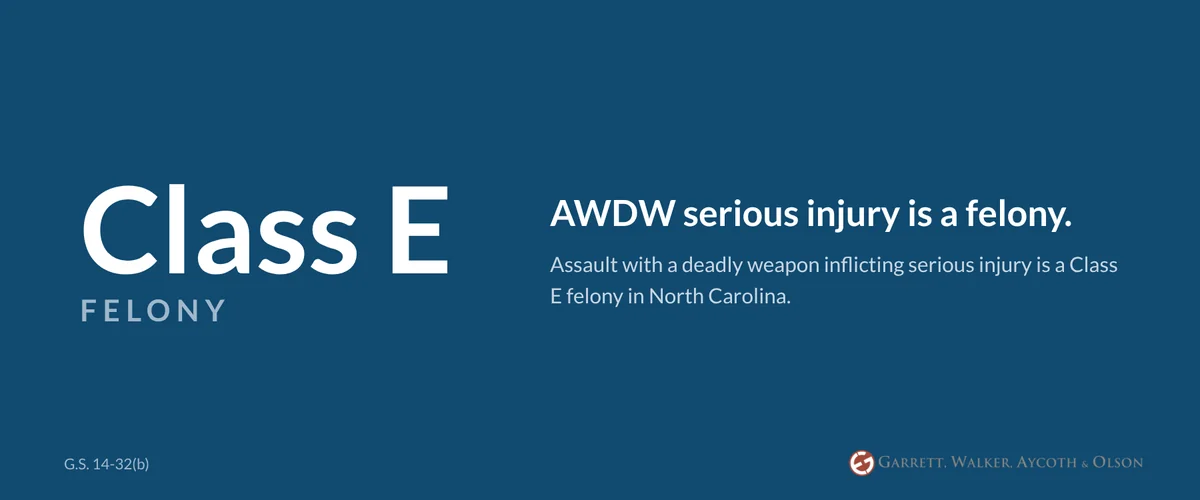
AWDW serious injury is assault with a deadly weapon inflicting serious injury, a Class E felony under G.S. 14-32(b). The State does not have to prove intent to kill, but a conviction brings a felony record and a possible prison term.
Many people think serious injury means a hospital stay or a permanent injury. It does not, and that lower test is often where a lawyer fights the charge.
With no prior record, the presumptive minimum is 20 to 25 months. Whether that sentence is suspended is argued by your lawyer.
Charged with AWDW serious injury in Guilford County? Call (336) 379-0539 today so a lawyer can get the medical records and any video before your first court dates.
What AWDW Serious Injury Means on a North Carolina Charge
AWDW stands for assault with a deadly weapon. AWDW serious injury adds the words “inflicting serious injury,” often shortened to AWDWISI or “assault ISI.”
AWDW serious injury is a Class E felony under G.S. 14-32(b).
Because it is a felony, the charge itself is tried in Superior Court under G.S. 7A-271. The case still starts in District Court, with your first appearance there.
AWDW serious injury does not require proof that you meant to kill anyone. Intent to kill is a separate fact that turns this into a more serious charge, shown in the table below.
See how our Greensboro assault lawyers defend charges like this one, from bond to trial.
AWDW Serious Injury Statute and Elements of the Crime
To convict you of AWDW serious injury, the State must prove three things beyond a reasonable doubt.
“Any person who assaults another person with a deadly weapon and inflicts serious injury shall be punished as a Class E felon.” G.S. 14-32(b)
North Carolina’s pattern jury instruction for this charge breaks it into three elements:
- You assaulted the other person on purpose, without justification or excuse.
- You used a deadly weapon.
- You inflicted serious injury on that person.
If the State cannot prove even one element beyond a reasonable doubt, the jury cannot convict you of this charge.
What Counts as a Deadly Weapon
A deadly weapon is a weapon likely to cause death or serious bodily injury, according to the jury instruction. Jurors look at the object, how it was used, and the size and strength of each person.
So a car, a bottle or a bat can be a deadly weapon, depending on how it was used.
Tip: How the object was used is often disputed. Witness accounts and video can change how a jury sees it.
What Counts as a Serious Injury (and What Does Not Need to Happen)
For AWDW, serious injury means a physical injury that causes great pain and suffering. North Carolina courts describe it as an injury that is serious but falls short of death.
Courts look at pain, blood loss, hospital treatment and time missed from work. Courts have rejected the idea that serious injury requires a hospital stay.
Whether an injury is serious is usually a question for the jury, not something the police decide.
Serious bodily injury is a different and higher test, used in G.S. 14-32.4. It covers injury that creates a substantial risk of death, or causes serious permanent disfigurement or a coma.
It also covers a permanent or long-lasting condition that causes extreme pain. So does a permanent or long-lasting loss of a body part’s function, or a long hospital stay.
Important: Some websites, including ones that rank for this charge, describe serious injury with the serious bodily injury test. That is the wrong test for AWDW, and the gap between the two is where many defenses start.
AWDW Serious Injury Compared With the Other 14-32 Charges
AWDW serious injury is one of four deadly weapon felonies in G.S. 14-32, and each one adds a different fact. The table shows what the State must add for each charge.
| Charge | What Is Added | Statute | Class |
|---|---|---|---|
| AWDW inflicting serious injury (AWDWISI) | Deadly weapon + serious injury | G.S. 14-32(b) | Class E felony |
| AWDW with intent to kill (AWDWIK) | Deadly weapon + intent to kill, no serious injury needed | G.S. 14-32(c) | Class E felony |
| AWDW with intent to kill inflicting serious injury (AWDWIKISI) | Deadly weapon + intent to kill + serious injury | G.S. 14-32(a) | Class C felony |
| AWDW inflicting serious injury on an emergency worker | The person hurt is a police officer, firefighter, EMT or medical responder | G.S. 14-32(d) | Class D felony |
If the State adds intent to kill to a serious injury, the charge jumps to Class C. Our separate guide explains why AWDWIKISI is a Class C felony.
Talk to a defense lawyer before you talk to anyone else
What you say and sign in the first days often decides what is possible later. The earlier we see your paperwork, the more options you usually have.
Call (336) 379-0539Free consultation with a Greensboro attorneyPotential Penalties for AWDW Serious Injury in NC
AWDW serious injury carries a minimum prison term set by the felony grid in G.S. 15A-1340.17, based on your prior record level.
Your prior record level comes from points for past convictions under G.S. 15A-1340.14. Level I is 0 to 1 point, Level II is 2 to 5 points, and Level III starts at 6 points.
| Prior Record Level | Disposition Allowed | Presumptive Minimum (Months) | Mitigated / Aggravated Minimum (Months) |
|---|---|---|---|
| Level I (0-1 points) | Intermediate or active | 20-25 | 15-20 / 25-31 |
| Level II (2-5 points) | Intermediate or active | 23-29 | 17-23 / 29-36 |
| Level III (6-9 points) | Active | 26-33 | 20-26 / 33-41 |
| Level IV (10-13 points) | Active | 30-38 | 23-30 / 38-48 |
| Level V (14-17 points) | Active | 35-44 | 26-35 / 44-55 |
| Level VI (18+ points) | Active | 40-50 | 30-40 / 50-63 |
Each number in the table is a minimum term. The same statute sets the matching maximum: a 20-month minimum carries a 36-month maximum, and a 63-month minimum carries 88 months.
That 88-month figure is the worst case, at Level VI with aggravating factors. It is not the normal sentence for someone with little or no record.
At Levels I and II, the grid allows intermediate punishment. Under G.S. 15A-1340.13(f), the judge may then suspend the prison term and place you on probation.
From Level III up, the chart calls for active prison time. Getting the case into the lower range is argued by your lawyer, and nothing about it is automatic.
Our felony page shows how the felony sentencing chart works, including when probation is possible.
The judgment may also include a fine. Under G.S. 15A-1340.17(b), the amount is in the discretion of the court.
Note: A separate law, G.S. 15A-1340.16A, adds 72 months to the minimum for some Class A to E felonies committed with a firearm or deadly weapon. It does not apply where the weapon is needed to prove an element of the felony, which a lawyer checks in your indictment.
A felony conviction also makes it a crime to own or possess a firearm under G.S. 14-415.1. Our firearm rights page explains how a felony affects your gun rights.
Warning: Expunction will not clear an AWDW serious injury conviction later. G.S. 15A-145.5 leaves out every Class A through G felony and any offense with assault as an essential element.
What Happens After an AWDW Serious Injury Arrest in Guilford County
After an AWDW serious injury arrest, the case starts in District Court and moves to Superior Court for the felony. Many Guilford County cases are heard at the Guilford County Courthouse, 201 South Eugene St in Greensboro.
Release Conditions and Bond
After arrest, conditions of release, such as a bond, are set before you can leave custody. If the bond is too high, learn how bond hearings work in Guilford before the next court date.
First Appearance in District Court
Your first appearance is in District Court, even though the felony is tried later in Superior Court. Under G.S. 15A-603, the judge must check whether you have a lawyer or need one appointed.
Probable Cause Hearing or Indictment
Next comes a probable cause hearing under G.S. 15A-606(d), unless you waive it or a grand jury indicts you first. Our guide explains what happens at a probable cause hearing, and after an indictment under G.S. 15A-641 the case moves to Superior Court.
Key point: The serious injury fight often turns on medical records, photos and witness accounts gathered early. That is a reason to call before the first court date, not after it.
Our criminal defense page lists the full range of criminal charges we handle in Guilford County.
How a Lawyer Defends an AWDW Serious Injury Charge
A lawyer defends an AWDW serious injury charge by testing each element the State must prove. Depending on the facts of your case, these are common lines of defense.
Self-defense or defense of others: G.S. 14-51.3 allows force when a person reasonably believes it is needed. The threat must be imminent unlawful force against that person or someone else.
Deadly force is justified when the person reasonably believes it is needed to prevent imminent death or great bodily harm. When self-defense is an issue in the case, the jury instruction must include it.
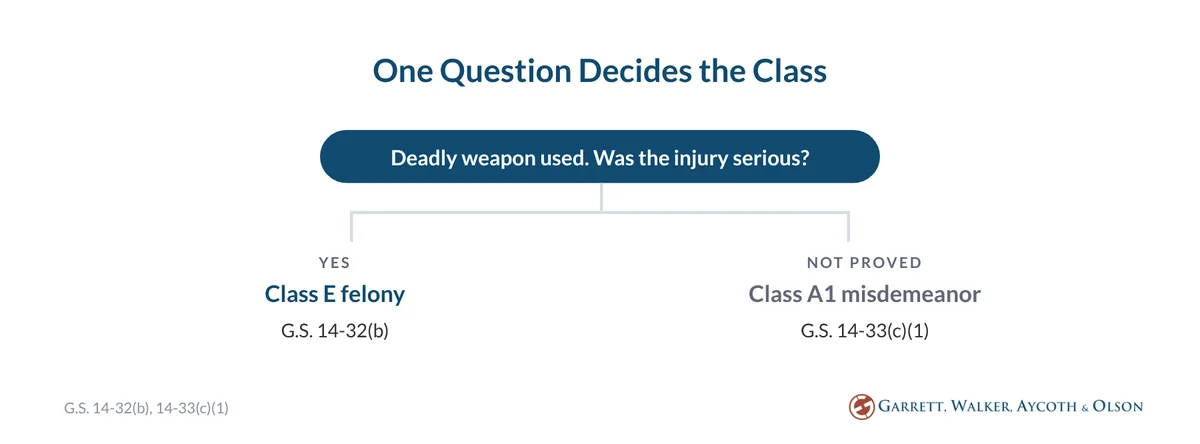
The injury was not serious: medical records, photos and time off work show how bad the injury really was. Because this is usually a jury question, it is a real point to contest.
Without serious injury, assault with a deadly weapon is a Class A1 misdemeanor under G.S. 14-33(c)(1). Depending on the facts of your case, a lawyer may be able to argue for that lesser charge.
The object was not a deadly weapon as used: the jury weighs the object, its use and the size of each person. If it was not a deadly weapon, the State cannot prove this felony.
Identity and witness accounts: fights are fast and confusing, and witnesses can disagree about who did what. Your lawyer tests each account against video and the physical evidence.
If the other person is a partner or family member, read when a domestic assault becomes a felony.
No lawyer can promise a result. What a lawyer can do is find the weak element and press it at every stage of the case.
Before you talk to anyone about the injury, talk to a Greensboro assault lawyer.
Facing an AWDW serious injury charge in Greensboro? Call (336) 379-0539 to talk with our team today.
Frequently Asked Questions
What does AWDW mean on a warrant in NC?
AWDW means assault with a deadly weapon. When the charge adds ISI, as in AWDWISI, it means inflicting serious injury, a Class E felony under G.S. 14-32(b). Assault with a deadly weapon and no other added fact is a Class A1 misdemeanor under G.S. 14-33(c)(1).
Is AWDW serious injury a felony in North Carolina?
Yes. AWDW serious injury is a Class E felony under G.S. 14-32(b). A conviction brings a felony record, a prison term from the felony grid and the loss of gun rights. Whether that term can be suspended depends on your prior record level.
How much time can you get for AWDW serious injury?
With no prior record, at Level I, the presumptive minimum is 20 to 25 months under G.S. 15A-1340.17. The worst case is a 63-month minimum with an 88-month maximum, at Level VI with aggravating factors. Your record level and the facts set the range.
Can you get probation for AWDW serious injury?
Probation is authorized only at prior record Levels I and II, up to 5 points, where the judge may suspend the sentence. From Level III, at 6 points and up, the grid calls for active prison time. Your lawyer argues your record level and the facts at sentencing.
Does serious injury mean the person went to the hospital?
No. North Carolina courts have rejected the idea that serious injury requires a hospital stay or immediate medical care. Courts look at pain, blood loss, treatment and time missed from work. Whether an injury was serious is usually decided by the jury.
Can a car or a bottle be a deadly weapon in NC?
Yes, depending on how it was used. A deadly weapon is one likely to cause death or serious bodily injury. The jury looks at the object, how it was used, and the size and strength of each person. Your lawyer can challenge that point.
Can AWDW serious injury be reduced to a misdemeanor?
It can, depending on the facts of your case. If the State cannot prove serious injury, assault with a deadly weapon is a Class A1 misdemeanor under G.S. 14-33(c)(1). A lawyer can press that point at trial or in plea talks. No lawyer can guarantee that result.
Will I lose my gun rights if convicted?
Yes. AWDW serious injury is a felony. G.S. 14-415.1 makes it a crime for anyone convicted of a felony to buy, own or possess a firearm, and breaking that rule is its own Class G felony. A lawyer can explain how the charge affects your rights before any plea.
Can an AWDW serious injury conviction be expunged?
No. The conviction fails two tests in G.S. 15A-145.5: it is a Class E felony, and assault is one of its elements. Neither kind of conviction can be expunged under that law. If the charge is dismissed or you are found not guilty, G.S. 15A-146 allows the charge to be expunged.
Is there always a probable cause hearing for AWDW serious injury?
Not always. If you do not waive it, G.S. 15A-606(d) sets the hearing within 15 working days of your first appearance, but an indictment returned first removes it. If the hearing happens, your lawyer can question the witnesses under oath. That is one reason to have a lawyer in place early.
- Former President, Greensboro Criminal Defense Lawyers Association
- Elected member, Criminal Justice Section, North Carolina Bar Association
- Selected to present the Wade M. Smith Award for Top Criminal Defense Lawyer in North Carolina
Talk to a Greensboro criminal defense lawyer today
Bring the warrant, the release order and anything else they gave you.
Garrett, Walker, Aycoth & Olson, Attorneys at Law
317 South Greene St, Greensboro, NC 27401
(336) 379-0539
This article explains North Carolina law in general terms. It is not legal advice about your case, and laws, penalties and court procedures change. Contact an attorney about your specific situation.