


At a probable cause hearing in North Carolina, a district court judge hears sworn witnesses and decides whether your felony case goes on to superior court. The judge can bind the case over, reduce it to a misdemeanor or dismiss it (G.S. 15A-612(a)).
This guide is for anyone charged with a felony in Greensboro or Guilford County who has been given a probable cause date.
Key point: This hearing is not a trial, and it is not guaranteed.
The UNC School of Government’s Defender Manual notes that dismissals here are not common. The State can also skip the hearing by indicting first.
A lawyer can cross-examine the State’s witnesses under oath and build a record for trial. That is where defense for a felony charge in Greensboro starts, before the case reaches superior court.
Have a probable cause date? Call (336) 379-0539 before it arrives, so your lawyer has time to prepare.
What Is a Probable Cause Hearing?
A probable cause hearing is a district court hearing on a felony charge, held before any indictment. The Defender Manual notes the right comes from statute, not the constitution.
G.S. 15A-611(b) sets the standard in these words:
“The State must by nonhearsay evidence, or by evidence that satisfies an exception to the hearsay rule, show that there is probable cause to believe that the offense charged has been committed and that there is probable cause to believe that the defendant committed it.” G.S. 15A-611(b)
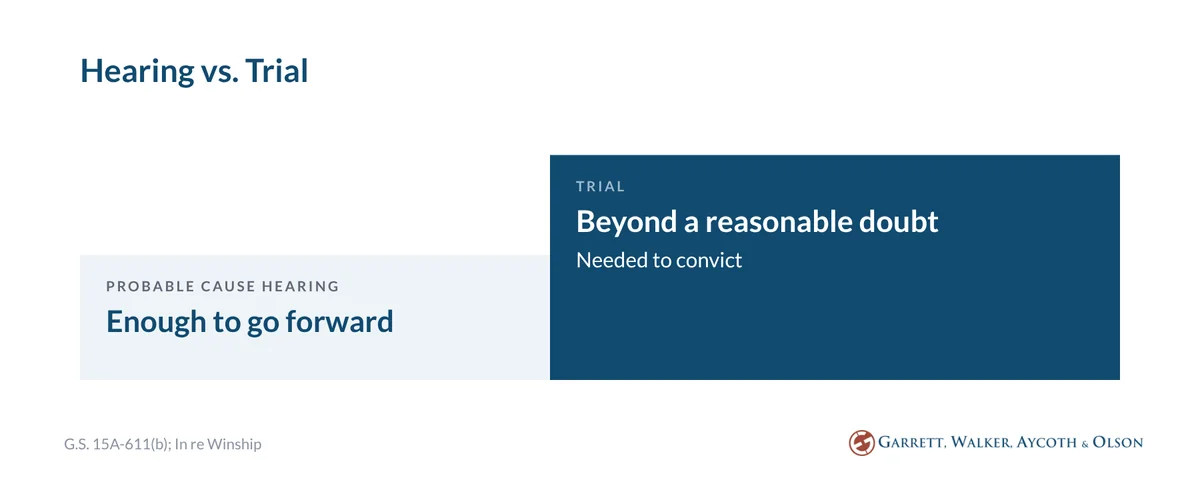
Probable cause is a much lower bar than guilt, and there is no jury.
Under In re Winship, 397 U.S. 358 (1970), a conviction at trial needs proof beyond a reasonable doubt.
For the trial side, see who carries the burden of proof at trial.
If the term itself is new, read how probable cause differs from reasonable suspicion.
When the Hearing Happens: The 15-Working-Day Clock
The hearing clock starts at your first appearance before a district court judge. If you are held in custody, that appearance comes within 72 hours or at the next regular session, if sooner (G.S. 15A-601(c)).
If you were released before it, the first appearance is held at the next session of district court in the county.
At that first appearance, the judge must tell you the charges, confirm you have the paperwork and review your release (G.S. 15A-605). It helps to know what happens at your first appearance before that day comes.
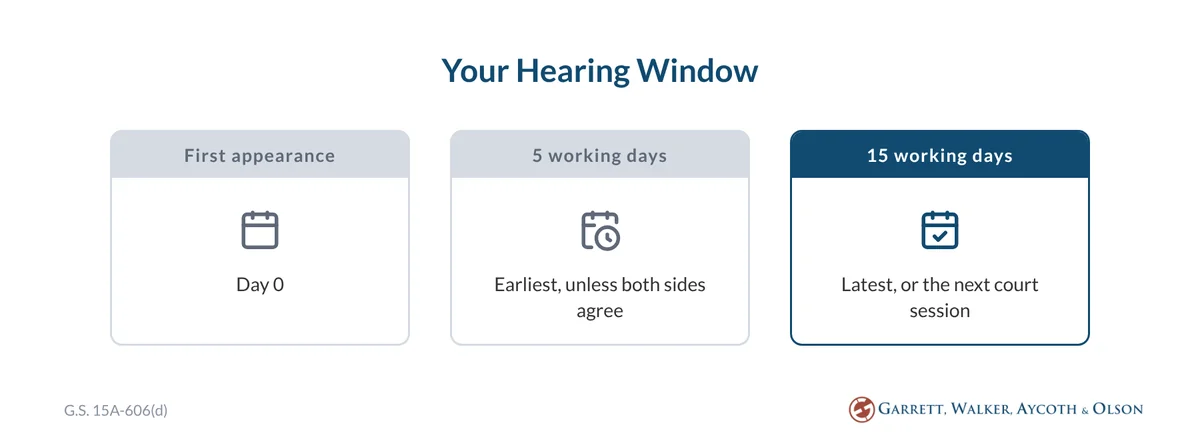
Unless you waive it, the judge must set the hearing no later than 15 working days after the first appearance (G.S. 15A-606(d)). If no district court session is scheduled in the county within that time, it goes on the first day of the next session.
The hearing also cannot be set sooner than 5 working days after the first appearance, unless you and the prosecutor both agree.
Count working days, not calendar days.
If no court holiday falls in between, the 15th working day after a Monday first appearance is usually the Monday three weeks later.
A continuance or the next-session rule can move the date.
Either side can ask to continue the hearing for good cause. Except for extraordinary cause, the motion must be made at least 48 hours before the hearing (G.S. 15A-606(f)).
A special rule covers people who have no lawyer yet, can afford one and have said they want one. The judge will tell them the hearing will not be continued because they still have no lawyer, except for extraordinary cause (G.S. 15A-606(e)).
Tip: If you plan to hire a lawyer, do it before the first appearance if you can. The hearing clock starts there.
What Happens at a Probable Cause Hearing in Court, Step by Step
At a probable cause hearing, the State calls sworn witnesses. Your lawyer tests them, and then the judge rules.
The Prosecutor Calls Witnesses Under Oath
A prosecutor must represent the State, and you may be represented by a lawyer (G.S. 15A-611(a)). Every witness testifies under oath or affirmation and can be cross-examined.
Your Lawyer Cross-Examines
The Defender Manual calls the hearing a chance for discovery and for building impeachment evidence for trial.
The manual also advises counsel to ask that the hearing be recorded, and transcribed if the case goes to trial.
The Evidence the State Can Use
The State must use nonhearsay evidence or evidence that fits a hearsay exception (G.S. 15A-611(b)). The statute adds two exceptions of its own.
An expert’s lab or fingerprint report is admissible. If there is no serious contest, reliable hearsay can also prove facts such as ownership of property or chain of custody.
Most of the Rules of Evidence do not apply here; only the privilege rules do (N.C. Rule of Evidence 1101(b)(3)). The hearsay limits in G.S. 15A-611(b) still apply.
The district judge does not have to throw out evidence because it was gathered unlawfully (G.S. 15A-611(b)). The Defender Manual notes the judge may still choose to exclude it, so your lawyer can raise the issue.
Whether You Testify
You may testify, call and question your own witnesses, and offer other evidence (G.S. 15A-611(a)(3)). The Defender Manual says counsel should rarely call the defendant or defense witnesses.
What you say at the hearing can be used against you at trial, so decide this with your lawyer.
Talk to a defense lawyer before you talk to anyone else
What you say and sign in the first days often decides what is possible later. The earlier we see your paperwork, the more options you usually have.
Call (336) 379-0539Free consultation with a Greensboro attorneyThree Ways the Judge Can Rule
The judge must take one of three actions at the end of a probable cause hearing.
| Ruling | What Happens Next | Statute |
|---|---|---|
| Probable cause found for the felony or a lesser felony | The case is bound over to superior court, and the judge notes the findings in the case records. | G.S. 15A-612(a)(1) |
| Probable cause only for a lesser misdemeanor | The case can stay in district court. A plea needs the prosecutor’s consent. A trial can happen at once if both sides agree, or is set 5 to 15 working days out. | G.S. 15A-612(a)(2), G.S. 15A-613 |
| No probable cause on any charge | The judge must dismiss. The State can still bring a new prosecution for the same offense. | G.S. 15A-612(a)(3), (b) |
After bindover, the prosecutor must send a bill of indictment to the grand jury. The exceptions are a dismissal or a bill of information (G.S. 15A-627(a)).
The next step is explained in how a grand jury indictment works.
If you are in custody when the case is bound over, the judge must review your release again (G.S. 15A-614). Before that moment, it helps to know how a bond motion works.
Why This Hearing Matters Even When the Case Goes Forward
The Defender Manual calls discovery and impeachment the hearing’s possibly more important functions, because courts do not often dismiss for lack of probable cause.
The manual adds that the hearing may give both sides a more realistic view of the case and encourage a plea agreement. A judge may also be willing to lower bond after learning about weaknesses in the State’s case.
How much you gain depends on your lawyer’s preparation and the facts of your case.
Warning: The hearing can be set as soon as 5 working days after your first appearance. Call (336) 379-0539 now so your lawyer can prepare cross-examination.
Waiving or Losing the Hearing
You can give up the hearing, but only in writing (G.S. 15A-606(a)). If you have a lawyer or want one, a waiver before the hearing date needs written consent from you and your lawyer.
A waiver means the judge must bind the case over to superior court (G.S. 15A-606(c)). Neither a demand nor a waiver can be used as evidence at your trial (G.S. 15A-606(b)).
A lawyer may waive for a reason. The Defender Manual says a prosecutor may offer earlier discovery, a bond reduction or a misdemeanor plea in return.
Discovery timing is another reason to hire early. If you have a lawyer before or during the hearing, or before you sign a waiver, your lawyer has 10 working days after it to request discovery as of right (G.S. 15A-902(d)).
Without a lawyer by then, that 10-day window runs from a later event, such as notice of an indictment or the appointment of counsel.
The hearing can also be lost. It may not be held if you waive indictment and a bill of information is filed in superior court before the hearing date (G.S. 15A-611(d)).
The Defender Manual explains that once the State gets an indictment, the district court can no longer hold the hearing. See how an indictment can cancel this hearing.
The manual also says some judicial districts still hold probable cause hearings and many others do not. Where they are rare, counsel may need to file a demand.
Immediate Steps to Take Before Your Hearing
Use the days before a probable cause hearing to prepare with a lawyer.
- Call a lawyer before the hearing date, not on the morning of it.
- Write down the names of possible witnesses and keep every paper you received.
- Do not discuss the case with police or post about it online.
- Go to every court date. If you were released and miss court, a judge can issue an order for your arrest (G.S. 15A-305(b)(2)).
The safest move is to talk to a felony lawyer before the hearing. You can also meet the Greensboro criminal defense lawyers at our firm and see the charges they handle.
Have a hearing date coming up? Call (336) 379-0539 today so there is time to prepare.
Frequently Asked Questions
Can charges be dropped at a probable cause hearing?
Yes. If the judge finds no probable cause on any charge, the judge must dismiss under G.S. 15A-612(a)(3). The State can still charge the same offense again. Dismissals are not common here, so your lawyer also uses the hearing to learn the State’s case.
What happens after a probable cause hearing?
If probable cause is found, the case is bound over to superior court. The prosecutor must then send a bill of indictment to the grand jury, unless the charge is dismissed or an information is used. Your lawyer can use what the hearing revealed to prepare for that next stage.
What does “order of probable cause found” mean?
It means the district judge found that you probably committed the felony charged or a lesser felony. The judge must bind the case over to superior court and note the findings in the case records. It is not a finding of guilt; guilt is decided at trial.
Is a probable cause hearing the same as a trial?
No. A probable cause hearing is held before a district court judge, with no jury, and decides only probable cause. Guilt is decided at trial, where the State must prove it beyond a reasonable doubt. Your lawyer can use the hearing to prepare for that trial.
Is there a probable cause hearing for a misdemeanor charged with a felony?
The hearing is required for charges in the superior court’s original jurisdiction (G.S. 15A-606(a)). The Defender Manual says a defendant appears to have a statutory right to one on felonies and any joined misdemeanors. Ask your lawyer how that applies to your charges.
Is a probable cause hearing the same as a preliminary hearing?
Yes, in North Carolina. The UNC School of Government’s Defender Manual notes that the probable cause hearing was formerly called a preliminary hearing. Pages written for other states may describe different rules, so rely on North Carolina law.
Why was my probable cause hearing continued or never held?
Either side can ask for a continuance for good cause, at least 48 hours ahead except for extraordinary cause. A hearing may never happen if the State indicts first, and the Defender Manual notes many districts do not hold these hearings. Your lawyer can check the court file and, where needed, file a demand.
What if I do not have a lawyer by the hearing date?
It depends on your situation. If you can afford a lawyer and have asked for one, the hearing will not wait for a missing lawyer, except for extraordinary cause. If you are indigent, you have the right to appointed counsel (G.S. 15A-603(b)). Either way, get a lawyer in place early.
Can I be released before the hearing?
Release is decided or reviewed at your first appearance before a district court judge under G.S. 15A-605. If you are in custody when the case is bound over, the judge must review release again. The Defender Manual notes a judge may lower bond after learning about weaknesses in the State’s case.
- Former President, Greensboro Criminal Defense Lawyers Association
- Elected member, Criminal Justice Section, North Carolina Bar Association
- Selected to present the Wade M. Smith Award for Top Criminal Defense Lawyer in North Carolina
Talk to a Greensboro criminal defense lawyer today
Bring the warrant, the release order and anything else they gave you.
Garrett, Walker, Aycoth & Olson, Attorneys at Law
317 South Greene St, Greensboro, NC 27401
(336) 379-0539
This article explains North Carolina law in general terms. It is not legal advice about your case, and laws, penalties and court procedures change. Contact an attorney about your specific situation.