


The age of consent in North Carolina is 16. Below 16, the statutory rape laws make sex a felony when the other person is more than four years older, and consent or a lie about age is not a defense.
This guide is for adults who have been accused, contacted by a detective or charged, and for their families. The charge, the felony class and any registration turn on two birth dates, which the State must prove.
These are Class B1, C and F felony charges, and on the most serious ones only a judge can set bond. A defense lawyer checks every date and every piece of proof, and what that can change depends on the facts of your case.
Contacted by police or already charged? Call (336) 379-0539 and talk with Jason Aycoth’s team before you speak to anyone about the case.
What Is the Age of Consent in NC?
The age of consent in North Carolina is 16. No statute uses the words “age of consent,” so the legal age of consent comes from three criminal laws that protect people 15 and younger.
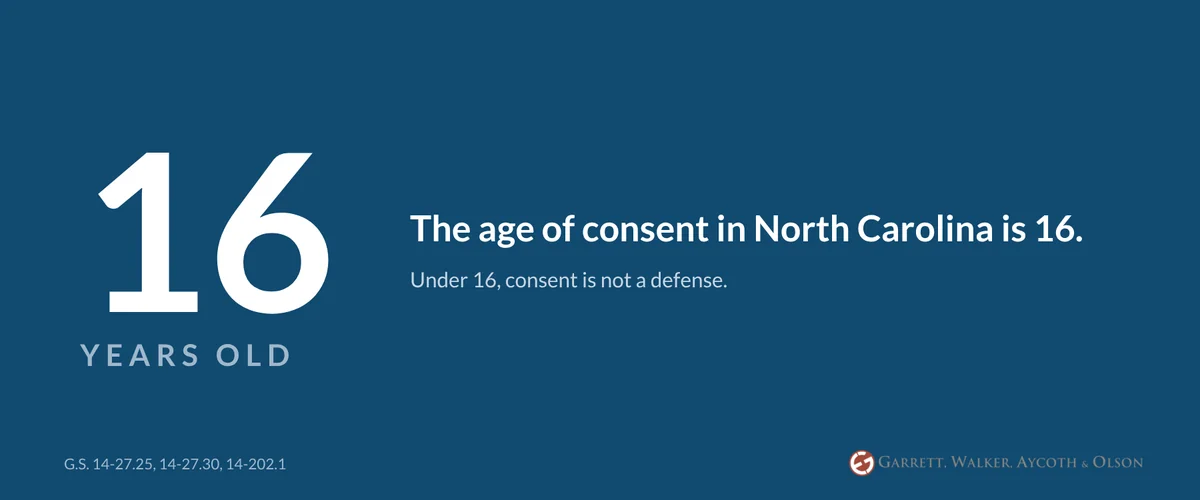
Those laws are statutory rape and statutory sexual offense with a person 15 or younger, G.S. 14-27.25 and G.S. 14-27.30, and taking indecent liberties with a child under 16, G.S. 14-202.1. A “sexual offense” covers the other sexual acts defined in G.S. 14-27.20.
“A defendant is guilty of a Class B1 felony if the defendant engages in vaginal intercourse with another person who is 15 years of age or younger and the defendant is … at least six years older than the person, except when the defendant is lawfully married to the person.”
G.S. 14-27.25(a)
Separate, stricter laws apply when the accused is an adult and the child is under 13: G.S. 14-27.23 and G.S. 14-27.28.
The age of consent is not 18, although 18 still matters for images.
Age of Consent Laws in NC: Which Charge Depends on the Ages
Under North Carolina age of consent laws, the charge depends on the younger person’s age and the age gap, not on whether anyone agreed.
| Age of the Younger Person | Age Gap or Age of Accused | Charge and Statute | Felony Class | Level I Presumptive Range (or Floor) |
|---|---|---|---|---|
| Under 13 | Accused is 18 or older | Statutory rape or sexual offense of a child by an adult, 14-27.23, 14-27.28 (also 14-27.24, 14-27.29) | B1 | No active term under 300 months |
| 15 or younger | At least 6 years older | Statutory rape or statutory sexual offense, 14-27.25(a) and 14-27.30(a) | B1 | 192-240 months |
| 15 or younger | More than 4 but less than 6 years older | Same laws, subsection (b) | C | 58-73 months |
| Under 16 | At least 5 years older (no intercourse required) | Indecent liberties with children, 14-202.1 | F | 13-16 months |
Note: Level I is the lowest prior record level, and the ranges are presumptive minimum prison terms in months. Under G.S. 15A-1340.17, Class B1 and Class C felonies carry active prison at every record level.
In State v. Anthony (1999), the accused was 20 years and 1 month old and the other person was 14 years and 9 months. That gap is more than four but less than six years, so the case was charged under the Class C tier, then numbered 14-27.7A(b).
Near the four- or six-year line, the exact birth dates decide the tier, and your lawyer checks them. Once the younger person turns 16, these age-based laws no longer apply, but the laws in the next sections can.
If you are facing one of these charges, read how statutory rape charges are defended in Greensboro.
Indecent liberties is a separate crime with its own five-year test; see what an indecent liberties charge means.
Is There a Romeo and Juliet Law in NC?
No statute in North Carolina is called a Romeo and Juliet law. The age-gap lines written into G.S. 14-27.25 and 14-27.30 do that job.
For a person 15 or younger, the charge is Class C when the accused is “more than four” years older. It is Class B1 when the accused is “at least six” years older.
Some websites say the line is a gap of “less than four years.” That is not the statute’s wording, and the stricter under-13 laws follow their own rules.
North Carolina has no separate dating age law. These age-gap rules decide what the State can charge; they are not a guide to what is allowed.
Important: The age-gap lines do not protect anyone under the custodian, school or image laws, which have no such line. Exact dates of birth decide which side of a line a case falls on, and a lawyer checks the dates the State relies on.
Does Marriage Change the Charge?
G.S. 14-27.25, 14-27.30 and subsection (a) of the school law, G.S. 14-27.32, make an exception for a person “lawfully married” to the other person.
Since August 26, 2021, North Carolina bars marriage for anyone under 16 under G.S. 51-2(b1). A 16- or 17-year-old may marry only someone no more than four years older, with a parent’s or custodian’s written consent or a court order (G.S. 51-2(a1)).
The custodian law, G.S. 14-27.31, has no marriage exception, and under it consent is not a defense.
Laws That Still Apply When the Person Is 16 or 17
Turning 16 ends the age-based statutory rape laws, but four other laws still reach adults.
- Parent role or custody: an adult who acts as a parent in the home, or has custody of the person, commits a Class E felony (G.S. 14-27.31), and consent is not a defense. For offenses on or after December 1, 2025, S.L. 2025-70 defines custody broadly. It includes volunteers and religious organizations that supervise a minor.
- School personnel: a teacher, coach, school safety officer or other school employee commits a Class G felony with a student, and consent is not a defense (G.S. 14-27.32).
- Images: knowingly possessing an image that shows a person under 18 in sexual activity, as G.S. 14-190.13 defines it, is third-degree sexual exploitation of a minor, a Class H felony. Mistake of age is not a defense (Section 14-190.17A).
- Online contact: using a phone or computer to solicit someone believed to be under 16 and at least five years younger to meet for an unlawful sex act is a separate crime (G.S. 14-202.3).
Images bring separate sexual exploitation of a minor charges, even at 16 or 17. All four laws are on North Carolina’s sex offender registration list.
Talk to a defense lawyer before you talk to anyone else
What you say and sign in the first days often decides what is possible later. The earlier we see your paperwork, the more options you usually have.
Call (336) 379-0539Free consultation with a Greensboro attorneyIs Mistake of Age or Consent a Defense in NC?
No. In State v. Anthony, 133 N.C. App. 573 (1999), the Court of Appeals held that “mistake of age is not a defense” to statutory rape, just as consent is not.
The court decided the case under the earlier numbering of the statute. It said the accused “assumed the risk” that the other person was under the legal age.
So a fake ID, a dating-app profile or the other person’s own statement about age does not change the charge.
That does not mean the case is decided. A defense lawyer tests the proof of both birth dates and the age gap the felony class depends on, depending on the facts of your case.
Your lawyer also examines the evidence that the act happened and how statements and phone records were obtained. Another question is whether a lower-class charge fits the facts.
Talked to a detective already, or been asked to come in for an interview? Call (336) 379-0539 first.
Penalties and What Happens After an Arrest
Every charge in the table is a felony, and the most serious carry long active prison terms. For an adult charged over a child under 13, G.S. 14-27.23 and 14-27.28 bar any active term under 300 months.
After release from that sentence, those two laws also require enrollment in satellite-based monitoring. For the Class B1 and Class C tiers, the sentencing grid allows only an active prison term at every prior record level.
Bond: Only a Judge Decides
For statutory rape and statutory sexual offense charges, a judge, not a magistrate, decides pretrial release under G.S. 15A-533(b).
That list includes G.S. 14-27.24 and G.S. 14-27.29 as well. The law starts from a rebuttable presumption that no condition of release will assure your appearance and the safety of the community.
A lawyer’s job at that hearing is to rebut the presumption with facts about your home, work, family and record. Your lawyer prepares for what happens at a bond reduction hearing before you stand in front of the judge.
These cases go to Superior Court, so read how a felony case moves after indictment.
Sex Offender Registration and Your Record
Most of these convictions require registration with the sheriff for at least 30 years under G.S. 14-208.7.
The registration list in G.S. 14-208.6(5) names the under-13 laws and subsection (a) of 14-27.25 and 14-27.30. It also names the custodian, school, indecent liberties, image and online solicitation laws.
After 10 years, a person may petition the superior court to end registration under Section 14-208.12A. The court must find the person is not a threat to public safety, and that ending registration meets federal registration standards (Section 14-208.12A(a1)(2)).
For many of these offenses federal standards set a longer minimum, so early removal is often not possible. Ask your lawyer which applies to you before any plea.
The Class C tier (G.S. 14-27.25(b), 14-27.30(b)) is not on the registration list. But G.S. 15A-145.5(a)(4) names it as never expungeable, so a Class C conviction is a felony that stays on your record for life.
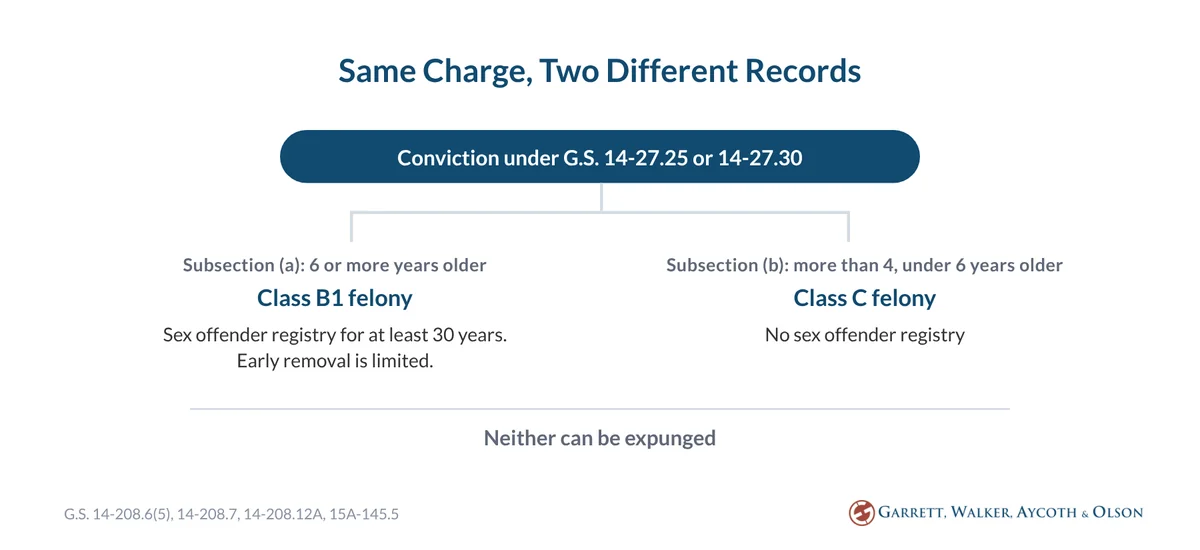
The (a) tier cannot be expunged either. It is a Class B1 felony that requires registration, and G.S. 15A-145.5(a)(1) and (a)(3) exclude both.
Which statute and subsection you plead to decides registration and the record, so make that decision with your lawyer.
Before any plea, ask your lawyer what life on the NC registry involves. A conviction that can never be expunged stays on your criminal record; see how a record follows your job search.
Accused or Under Investigation in Guilford County: What to Do Now
Do not explain your side to a detective, the other person or their family before you have a lawyer. What you say or text can become evidence.
Do Not Talk About the Case
Politely say you want a lawyer before any interview. Do not post about the accusation or message anyone involved.
Do Not Delete, Reset or Hand Over Your Phone
Ask your lawyer first what to do with it.
Write Down Dates and Names While You Remember Them
Note where you were, who you were with and when. Share those notes only with your lawyer.
Call a Defense Lawyer Before Any Interview or Court Date
Felony cases in Greensboro are heard at the Guilford County Courthouse. The criminal defense lawyers at our Greensboro office handle felony charges, including sex offense accusations.
If a detective has called, talk with us about a statutory rape accusation before you answer.
Under investigation or charged? Call (336) 379-0539 today.
Frequently Asked Questions
Is the age of consent in NC 16 or 18?
It is 16. Senate Bill 464, a 2023 bill to raise it to 18, was sent to a Senate committee and saw no further action. Eighteen matters for images: knowingly possessing an image of anyone under 18 in sexual activity is a felony.
Can an adult still be charged if the other person is 16 or 17?
Yes. The age-based statutory rape laws stop at 15, but charges can still come from the custodian or school laws. They can also come from an image of a person under 18 in sexual activity, or from any act without consent. If police have contacted you, call a lawyer before you answer questions.
Can a parent give permission?
No. None of these statutes has a parental-permission exception. The only exception written into the statutory rape laws for a person 15 or younger is lawful marriage, and a person under 16 cannot marry in North Carolina. A parent’s approval does not change the charge.
Is statutory rape a felony in NC?
Yes, always. It is a Class B1 or Class C felony depending on the ages and the gap, and indecent liberties with a child under 16 is Class F. The class decides the prison range, and the subsection decides whether you must register.
Can a statutory rape conviction be expunged?
No, not a conviction: G.S. 15A-145.5 excludes registrable offenses and the Class C tier. If all charges are dismissed without leave or you are found not guilty, in a case closed on or after December 1, 2021, the charges are expunged automatically 180 to 210 days later under G.S. 15A-146(a4). A felony dismissed under a plea deal is excluded.
Will I have to register if I plead to a lower charge?
It depends on the statute and subsection you plead to. The (a) tier, indecent liberties and the custodian and school laws require registration. The (b) tier does not, but it stays on your record for life. Your lawyer weighs this with you before any plea.
Can the accuser drop the charges?
No. Once a case is charged, it belongs to the State, and only the prosecutor can dismiss it under G.S. 15A-931. Do not contact the accuser to ask, because that can create new problems for you. Your lawyer deals with the prosecutor.
Do I need a lawyer if no charge has been filed yet?
Yes. A detective may ask you to come in and “give your side” before any warrant exists, and what you say can be used to bring the charge. A lawyer can speak for you from the first call and sit with you in any interview.
- Former President, Greensboro Criminal Defense Lawyers Association
- Elected member, Criminal Justice Section, North Carolina Bar Association
- Selected to present the Wade M. Smith Award for Top Criminal Defense Lawyer in North Carolina
Talk to a Greensboro criminal defense lawyer today
Bring the warrant, the release order and anything else they gave you.
Garrett, Walker, Aycoth & Olson, Attorneys at Law
317 South Greene St, Greensboro, NC 27401
(336) 379-0539
This article explains North Carolina law in general terms. It is not legal advice about your case, and laws, penalties and court procedures change. Contact an attorney about your specific situation.