



An indictment in North Carolina is a grand jury’s formal felony charge, not a conviction, so it does not decide whether you go to prison. That comes later, through a plea or verdict and the grid in G.S. 15A-1340.17, which requires prison for Class B1 to D felonies.
If you were not already arrested, a true bill can lead to an order for arrest (G.S. 15A-305(b)(1)). After that, whether you are held before trial depends on your release conditions.
This guide is for anyone in Guilford County facing a true bill, or whose family member was indicted.
Does indictment mean jail time? Not by itself, but it starts deadlines that shape your case.
After an indictment, you have 21 days from service to ask in writing for an arraignment (G.S. 15A-941(d)). If you do not ask, key motions are due 21 days after the true bill, and late motions are waived unless the judge grants relief (G.S. 15A-952(c), (e)).
Talk with a Greensboro felony defense lawyer before that window closes.
Indicted, or expecting it? Call (336) 379-0539 and talk with Jason Aycoth’s team before those 21 days run.
What Is an Indictment in North Carolina?
An indictment is “a written accusation by a grand jury, filed with a superior court” under G.S. 15A-641(a). It moves a felony into superior court, which hears felony cases (G.S. 7A-271(a)).
A felony case must proceed on a bill of indictment unless you waive it (G.S. 15A-923(a)).
A waiver must be in writing and signed by you and your lawyer. It is never allowed in a capital case or without a lawyer (G.S. 15A-642(b), (c)).
After a valid waiver, the prosecutor files an information, its own written accusation (G.S. 15A-641(b)).
Every indictment carries the foreman’s signature showing that 12 or more grand jurors agreed (G.S. 15A-644(a)(5)). An indictment the grand jury approves is called a true bill.
This post covers North Carolina state court. Federal indictments follow different rules.
For the full definition, read what an indictment means under NC law.
Indicted vs. Charged vs. Arrested vs. Convicted
You can be charged and arrested without being indicted, and indicted without being arrested. Only a conviction leads to a sentence.
| Step | Who Decides | What It Means for Jail |
|---|---|---|
| Arrest on a warrant | A magistrate or other judicial official, on probable cause (G.S. 15A-304) | Release conditions are set; you may be held if you cannot meet them (G.S. 15A-534) |
| Indictment (true bill) | 12 or more of the 12 to 18 grand jurors, on probable cause | None by itself; the case moves to superior court |
| Information | The prosecutor, only after you waive indictment with a lawyer | Same as an indictment |
| Conviction | Your guilty plea, or a judge or jury verdict | The felony sentencing grid now applies |
If your case began with an arrest, see how an arrest warrant is issued.
Does an Indictment Mean Jail Time?
An indictment alone does not set a sentence. If you are convicted, the felony class and your prior record level decide what the judge may impose (G.S. 15A-1340.17(c)).
The chart shows Level I, the lowest record level. Ranges rise with each level.
| Felony Class | Sentence Types Allowed, Level I (0-1 Record Points) | Presumptive Minimum, Level I |
|---|---|---|
| Class B1 to D | Active prison required at every level | 51-64 months (D) up to 192-240 months (B1) |
| Class E | Intermediate or active | 20-25 months |
| Class F | Intermediate or active | 13-16 months |
| Class G | Intermediate or active | 10-13 months |
| Class H | Community, intermediate or active | 5-6 months |
| Class I | Community | 4-6 months |
Community, intermediate and active are the three types of punishment the grid authorizes (G.S. 15A-1340.17(c)(1)). A felony with no stated class is treated as Class I (G.S. 15A-1340.17(a)).
One point keeps you at Level I, and two to five points puts you at Level II (G.S. 15A-1340.14(c)). There, a Class H felony allows only intermediate or active punishment, and a Class I felony allows community or intermediate punishment (G.S. 15A-1340.17(c)).
Six points moves you to Level III, and five or more points rules out the extraordinary mitigation exception below. Counting those points is part of your lawyer’s work.
Read more on sentencing for a Class H felony and how North Carolina felony sentencing works.
Where the grid allows community or intermediate punishment, probation is possible (G.S. 15A-1341(a)). Where it requires active time, a judge may impose intermediate punishment only after finding extraordinary mitigation in writing (G.S. 15A-1340.13(g)).
That exception is not available for Class A or B1 felonies, drug trafficking, or five or more record points (G.S. 15A-1340.13(h)). Which class you are convicted of and which level you are sentenced at is argued by your lawyer, not assumed.
Key point: An indictment is not a sentence, but it is not nothing either.
How Does the Grand Jury Work in North Carolina?
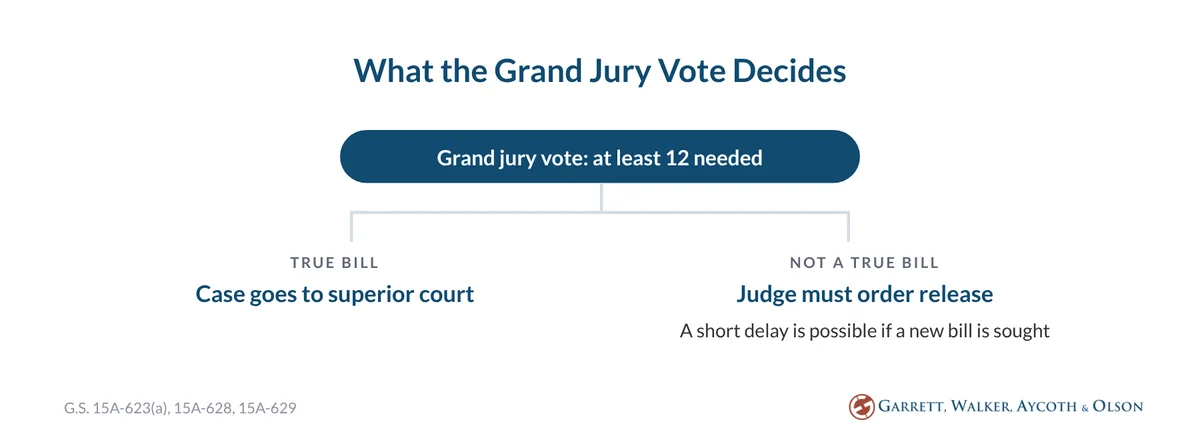
A North Carolina grand jury is 12 to 18 citizens sitting as part of the superior court (G.S. 15A-621). At least 12 of them must agree before an indictment is returned.
“The finding of an indictment, the return of a presentment, and every other affirmative official action or decision of the grand jury requires the concurrence of at least 12 members of the grand jury.” G.S. 15A-623(a)
Grand jury proceedings are secret. Only the grand jurors may be in the room while they deliberate and vote (G.S. 15A-623(d), (e)).
No one has a right to appear or call witnesses before the grand jury. The prosecutor or the judge decides who is called (G.S. 15A-626(a), (d)).
Your side of the story is usually not heard there.
The standard is probable cause, and finding it means a true bill. Without it, the bill comes back as not a true bill (G.S. 15A-628(a)).
After a not a true bill, the judge must order your release from custody, bail or release conditions (G.S. 15A-629(a)). If the grand jury asks for a lesser or related bill, the judge may delay release, but not past the end of that session (G.S. 15A-629(b)).
A judge can also order an indictment kept secret until the person is arrested or appears in court (G.S. 15A-623(f)), known as a sealed indictment.
Will You Be Arrested After an Indictment? Bond and Custody
If you are not in custody or on pretrial release, the court may issue an order for arrest on the true bill (G.S. 15A-305(b)(1)). A prosecutor can also take a case straight to the grand jury before any arrest (G.S. 15A-627(b)).
If you are already out on bond from the district court charge, that bond stays in force through every stage until judgment (G.S. 15A-534(h)). The prosecutor can still ask a judge to modify or revoke your release at any time (G.S. 15A-539(a)).
Once the case is in superior court, a superior court judge can modify your release conditions (G.S. 15A-534(e)). Here is how a bond reduction hearing works.
The court mails notice of the indictment to you unless you already have a lawyer of record (G.S. 15A-630).
Tip: If you think a sealed indictment or an order for arrest is out, call before you are picked up.
Talk to an attorney about your situation
A short call is often enough to understand your options.
Call (336) 379-0539Free consultation with a Greensboro attorneyWhat Happens After an Indictment in NC: The 21-Day Window
You have 21 days after the indictment is served on you to ask in writing for an arraignment (G.S. 15A-941(d)). If you do not ask, key motions, including a motion to dismiss the indictment, are due 21 days after the true bill (G.S. 15A-952(c)).
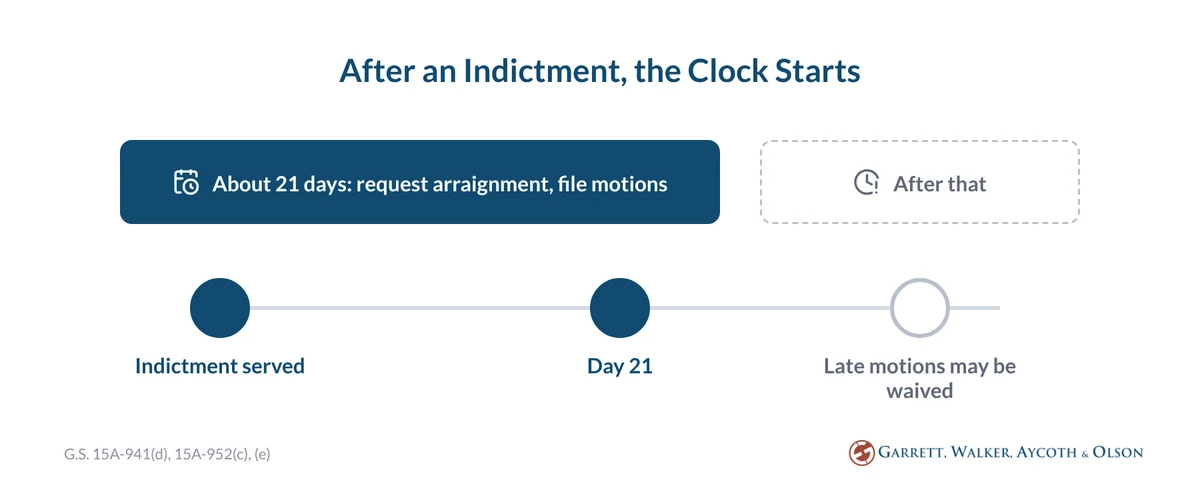
If you do ask, those motions are generally due at or before the arraignment. If the indictment does not have to be served, the arraignment request runs from the true bill instead.
If no request is filed, the court enters a not guilty plea for you (G.S. 15A-941(d)). Late motions are waived unless the judge grants relief (G.S. 15A-952(e)).
Grounds to dismiss the indictment itself are narrow, such as too few qualified grand jurors agreeing (G.S. 15A-955). That is why your lawyer reviews it early, while those motions are still on time.
Warning: The 21 days start when the indictment is served or returned, not when you feel ready. Call (336) 379-0539 and we will check your dates.
Why an Indictment Can Skip Your Probable Cause Hearing
The judge must schedule a probable cause hearing within 15 working days of the first appearance unless you waive it in writing (G.S. 15A-606(a), (d)). At that hearing your lawyer can cross-examine the State’s witnesses (G.S. 15A-611(a)).
The July 2026 UNC School of Government Defender Manual notes that “some judicial districts still hold probable cause hearings; many others do not.”
The same manual explains that once the State obtains an indictment, the district court loses the case and the hearing can no longer be held (State v. Hudson, 295 N.C. 427 (1978)). The State can avoid the hearing by indicting first.
That hearing is an early chance to test the evidence, so hiring a lawyer before the indictment matters. Read how probable cause is tested in court before a case is indicted.
Possible Outcomes After an Indictment
An indicted case can end in several ways. Your lawyer’s work shapes which ones are on the table, depending on the facts of your case.
| Outcome | What It Means | Who Has to Agree |
|---|---|---|
| Dismissal | The prosecutor drops the charge, orally in court or in writing (G.S. 15A-931(a)) | The prosecutor |
| Deferred prosecution | For a Class H or I felony, probation while the charge is held off, only if you have no prior felony conviction and have never been on probation, among other conditions (G.S. 15A-1341(a1)). Your lawyer checks whether you qualify. | You, the prosecutor and the court |
| Plea arrangement | A guilty plea to an agreed charge or sentence; a recommended sentence needs the judge’s approval (G.S. 15A-1023(b)) | You, the prosecutor and the judge |
| Trial | A judge or jury decides guilt | The judge or jury decides |
| Conviction | The felony sentencing grid applies (G.S. 15A-1340.17) | Follows a guilty plea or a verdict |
Note: If the judge rejects a plea arrangement, neither you nor the State is bound by it (G.S. 15A-1023(b)).
Myths and Misconceptions About Indictments
“An indictment means you are guilty.” It means at least 12 grand jurors found probable cause on the State’s evidence alone (G.S. 15A-623(a), 15A-626).
“A grand jury hears both sides.” No one has a right to appear or call witnesses there (G.S. 15A-626(a)).
“It is only a charge, so I can wait.” The 21-day windows run without you.
How to Respond if You’re Indicted
Four steps protect your options after an indictment.
Call a Lawyer Before the 21 Days Run
Your lawyer can file the arraignment request, the motions and the discovery request on time (G.S. 15A-941(d), 15A-952, 15A-630). Call (336) 379-0539 about defending felony charges in superior court.
Do Not Talk About the Case
Do not discuss the facts with police, the alleged victim or friends, or post about it. Let your lawyer do the talking.
Follow Every Bond Condition
Any judge may revoke your pretrial release for good cause (G.S. 15A-534(f)). The prosecutor can also ask a judge to change or revoke it (G.S. 15A-539(a)).
Gather Documents and Names Now
Save messages, receipts, photos and witness names for your lawyer.
A lawyer’s job is to look for a dismissal, a reduced charge, a lower sentencing class or a trial defense, depending on the facts of your case. Talk with our Greensboro criminal defense lawyers about your felony charge before the 21 days run.
Frequently Asked Questions
Does an indictment mean you are guilty?
No. An indictment means at least 12 grand jurors found probable cause on the evidence the State presented (G.S. 15A-623(a), 15A-628). Guilt still requires your guilty plea or a verdict, and your lawyer can challenge the case before either happens.
If you are indicted, are you arrested?
Not always. If you are not in custody or on pretrial release, the court may issue an order for arrest on the true bill (G.S. 15A-305(b)(1)). If you are already out on bond from the district court charge, that bond stays in force until judgment (G.S. 15A-534(h)).
Can you be indicted without being arrested first?
Yes. A prosecutor may send a felony bill of indictment straight to the grand jury, with no earlier arrest (G.S. 15A-627(b)). A judge can also keep the indictment secret until the person is arrested or appears in court (G.S. 15A-623(f)).
How long after an indictment is the arraignment?
You get an arraignment only if you request it in writing within 21 days after service of the indictment (G.S. 15A-941(d)). The arraignment is then scheduled, and motions are due at or before it. Without a request, the court enters a not guilty plea, and motions are due 21 days after the true bill (G.S. 15A-952(c)).
What does “not a true bill” mean?
It means the grand jury did not find probable cause for the charge (G.S. 15A-628(a)(2)). The judge must then order your release from custody, bail or release conditions. If the grand jury asks for a lesser or related bill, the judge may delay that release, no later than the end of that court session (G.S. 15A-629(b)).
What does awaiting indictment mean?
It usually means a felony charge is pending and no bill has gone to the grand jury yet. Once a case is bound over to superior court, the prosecutor must submit a bill (G.S. 15A-627(a)). If the case is still in district court, a probable cause hearing may be scheduled (G.S. 15A-606(a)).
Can an indictment be dismissed?
Sometimes. A motion to dismiss the indictment itself has narrow grounds (G.S. 15A-955). Without an arraignment request, it is due 21 days after the true bill, and a late motion is waived unless the judge grants relief (G.S. 15A-952(c), (e)). The prosecutor can also dismiss the charges at any time (G.S. 15A-931(a)).
What does reindicted mean?
It means a new bill of indictment is returned on the same matter. For example, after a not a true bill, the grand jury may ask for a bill on a lesser or related charge (G.S. 15A-629(b)). The statute also says a bill of indictment may not be amended (G.S. 15A-923(e)).
How many indictments lead to a conviction?
No statistic can tell you how your own case will end. A conviction still requires your guilty plea or a verdict. Your lawyer’s work on the evidence, the motions and any plea offer shapes the result, depending on the facts of your case.
Talk to our team today
Tell us where things stand and we will explain the next steps.
Garrett, Walker, Aycoth & Olson, Attorneys at Law
317 South Greene St, Greensboro, NC 27401
(336) 379-0539
This article explains North Carolina law in general terms. It is not legal advice about your case, and laws, penalties and court procedures change. Contact an attorney about your specific situation.