


Uttering a forged instrument means passing, or trying to pass, a forged check or similar instrument as genuine while knowing it is fake. In North Carolina it is a Class I felony under G.S. 14-120, even if the bank or store refuses it.
This guide is for anyone in Greensboro or Guilford County charged after a bank, check-cashing store or business flagged a check, money order or endorsement.
What the State can prove about what you knew is where these cases are won or lost, depending on the facts of your case. Talk with a white collar crime lawyer in Greensboro before you answer questions from the bank or the police.
Questioned about a check? Call (336) 379-0539 before you give any statement.
What Is Uttering a Forged Instrument in North Carolina?
Uttering is offering, passing or delivering a forged instrument to another person as if it were real, knowing it is forged. The key words of G.S. 14-120 read:
“… shall pass or deliver, or attempt to pass or deliver, any of them to another person (knowing the same to be falsely forged or counterfeited) the person so offending shall be punished as a Class I felon.” G.S. 14-120
What Counts as an Instrument
Under G.S. 14-119(c)(4), an instrument is currency, a bill, note, warrant, check or order of a bank or government unit. It also covers securities issued by a corporation, bank or government unit.
So personal checks, payroll checks, cashier’s checks and money orders usually fit. Forging a deed, will, receipt or promissory note is covered by G.S. 14-122, a Class H felony.
Uttering a Forged Endorsement
Falsely signing someone else’s name on the back of a check, without their permission and to gain or defraud, is also a Class I felony under G.S. 14-120. So is passing a check you know carries a false endorsement.
That rule applies “whether such instrument be genuine or false.”
When the check came from an employer’s account, prosecutors may also look at how larceny by employee charges work.
Forgery vs Uttering: What Is the Difference?
Forgery is making the fake. Uttering is passing it on.
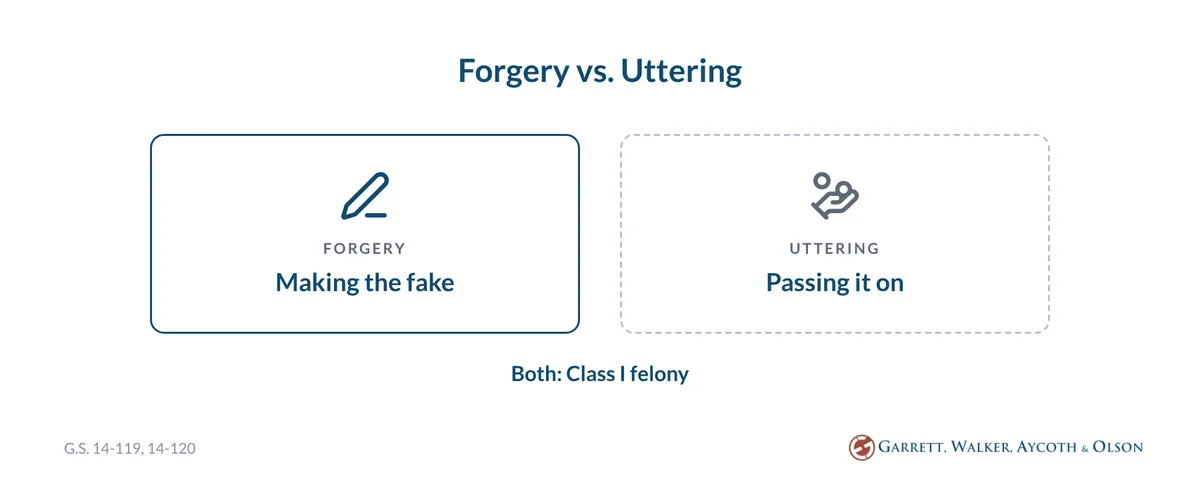
Both are Class I felonies: forgery under G.S. 14-119(a) and uttering under G.S. 14-120.
You can be charged with uttering even if someone else made the document. What matters is that you knew it was forged when you passed it.
Because they sit in two statutes, the State can list forgery and uttering as separate charges.
Elements of the Crime of Uttering a Forged Instrument
To convict you of uttering, the State must prove four elements. They come from North Carolina’s pattern jury instruction for uttering.
You Passed or Tried to Pass It
You passed, delivered or tried to pass the instrument to another person. That can be a teller, a clerk or a check-cashing employee.
The North Carolina Supreme Court has said an offer counts, whether it succeeds or not (State v. Kirkpatrick, 1996).
It Was False, Forged or Counterfeit
The check, note or other instrument must be false, forged or counterfeit. A genuine check with a forged endorsement also qualifies.
You Knew It Was Forged
The State must prove you knew the instrument was forged when you passed it. Having the check is not the same as knowing it was fake.
But a jury may be allowed to draw conclusions from having the check and trying to cash it, so how your lawyer explains the facts matters.
For Gain or to Defraud
You acted “for the sake of gain” or “with intent to defraud or injure” another person. Under the statute, either one is enough.
Each of these elements is a place your lawyer can test the State’s evidence, depending on the facts of your case.
Is Uttering a Felony? Penalties in North Carolina
Yes. Uttering a forged instrument is a Class I felony under G.S. 14-120, the same class as forging it under G.S. 14-119(a).
Related forgery charges carry different classes:
| Charge | Statute | Class |
|---|---|---|
| Uttering a Forged Instrument or Endorsement | G.S. 14-120 | Class I Felony |
| Forging, Counterfeiting or Possessing a Counterfeit Instrument | G.S. 14-119(a) | Class I Felony |
| Transporting or Possessing Five or More Counterfeit Instruments | G.S. 14-119(b) | Class G Felony |
| Forging a Deed, Will, Receipt or Promissory Note | G.S. 14-122 | Class H Felony |
| Selling a Forged Note, Bond or Judgment | G.S. 14-121 | Class H Felony |
| Fake Diploma, Transcript or License | G.S. 14-122.1 | Class 1 Misdemeanor |
| Common Law Forgery | Common law, G.S. 14-3(b) | Misdemeanor; can be charged as a Class H felony |
Note: The Class G rule in G.S. 14-119(b) is about transporting or possessing five or more counterfeit instruments. If you are charged over several checks, the State may bring a separate charge for each one, and holding five or more at once can add a Class G charge.
How the charges are counted is something your lawyer checks.
At Prior Record Level I, the chart in G.S. 15A-1340.17 authorizes community punishment for a Class I felony. The presumptive minimum is 4 to 6 months.
At Level II the chart authorizes community or intermediate punishment, and at Level III intermediate punishment. From Level IV to Level VI, it authorizes intermediate or active punishment.
The highest Class I minimum is 12 months, at Level VI with an aggravated sentence. That 12-month minimum carries a 24-month maximum under G.S. 15A-1340.17(d).
Where your case lands, and whether the charge stays at Class I, is argued by your lawyer, not assumed.
A fine can be added at the court’s discretion under G.S. 15A-1340.17(b). For a felony like uttering, the judge must also order restitution to the person or bank that lost money, under G.S. 15A-1340.34(b) and G.S. 15A-830.
If money or goods were obtained with the check, the State may add an obtaining property by false pretenses charge. A felony conviction can also count toward habitual felon status, so see how habitual felon status raises a sentence.
Charged with several checks, or with forging and uttering together? Call (336) 379-0539 before your first court date.
Talk to a defense lawyer before you talk to anyone else
What you say and sign in the first days often decides what is possible later. The earlier we see your paperwork, the more options you usually have.
Call (336) 379-0539Free consultation with a Greensboro attorneyWhat Is Common Law Forgery in NC?
For a false writing that is not an “instrument” under G.S. 14-119, prosecutors can charge common law forgery. The pattern jury instruction for it lists four elements.
First, you falsely made or altered a writing. Second, you intended to defraud.
Third, the writing appeared to be genuine. Fourth, if genuine, it would have legal effect or be evidence of another person’s legal rights.
At common law this is a misdemeanor. But G.S. 14-3(b) makes a misdemeanor done “with deceit and intent to defraud” a Class H felony, so common law forgery can be charged as a Class H felony.
Showing a forged deed, will, receipt or promissory note in evidence, knowing it is forged and intending to defraud, is a Class H felony under G.S. 14-122.
How a Lawyer Fights an Uttering Charge
A lawyer fights an uttering charge by testing each element the State must prove.
Knowledge
Did you know the check was forged? A check from a buyer, a roommate or an online “job” can look real.
Intent
The State must prove you acted for gain or with intent to defraud. Your lawyer looks at what you were told and what you did after the check was questioned.
Was It Really Forged, and Is It an Instrument?
A signature you were allowed to make may not be a forgery.
Identity and the Evidence
Who presented the check? Bank video, teller notes and mobile deposit records can answer that, so your lawyer asks for them early.
A defense lawyer looks at each of these before any plea talk. Call (336) 379-0539 and we can start with yours.
Any result depends on the facts of your case. If other charges came with this one, talk with our Greensboro criminal defense attorneys about the whole case.
What Happens After an Uttering Charge in Greensboro
An uttering case starts with an arrest or a summons, then bond and a first appearance in Guilford County District Court.
Before any indictment, the case may be set for a probable cause hearing. Read what happens at a probable cause hearing.
A grand jury indictment sends the case to Superior Court. Here is what a felony indictment means in NC.
What you say to the bank, the store or a detective in the first days becomes evidence. That is the main reason to call a lawyer today.
Can an Uttering Conviction Be Expunged?
It can qualify, after a long wait. One Class I uttering conviction can count as a “nonviolent felony” under G.S. 15A-145.5.
The petition can be filed 10 years after the conviction, or 10 years after the sentence and probation end, whichever is later.
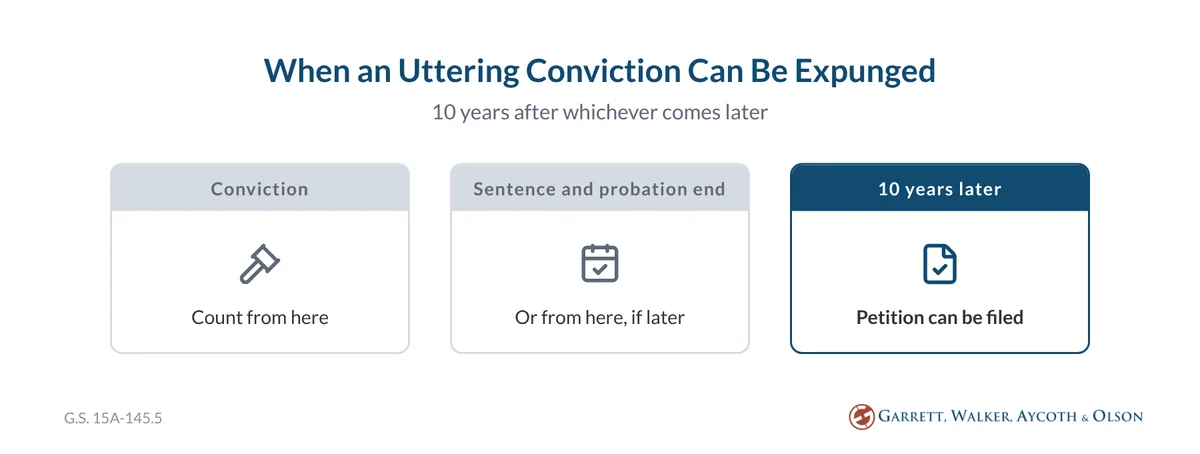
The petition also needs an affidavit that no restitution orders are outstanding.
Once the wait is over, read how expunction works in North Carolina. The better time to protect your record is before a conviction exists.
Call (336) 379-0539 to talk with our Greensboro white collar defense lawyers before your first court date.
Frequently Asked Questions
Is uttering a forged instrument a felony in NC?
Yes. Uttering a forged instrument is a Class I felony under G.S. 14-120. Transporting or possessing five or more counterfeit instruments is a Class G felony under G.S. 14-119(b). Possessing four counterfeit instruments is still a Class I felony under G.S. 14-119(a).
What is the difference between forgery and uttering?
Forgery is making or altering the fake instrument. Uttering is passing it on, or trying to, while knowing it is forged. Both are Class I felonies in North Carolina, and the State can charge them as separate offenses. You can face uttering even if someone else made the check.
Can I be charged if the bank or store refused the check?
Yes. G.S. 14-120 covers an attempt to pass or deliver a forged instrument. The North Carolina Supreme Court held that an offer is uttering “whether successful or unsuccessful” (State v. Kirkpatrick). A refused or returned check can still lead to a Class I felony charge.
What if I did not know the check was forged?
Knowledge is an element the State must prove under N.C.P.I.-Crim. 221.20. Holding a forged check is not the same as knowing it was forged. Your lawyer tests what the State can show you knew, depending on the facts of your case.
Can you go to jail for uttering a forged instrument?
Yes, it is possible. From Prior Record Level IV up, the chart in G.S. 15A-1340.17 authorizes active prison time. At Levels II and III, intermediate punishment can include jail time as special probation (G.S. 15A-1351(a)). Where your case lands on the grid is argued by your lawyer.
What is common law forgery in North Carolina?
Common law forgery is falsely making or altering a writing that would have legal effect, with intent to defraud (N.C.P.I.-Crim. 221.80). It is a misdemeanor at common law, but it can be charged as a Class H felony under G.S. 14-3(b).
Is signing someone else’s name on the back of a check uttering?
It can be. Falsely endorsing a check, or passing a check you know is falsely endorsed, is a Class I felony under G.S. 14-120. The rule applies even when the check itself is genuine. Whether the named person gave you permission is a key fact your lawyer checks.
Can an uttering conviction be expunged in NC?
It can qualify. One Class I conviction can count as a nonviolent felony under G.S. 15A-145.5. The petition can be filed 10 years after the conviction, or 10 years after the sentence and probation end, whichever is later. You also need an affidavit that no restitution is outstanding.
How long does the State have to charge uttering or forgery?
North Carolina has no statute of limitations for felonies, according to the UNC School of Government. An old check can still lead to an uttering or forgery charge years later. If you think a charge is coming, call (336) 379-0539 first.
- Former President, Greensboro Criminal Defense Lawyers Association
- Elected member, Criminal Justice Section, North Carolina Bar Association
- Selected to present the Wade M. Smith Award for Top Criminal Defense Lawyer in North Carolina
Talk to a Greensboro criminal defense lawyer today
Bring the warrant, the release order and anything else they gave you.
Garrett, Walker, Aycoth & Olson, Attorneys at Law
317 South Greene St, Greensboro, NC 27401
(336) 379-0539
This article explains North Carolina law in general terms. It is not legal advice about your case, and laws, penalties and court procedures change. Contact an attorney about your specific situation.