


In North Carolina, firing a gun inside city limits is charged under your city’s ordinance, a Class 3 misdemeanor when the ordinance makes it a crime. Firing into an occupied building or vehicle, or firing inside one to scare someone, can be a felony under state law.
This guide is for adults cited or arrested in Greensboro, High Point or elsewhere in Guilford County after a gun was fired in town.
Some websites call every shot in town a felony, or cite a gang statute that does not fit. The ordinance, where the bullet went and why you fired decide the charge.
Your lawyer argues the charge and any defense from the facts. Call (336) 379-0539 and talk with Jason Aycoth’s team before your court date.
Is It Illegal to Discharge a Firearm in City Limits in NC?
Discharging a firearm in city limits is illegal when your city’s ordinance bans it. North Carolina state law gives every city that power.
“A city may by ordinance regulate, restrict, or prohibit the discharge of firearms at any time or place within the city except when used in defense of person or property or pursuant to lawful directions of law-enforcement officers.” G.S. 160A-189
Many North Carolina cities have a discharge ordinance. If you were cited in Greensboro or High Point, the citation names the section, and your lawyer pulls its exact wording and fine.
What About Outside City Limits?
Counties have the same power under G.S. 153A-129, with one more exception. A county ban cannot reach lawful hunting under Chapter 113, defense of a person or property, or shots fired at police direction.
Your lawyer checks where the city limits end and which rules applied.
Exceptions: Self-Defense and Police Directions
Those two exceptions are written into G.S. 160A-189 itself, so they apply in every city.
Self-defense has its own statute. Under G.S. 14-51.3, deadly force is justified if you reasonably believe it is necessary to prevent imminent death or great bodily harm to yourself or another.
In that situation, where you have a lawful right to be, the statute says you have no duty to retreat.
Whether your facts fit an exception is proved with evidence: what you saw, when and who was there. Your lawyer gathers that proof early, while memories are fresh.
What Is the Penalty for Discharging a Firearm in City Limits?
When the ordinance makes it a crime, a violation is a Class 3 misdemeanor under G.S. 14-4. The fine can be up to $500, but no more than $50 unless the ordinance states a higher maximum.
The days a judge may order depend on your prior convictions under G.S. 15A-1340.23.
| Prior Convictions | Days the Law Authorizes | What the Judgment Can Be |
|---|---|---|
| None (Level I) | 1 to 10 days | Fine only (G.S. 15A-1340.23(d)) |
| One to three (Level II) | 1 to 15 days | Fine only (G.S. 15A-1340.23(d)) |
| Four (Level II) | 1 to 15 days | Community or intermediate |
| Five or more (Level III) | 1 to 20 days | Community, intermediate or active |
With three or fewer prior convictions, G.S. 15A-1340.23(d) says the judgment is a fine only. The conviction on your record is the part that lasts, and that is what a lawyer is for.
See how Class 3 misdemeanor cases are handled in Guilford County.
Got a citation or a court date for firing a gun in town? Call (336) 379-0539 and we will read the ordinance with you.
Talk to a defense lawyer before you talk to anyone else
What you say and sign in the first days often decides what is possible later. The earlier we see your paperwork, the more options you usually have.
Call (336) 379-0539Free consultation with a Greensboro attorneyIs Discharging a Firearm in City Limits a Felony?
Firing a gun in town is not a felony by itself. State felony statutes apply when the shot is inside or into an occupied place, is part of gang activity, or hurts someone.
G.S. 14-34.10 covers willfully or wantonly firing, or trying to fire, a gun inside an occupied building, structure or vehicle. Done with intent to incite fear in another, it is a Class F felony.
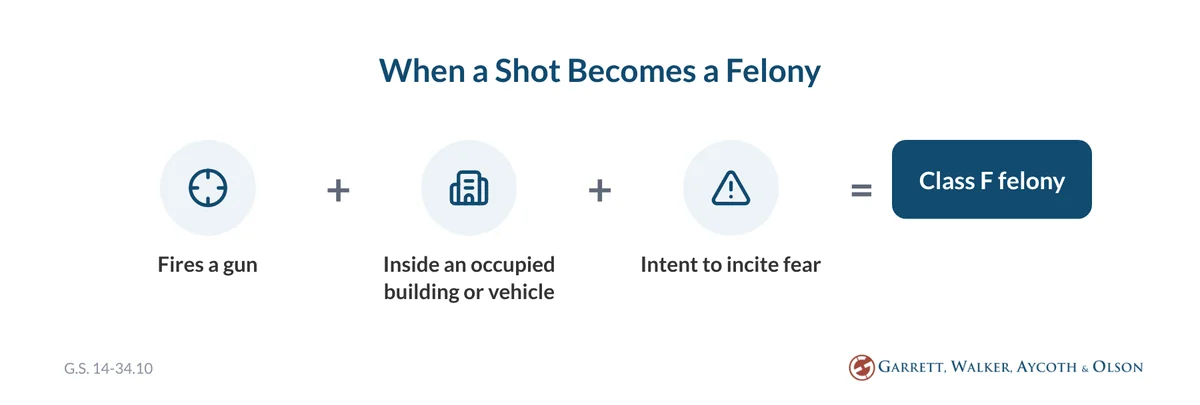
At prior record Level I, the presumptive minimum for a Class F felony is 13 to 16 months under G.S. 15A-1340.17.
Firing into occupied property is a separate crime under G.S. 14-34.1. It is a Class E felony, and higher in some cases.
Read what counts as firing into occupied property.
Some sites cite G.S. 14-34.9 for any shot in town, but it is not the city-limits law. It applies only to firing “as a part of criminal gang activity.”
If someone is hurt, assault with a deadly weapon inflicting serious injury is a Class E felony under G.S. 14-32(b). See how assault with a deadly weapon is charged in Greensboro.
Before any plea, learn what a felony conviction means in North Carolina.
Defenses to a Discharging a Firearm Charge
The right defense depends on the ordinance’s wording and the facts. Your lawyer checks both before your first court date.
Does the Ordinance Make It a Crime?
Since 2021, breaking a city ordinance is a misdemeanor only if the city says so in the ordinance, under G.S. 160A-175(b). If your city’s section does not specify a criminal penalty, your lawyer raises that as a defense.
Self-Defense or Police Direction
If you fired to defend a person or property, or at an officer’s lawful direction, the exceptions above apply.
The 12-Month Compliance Rule
Under G.S. 14-4(c), a person may not be found guilty of a local ordinance misdemeanor after producing proof of compliance at trial. One proof is no new alleged violation of that ordinance within 12 months of the first one.
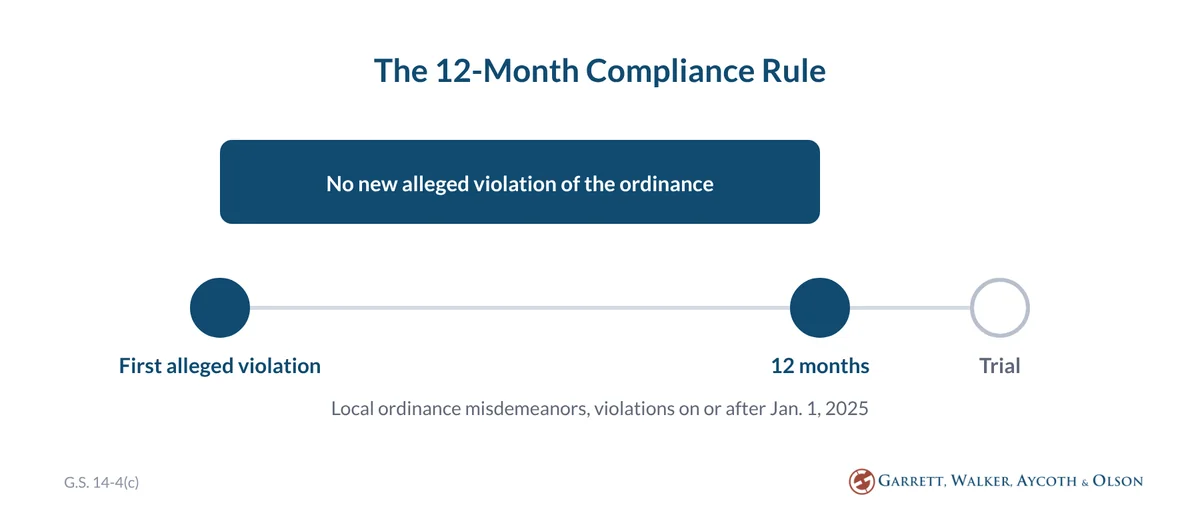
Another is documented proof of a good-faith effort to get help with unemployment, homelessness, mental health or substance abuse. The 12-month period comes from S.L. 2024-57 and applies to violations on or after January 1, 2025, according to the UNC School of Government.
The 12 months run from the first alleged violation, so this defense does not work if you are tried within that year. The trial date matters.
Whether this rule fits a gun discharge case, and whether to ask for more time, depends on your facts. Your lawyer decides that with you.
Who Fired the Shot
The State must prove that you fired the gun, and that it happened inside the city limits. Witness accounts, the location and the timing are all tested.
Will It Stay on Your Record?
A conviction stays on your criminal record unless it is expunged. An ordinance misdemeanor may be eligible for a petition as one nonviolent misdemeanor.
Under G.S. 15A-145.5(c)(1)a, the wait is three years after the conviction. If a sentence, probation or post-release supervision ends later, the wait runs from that date.
Our expungement page explains how to clear one misdemeanor in NC.
Charged in Greensboro or Guilford County: What to Do Now
Do not explain to officers why you fired before you have a lawyer. The reason, whether self-defense, fear or celebration, is exactly what decides the charge.
Do Not Talk About Why You Fired
Say you want to talk with a lawyer before answering questions.
Keep the Citation and Write Down What Happened
Note the time, the place and who was there. The citation names the ordinance section your lawyer needs.
Do Not Contact Witnesses About the Case
Talking to neighbors about the shot can look like pressure. Let your lawyer handle it.
Call a Defense Lawyer Before Your Court Date
Carrying a gun is a different law from firing one. See what a concealed carry charge involves, and where open carry is allowed in North Carolina.
Our Greensboro criminal defense team works in Guilford County courts.
If you have a court date, talk with a Greensboro misdemeanor lawyer about the ordinance first. Call (336) 379-0539 today.
Frequently Asked Questions
Can you shoot a gun on your own property inside city limits?
Owning the land is not one of the state-law exceptions. G.S. 160A-189 lets a city ban discharge “at any time or place within the city,” except for defense of person or property and police direction. Your lawyer checks your city’s exact wording for other exceptions.
Can I shoot outside city limits in NC?
It depends on the county. G.S. 153A-129 lets counties regulate or ban firing guns too, except for lawful hunting, defense of person or property, and police direction. Your lawyer checks which rules applied at the exact spot where the shot happened.
Is celebratory gunfire on New Year’s Eve or July 4 legal?
No holiday exception appears in G.S. 160A-189, so a city ban applies on holidays too. If a shot goes into an occupied home or car, it can be charged as a felony under G.S. 14-34.1. Have a lawyer review the facts before you give any statement.
Is firing a warning shot self-defense in NC?
It depends on the facts. The law justifies deadly force only when you reasonably believe it is necessary to prevent imminent death or great bodily harm. Talk to a lawyer before explaining a warning shot to anyone, because your words can shape the charge.
Is discharging a firearm in city limits a felony if no one was hurt?
It can be. Firing inside an occupied building or vehicle with intent to incite fear is a Class F felony. Firing into occupied property is a separate felony under G.S. 14-34.1, even with no injury. Your lawyer reads the charging papers to see which statute the State used and what class it carries.
Can a discharging a firearm conviction be expunged in NC?
An ordinance misdemeanor may be eligible as one nonviolent misdemeanor, three years after the conviction or the end of the sentence, whichever is later. A felony conviction has different rules. Your lawyer checks your full record before anything is filed.
Do I have to go to court for a discharging a firearm citation?
A criminal ordinance charge is a misdemeanor case, so treat the court date as required. Talk to a lawyer before that date about the ordinance and your defenses. Missing court can create new problems on top of the original charge.
Who sets the fine for firing a gun in city limits?
The ordinance does, within limits. G.S. 14-4 caps the fine at $500 and limits it to $50 unless the ordinance states a higher maximum. With three or fewer priors the judgment is a fine only, but the conviction stays on your record.
- Former President, Greensboro Criminal Defense Lawyers Association
- Elected member, Criminal Justice Section, North Carolina Bar Association
- Selected to present the Wade M. Smith Award for Top Criminal Defense Lawyer in North Carolina
Talk to a Greensboro criminal defense lawyer today
Bring the warrant, the release order and anything else they gave you.
Garrett, Walker, Aycoth & Olson, Attorneys at Law
317 South Greene St, Greensboro, NC 27401
(336) 379-0539
This article explains North Carolina law in general terms. It is not legal advice about your case, and laws, penalties and court procedures change. Contact an attorney about your specific situation.