


Larceny by employee is taking property your employer trusted you to hold for the business, intending to keep it. In North Carolina it is a felony at any amount under G.S. 14-74: Class H under $100,000 and Class C at $100,000 or more.
The $1,000 misdemeanor line for ordinary larceny does not apply here. That surprises many people charged after a small till shortage.
This guide is for cashiers, store managers, delivery and warehouse workers and office staff. Many cases start with an audit, a drawer count or a loss-prevention interview.
Whether the property was really entrusted to you decides if this charge fits at all. Its value decides the class.
Your lawyer argues both, depending on the facts of your case.
Asked to sign a statement or a repayment note? Call (336) 379-0539 and talk with a theft defense lawyer in Greensboro first.
What Is Larceny by Employee?
Larceny by employee is when an employee takes or uses property the employer handed over for the business, intending to steal it.
“If any servant or other employee, to whom any money, goods or other chattels … by his master shall be delivered safely to be kept to the use of his master … the servant so offending shall be guilty of a felony.” G.S. 14-74
The statute uses old wording. “Servant” means employee, and “master” means employer.
Money, goods and other property can all qualify. The key is that the employer gave it to you for a job, such as a bank deposit, a cash drawer or a delivery.
Larceny by Employee vs Regular Larceny
Ordinary larceny under G.S. 14-72(a) is a Class H felony only when the value is more than $1,000. At $1,000 or less, it is a Class 1 misdemeanor.
Larceny by employee has no misdemeanor version. A $40 shortage and a $40,000 shortage are both felonies under G.S. 14-74.
That $1,000 line is what makes ordinary larceny a felony; see how felony larceny is charged in Greensboro.
Elements of Larceny by Employee in North Carolina
The State must prove five elements beyond a reasonable doubt. They come from North Carolina’s pattern jury instruction 216.60, which judges read to jurors.
You Were an Employee
The State must show you were an employee of the business named in the charge.
Your Employer Entrusted the Property to You
The employer must have given you the property for a purpose. Examples are running the register, making a deposit or delivering goods.
This is where many cases turn. Not every theft at work involves property that was entrusted to you.
You Used It for Yourself or Someone Else Instead
Instead of using the property for that purpose, you took it for your own use or for another person.
You Meant to Keep It
You intended to deprive the employer of the property permanently. The jury instruction notes that a temporary deprivation will not suffice.
You Knew You Were Not Allowed To
You knew you were not entitled to use the property that way. Proof that a manager allowed it goes straight to this element.
If the jury has a reasonable doubt about any one element, the instruction tells it to find you not guilty. Your lawyer looks for the weak element, depending on the facts of your case.
The Statute for Larceny by Employee: Felony Classes Under G.S. 14-74
Every violation of G.S. 14-74 is a felony, and the value of the property sets the class.
The line sits at exactly $100,000. Taking $100,000 or more is Class C, while even $99,999 stays Class H.
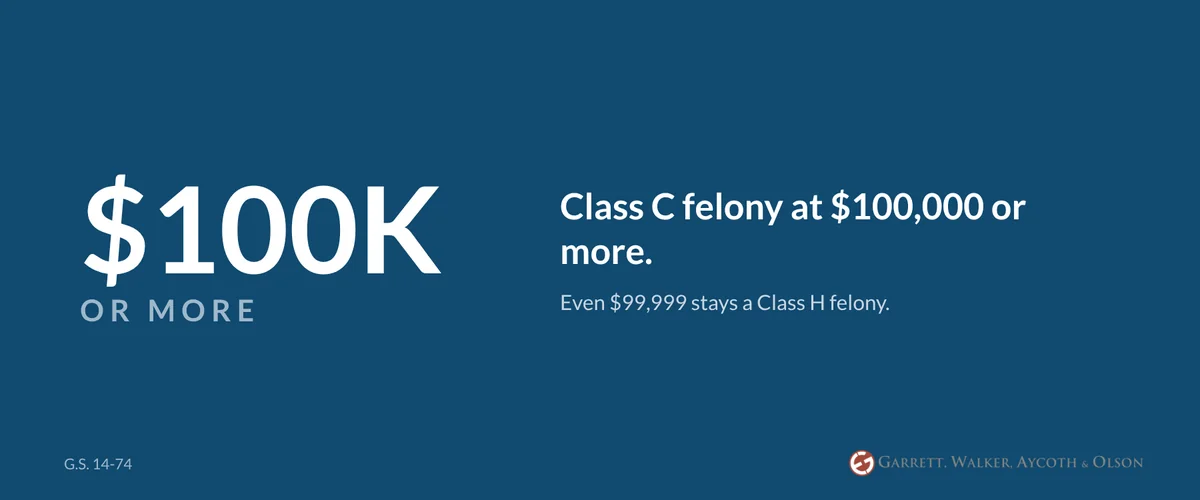
At Class C, the Level I presumptive range is 58 to 73 months, about five to six years. That makes the value the State claims worth a close look.
Losses are often added up from register reports, inventory counts and bank records. How the employer reached its total matters.
Talk to a defense lawyer before you talk to anyone else
What you say and sign in the first days often decides what is possible later. The earlier we see your paperwork, the more options you usually have.
Call (336) 379-0539Free consultation with a Greensboro attorneyLarceny by Employee NC First Offense: What the Law Authorizes
A first offense of larceny by employee is still a felony. The sentence the law authorizes depends on the class and your prior record level.
A first offense usually means prior record Level I, the lowest level on the chart in G.S. 15A-1340.17.
| Value | Class | Level I Disposition | Level I Presumptive Minimum |
|---|---|---|---|
| Under $100,000 | Class H | Community, Intermediate or Active | 5-6 Months |
| $100,000 or More | Class C | Active Only | 58-73 Months |
The maximum term is set by statute. A 6-month minimum carries a 17-month maximum, and a 73-month minimum carries a 100-month maximum.
Which disposition you get, and where in the range, is argued by your lawyer, not assumed.
Can the Judge Add Time for a Position of Trust?
The State may argue you “took advantage of a position of trust or confidence.” That is an aggravating factor under G.S. 15A-1340.16(d)(15).
The same statute says evidence needed to prove an element cannot also prove an aggravating factor. Entrustment is an element of this charge, so your lawyer can argue that objection.
Restitution to the Employer
For a felony like this, the judge must order restitution to the employer. G.S. 15A-1340.34(b) requires it for victims covered by Article 46.
That article, through G.S. 15A-830(a)(3b), covers felony property crimes such as larceny by employee. If you get probation, paying restitution becomes a condition of it.
Facing a Class C charge, or a value you think is wrong? Call (336) 379-0539 before the first court date.
Larceny by Employee vs Embezzlement
Both crimes punish misusing property you were trusted with. The UNC School of Government calls misusing entrusted property “the essence of both crimes.”
Larceny by employee reaches employees only. Embezzlement under G.S. 14-90 also covers officers, agents, bailees and others who hold property for someone else.
Because the two statutes overlap, the district attorney chooses which one to charge. Your defense depends on which statute is used and what it requires.
If you held the money as an officer or agent, read about an embezzlement charge in Guilford County.
What Happens After Your Employer Accuses You
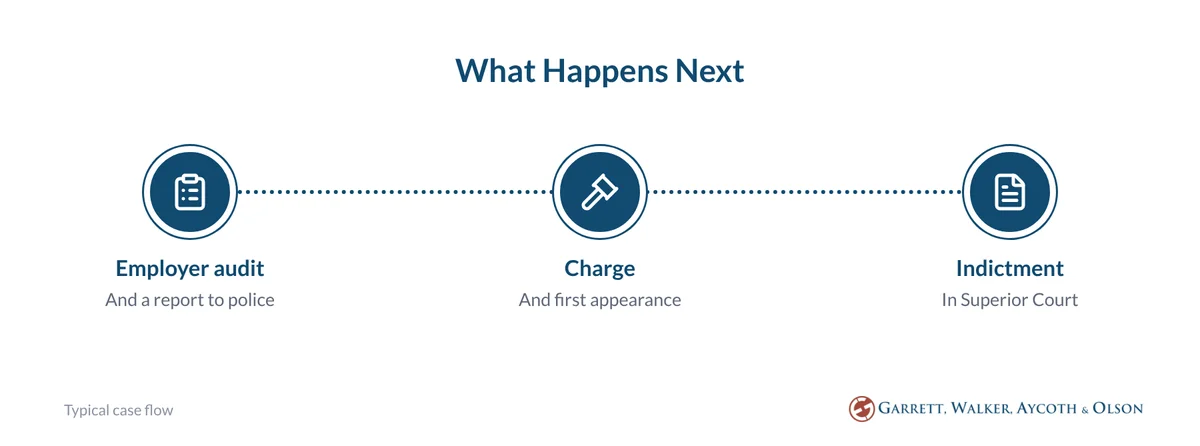
Cases often start with an internal audit or a loss-prevention interview. The employer then reports to police, and a warrant or summons follows.
A felony charge can first go to a probable cause hearing in District Court. From there the grand jury decides, so it helps to know how a felony indictment works in NC.
A typical case moves from the employer’s audit, to the charge, to an indictment in Superior Court.
Does Paying It Back End the Case?
Paying the money back is not a defense written into G.S. 14-74. It does not end the case by itself.
In State v. Evans, a 2024 Court of Appeals case, a store manager repaid the full amount more than six months after her arrest. The court still held the trial judge was right not to dismiss the charges.
Repayment can still matter at sentencing. Full or substantial restitution is a mitigating factor the judge can find under G.S. 15A-1340.16(e)(5).
Your lawyer can raise repayment with the prosecutor and the judge, depending on the facts of your case.
Warning: What you sign or say in the HR or loss-prevention room can become evidence. Talk with a lawyer before you sign a statement or a repayment note.
Defending Larceny by Employee Charges in North Carolina
A defense starts with the elements and the value. Each one is the State’s burden to prove.
Was the Property Entrusted to You?
The State must show the employer gave you this property for a purpose. If you were never trusted with it, the second element is missing.
Permission, Borrowing or a Pay Dispute
The State must prove you meant to keep the property and knew you were not allowed to take it. The jury instruction says a temporary deprivation will not suffice.
A manager’s approval, a payroll advance or a pay dispute can go to intent, depending on the facts of your case.
The Value Claimed
The $100,000 line separates Class C from Class H. Your lawyer checks the register reports, inventory counts and how the losses were added up.
Who Took It
Shared registers, shared logins and gaps in the video can leave real doubt about who took the property.
If company checks were signed or cashed, see how uttering a forged check is charged.
A defense lawyer should see the audit before you give any statement. Any result depends on the facts of your case.
If the same report leads to other charges, start with our Greensboro criminal defense overview.
Shown an audit or asked to repay? Call (336) 379-0539 to talk with our theft defense lawyers in Greensboro.
Frequently Asked Questions
Is larceny by employee a felony in NC?
Yes. Under G.S. 14-74, larceny by employee is a felony at any amount. Property worth less than $100,000 makes it a Class H felony, and $100,000 or more makes it Class C. There is no misdemeanor version, even for a small cash shortage.
What happens on a first offense for larceny by employee in NC?
A first offense is still a felony. At prior record Level I, the chart authorizes community, intermediate or active punishment for Class H, with a 5 to 6 month presumptive minimum. Class C is active only, with 58 to 73 months. Your lawyer argues where you land.
What is the difference between larceny and larceny by employee?
Ordinary larceny turns on value: over $1,000 is a felony, and $1,000 or less is a misdemeanor. Larceny by employee needs property your employer entrusted to you, and it is a felony at any amount. The entrustment element is often where the defense starts.
Is larceny by employee the same as embezzlement?
Not exactly. Both involve property you were trusted with, according to the UNC School of Government. Larceny by employee applies only to employees, while embezzlement under G.S. 14-90 also covers officers, agents and bailees. The district attorney decides which statute to charge.
If I pay the money back, will the charge be dropped?
Repayment can help at sentencing, where full or substantial restitution is a mitigating factor under G.S. 15A-1340.16(e)(5). It does not end the case by itself. In a 2024 appeal, repayment after arrest did not require dismissal. Your lawyer can raise repayment with the prosecutor, depending on the facts of your case.
What if I planned to return it or had permission?
Then two elements are in question. The State must prove you meant to keep the property permanently and knew you were not allowed to take it. The jury instruction says a temporary deprivation will not suffice. Your lawyer gathers the proof, such as texts or a manager’s approval.
Can a larceny by employee conviction be expunged?
A Class H conviction can qualify as one nonviolent felony under G.S. 15A-145.5, 10 years after conviction or after the sentence ends, whichever is later. No restitution order can be outstanding. A Class C conviction cannot qualify. Ask us about expunging a Class H conviction later.
Can my employer sue me as well?
Yes. Under G.S. 1-538.2, the employer can also file a civil suit over an act punishable under G.S. 14-74, with or without a criminal case. For what that suit can involve, read whether embezzlement is criminal or civil in NC.
How long can they wait to charge me?
North Carolina has no statute of limitations for felonies, as the UNC School of Government explains. Larceny by employee is always a felony, so an old audit can still lead to a charge. If you think a report is coming, talk with a lawyer before police call.
- Former President, Greensboro Criminal Defense Lawyers Association
- Elected member, Criminal Justice Section, North Carolina Bar Association
- Selected to present the Wade M. Smith Award for Top Criminal Defense Lawyer in North Carolina
Talk to a Greensboro criminal defense lawyer today
Bring the warrant, the release order and anything else they gave you.
Garrett, Walker, Aycoth & Olson, Attorneys at Law
317 South Greene St, Greensboro, NC 27401
(336) 379-0539
This article explains North Carolina law in general terms. It is not legal advice about your case, and laws, penalties and court procedures change. Contact an attorney about your specific situation.