


Common law robbery is taking property from a person, or from right in front of them, by violence or by putting them in fear, without a dangerous weapon. In North Carolina it is a Class G felony under G.S. 14-87.1.
“No weapon” does not make the charge minor. A struggle over shoplifted goods can turn a simple store stop into this felony.
This guide is for people charged in Greensboro or High Point after a purse or phone snatch. It also covers wallet fights and store stops that turned physical.
Whether the State can prove force or fear, and when it happened, is often the whole case. Your lawyer argues that point, depending on the facts of your case.
Charged, or contacted by a detective? Call (336) 379-0539 to talk with a robbery defense lawyer in Greensboro before you give any statement.
What Is Common Law Robbery in North Carolina?
Common law robbery is taking someone’s money or property, from their person or presence, by violence or fear. The North Carolina Supreme Court gave that definition in State v. Smith in 1982.
The taking must also be felonious and without the person’s consent. Some people call it strong-arm robbery, because force or threats take the place of a weapon.
The statute does not define the crime. It only sets the punishment:
“Robbery as defined at common law, other than robbery with a firearm or other dangerous weapon as defined by G.S. 14-87, shall be punishable as a Class G felony.” G.S. 14-87.1
So the courts define common law robbery, and the legislature sets its class. The UNC School of Government puts it simply: it is a felonious larceny from a person or their presence, by violence or intimidation.
The added fact of force or fear makes it a felony, whatever the property is worth.
Elements of Common Law Robbery
To convict, the State must prove six elements beyond a reasonable doubt. North Carolina’s pattern jury instruction for common law robbery lists them.
Property Was Taken From the Person or Their Presence
The property was taken from the person’s body or from their presence. It does not have to be in their hand or pocket.
The Property Was Carried Away
The property was moved. The jury instruction notes say the slightest movement is sufficient.
Without Consent
The person did not voluntarily agree to the taking. Handing over a wallet in fear is not consent.
You Meant to Deprive the Owner of It Permanently
At the time, the accused intended to deprive the owner of its use permanently. The instruction notes say a temporary deprivation will not suffice.
You Knew You Had No Right to It
The State must prove you knew you were not entitled to take the property. If you honestly believed you were entitled to it, the instruction says you cannot be guilty of robbery.
By Violence or by Putting the Person in Fear
The taking happened through violence or by putting the person in fear. This element is what separates robbery from a plain theft.
Key point: If the State cannot prove any one of the six elements, the robbery charge fails. Elements 5 and 6 are where many defenses start.
When Can Shoplifting or a Purse Snatch Become Robbery?
A theft can become common law robbery when force or fear is used during the taking or to get away. That is how a shoplifting stop or a purse snatch can lead to a felony charge.
The UNC School of Government explains that the force and the taking can be part of one continuous transaction. Force used after the theft begins, when the victim resists, also counts.
A scuffle with a store employee over merchandise is a common example. In a School of Government post on scuffles over merchandise, the answer is usually robbery, “though the answer may depend on how the scuffle goes.”
The question is whether force or fear came with the taking or the getaway.
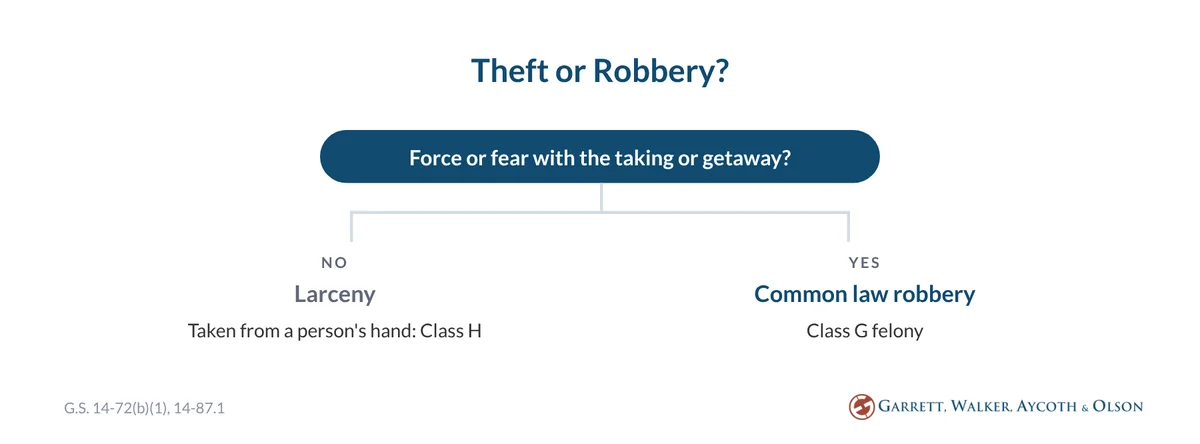
Without violence or fear, a snatch from someone’s hand may be larceny from the person instead. That is still a Class H felony at any value under G.S. 14-72(b)(1).
Before a stop turns physical, it helps to know how shoplifting charges work in Greensboro.
Talk to a defense lawyer before you talk to anyone else
What you say and sign in the first days often decides what is possible later. The earlier we see your paperwork, the more options you usually have.
Call (336) 379-0539Free consultation with a Greensboro attorneyIs Common Law Robbery a Violent Crime?
Yes, in the plain sense, because violence or fear is one of its elements. The legal label depends on which statute is asking.
For expunction, Class A through G felonies are not nonviolent felonies under G.S. 15A-145.5(a)(1). So a common law robbery conviction cannot be expunged under that statute.
For the violent habitual felon law, a “violent felony” means a Class A through E felony under G.S. 14-7.7(b). Class G common law robbery is not on that list.
The label on your record is part of what your lawyer fights. The time to fight it is before a conviction.
Common Law Robbery vs Armed Robbery
The difference is a firearm or other dangerous weapon that endangers or threatens a person’s life. With one, the charge is robbery with a dangerous weapon, a Class D felony under G.S. 14-87(a).
Without a dangerous weapon it is Class G. With one, it is Class D.
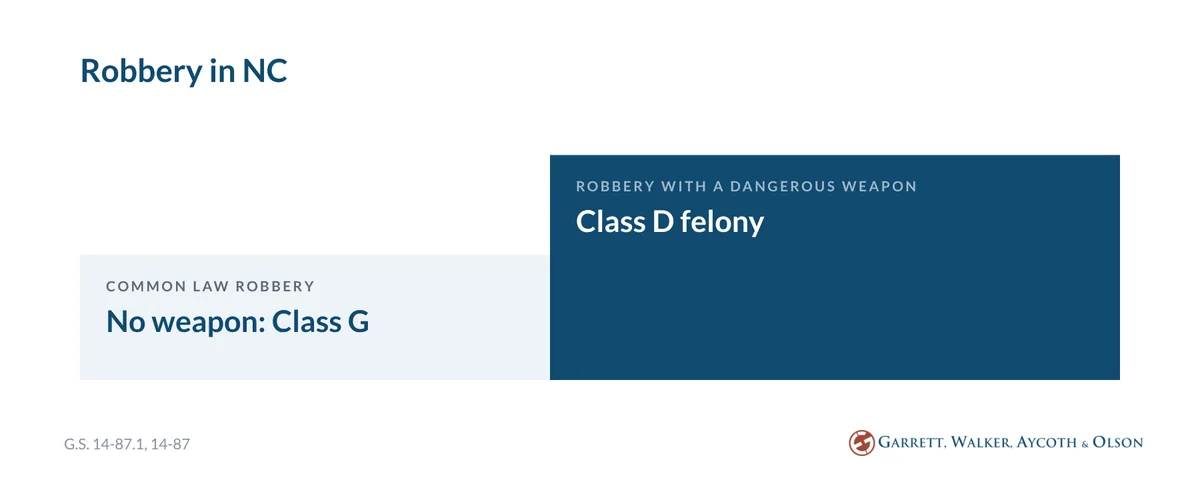
Under the felony sentencing chart, Class D calls for active punishment at every prior record level.
Whether an object counts as a dangerous weapon is a fact question for your lawyer. For weapons cases, read the armed robbery rules under G.S. 14-87.
Penalties for Common Law Robbery in North Carolina
Common law robbery is a Class G felony, and the sentence depends on your prior record level. The ranges come from the felony sentencing chart in G.S. 15A-1340.17(c).
| Prior Record Level | Disposition Authorized | Presumptive Minimum |
|---|---|---|
| Level I | Intermediate or Active | 10-13 Months |
| Level II | Intermediate or Active | 12-14 Months |
| Level III | Intermediate or Active | 13-17 Months |
| Level IV | Intermediate or Active | 15-19 Months |
| Level V | Active | 17-22 Months |
| Level VI | Active | 20-25 Months |
At Levels I to IV, the chart authorizes intermediate or active punishment. At Levels V and VI, it authorizes active punishment only.
Minimums can go as low as 8 months, in the mitigated range at Level I. They can go as high as 31 months, in the aggravated range at Level VI, with a 47-month maximum.
Which range applies is argued by your lawyer, not assumed.
Attempted common law robbery is punished one class lower, as a Class H felony, under G.S. 14-2.5.
Robbery is in Subchapter V of Chapter 14, so it is a felony property crime under G.S. 15A-830(a)(3b). That means the judge must order restitution for the victim’s injuries or damages under G.S. 15A-1340.34(b).
If the State also charges habitual felon status, a Class G felony is sentenced as Class C under G.S. 14-7.6. With three prior felonies, see how habitual felon status changes the class.
Warning: Facing a robbery charge with a record, or a habitual felon notice? Call (336) 379-0539 now, before a plea offer is on the table.
How a Lawyer Fights a Common Law Robbery Charge
A defense lawyer tests each element the State must prove, starting with force, fear and timing. What works depends on the facts of your case.
Was There Force or Fear, and When?
If the evidence shows no violence or fear, it may support only a larceny charge. Larceny from the person is still a Class H felony, so every detail of the contact matters.
Your lawyer compares the video, the 911 call and witness accounts to pin down when any force happened.
Claim of Right
If you honestly believed the property was yours, the jury instruction says it is not robbery. Texts, receipts or an earlier agreement can help show that belief.
Identity
Many robbery cases turn on who took the property. Video, phone records and witness descriptions are checked against each other.
What Happens Next in Guilford County
After an arrest, a bond is set. If it is high, your lawyer can start by asking a judge to lower your bond.
In District Court, the next step may be the probable cause hearing for a felony, if one is held. Felony cases are then tried in Superior Court, usually after a grand jury indictment.
If one arrives, learn what an indictment means in North Carolina.
A defense lawyer starts with the video and the statements, because that is where force and fear are proven or not. A Class G conviction cannot be expunged under G.S. 15A-145.5, so the time to act is before any plea.
Call (336) 379-0539 to talk with our robbery defense team in Greensboro. You can also read about the criminal defense attorneys at our Greensboro office.
Frequently Asked Questions
Is common law robbery a felony in North Carolina?
Yes. Common law robbery is a Class G felony under G.S. 14-87.1, whatever the property is worth. The sentence depends on your prior record level. Your lawyer argues which range applies, depending on the facts of your case.
What is the difference between common law robbery and armed robbery?
The difference is a firearm or other dangerous weapon that endangers or threatens a life. With one, the charge is robbery with a dangerous weapon, a Class D felony under G.S. 14-87. Without one, it is common law robbery, a Class G felony.
Is common law robbery a violent crime in NC?
It requires violence or fear, so in plain terms it is a violent crime. A conviction, as a Class G felony, cannot be expunged under G.S. 15A-145.5. But it is not a “violent felony” under the violent habitual felon law, which covers only Class A through E felonies.
How much time can you get for common law robbery in NC?
At Level I, the chart authorizes intermediate or active punishment, with a presumptive minimum of 10 to 13 months. Across all levels, minimums run from 8 months to 31 months, with a 47-month maximum at the top. Which range applies is argued by your lawyer, not assumed.
Can shoplifting turn into robbery?
Yes. If force or fear is used to take an item, or to get away with it, a shoplifting case can become common law robbery. The UNC School of Government says a scuffle over merchandise is usually robbery, though it depends on how the scuffle goes.
What is attempted common law robbery?
An attempt means the robbery was tried but not completed. Under G.S. 14-2.5, an attempt is punished one class lower than the completed crime. So attempted common law robbery is a Class H felony, which is still a felony conviction.
Can a common law robbery charge be reduced?
If the State cannot prove violence or fear, the evidence may support only a larceny charge. Larceny from the person is still a Class H felony under G.S. 14-72(b)(1). Pressing the State on force and fear, and arguing for a reduction, is your lawyer’s job, depending on the facts of your case.
Can common law robbery be expunged in NC?
A conviction cannot be expunged under G.S. 15A-145.5, because Class A through G felonies are not nonviolent felonies. That is why the fight over the charge happens before a conviction or plea. Call (336) 379-0539 to talk with a lawyer about your case.
How long does the State have to charge robbery in NC?
North Carolina has no statute of limitations for felonies. The UNC School of Government confirms that no time limit bars a felony prosecution, so a charge can come years later. If you think you are under investigation, talk with a lawyer before you talk with police.
- Former President, Greensboro Criminal Defense Lawyers Association
- Elected member, Criminal Justice Section, North Carolina Bar Association
- Selected to present the Wade M. Smith Award for Top Criminal Defense Lawyer in North Carolina
Talk to a Greensboro criminal defense lawyer today
Bring the warrant, the release order and anything else they gave you.
Garrett, Walker, Aycoth & Olson, Attorneys at Law
317 South Greene St, Greensboro, NC 27401
(336) 379-0539
This article explains North Carolina law in general terms. It is not legal advice about your case, and laws, penalties and court procedures change. Contact an attorney about your specific situation.