


A crime against nature is a Class I felony in North Carolina under G.S. 14-177. Since Lawrence v. Texas (2003), conduct between people can be charged only when the State also proves an extra fact, such as a minor, coercion, incapacity, money or a public place.
Many websites say this charge puts you on the sex offender registry. G.S. 14-177 is not on the registration list, but a conviction is still a felony record.
This guide is for adults charged, arrested or called by a detective in Greensboro or Guilford County. Whether the case can go forward often turns on that one extra fact.
Which fact the State relies on shapes your defense. Call (336) 379-0539 and talk with Jason Aycoth’s team before you talk to anyone about the case.
What Is a Crime Against Nature in NC?
A crime against nature is the offense in G.S. 14-177, and it is a Class I felony.
The whole statute is one sentence:
“If any person shall commit the crime against nature, with mankind or beast, he shall be punished as a Class I felon.” G.S. 14-177
The statute does not list the acts it covers. North Carolina courts defined the term in decisions going back more than a century.
Your lawyer reads the exact act the warrant or indictment alleges against those decisions.
The same statute also reaches conduct “with … beast,” at the same Class I level. This guide covers charges involving people.
Is the Crime Against Nature Law Still Enforced After Lawrence v. Texas?
Yes. G.S. 14-177 is still in force and still charged, but only in narrower situations than its words suggest.
Lawrence v. Texas, 539 U.S. 558 (2003), is the U.S. Supreme Court case that changed how this law works. Under it, private conduct between consenting adults, not for money, is protected by the Constitution.
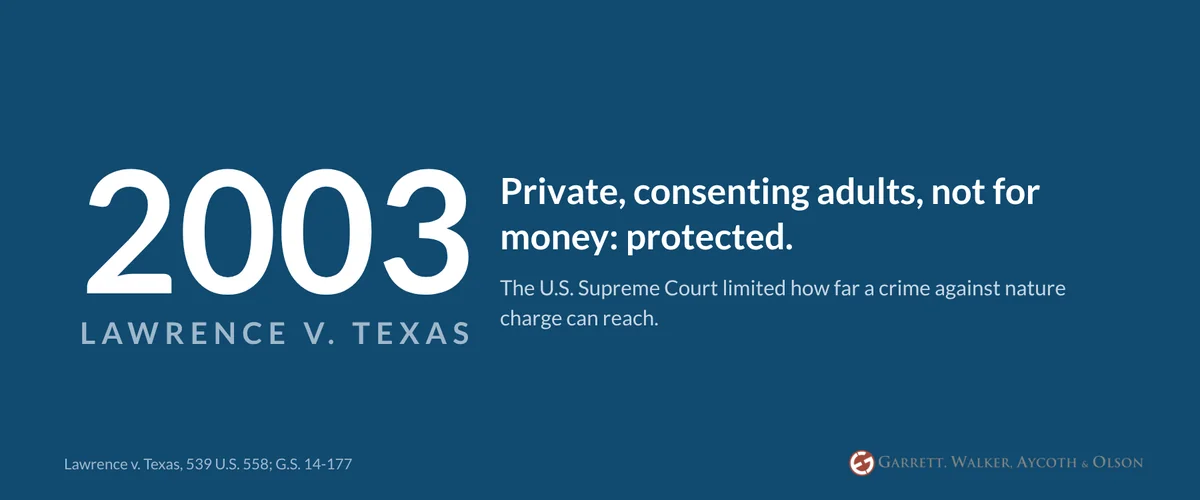
In State v. Whiteley (2005) and State v. Pope (2005), the North Carolina Court of Appeals held that the statute is not unconstitutional on its face.
The UNC School of Government summary of crime against nature law explains what is still charged and why.
Key point: Lawrence did not erase G.S. 14-177. It changed who can be charged and what the State has to prove.
The law has not been repealed. Senate Bill 274, titled “Repeal Crime Against Nature Law,” was sent to a Senate committee in March 2025 and has not moved.
What the State Must Prove in a Crime Against Nature Case Today
For conduct between people, the State must prove the act itself and at least one more fact. That fact is what takes the case outside the protection of Lawrence.
North Carolina’s pattern jury instruction for this charge, number 226.10A, lists five such circumstances:
- One of the people was a minor, that is under 18 years of age.
- One person was an adult with a mental disability, or was incapacitated or physically helpless, so as to be unable to properly consent.
- The act was offered or committed for money or other valuable consideration.
- The act was committed in a public place, not in a private residence or other private place.
- One of the people was coerced into committing the act.
In State v. Hunt (2011), the North Carolina Court of Appeals reversed a conviction because the State did not prove lack of consent.
How consent works when the other person was under 18 is not fully settled in North Carolina cases. Your lawyer reads the exact facts the State alleges.
A defense lawyer tests which of the five facts the State claims and the proof behind it, depending on the facts of your case. That means where it happened, whether money was involved, and how any statements or messages were obtained.
See how we defend sex offense charges in Greensboro.
Talk to a defense lawyer before you talk to anyone else
What you say and sign in the first days often decides what is possible later. The earlier we see your paperwork, the more options you usually have.
Call (336) 379-0539Free consultation with a Greensboro attorneyCrime Against Nature Penalties: Class I Felony Sentencing in NC
A Class I felony is sentenced on North Carolina’s felony chart in G.S. 15A-1340.17. The range depends on your prior record level.
| Prior Record Level | Presumptive Minimum (Months) | Sentences the Chart Authorizes |
|---|---|---|
| Level I | 4-6 | Community |
| Level II | 4-6 | Community or intermediate |
| Level III | 5-6 | Intermediate |
| Level IV | 6-8 | Intermediate or active |
| Level V | 7-9 | Intermediate or active |
| Level VI | 8-10 | Intermediate or active |
The highest minimum on the chart for Class I is 12 months, at Level VI with aggravating factors. That minimum carries a 24-month maximum.
“Community” means the chart authorizes community punishment at that level. Which level and which sentence apply is argued by your lawyer, not assigned.
The level comes from your past convictions. See how your prior record level is counted.
You may read online that the penalty is a $2,000 fine and five years. That is not how North Carolina sentences a Class I felony today.
Not sure which level you are? Call (336) 379-0539 and we will go over your record before your first court date.
Sex Offender Registration and Your Record
A conviction under G.S. 14-177 does not by itself put you on the sex offender registry. The statute is not on the list of offenses that require registration in G.S. 14-208.6.
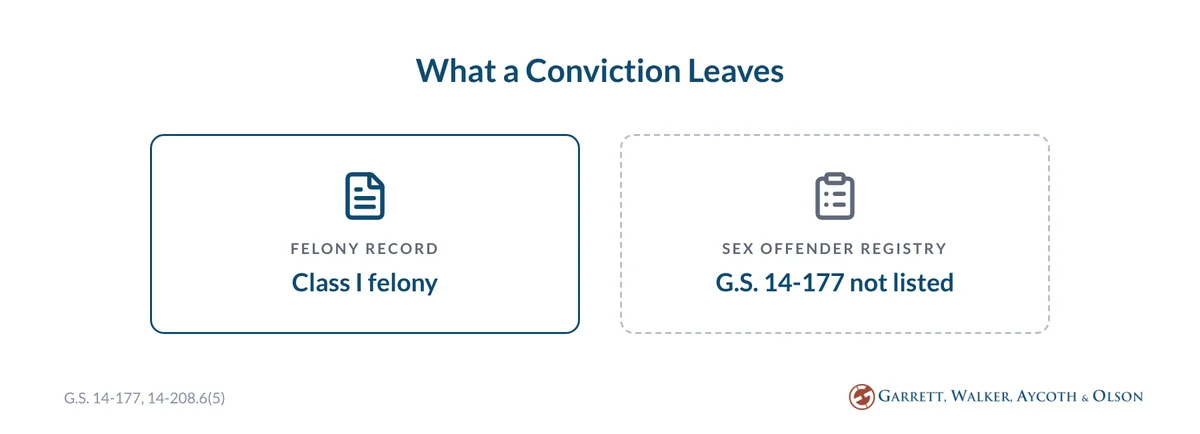
Warning: That changes if the case is charged or pleaded under a different statute. Offenses on that list carry registration for at least 30 years under G.S. 14-208.7.
After 10 years, a person may petition to end it under section 14-208.12A. The court can grant that only if federal registration standards allow it.
So which statute any plea is to decides registration. That is worked out with your lawyer.
A Class I conviction that is not on the registry list is not excluded by G.S. 15A-145.5(a) on its face.
You may be eligible to petition 10 years after the conviction or the end of the sentence, whichever is later. Even then, a judge decides whether to grant it.
Your lawyer checks your full record first. Our expungement page explains what can and cannot be cleared.
Related Charges With Their Own Statutes
When the State’s extra fact is money or a minor, separate statutes may apply.
- Prostitution is a Class 1 misdemeanor under G.S. 14-204, with a one-time conditional discharge for a first offense.
- Soliciting an adult to commit a Class I felony, such as G.S. 14-177, is a Class 2 misdemeanor under G.S. 14-2.6(a).
- Soliciting another for prostitution is a Class I felony for a first offense and a Class H felony after that under G.S. 14-205.1.
- When the other person is young, see how North Carolina age-based charges work and which of them require registration.
Charged in Greensboro or Guilford County: What to Do Now
Do not explain your side to a detective before you have a lawyer. A statement can supply the one fact the State has to prove, such as where it happened, money or consent.
Do Not Talk About the Case
Tell officers you want a lawyer, then stop answering questions. Do not discuss the case by text, phone or social media.
Keep Your Phone as It Is and Ask Your Lawyer First
Do not delete messages, photos or accounts. Ask your lawyer before you change anything on your phone.
Write Down Dates, Places and Names
Note where you were, who was there and any contact with police. Share those notes only with your lawyer.
Call a Defense Lawyer Before Any Interview or Court Date
If a detective has called, talk with our sex offense defense team before you answer.
Ask your lawyer early about the probable cause hearing in District Court. For the next step in a felony case, read what happens when a grand jury indicts.
In Greensboro, felony cases are heard at the Guilford County Courthouse, 201 South Eugene St. Our criminal defense lawyers in Greensboro handle felony cases there.
Contacted by a detective? Call (336) 379-0539 today.
Frequently Asked Questions
Is crime against nature a felony in NC?
Yes. G.S. 14-177 makes it a Class I felony, the lowest felony class in North Carolina. It is sentenced on the felony chart by your prior record level. A felony conviction stays on your record unless it is later expunged.
Do you have to register as a sex offender for crime against nature in NC?
Not for a conviction under G.S. 14-177 alone, because it is not on the registration list in G.S. 14-208.6. A plea to a different sex offense can require registration. Check the exact statute with your lawyer before you agree to any plea.
Does it matter that both people agreed?
It can. In State v. Hunt (2011), the Court of Appeals reversed a conviction because the State did not prove lack of consent. How consent works when the other person was under 18 is not fully settled in North Carolina cases. Your lawyer reads the exact facts the State alleges.
Can a crime against nature conviction be expunged in NC?
Possibly. G.S. 15A-145.5 does not exclude a Class I conviction that is not on the registry list. One nonviolent felony can be petitioned 10 years after the conviction or the sentence ends, if the other conditions are met. Your lawyer confirms eligibility from your full record.
What does solicit crime against nature mean?
Solicitation means asking another person to commit the offense. Under G.S. 14-2.6(a), soliciting an adult to commit a Class I felony such as G.S. 14-177 is a Class 2 misdemeanor. Different rules apply if the other person was under 18. Soliciting another for prostitution is a separate Class I felony for a first offense under G.S. 14-205.1.
Is there an aggravated crime against nature in NC?
No. North Carolina’s statute, G.S. 14-177, has one offense and one class, Class I. The extra facts the State must prove decide whether a case can be charged at all. They do not create a higher degree. Aggravating factors only move the sentence within Class I.
Was the crime against nature law repealed?
No. Senate Bill 274, a 2025 bill to repeal G.S. 14-177, was sent to a Senate committee and has not moved. The statute remains in force, and people are still charged under it. Your lawyer works with the law as it stands on your court date.
What counts as a public place for a crime against nature charge?
The pattern jury instruction describes it as a place that is not a private residence or other private place. Whether a specific location counts is a fact question. Your lawyer tests the State’s proof on where it happened, because that one fact can decide the case.
- Former President, Greensboro Criminal Defense Lawyers Association
- Elected member, Criminal Justice Section, North Carolina Bar Association
- Selected to present the Wade M. Smith Award for Top Criminal Defense Lawyer in North Carolina
Talk to a Greensboro criminal defense lawyer today
Bring the warrant, the release order and anything else they gave you.
Garrett, Walker, Aycoth & Olson, Attorneys at Law
317 South Greene St, Greensboro, NC 27401
(336) 379-0539
This article explains North Carolina law in general terms. It is not legal advice about your case, and laws, penalties and court procedures change. Contact an attorney about your specific situation.