


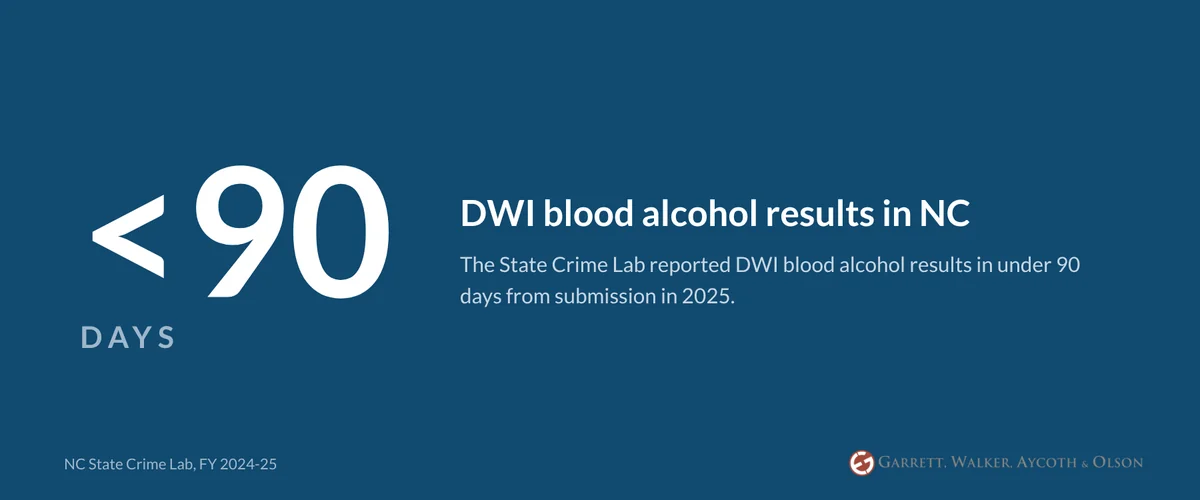
The North Carolina State Crime Lab reports that DWI blood alcohol tests now take under 90 days from submission to report, and drug tests often take longer. The wait does not freeze your case: if the result is 0.08 or more, your license can be revoked by a mailed order.
North Carolina calls the charge DWI, not DUI. The time frame for DUI blood test results depends on which lab has the sample and whether it tests for alcohol or drugs.
While the lab works, your lawyer tracks the report, the license deadlines and the evidence. See how our Greensboro DWI lawyers handle blood cases.
Waiting on a blood result? Call (336) 379-0539 today, before a mailed revocation or a report deadline catches you off guard.
Blood Work Timing in North Carolina DWI Cases: What the Lab’s Own Numbers Say
No law sets a deadline for the lab to finish your blood test. The best guide is the State Crime Lab’s own “lead time,” the time from submission to the published report.
Lead time is the wait you feel. The lab’s shorter “turnaround” figure only starts when an analyst picks up the sample.
| Source | What It Measured | Figure | Date |
|---|---|---|---|
| NC State Crime Lab annual report | DWI blood alcohol lead time, submission to report | Under 90 days | FY 2024-25 report (October 2025) |
| NC State Crime Lab Forensic Update | DWI blood alcohol lead time | Under 90 days | January 2025 |
| NC State Crime Lab annual report | Drug-impaired driving (DUID) toxicology | Not on the lab’s under-90-day list; no figure published | FY 2024-25 report |
| Union County crime lab (local lab) | Blood alcohol, average | 5 days | 2024 |
| NMS Labs (private lab used by NC agencies) | Its own turnaround | About 14 days | August 2026 |
These are averages and snapshots, not a promise for your case. Guilford County has no published figure, so the first job is finding out which lab has your sample.
The State Crime Lab handles a large volume. In FY 2024-25 it completed 5,061 DWI alcohol cases and 2,633 drug-impaired driving cases.
From Traffic Stop to Blood Draw: What Actually Happens
After a DWI arrest, the officer chooses the chemical test, and blood can be asked for instead of breath or in addition to it. G.S. 20-139.1(b5) leaves that choice to the officer.
Your Rights Before Any Test
Before testing, you get a written notice of your rights under G.S. 20-16.2(a). You may call a lawyer or a witness, but testing waits no longer than 30 minutes.
After release, you may seek your own test as well. Blood is not the only test; here is how breath and field tests differ.
Consent, Refusal or a Search Warrant
You can refuse, but a refusal brings a license revocation. The rights notice also warns that “an officer can compel you to be tested under other laws.”
Without consent, police need a search warrant or a real emergency. In Missouri v. McNeely (2013), the U.S. Supreme Court held that fading alcohol is not an emergency in every case.
For a driver who is unconscious and taken to a hospital, Mitchell v. Wisconsin (2019) is different. A plurality of the U.S. Supreme Court said a warrantless draw will almost always be allowed.
In State v. Burris, the N.C. Supreme Court affirmed in 2024 a ruling that exigent circumstances justified a warrantless draw. Whether your draw was lawful depends on the facts, and your lawyer tests it.
Who Draws the Blood
A physician, registered nurse, emergency medical technician or other qualified person draws the sample. The State Crime Lab asks for two 10 mL tubes of blood.
How Long Does Blood Work Take Once It Reaches the Lab?
The State Crime Lab now reports DWI blood alcohol results in under 90 days from the day the sample is submitted.
Alcohol-Only Blood Tests
The lab tests alcohol with headspace gas chromatography and analyzes each sample twice. The result is stated in grams of alcohol per 100 milliliters of blood.
Under G.S. 20-4.01(1b), the result is reported to the hundredth and rounded down. A 0.089 is reported as 0.08, at the limit; a 0.079 is reported as 0.07, under it.
Why Drug Panels Take Longer
A drug test starts with a screen, then a confirmation. A drug only goes on the report after two separate tests identify it.
The lab publishes no current day count for drug cases, but they often take longer than alcohol.
Since February 2022, the lab stops testing when it finds a Schedule I drug in a non-fatal DWI. Under G.S. 20-138.1, any amount of a Schedule I drug is itself a DWI.
Being legally allowed to use a drug is no defense under the same statute. If the lab is testing for drugs, read about defending a drug-impaired driving charge.
What Speeds a Sample Up or Slows It Down
The district attorney can ask the lab for a rush, for example to meet a court date. A sample with too little blood, or one that has clotted, cannot be tested.
Your lawyer cannot order the lab around, but can track the case and press for the report.
What Happens to Your License While You Wait
Your license does not wait for the lab. The civil revocation rules in G.S. 20-16.5 run on their own clock.
If the Result Is Ready at Your First Appearance
If a result of 0.08 or more is already in at your first appearance, the magistrate revokes your license then. With no other pending revocation offense, the revocation is 30 days.
If the Result Comes Back Later
If the result is not ready, the lab report goes to the clerk of superior court. If the result is 0.08 or more, the clerk mails you a revocation order.
If the order is mailed, it takes effect on the fourth day after it goes in the mail.
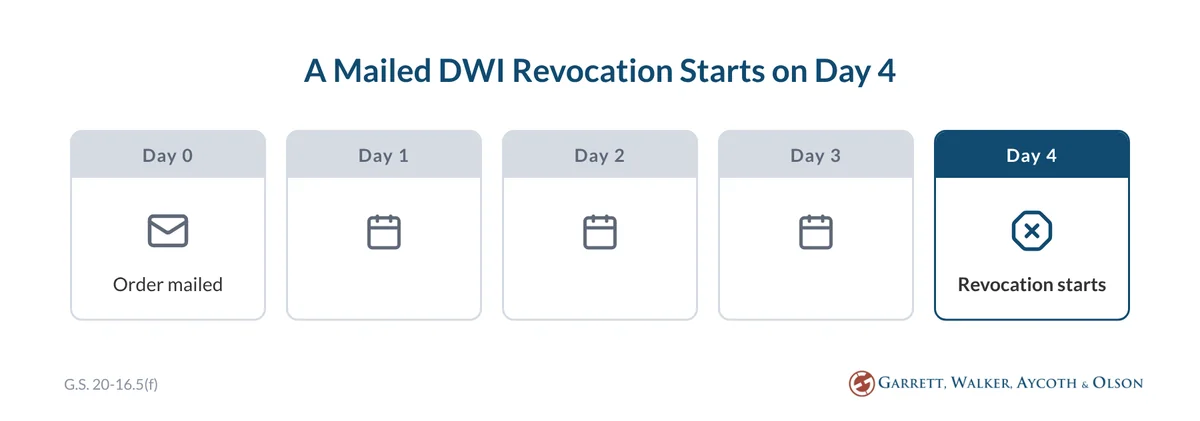
Warning: You must surrender your license within five working days of the effective date to keep the revocation at 30 days. After that, it becomes 45 days.
Surrender on working day 5 after the order takes effect: 30 days. Working day 6: 45 days, counted from surrender.
You can ask in writing for a hearing within 10 days of the effective date. You also pay $100 in costs before the license comes back.
If You Refused the Test
A refusal brings the 30-day civil revocation, usually at the first appearance. DMV adds a 12-month revocation under G.S. 20-16.2(d), effective the 30th day after it mails the order unless you request a hearing in writing first.
Here is what the 30-day civil revocation means for your daily driving.
Driving to Work During the Revocation
After 10 days of a 30-day revocation, a judge may grant a pretrial limited driving privilege. You need a substance abuse assessment first, and nothing is automatic.
Our guide explains how to drive to work during the revocation.
A mailed order can arrive any day after the lab reports. Call (336) 379-0539 so we can watch for it and act inside the deadline.
Talk to a DWI and traffic lawyer before your court date
Deadlines in traffic and DWI cases run from the day of the charge. The earlier we see your paperwork, the more options you usually have.
Call (336) 379-0539Free consultation with a Greensboro attorneyA Practical Timeline for Many North Carolina Blood Cases
Most blood cases move through five stages, and only some have fixed deadlines.
Arrest Night: Rights Notice and Blood Draw
You get the rights notice, up to 30 minutes to reach a lawyer, then the draw.
First Appearance: Revocation Only if a Result or Refusal Is In
The magistrate revokes now only if a refusal report or a qualifying result (0.08 or more; 0.04 in a commercial vehicle; any alcohol under 21) is available.
The Lab Works: Weeks to Months
Alcohol results come back in under 90 days; drug panels often take longer.
The Result Reaches the Clerk and DMV
Copies go to the officer, the clerk and DMV, and a mailed revocation may follow.
The State’s Notice: at Least 15 Business Days Before Court
To use the report without the analyst, the State must give notice on a strict schedule:
“The State notifies the defendant no later than 15 business days after receiving the report and at least 15 business days before the proceeding at which the evidence would be used of its intention to introduce the report into evidence.” G.S. 20-139.1(c1)(1)
Your lawyer then has until five business days before the hearing to object in writing.
Why Delay Can Help or Hurt
A slow lab rarely ends a DWI by itself. Courts weigh speedy-trial claims on four factors, and the UNC School of Government reads a dismissal for lab delay alone as unlikely in a misdemeanor DWI.
Delay is a tool your lawyer uses, not a free pass.
How Delay Can Help
The wait gives your lawyer time to gather records and witnesses. Your own blood test result can rebut the State’s number under G.S. 20-138.1(a1).
How Delay Can Hurt
The civil revocation clock keeps running while the lab works.
The lab can destroy the sample 12 months after filing or after the case ends, whichever is later. If an independent retest matters, your lawyer can file a Motion to Preserve so it is kept.
Missing the Report Deadlines
If the defense does not object in writing on time, the report comes in without the analyst. If the State never sends you a copy, you can ask in writing; the remedy is a continuance, not suppression.
Delay also affects any other charge from the same night, which our full criminal defense practice in Greensboro handles.
The Science Behind the Number: What Your Lawyer Checks in a Blood Report
A blood number is only as good as the chain of steps behind it. Chain of custody can be proved with signed statements, and the defense can object to those, too.
Results from a hospital lab approved under the federal CLIA rules can be used in court. So blood drawn for medical treatment can become evidence.
In district court, the analyst can testify remotely if the State gives notice in time. The law looks at 0.08 or more “at any relevant time after the driving,” so the time of the draw matters.
That timing matters because of why only time lowers your BAC. Finding a weak link depends on the facts of your case, and that is your lawyer’s job.
Steps You Can Take Right Now
Five simple steps now protect your license and your defense.
Write Down the Times
Note when you were stopped, arrested, tested and released.
Watch Your Mail
Open every letter from the court or DMV. A revocation order can arrive any day.
Keep Any Record of Your Own Test
Give the paperwork from your own blood test to your lawyer.
Talk Only to Your Lawyer About the Case
Keep the night and the test off social media and out of texts.
Call a DWI Lawyer Before the Report Arrives
Bring your paperwork and talk with a Greensboro DWI defense lawyer. Possible penalties depend on the sentencing level, which your lawyer can explain.
Frequently Asked Questions
How do I get my DUI blood test results?
Your lawyer usually gets them through the case. To use the report without the analyst, the State must notify you within 15 business days after receiving it. If you have no copy before trial, you can ask in writing under G.S. 20-139.1(e).
Can a DWI be dismissed if the blood test takes too long?
Rarely on delay alone. Courts weigh four speedy-trial factors, and a lab backlog is not blamed on the prosecutor. Your lawyer can still use the delay and the notice deadlines, and the result depends on the facts of your case.
How long does it take police to get a warrant for a blood test?
No law sets a time for it. A magistrate or judge decides whether to issue the warrant. Without consent, police need a warrant or a real emergency, and your lawyer checks whether your draw met that rule.
Does a blood test taken 2 hours after driving still count?
Yes, it can. The law covers 0.08 or more at any relevant time after the driving, while alcohol drunk before or during the driving is still in your body. The gap between driving and the draw is something your lawyer examines.
Can police take my blood without a warrant in North Carolina?
With consent, a warrant or a real emergency. For an unconscious driver taken to a hospital, a plurality of the U.S. Supreme Court in Mitchell v. Wisconsin (2019) said a warrantless draw will almost always be allowed. State v. Burris (N.C. 2024) upheld one. Your lawyer tests whether your draw fit.
Can I get my own blood test?
Yes. You may seek your own test after release. If you are still held after your first appearance, the jail must make reasonable efforts to help you reach a phone to arrange one. Your own blood result can be used to rebut the State’s number.
Can blood taken at the hospital for treatment be used against me?
It can. Results from a hospital lab approved under the federal CLIA rules can be admitted in a DWI case. How the blood and the records were obtained still matters, and your lawyer reviews that closely.
Can I drive while I wait for my blood results?
Usually, until a revocation takes effect. A refusal revocation usually starts at the first appearance. A 0.08 or higher result brings one then, or by a mailed order effective on day four. A pretrial privilege may be possible after 10 days.
Do I need a lawyer if my blood results are not back yet?
Yes. The license and report deadlines can start before you see the result. A lawyer can track the report, ask for a hearing in time and test the draw. Call (336) 379-0539 to talk with our team.
- Continuing Legal Education Instructor of the Year, North Carolina Bar Association
- Former President, Greensboro Criminal Defense Lawyers Association
- Board Member, Criminal Justice Section, North Carolina Bar Association
Talk to a Greensboro traffic and DWI lawyer today
Bring the citation, any DMV letter and your court date.
Garrett, Walker, Aycoth & Olson, Attorneys at Law
317 South Greene St, Greensboro, NC 27401
(336) 379-0539
This article explains North Carolina law in general terms. It is not legal advice about your case, and laws, penalties and court procedures change. Contact an attorney about your specific situation.