


A 2nd DWI in NC is a misdemeanor, but a prior DWI conviction within 7 years of the new offense means at least Level Two: 7 days to 12 months, up to $2,000. Your license loss, 1 year or 4, depends on whether the first offense was within 3 years.
This is for anyone charged with a second DWI, or whose first DWI was years ago. People say DUI, but the NC charge is DWI, impaired driving under G.S. 20-138.1.
The level, the jail minimum and the license length all turn on dates the State must prove. Checking them is your lawyer’s job.
Charged with a second DWI? Call (336) 379-0539 today so we can pull both records before your first court date.
Understanding a 2nd Offense DUI in NC: When the First One Counts
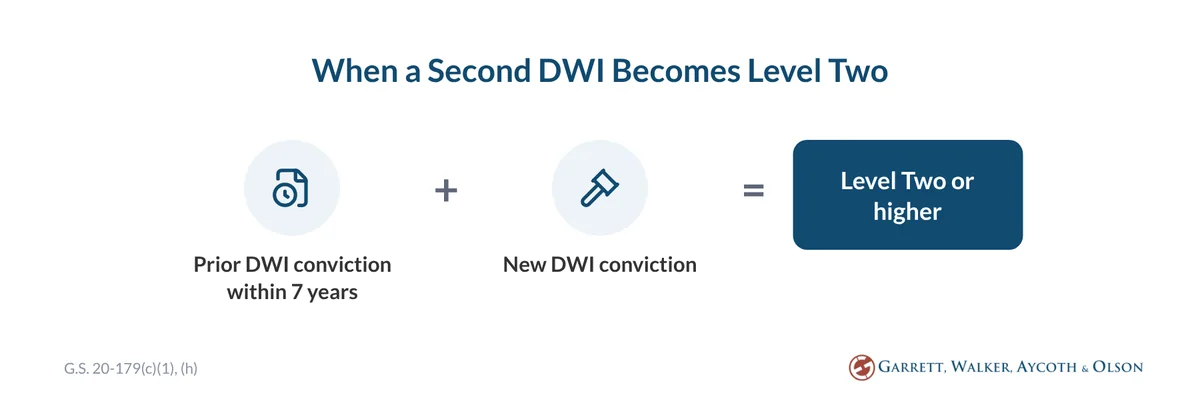
North Carolina has no separate crime called a second offense DWI. A second DWI is the same misdemeanor, and the earlier conviction raises the sentencing level under G.S. 20-179:
“A prior conviction for an offense involving impaired driving if: a. The conviction occurred within seven years before the date of the offense for which the defendant is being sentenced…” G.S. 20-179(c)(1)
A prior DWI conviction within 7 years plus a new DWI conviction means at least Level Two at sentencing.
The 7 Years Run From the Old Conviction to the New Offense
The clock runs from the prior conviction date to the new offense date, not to your court date. A conviction entered after the new arrest but before sentencing also counts.
No contest pleas count, and so do out-of-state DWIs for substantially similar conduct, under G.S. 20-4.01.
Example with made-up dates: your first DWI conviction was March 1, 2019. A new arrest on February 28, 2026 is inside the 7 years; an arrest on March 2, 2026 is not.
If the First DWI Was More Than 7 Years Ago
An older conviction is not a grossly aggravating factor, but the judge still weighs it as an ordinary aggravating factor. Level Three, Four or Five becomes possible.
It also still counts toward habitual impaired driving, which looks back 10 years under G.S. 20-138.5.
Each Prior Counts Separately
Each prior inside 7 years is its own grossly aggravating factor, and two mean Level One. The judge decides whether a prior exists, and the State must prove it.
Your lawyer can get your record before it is used. Checking those dates is the first thing we do in Greensboro DWI defense for repeat charges.
Typical Penalties for Second DUI in North Carolina
With one prior conviction inside 7 years and no other grossly aggravating factor, the judge must impose Level Two. A child in the car or a serious injury moves it higher.
| Situation | Level | Jail Range | Minimum If Suspended | Maximum Fine |
|---|---|---|---|---|
| Prior within 7 years, nothing else | Level Two | 7 days to 12 months | 7 days jail or 90 days alcohol monitor | $2,000 |
| Prior within 7 years plus a child under 18 in the car | Level One | 30 days to 24 months | 30 days, or 10 days plus 120 days monitor | $4,000 |
| Prior within 7 years plus a child in the car plus serious injury | Aggravated Level One | 12 to 36 months | 120 days | $10,000 |
| Prior more than 7 years old, no grossly aggravating factor | Level Three, Four or Five | Up to 6 months / 120 days / 60 days | 72 / 48 / 24 hours jail or community service | $1,000 / $500 / $200 |
The level is argued at a sentencing hearing. The State must prove each aggravating factor beyond a reasonable doubt.
What a Level 2 DWI Means
A prior conviction within 5 years adds one rule to Level Two. If the judge suspends all jail for an alcohol monitor, you must also do 240 hours of community service.
A prior 5 to 7 years back is still Level Two, without the 240 hours. For every factor the judge weighs, see how NC DWI punishment levels are set.
Is a Second DWI a Felony?
No, a second DWI stays a misdemeanor. Three or more prior impaired-driving convictions in 10 years make it habitual impaired driving.
That is a Class F felony with at least 12 months active and permanent revocation.
Two priors is a misdemeanor; three in 10 years is a felony. For a third DWI, read when a repeat DWI becomes a felony.
Jail Time Expectations for a Second DWI
At Level Two, the law requires a jail term of at least 7 days, suspended only on strict conditions.
The Level Two minimum can be met with 7 days in jail, served on weekends or as an inpatient, or 90 days on an alcohol monitor, and the judge decides which.
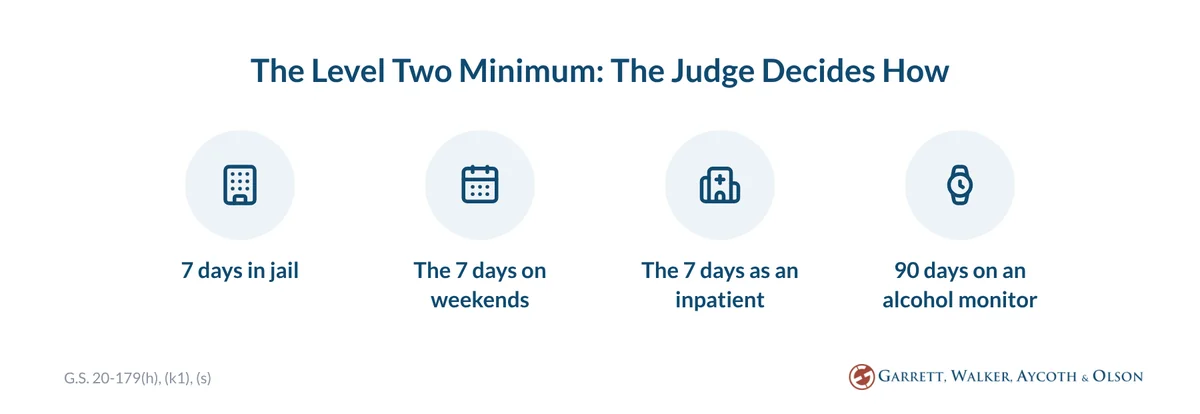
Weekend jail is allowed, but a term of 48 hours or more needs 48 continuous hours to count. The judge may also order the time served as an inpatient at a state-licensed treatment facility.
Up to 60 days of pretrial alcohol monitoring can count toward the 90 days. Talk to your lawyer before you choose a monitor.
Good time cannot reduce the mandatory minimum. The first 24 hours you spend in jail before trial are not credited.
Which option the judge allows is argued, not offered. With a lawyer prepared for sentencing, the minimum can often be met in a way that protects your job.
That depends on the facts of your case.
Your sentencing options start shrinking the day you are charged. Call (336) 379-0539.
Impact on Driver’s License After a Second DWI
A conviction means DMV must revoke your license under G.S. 20-17. How long depends on when your first offense happened.
License Suspension Details: 1 Year or 4 Years
The revocation is 4 years only if your prior offense happened within 3 years before the new offense. Otherwise it is 1 year under G.S. 20-19.
For example, a first offense on May 1, 2023 and a new one on April 30, 2026 means 4 years. A new offense on May 2, 2026 means 1 year.
Note: The license rule counts the old offense date, while the sentencing rule counts the old conviction date. A second DWI brings permanent revocation only at Aggravated Level One.
At the Magistrate: The Civil Revocation
A refusal or a result of 0.08 or more brings a civil revocation of at least 30 days. If your first DWI case is still open, it lasts until both cases end, under G.S. 20-16.5.
Warning: A refusal also brings a separate 12-month DMV revocation under G.S. 20-16.2. To fight it, ask for a hearing in writing before the 30th day after the order is mailed.
A Limited Driving Privilege Is Not Ruled Out
With a prior conviction inside 7 years, G.S. 20-179.3(b)(3) may allow a privilege if your BAC was under 0.15. That path always requires an ignition interlock, as the UNC School of Government explains.
If your first conviction is more than 7 years old and you get Level Three, Four or Five, the regular path in (b)(1) applies. There, an interlock is required only at a BAC of 0.15 or more.
So a 0.16 with a prior 5 years back rules out (b)(3). A 0.16 with a prior 9 years back at Level Three may qualify under (b)(1).
See who qualifies for a limited driving privilege.
Conditions for Reinstatement
DMV will not restore your license until it receives your assessment certificate of completion under G.S. 20-17.6. After a 4-year revocation, DMV may restore it conditionally after 2 years.
That needs no new alcohol, drug or motor vehicle convictions, and 120 days on an alcohol monitor is accepted as proof of abstinence. A second restoration carries a 0.00 alcohol limit for 3 years.
We also help with getting your license back after a revocation.
Talk to a DWI and traffic lawyer before your court date
Deadlines in traffic and DWI cases run from the day of the charge. The earlier we see your paperwork, the more options you usually have.
Call (336) 379-0539Free consultation with a Greensboro attorneyThe Role of Ignition Interlock Devices After a Second DWI
DMV must require an ignition interlock on restoration if your prior DWI offense happened within 7 years of the new one. It is also required at a BAC of 0.15 or more, or after Aggravated Level One, under G.S. 20-17.8.
It lasts 1, 3 or 7 years, matching a 1-year, 4-year or permanent revocation, with a 0.02 limit. Time on an interlock-limited privilege counts toward it.
Example: first offense June 1, 2018, convicted March 1, 2019, new offense February 1, 2026. That is Level Two, but no interlock unless your BAC was 0.15 or more, because the old offense is over 7 years back.
With a first offense on March 1, 2019, the interlock would be required.
The New 2025 Interlock Option Before Trial
For offenses on or after December 1, 2025, a voluntary interlock can be a mitigating factor under S.L. 2025-71. You install it within 45 days of the charge and use it at least 6 months before trial.
It requires a DWI charge, a BAC under 0.15 and a valid license, or one expired under a year, at the offense. No crash can have caused serious injury or death.
No other DWI charge can be pending, and you cannot have a DWI conviction in the prior 5 years.
You must drive only that one vehicle, and only while your license or a valid limited privilege allows it. You must also prove you never started it above 0.02 or broke the interlock rules.
So a prior 4 years back rules it out, while a prior 6 years back allows it within Level Two. Whether it is worth it in your case is a call to make with your lawyer before day 45.
Mandatory Substance Abuse Assessments, Treatment and Probation
If you are placed on probation, at any level, the judge must order a substance abuse assessment. You must also complete the education or treatment it recommends, such as ADET school.
Finishing the assessment while staying alcohol-free for 60 days on a monitor is a listed mitigating factor. At Level Two the judge may consider it when choosing the sentence inside the level.
With a DWI conviction in the past 7 years, unsupervised probation is not the default. When to get the assessment, and from whom, is a timing decision, so ask your lawyer first.
Effect on Criminal Record, Insurance and Your Job
A DWI conviction cannot be expunged under G.S. 15A-145.5, so a second conviction stays on your record. Here is how long a DWI follows your record.
A DWI carries 12 insurance points under the Safe Driver Incentive Plan, a 340% surcharge. For convictions on or after July 1, 2025, it lasts 5 policy years under G.S. 58-36-65.
No DMV license points are added, because G.S. 20-16 skips points for convictions that bring a revocation.
A DWI in your own car disqualifies a CDL for 1 year under G.S. 20-17.4. A second disqualifying conviction means a lifetime disqualification, which DMV may reduce to 10 years.
Your car can be seized if you were driving while revoked from an earlier impaired-driving revocation, or if you had no valid license and no insurance, under G.S. 20-28.3. Court costs are added on top of the fines.
Legal Defenses for a 2nd DUI Offense
A second DWI is defended on two fronts: the new arrest and the old conviction. Either can change the level or the license loss.
Challenging the Prior
Your lawyer checks whether the prior is really inside the window by the right dates, and whether it qualifies as impaired driving.
Sometimes the judge plans active jail that would not happen without the old conviction. Then you get a chance to prove three things: you had no lawyer, you could not afford one, and you did not waive one.
If you prove all three, by the greater weight of the evidence, that conviction cannot be used to raise the level. Your lawyer gathers that proof.
Challenging the New Stop and Test
The stop, probable cause, the test and the rights notice are all checked. If you were stopped at a checkpoint, read the rules a DWI checkpoint must follow.
If blood was drawn, learn why blood test results take months.
Why a Reduction Needs Real Evidence Problems
A prosecutor who dismisses or reduces a DWI must explain why in open court and in writing, under G.S. 20-138.4. So a reduction comes from real problems in the evidence that your lawyer finds, not from asking.
No lawyer can promise a result; finding those problems is the work. A DWI often comes with other charges, and you can see the full range of criminal cases we defend in Guilford County.
Steps to Take After a 2nd DUI Charge
Find the Dates of Your First DWI
Write down both the offense date and the conviction date. The sentencing level and the license rules use different ones.
Check Your License Deadlines
The civil revocation starts at the magistrate. After a refusal, the written hearing request must be made before the 30th day after the DMV order is mailed.
Get Advice Before a Monitor, Interlock or Assessment
Timing decides what counts, from 60 days of pretrial monitoring to the 45-day interlock window.
Call a DWI Lawyer Before Your First Court Date
Before your first court date, talk with a DWI lawyer about your dates. Call (336) 379-0539 and we can start with your records today.
Frequently Asked Questions
Is a second DWI a felony in NC?
No. A second DWI is a misdemeanor under G.S. 20-138.1, even with a prior inside 7 years. It becomes habitual impaired driving, a Class F felony under G.S. 20-138.5, only with three or more prior impaired-driving convictions within 10 years.
Is jail mandatory for a second DWI in NC?
With a prior conviction inside 7 years, Level Two requires a jail term of at least 7 days. The judge can suspend it only with 7 days served or 90 days on an alcohol monitor. How that minimum is met is argued by your lawyer.
What if my first DWI was more than 7 years ago?
It is not a grossly aggravating factor, so Level Two is not automatic. The judge still weighs it as an aggravating factor at Levels Three to Five under G.S. 20-179(d)(5). It also counts toward habitual impaired driving within 10 years.
Does an out-of-state DWI count as a prior in NC?
Yes. North Carolina counts a conviction from another state for substantially similar conduct, under G.S. 20-4.01(24a). Inside 7 years, it can be a grossly aggravating factor. Your lawyer checks whether it really matches and whether its date falls inside the window.
Can I serve my jail time on weekends?
The judge may order weekend jail under G.S. 20-179(s). If the term is 48 hours or more, you must serve 48 continuous hours to get credit. The judge may also order the time served as an inpatient in treatment. Which option applies is part of your lawyer’s sentencing argument.
Can a second DWI be reduced or dismissed?
It is possible when the evidence has real problems. Under G.S. 20-138.4, a prosecutor must explain any DWI dismissal or reduction in open court and in writing. No lawyer can promise a result; your lawyer looks for those problems.
Can I get a limited driving privilege after a second DWI?
Possibly. With a prior inside 7 years, G.S. 20-179.3(b)(3) may allow one if your BAC was under 0.15, with an interlock required. With a prior over 7 years old, Level Three, Four or Five uses the regular (b)(1) path. There, an interlock is needed only at 0.15 or more.
What happens if I refused the breath test this time?
A refusal brings a civil revocation of at least 30 days right away. DMV also revokes your license for 12 months unless you request a hearing in writing before the 30th day after the order is mailed. A refusal also disqualifies a CDL.
Should I get a substance abuse assessment before court?
You will need one: it is required for probation at any level and before DMV restores your license. Completing it with 60 days on an alcohol monitor can also be a mitigating factor. Time it with your lawyer.
- Continuing Legal Education Instructor of the Year, North Carolina Bar Association
- Former President, Greensboro Criminal Defense Lawyers Association
- Board Member, Criminal Justice Section, North Carolina Bar Association
Talk to a Greensboro traffic and DWI lawyer today
Bring the citation, any DMV letter and your court date.
Garrett, Walker, Aycoth & Olson, Attorneys at Law
317 South Greene St, Greensboro, NC 27401
(336) 379-0539
This article explains North Carolina law in general terms. It is not legal advice about your case, and laws, penalties and court procedures change. Contact an attorney about your specific situation.