


Short answer: Often you are not told. A magistrate needs sworn facts showing probable cause to issue a warrant, and warning you first is not part of that.
What it means for you: Signs tell you more than searches. An active warrant is not a public record until it is returned, so a clean online search can be wrong.
What a lawyer changes: A lawyer can check quietly and plan the next step. Walking in to ask can end in an arrest on the spot.
Think one of these signs fits you? Call (336) 379-0539 and we will check the court records with you.
How do I know if I have a warrant? Most people ask after something feels wrong: a missed court date, a letter, or an officer at the door.
Nobody wants to be arrested at work, in front of their kids or at a traffic stop. This guide shows how to tell, what your record means and how to find out safely.
Can You Have a Warrant and Not Know? Often Yes, and Often Without Warning
Yes. In North Carolina a warrant can exist for days or months before you hear about it.
Under G.S. 15A-304(d), a judicial official needs sworn information showing probable cause, by affidavit or testimony. Telling you first is not one of the requirements.
Our guide on how a magistrate decides on a warrant walks through that step.
The warrant then sits in the court’s electronic system, which police and court officials can reach. It is not a public record until it is returned under G.S. 132-1.4(k), so you usually cannot look it up.
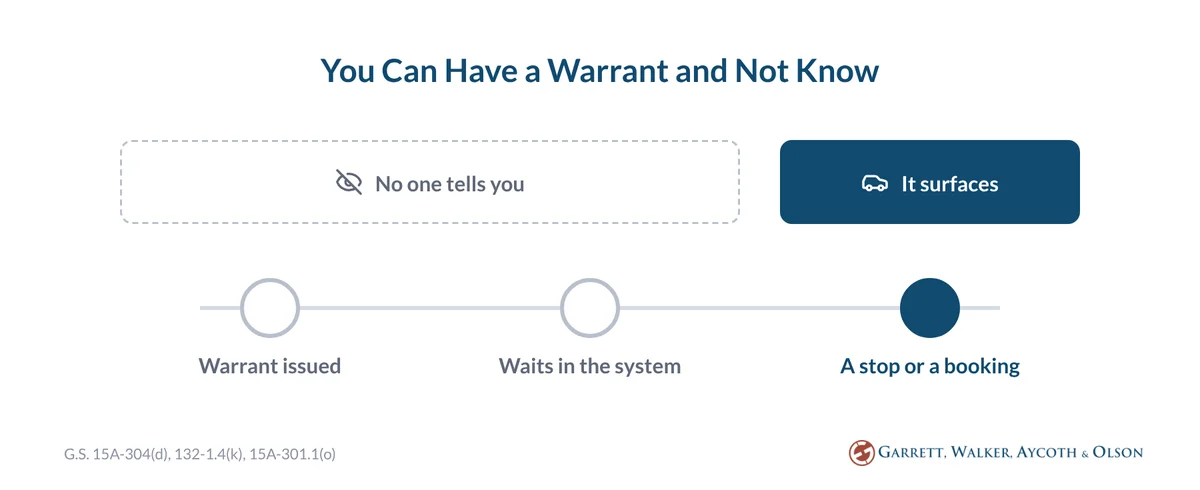
Court mail also goes to the address on file. If you moved, you may never see a notice at all.
That is why the safest first step is to ask a warrant lawyer to check quietly. You learn the answer without handing yourself to an officer.
7 Signs You May Have a Warrant in North Carolina
None of these signs proves a warrant exists. Each one is a reason to check today.
You Missed a Court Date
A missed court date is the most common sign. Under G.S. 15A-305(b), an order for arrest may issue when a released defendant misses court.
The same is true after a missed date on a served summons or a misdemeanor citation. Read how an FTA charge works in NC before your next date.
Missing court can also be its own crime. Under G.S. 15A-543, it applies if you were released after arrest on pretrial release conditions of any kind and willfully missed court.
That crime is a Class 2 misdemeanor on a misdemeanor case, and a Class I felony on a felony case. A lawyer can often put the case back on the calendar before day 20 and appear for you.
A DMV Letter Says Your License Will Be Revoked
On a motor vehicle charge, a missed court date or unpaid fine can lead DMV to revoke your license. Under G.S. 20-24.1, the revocation starts on the 60th day after the order is mailed.
Clearing the case before that date deletes the revocation. Acting within 20 days is better still.
Under G.S. 20-24.2(a)(1), the court does not report the miss to DMV if you appear or resolve the charge within 20 days. The $200 fee in G.S. 7A-304(a)(6) follows the same 20-day rule.
A misdemeanor traffic charge can also bring an order for arrest. A missed infraction, like most speeding tickets, cannot: G.S. 15A-1116(b) allows a summons instead.
Before the 60th day, a traffic lawyer who can clear it may save the license.
An Officer Came to Your Home or Job
An officer at your door, or a card left asking you to call, is a strong sign. Police often try to serve a warrant where they expect to find you.
Do not call back to “explain.” Call a lawyer first.
Someone Told You They “Took Out Charges” on You
A private person can go to a magistrate and swear to facts against you. When only a private person swears to the facts, the law usually calls for a summons, though there are exceptions.
So a citizen complaint often arrives as a court date, not an arrest. Do not count on it.
You Know You Are Under Investigation
An order for arrest may issue after a grand jury indicts someone who is not in custody. Investigation files are not public records under G.S. 132-1.4(a), so you will not see this coming online.
If a detective has called, talk to a lawyer before you talk to anyone else.
You Are on Probation and Broke a Condition
A probation violation can lead to an order for arrest. Missing a meeting or picking up a new charge are common triggers.
We handle defending a probation violation in Greensboro, including the order for arrest that often comes with it.
You Ignored a Court Paper
Failing to appear on a served criminal summons can bring an order for arrest under G.S. 15A-303(e)(2). Missing a show cause order in a criminal case can do the same.
What It Means to “Have a Warrant” in North Carolina: OFA, Active, Returned
“Having a warrant” usually means a warrant for arrest or an order for arrest is waiting to be served on you. Here is what the words on a record mean.
| Term | What It Means | Common Trigger | Statute |
|---|---|---|---|
| Warrant for arrest | A statement of the crime and an order to arrest you | A new charge | G.S. 15A-304(a) |
| Order for arrest (OFA) | An order that an officer take you into custody | Missed court, probation violation, indictment | G.S. 15A-305 |
| Criminal summons | An order to appear in court, not an arrest | Many citizen complaints | G.S. 15A-303(a) |
| Active or outstanding | Issued and not yet served (plain words, not legal terms) | Any of the above | None |
| Returned | Served, or no longer actively pursued; only then public | Service or end of efforts | G.S. 15A-301.1(n) |
In NC the paper issued after a missed court date is an order for arrest, what other states call a bench warrant. So “OFA” on a Guilford County record means an order for arrest.
“Pending” usually means the case is still open. It does not by itself mean a warrant exists.
How Do Police Know If You Have a Warrant?
Police and court officials can reach North Carolina’s electronic warrant system from anywhere they have access. An officer can print your warrant anywhere in the State, and the copy has full force.
Any jail booking also triggers a check. The statute is direct:
“At the time an individual is taken into custody, the custodial law enforcement agency shall attempt to identify all outstanding warrants against that individual and notify the appropriate law enforcement agencies of the location of the individual.” G.S. 15A-301.1(o)
So a broken taillight stop or a small charge in another county can surface an old warrant. Under G.S. 15A-401(a)(2), an officer who knows of it can arrest you without the paper in hand.
You can choose when this gets handled, or an officer can choose for you. Call (336) 379-0539 today.
Talk to a defense lawyer before you talk to anyone else
What you say and sign in the first days often decides what is possible later. The earlier we see your paperwork, the more options you usually have.
Call (336) 379-0539Free consultation with a Greensboro attorneyThe Safest Way to Find Out If You Have a Warrant
The safest way is a quiet check by a criminal defense lawyer, then a plan, before you talk to police.
- Look yourself, at no risk, for cases and court dates in the NC eCourts Portal.
- Do not read a clean result as clear. Unserved warrants are not public.
- Call a lawyer to check and explain the record. If a warrant exists, plan the surrender and court date together.
Why Walking In to Ask Is the Riskiest Option
At a station or a front desk, you give your name to people who can arrest you on a known warrant. You lose the chance to arrive with a plan.
See every NC warrant search and its blind spots, including checks on a family member.
In Greensboro or High Point, here is where to go in Guilford County.
What a Lawyer Can Do That a Simple “Warrant Search” Cannot
A lawyer turns “do I have a warrant?” into “how do we handle it on our terms?” Depending on the facts of your case, a lawyer can:
- Check the record and tell an order for arrest from a new warrant or a probation order.
- After a missed court date, put the case back on the calendar before day 20 and appear for you.
- Plan a voluntary surrender, so you choose the day instead of an officer.
- Prepare the release argument for the magistrate.
At that hearing, G.S. 15A-511(b) requires the magistrate to tell you the charges and your right to contact a lawyer. The magistrate must also explain how release works.
If You Confirm a Warrant Exists: Smart Next Steps
- Do not wait. Every traffic stop is a chance for an arrest.
- Gather the case number, county and last court date.
- Plan the surrender time with your lawyer.
Your lawyer can point to the fact that you came in on your own. Then follow the full steps to clear the warrant together.
Is That Warrant Call Real? How to Spot a Warrant Scam
A call demanding payment to “clear a warrant” is a red flag. The U.S. Marshals Service says it will never ask for card, gift card, wire transfer or bank routing numbers.
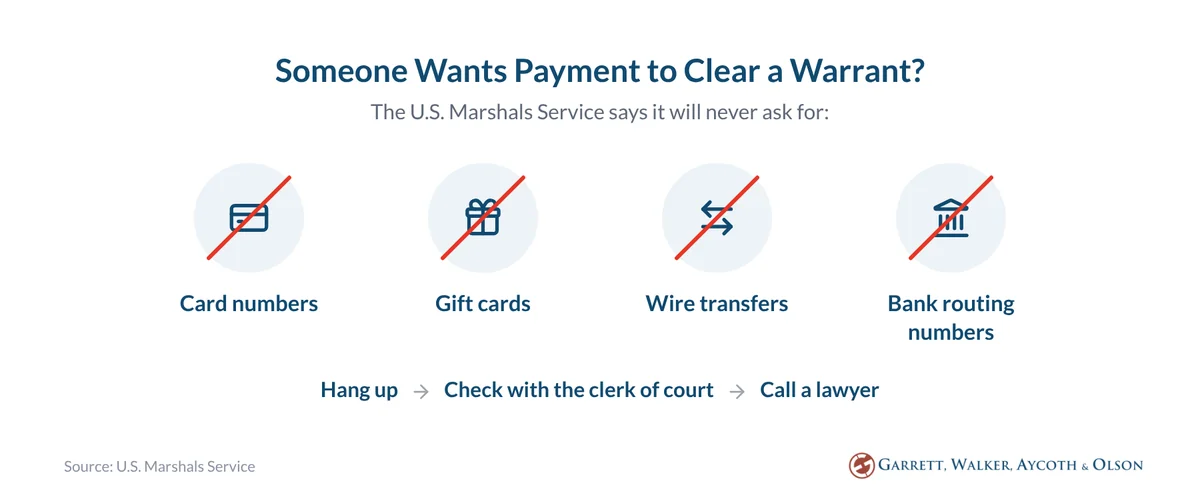
Hang up and share nothing. Check with the clerk of court, then call a lawyer.
What Not to Do When You Suspect a Warrant
- Do not ignore court or DMV mail. The 60-day license clock keeps running.
- Do not miss your next court date or probation meeting.
- Do not walk into a station to ask.
- Do not give a false name at a traffic stop.
Frequently Asked Questions
Will the police call me if I have a warrant?
Do not count on it. The law sets what a magistrate needs to issue a warrant, and a warning to you is not on that list. Some officers do leave a card or knock on a door. A phone call demanding money to clear a warrant is a scam sign, so hang up and call a lawyer.
What does OFA mean on my NC court record?
OFA means order for arrest. It is an order from a judge, clerk or magistrate that an officer take you into custody. It often follows a missed court date, a probation violation or an indictment. If you see OFA on a Guilford County case, call a lawyer before you go to the courthouse.
Can I be arrested at work on a warrant?
Yes. Under G.S. 15A-401(a)(1), an officer with the warrant may arrest you at any time and any place within the officer’s territorial jurisdiction. That includes a job site. A planned surrender with a lawyer is the way to avoid an arrest in front of your boss and coworkers.
Will I get a warrant for missing court on a speeding ticket?
Not an order for arrest, if the ticket is an infraction like most speeding tickets. The court may issue a summons instead. A misdemeanor traffic charge is different and can bring an order for arrest. Either way, DMV can revoke your license 60 days after it mails the order.
Can a lawyer find out if I have a warrant without me being arrested?
A lawyer can check court records for you and explain what they show. If a warrant exists, the lawyer can plan a surrender on a day you choose. That way you are not picked up without warning, and you arrive with a release plan in place.
What if the warrant names the wrong person?
Tell a lawyer right away. Under G.S. 15A-301(g), an order for arrest can be recalled for good cause, including that the person named did not commit the offense. A warrant for arrest is recalled when the official who issued it finds there was no probable cause. A lawyer can raise a mix-up before an arrest.
An officer left a card asking me to call. What should I do?
Do not call back to explain. A card or a knock often means police want to serve paper on you. An officer who knows of a warrant can arrest you at any time, so call a lawyer first. The lawyer can check the record and plan the next step with you.
Is it a crime to miss court in NC?
It can be. If you were released after arrest on pretrial release conditions and willfully missed court, that is a Class 2 misdemeanor on a misdemeanor case. On a felony case it is a Class I felony. A lawyer can explain which applies and what can be done.
- Former President, Greensboro Criminal Defense Lawyers Association
- Elected member, Criminal Justice Section, North Carolina Bar Association
- Selected to present the Wade M. Smith Award for Top Criminal Defense Lawyer in North Carolina
Talk to a Greensboro criminal defense lawyer today
Bring the warrant, the release order and anything else they gave you.
Garrett, Walker, Aycoth & Olson, Attorneys at Law
317 South Greene St, Greensboro, NC 27401
(336) 379-0539
This article explains North Carolina law in general terms. It is not legal advice about your case, and laws, penalties and court procedures change. Contact an attorney about your specific situation.