


Short answer: Probable cause in court means a reasonable ground to believe a crime was committed and that the person charged committed it. Courts judge it on all the circumstances, and it has no set percentage.
What it means for you: Probable cause is tested at several points in a North Carolina case. A magistrate checks it before a warrant or after an arrest, a District Court judge checks it at a felony probable cause hearing, and a judge can suppress evidence on a motion.
What a lawyer changes: Probable cause is not proof of guilt, and a traffic stop needs only reasonable suspicion. Challenging probable cause is a lawyer’s job, and the windows to do it are short.
Arrested, searched or facing a felony hearing? Call (336) 379-0539 to talk with our team today.
This guide is for anyone who was arrested, had a car or home searched, or was told a probable cause hearing is coming. It explains the standard in plain words and shows where your lawyer can challenge it.
What Is Probable Cause in Court?
Probable cause in court is the legal bar the State must clear before it can arrest you, charge you or search you without your consent. It means enough facts for a reasonable ground to believe a crime happened and that you did it.
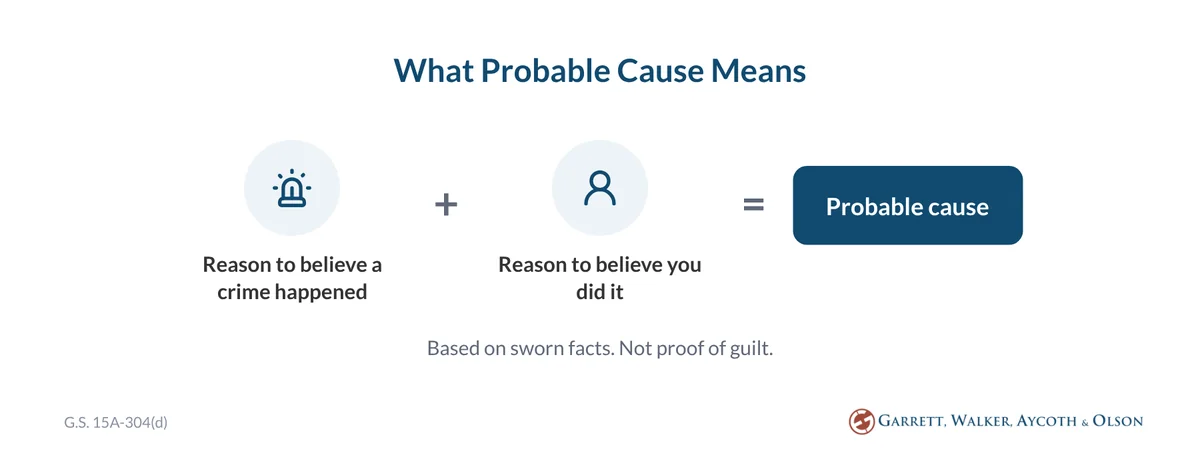
In North Carolina, a magistrate or judge may issue a warrant only after making an independent judgment from sworn information that probable cause exists (G.S. 15A-304(d)). The same showing is needed for a criminal summons under G.S. 15A-303(c).
Because a summons uses the same test, a private complaint can turn into a court date fast. Here is how long a criminal summons takes in North Carolina.
Legal Standards for Probable Cause
Probable cause has no neat formula. The U.S. Supreme Court called it a “fluid concept” in Illinois v. Gates, and later said it is “incapable of precise definition or quantification into percentages” in Maryland v. Pringle.
Courts look at the totality of the circumstances. Pringle described the test as a “reasonable ground for belief of guilt” (UNC School of Government).
Here is where probable cause sits among the standards courts use, from the highest bar to the lowest:
- Beyond a reasonable doubt (needed to convict)
- Clear and convincing evidence
- Preponderance of the evidence
- Probable cause
- Reasonable suspicion
Probable cause is a low bar. A magistrate deciding on a warrant may even consider hearsay, because the rules of evidence do not apply there (NC Rule of Evidence 1101(b)(3)).
That is why the fight is usually about the facts behind the finding. Your lawyer tests those facts line by line.
Where Probable Cause Is Tested in a North Carolina Case
Probable cause is tested at four main points in an NC criminal case, and each one is a chance to push back.
- Before a warrant or summons. A magistrate or other official must find probable cause from sworn information (G.S. 15A-304(d)).
- After an arrest without a warrant. The magistrate must decide probable cause, and if there is none, you must be released (G.S. 15A-511(c)).
- Felony cases. A District Court judge must schedule a probable cause hearing unless you waive it in writing (G.S. 15A-606(a)).
- Before trial. A judge can suppress evidence on a timely motion (G.S. 15A-974).
If you are charged with a felony, here is how a probable cause hearing works and what we do at it.
Probable Cause vs. Reasonable Suspicion
Reasonable suspicion is a lower standard than probable cause. It lets an officer briefly stop you to investigate, while probable cause is needed to arrest you, get a warrant or search a car without your consent.
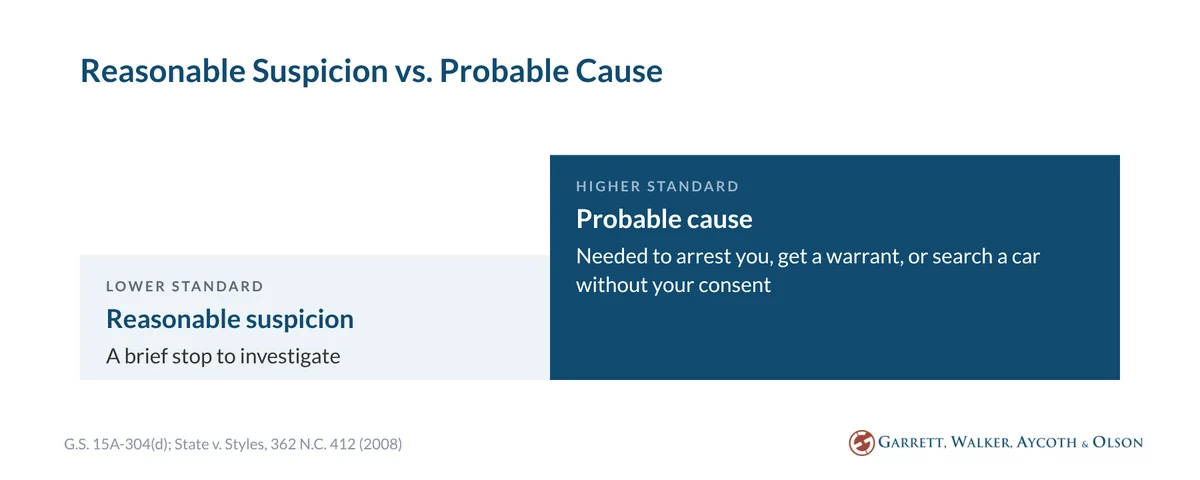
For a full side-by-side, see reasonable suspicion and probable cause compared.
Probable Cause in Traffic Stops
An officer does not need probable cause to pull you over. “Reasonable suspicion [is] the necessary standard for stops based on traffic violations,” the NC Supreme Court held in State v. Styles, 362 N.C. 412 (2008) (UNC School of Government).
Probable cause is the next step after the stop. The officer needs it to arrest you under G.S. 15A-401(b), or to search your car without your consent.
Is the Smell of Marijuana Probable Cause in NC?
The smell of cannabis is one factor, not an automatic answer. In State v. Dobson and State v. Rowdy (May 22, 2026), the NC Supreme Court said probable cause depends on the totality of the circumstances.
The Court did not decide whether odor alone is still enough now that hemp is legal. The UNC School of Government says neither case “squarely settles the question” (UNC School of Government, June 30, 2026).
That open question can matter when defending a drug possession charge after a car search.
Role of Probable Cause in Arrests
An officer needs probable cause for every arrest, with or without a warrant. What changes is where the offense happened and how serious it is.
- With a warrant: a judicial official already found probable cause under G.S. 15A-304(d).
- Offense in the officer’s presence: the officer may arrest without a warrant on probable cause (G.S. 15A-401(b)(1)).
- Felony out of the officer’s presence: arrest without a warrant is allowed on probable cause (G.S. 15A-401(b)(2)).
- Misdemeanor out of the officer’s presence: only if you will not be caught otherwise, may cause injury or damage, or the charge is on a short list that includes impaired driving (G.S. 15A-401(b)(2)).
After an arrest without a warrant, the magistrate reviews probable cause and must release you if there is none (G.S. 15A-511(c)). Once probable cause is found, here is how an NC arrest warrant works from issue to service.
Talk to a defense lawyer before you talk to anyone else
What you say and sign in the first days often decides what is possible later. The earlier we see your paperwork, the more options you usually have.
Call (336) 379-0539Free consultation with a Greensboro attorneyProbable Cause in Search Warrants
A search warrant needs a written, sworn application with affidavits that “particularly” set out the facts (G.S. 15A-244). The official may consider only what is in the affidavit or recorded on the record (G.S. 15A-245(a)).
If there is no probable cause, the official must deny the application (G.S. 15A-245(b)). That makes the paperwork the case, and a lawyer reads every line of it.
Exceptions to Search Warrants
Consent is one exception. An officer may search without a warrant if a person entitled to consent gives permission voluntarily (G.S. 15A-221, G.S. 15A-222).
A car search without a warrant still needs probable cause. In Dobson and Rowdy, the searches were upheld because officers had probable cause on those facts.
Other exceptions, such as emergencies, are covered in when police can search without a warrant.
How Police Establish Probable Cause: Examples
Police build probable cause from what they saw, what people told them and what they found. Here is how NC law treats common examples.
| Fact Police Point To | How the Law Treats It | Source |
|---|---|---|
| Officer saw the offense | May arrest without a warrant on probable cause | G.S. 15A-401(b)(1) |
| Sworn statement of a private person | Can support a summons; a warrant usually needs more | G.S. 15A-304(b)(3) |
| Hearsay from a witness | May be considered for a warrant; limited at the felony hearing | NC Rule of Evidence 1101(b)(3); G.S. 15A-611(b) |
| Lab or fingerprint report | Admissible at the probable cause hearing | G.S. 15A-611(b)(1) |
| Odor of cannabis | One factor; odor alone is unsettled | State v. Dobson, State v. Rowdy (2026) |
| Traffic violation seen by the officer | Reasonable suspicion for the stop | State v. Styles (2008) |
The defense question is always the same: what did police know, and when? Your lawyer answers it from the paperwork.
The Probable Cause Hearing in North Carolina
A probable cause hearing is a District Court hearing where a judge decides whether a felony case should go on to Superior Court. It is a right given by statute, and it has strict timing.
Who Gets a Probable Cause Hearing
Felony defendants get one, unless they waive it in writing (G.S. 15A-606(a)). The right also appears to cover misdemeanors joined with a felony (UNC School of Government Defender Manual).
When It Happens
The hearing must be set no later than 15 working days after your first appearance before a District Court judge. It cannot be set sooner than five working days without both sides agreeing (G.S. 15A-606(d)).
A continuance needs good cause and a motion at least 48 hours ahead, except for extraordinary cause (G.S. 15A-606(f)). If you show up without a lawyer, the judge will not delay the hearing for that reason except for extraordinary cause (G.S. 15A-606(e)).
What Happens at the Hearing
A prosecutor presents the State’s case, your lawyer can cross-examine every witness, and you may testify and call witnesses (G.S. 15A-611(a)). Every witness testifies under oath.
“The State must by nonhearsay evidence, or by evidence that satisfies an exception to the hearsay rule, show that there is probable cause to believe that the offense charged has been committed and that there is probable cause to believe that the defendant committed it” G.S. 15A-611(b)
Some reports, like lab results, are allowed in. The judge also does not have to exclude unlawfully obtained evidence at this stage, so suppression usually comes later (G.S. 15A-611(b)).
Three Possible Outcomes
- Bound over: the judge finds probable cause and sends the case to Superior Court.
- Reduced: the judge finds probable cause only for a lesser misdemeanor and sets it for District Court trial within 5 to 15 working days (G.S. 15A-613).
- Dismissed: the judge finds no probable cause on any charge (G.S. 15A-612(a)).
A reduction or dismissal comes from a lawyer’s work at the hearing, depending on the facts of your case. A dismissal does not stop the State from charging you again later (G.S. 15A-612(b)).
Why Many Cases Never Get a Hearing
The prosecutor can take a felony straight to the grand jury (G.S. 15A-627(b)). Once there is an indictment, the District Court can no longer hold the hearing.
The Defender Manual puts it plainly: “Some judicial districts still hold probable cause hearings; many others do not.” In those districts, a lawyer may need to file a demand for the hearing.
If the prosecutor goes to the grand jury first, read what an indictment means for you.
Waiving the Hearing
You can waive the hearing in writing, and waiving it sends the case to Superior Court (G.S. 15A-606(c)). If you have or want a lawyer, the waiver needs your lawyer’s written consent (G.S. 15A-606(a)).
The hearing lets your lawyer question the officer under oath and lock in testimony for trial. That is often worth more than the ruling, because, as the Defender Manual notes, courts do not often dismiss for lack of probable cause.
Never waive the hearing without talking it through with your lawyer. We stand with clients at every stage of felony charges in Greensboro.
Challenging Probable Cause in Court
A lawyer can challenge probable cause at several stages, and each one uses a different tool. Here are the main ones.
- At the magistrate stage. After an arrest without a warrant, no probable cause means release (G.S. 15A-511(c)).
- Before a paper is served. An unserved warrant or summons must be recalled if the issuing official finds probable cause did not exist (G.S. 15A-301(g)(1)).
- At the probable cause hearing. Your lawyer cross-examines the State’s witnesses (G.S. 15A-611(a)).
- With a motion to suppress. Evidence must be suppressed if the US or NC Constitution requires it, or if it came from a substantial violation of Chapter 15A (G.S. 15A-974(a)).
In Superior Court, a motion to suppress generally must be made before trial (G.S. 15A-975(a)). It must be in writing, state its grounds and include a supporting affidavit (G.S. 15A-977(a)).
Will your case be thrown out? Suppression can remove key evidence, depending on the facts of your case, but nothing about it is automatic.
Arrested or searched and think the officer had no basis? Call (336) 379-0539 today.
Why Probable Cause Matters for Your Case
The deadlines run fast. The hearing must be set within 15 working days of your first appearance, and continuance motions need 48 hours’ notice (G.S. 15A-606(d), (f)).
A lawyer brought in early can demand the hearing before an indictment, prepare cross-examination and build the suppression record.
Before the hearing date is set, talk with a Greensboro defense lawyer about the facts.
Recent North Carolina Cases Involving Probable Cause
Two NC Supreme Court rulings shape probable cause on the road today.
State v. Styles (2008): the NC Supreme Court held that reasonable suspicion, not probable cause, is the standard for a traffic stop.
State v. Dobson and State v. Rowdy (2026): the Court applied the totality of the circumstances to car searches and left open whether cannabis odor alone is enough.
Frequently Asked Questions
What is probable cause in simple terms?
Probable cause is a reasonable ground to believe a crime happened and that a particular person did it. It is more than a hunch but far less than proof beyond a reasonable doubt. A magistrate must find it before issuing a warrant under G.S. 15A-304(d).
Do police need probable cause to pull you over?
No. In North Carolina, reasonable suspicion is the standard for a traffic stop, under State v. Styles (2008). The officer needs probable cause for the next steps, such as arresting you or searching the car without your consent. Whether the stop itself was valid is often worth a lawyer’s review.
Is the smell of marijuana probable cause in NC?
The odor of cannabis is one factor in the totality of the circumstances. In State v. Dobson and State v. Rowdy (2026), the NC Supreme Court did not decide whether odor alone is still enough now that hemp is legal. That question remains open, which matters in many car search cases.
What happens if police did not have probable cause?
It depends on the stage. A magistrate must release you after a warrantless arrest under G.S. 15A-511(c). A judge must dismiss at the hearing under G.S. 15A-612(a)(3), and evidence can be suppressed under G.S. 15A-974. The State may still recharge under G.S. 15A-612(b).
Do misdemeanors get a probable cause hearing?
Generally only when the misdemeanor is joined with a felony, according to the UNC School of Government Defender Manual. A misdemeanor charged alone is handled in District Court without a probable cause hearing. Your lawyer can still challenge probable cause in other ways, such as a motion to suppress.
Can hearsay be used to show probable cause?
For a warrant, yes, because the rules of evidence do not apply when a magistrate issues one (NC Rule of Evidence 1101(b)(3)). At the felony probable cause hearing, the State must use nonhearsay evidence or a hearsay exception under G.S. 15A-611(b), with some listed exceptions such as lab reports.
Is probable cause the same as being proven guilty?
No. Probable cause is one of the lowest standards in criminal law. A finding of probable cause at the hearing only sends a felony on to Superior Court under G.S. 15A-612(a)(1). The State still has to prove guilt beyond a reasonable doubt at trial.
Is federal probable cause different from NC probable cause?
The probable cause standard comes from the Fourth Amendment, and NC courts apply federal Fourth Amendment doctrine, as the NC Supreme Court did in State v. Dobson. North Carolina statutes add the procedure, such as G.S. 15A-304 for warrants and G.S. 15A-606 for the hearing.
- Former President, Greensboro Criminal Defense Lawyers Association
- Elected member, Criminal Justice Section, North Carolina Bar Association
- Selected to present the Wade M. Smith Award for Top Criminal Defense Lawyer in North Carolina
Talk to a Greensboro criminal defense lawyer today
Bring the warrant, the release order and anything else they gave you.
Garrett, Walker, Aycoth & Olson, Attorneys at Law
317 South Greene St, Greensboro, NC 27401
(336) 379-0539
This article explains North Carolina law in general terms. It is not legal advice about your case, and laws, penalties and court procedures change. Contact an attorney about your specific situation.