


Concurrent means at the same time. In a North Carolina criminal case, it usually means two sentences are served together instead of stacked, and for offenses on or after December 1, 2025, the judge must choose and say why.
Many people think concurrent time is automatic. For those newer offenses, G.S. 15A-1354 no longer says silent sentences run concurrently.
So what does concurrent mean in legal terms for you? If you face several charges or a plea offer, that one word decides whether time is shared or added.
Facing more than one charge in Guilford County? Call (336) 379-0539 before you accept a plea, so a lawyer can argue for concurrent time while it can still be argued.
The plain-English meaning lawyers use
Concurrent means operating or happening at the same time. “Concurrently” is the same idea as an adverb, so sentences that run concurrently are served side by side.
The word has a second legal sense: power shared by two authorities over the same matter. That is the meaning behind “concurrent jurisdiction,” where two courts can hear the same kind of case.
The opposite of concurrent is consecutive, which means one after the other. Two consecutive sentences are served in a line, with the second starting when the first ends.
Concurrent vs. consecutive: a quick comparison
Concurrent sentences overlap, while consecutive sentences start only when the earlier one ends. Here is how the two compare in a North Carolina case.
| Question | Concurrent | Consecutive |
|---|---|---|
| How the time runs | Served at the same time | The second starts when the State has custody after the first ends (G.S. 15A-1355(a)) |
| What sets the total | The longest term | The terms added together, with NC’s felony reduction (G.S. 15A-1354(b)) |
| Who decides | The judge; for offenses on or after Dec. 1, 2025, with a stated reason (G.S. 15A-1354(a)) | The same judge, under the same rule |
| Probation | Runs alongside other sentences unless the judge says otherwise (G.S. 15A-1346) | Only if the judge orders it |
The written judgment controls in the end, so its exact words matter most.
What Does Concurrent Mean on an NC Sentence? Who Decides
In North Carolina, the judge decides whether sentences run concurrently or consecutively. The statute says so in plain terms:
“When multiple sentences of imprisonment are imposed on a person at the same time … the sentences may run either concurrently or consecutively, as determined by the court.
The court shall make a finding on the record stating the reasoning for the determination of the court.” G.S. 15A-1354(a)
That rule covers sentences given on the same day. It also covers a new sentence for someone already serving one, including a sentence from another state or a federal court.
What the judge hears before deciding is argued by your lawyer: the facts, the plea terms and your record.
Concurrent time is never promised. The judge makes the choice, and your lawyer is the one who asks for it.
Each sentence itself comes from how the NC sentencing grid works for your class and record.
The December 1, 2025 change: no automatic concurrent default
For offenses committed on or after December 1, 2025, S.L. 2025-70 removed the rule that silent sentences run concurrently. The deleted line in G.S. 15A-1354(a) said sentences “shall run concurrently” when the judgment did not say otherwise.
Older offenses stay under the old rule, so the offense date of each charge matters. The UNC School of Government explains the end of the concurrent sentence default.
One point is unsettled. The felony statute, G.S. 15A-1340.15(a), still says sentences run concurrently “unless otherwise specified by the court,” and S.L. 2025-70 did not change it.
This is unsettled law: North Carolina courts have not decided whether a silent felony judgment still defaults to concurrent. The UNC School of Government expects the prison system to send a silent judgment back to the court to clarify it.
Warning: If a plea offer depends on concurrent time, make sure the plea paper and the judgment both say it in writing.
Before sentencing, your lawyer can argue for concurrent time on the record, so the judgment is not silent. If a felony judgment for a newer offense is silent anyway, your lawyer can argue that G.S. 15A-1340.15(a) still makes the sentences concurrent.
How consecutive time adds up in NC: a worked example
Consecutive felony sentences are added together, but North Carolina trims the maximum for each added sentence. Under G.S. 15A-1354(b)(1), the cut is 9 months for each added Class F through I felony.
For most added Class B through E felonies, the cut is 12 months. The minimum terms are simply added together, under G.S. 15A-1354(b)(2).
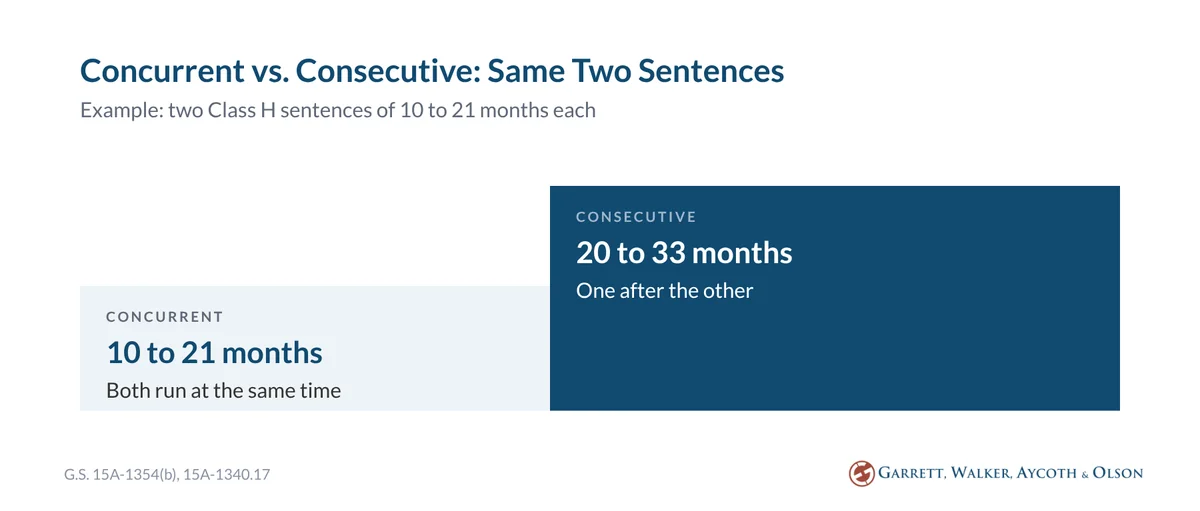
Here is an example. Take two Class H felonies at Prior Record Level IV, each sentenced to 10 to 21 months active under G.S. 15A-1340.17.
Run concurrently, the total stays 10 to 21 months, because the terms overlap. Run consecutively, the two minimums add up to 20 months.
The maximums add up to 42 months, less 9 months for the second Class H sentence, which leaves 33. Run consecutively, the same two judgments become 20 to 33 months instead of 10 to 21.
Whether a judge stacks two felony judgments is argued at sentencing, which is why a Greensboro felony defense lawyer prepares that argument before the plea. Any concurrent time the judge orders follows that work, depending on the facts of your case.
When NC law limits or requires consecutive sentences
North Carolina caps consecutive misdemeanor time and requires consecutive time for habitual felon sentences.
Misdemeanors: the twice-the-maximum cap
If the most serious misdemeanor is Class A1, 1 or 2, stacked sentences cannot total more than twice the maximum for that class and level. That cap comes from G.S. 15A-1340.22(a).
For example, a Class 1 misdemeanor at prior conviction Level III allows 1 to 120 days under G.S. 15A-1340.23. Stacked misdemeanor sentences in that case cannot pass 240 days.
If every conviction is a Class 3 misdemeanor, the judge cannot run the sentences consecutively at all. If every charge is a Class 3, read what a Class 3 misdemeanor carries in North Carolina.
Habitual felon sentences must run consecutively
A habitual felon sentence must run consecutively with any sentence the person is already serving. It starts when that sentence ends, under G.S. 14-7.6, and G.S. 14-7.41 says the same for armed habitual felons.
For the rules that trigger the status, see how NC habitual offender laws work.
How jail credit works with concurrent and consecutive sentences
Days you already spent in custody on the charge come off both the minimum and the maximum. That is the rule in G.S. 15-196.1 and G.S. 15-196.3.
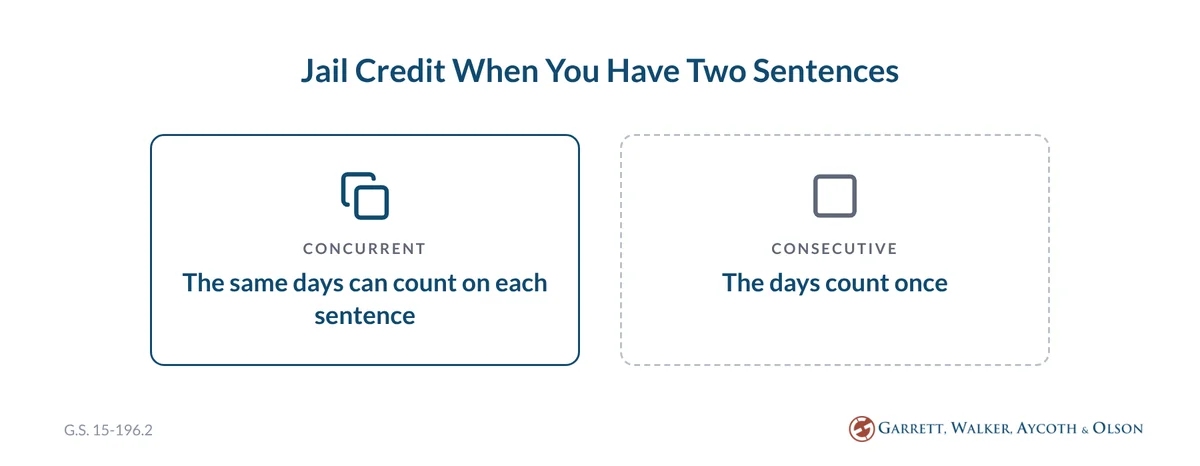
With concurrent sentences, each sentence gets credit for the custody time spent on its own offense. With consecutive sentences, the law treats them as one sentence, and the credit is not multiplied (G.S. 15-196.2).
If you were held on both charges, two concurrent sentences can each use those same days, but consecutive sentences share one pool of credit.
Important: Time held on a new charge while you are already serving a sentence for another offense does not count toward the new sentence. That limit is written into G.S. 15-196.1.
The judge sets the credit at sentencing, under G.S. 15-196.4, and missed credit can be raised later by petition. Your lawyer brings the custody dates, so the days land on the right case the first time.
Talk to a defense lawyer before you talk to anyone else
What you say and sign in the first days often decides what is possible later. The earlier we see your paperwork, the more options you usually have.
Call (336) 379-0539Free consultation with a Greensboro attorneyConcurrent probation and probation violations
Probation runs at the same time as other probation, parole or prison unless the judge orders it to run consecutively. If the judgment says nothing, it runs concurrently under G.S. 15A-1346.
On a violation, an activated sentence starts the day probation is revoked. It runs concurrently with other time unless the revoking judge says it runs consecutively, under G.S. 15A-1344(d).
That means a revoking judge can stack an activated sentence on top of other time. A shorter confinement for a violation runs concurrently on all the cases tied to that violation, under G.S. 15A-1344(d2).
How the 2025 change fits with this revocation rule is not settled yet.
If a violation report has been filed, defending a probation violation hearing starts before the hearing date. If a family member is on supervision after prison, the difference between probation and parole matters here.
Concurrent jurisdiction: when more than one court can hear a case
Concurrent jurisdiction means two courts both have the power to decide the same kind of case. District court tries misdemeanors under G.S. 7A-272(a), and superior court tries felonies under G.S. 7A-271(a).
But G.S. 7A-272 is titled “concurrent jurisdiction” for certain felony pleas. With the prosecutor and defendant consenting, a district judge can accept a guilty or no contest plea to a Class H or I felony that is not yet indicted, or was indicted and then transferred down from superior court.
| Court | What It Hears | Where “Concurrent” Comes In |
|---|---|---|
| District Court | Misdemeanors and ordinance violations (G.S. 7A-272(a)) | Can take a consented plea to a Class H or I felony (G.S. 7A-272(c)) |
| Superior Court | Felonies, plus some misdemeanors: lesser included offenses, misdemeanors joined with a felony, pleas in place of a felony, and appeals for a new trial (G.S. 7A-271) | Hears misdemeanors only in those listed cases |
| Federal Court | Federal crimes | The same act can be charged by North Carolina and by the federal government |
Most misdemeanor cases start and end in district court, so it helps to know what happens in Guilford District Court.
State and federal charges for the same act
North Carolina and the United States are separate sovereigns, so both can prosecute the same act without double jeopardy. The U.S. Supreme Court kept that rule in Gamble v. United States (2019).
On the NC side, a judge may order the NC sentence to run concurrently with a sentence from another jurisdiction. Under G.S. 15-6.3, the judge can also give credit for time later served there.
On the federal side, terms imposed at different times run consecutively unless the federal court orders otherwise, under 18 U.S.C. § 3584(a).
The government that arrested first usually holds the person first, and plea deals that rely on the other court’s sentence need care. If you are charged in both state and federal court, the order of sentencing needs a plan.
Concurrent charges: several charges from one arrest
“Concurrent charges” is an everyday phrase, not a statute term. It means several charges are pending against you at the same time.
Charges from the same act, or from a connected series of acts, can be joined for trial under G.S. 15A-926(a). Felonies and misdemeanors can be joined together.
At sentencing, several offenses can be consolidated into one judgment at the level of the most serious offense. That option appears in G.S. 15A-1340.15(b) for felonies and G.S. 15A-1340.22(b) for misdemeanors.
Consolidation is something your lawyer asks for; the judge does not give it automatically. Concurrent time and consolidation are often part of the deal, so learn how plea bargains are negotiated in NC.
How to spot “concurrent” language in your judgment or plea papers
The exact words on the judgment control how the time runs. These five steps help you read them.
Find the phrase and the file number
Look for “to run concurrent with” or “at the expiration of,” followed by a file number. That number names the other case.
Find the judge’s reason
Newer AOC judgment forms, such as AOC-CR-601, have space for the court’s finding on concurrent or consecutive time.
Check the offense date of each charge
An offense date on or after December 1, 2025 means the new rule applies. Earlier dates follow the old concurrent default.
Check the jail credit days
Compare the credit on the judgment with the dates you were actually held on each case.
Bring the papers to your lawyer
Bring the plea paper and the judgment to your lawyer before you sign anything.
Concurrent causes, ownership and powers outside criminal court
Outside criminal court, “concurrent” keeps the same idea of overlap. Concurrent causes, or concurrent negligence, means more than one cause led to the same harm.
Concurrent ownership means two or more people hold rights in the same property at the same time. Concurrent powers means two governments can act in the same area.
This guide covers what concurrent means in a criminal case. For a civil lawsuit or property question, ask a lawyer who handles that kind of case.
When to call a lawyer about concurrent time
The concurrent or consecutive choice is made at the plea or sentencing hearing. That hearing is when a lawyer can argue for concurrent time or consolidation, depending on the facts of your case.
If you are facing more than one count, see how we defend multiple felony charges in Guilford County.
Every sentencing question in this guide is handled by our Greensboro criminal defense team, from the first appearance to the judgment.
Have a plea offer or a court date coming up? Call (336) 379-0539 to have the plea terms checked before your court date.
Frequently Asked Questions
Does concurrent mean at the same time?
Yes. Concurrent means happening at the same time. For a criminal sentence, it means the terms overlap, so the longest one usually sets how long you serve. Each sentence still keeps its own minimum, maximum and jail credit on the judgment.
What does “to run concurrent with” mean on a judgment?
It means the sentence is served alongside the sentence in the file number named after the phrase. If the judgment says “at the expiration of” instead, the sentence starts after the other one ends. Your lawyer can match each file number to its case.
Are sentences automatically concurrent in North Carolina now?
Not for offenses on or after December 1, 2025 under G.S. 15A-1354. The judge must choose and give a reason. For felonies, G.S. 15A-1340.15(a) still has a concurrent default, and courts have not settled whether it applies. Your lawyer argues for concurrent time on the record.
Can a judge run misdemeanor sentences back to back?
Yes, but only within limits. Under G.S. 15A-1340.22(a), stacked misdemeanor sentences cannot total more than twice the maximum for the most serious offense’s class and level. If every conviction is a Class 3 misdemeanor, consecutive sentences are not allowed at all.
Does jail credit count on both concurrent sentences?
Yes, if you were held on both charges. Each concurrent sentence gets credit for the custody time spent on its own offense under G.S. 15-196.2. Consecutive sentences are treated as one sentence, so the same days count only once. Your lawyer brings your custody dates to sentencing.
Can my NC sentence run concurrent with a federal sentence?
If you are already serving a federal sentence, an NC judge can order the NC sentence served concurrently and give credit under G.S. 15-6.3. Federal terms imposed at different times run consecutively by default. That is why the order of the two pleas needs planning.
Does probation run concurrent with jail time?
Yes, unless the judge orders otherwise. Under G.S. 15A-1346, probation runs at the same time as other probation, parole or prison when the judgment does not say. If probation is later revoked, the revoking judge can run the activated sentence consecutively.
What does concurrent jurisdiction mean in NC criminal court?
It means two courts share the power to handle the same kind of case. In North Carolina, a district court can accept a guilty or no contest plea to a Class H or I felony when the prosecutor and the defendant both consent, under G.S. 7A-272(c).
- Former President, Greensboro Criminal Defense Lawyers Association
- Elected member, Criminal Justice Section, North Carolina Bar Association
- Selected to present the Wade M. Smith Award for Top Criminal Defense Lawyer in North Carolina
Talk to a Greensboro criminal defense lawyer today
Bring the warrant, the release order and anything else they gave you.
Garrett, Walker, Aycoth & Olson, Attorneys at Law
317 South Greene St, Greensboro, NC 27401
(336) 379-0539
This article explains North Carolina law in general terms. It is not legal advice about your case, and laws, penalties and court procedures change. Contact an attorney about your specific situation.