


Usually not. In North Carolina, police need a search warrant to search your home unless someone with authority consents, a real emergency exists, or they are entering to make a lawful arrest.
“We were just looking around” is not an automatic pass. Each exception has limits, and a lawyer can test whether officers stayed inside them.
This guide is for anyone in Guilford County whose home was searched or who expects officers at the door.
Officers already searched your home? Call (336) 379-0539 before you answer more questions.
Talk to a Greensboro criminal defense lawyer about how officers got in and what they took.
The General Rule: Police Need a Warrant to Search a Home
The general rule is that police need a warrant to search your home. The Fourth Amendment protects your house against unreasonable searches and seizures.
Warrants need probable cause, supported by oath, and must describe the place to be searched. The U.S. Supreme Court has said:
“searches and seizures inside a home without a warrant are presumptively unreasonable.” Payton v. New York, 445 U.S. 573 (1980)
North Carolina’s constitution also bans general warrants (Article I, Section 20 of the North Carolina Constitution).
A search warrant is signed by a judicial official on sworn probable cause and must be executed within 48 hours (G.S. 15A-248). Here is how a search warrant is carried out in NC, step by step.
When Police Can Enter Without a Warrant
Police can enter or search a home without a warrant only under a few exceptions. The UNC School of Government lists consent, probable cause plus exigent circumstances, a protective sweep during an arrest, seizing weapons for self-protection, and emergency aid.
Consent
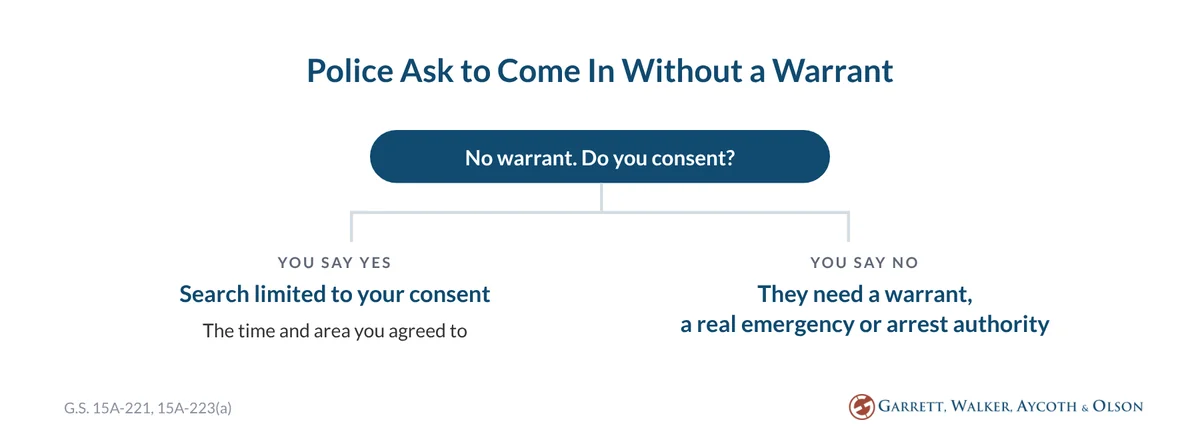
Officers may search without a warrant if consent is given (G.S. 15A-221). Consent means a statement, made voluntarily, that gives the officer permission to search.
For a home, consent must come from someone who, by ownership or otherwise, reasonably appears entitled to give or refuse it (G.S. 15A-222(3)).
You can limit consent, and the search may not go beyond the time or area you agreed to (G.S. 15A-223(a)). Say “the living room only,” and a locked bedroom safe is outside that consent.
When the search ends, the officer must list anything seized and give a receipt to the person who consented (G.S. 15A-223(b)).
Exigent Circumstances and Emergencies
Officers may enter with probable cause plus an emergency, such as evidence about to be destroyed. They may also enter to help someone seriously injured or threatened with injury (Brigham City v. Stuart).
There are limits. Police cannot create the emergency by violating or threatening to violate the Fourth Amendment (Kentucky v. King).
Chasing a fleeing misdemeanor suspect does not always justify entering a home; it depends on the facts (Lange v. California, 2021).
In State v. Marrero (2016), the N.C. Court of Appeals found that a possibly armed person inside and marijuana that could be destroyed justified a protective sweep.
Entering to Make an Arrest
Officers may enter a home to arrest someone when they have a warrant or other arrest authority, reasonable cause to believe the person is inside, and have given notice of their authority and purpose (G.S. 15A-401(e)).
Notice can be skipped only if it would clearly endanger life. Force is allowed if entry is denied or unreasonably delayed.
Without consent or an emergency, Payton v. New York bars a warrantless entry into a suspect’s home for a routine felony arrest.
Entering someone else’s home to find the person generally takes a search warrant, consent or an emergency (Steagald v. United States).
Plain View
Officers may seize an item in plain view without a warrant only if they have a lawful right of access to it and its criminal nature is immediately apparent (Horton v. California).
During a warrant search, North Carolina’s statute also lets officers take seizable items not listed in the warrant if they come across them inadvertently (G.S. 15A-253).
The Emergency Must Be Real, and It Has Limits
A separate statute, G.S. 15A-285, lets officers enter to save life or prevent serious harm. But seizing evidence cannot be justified by that section’s authority.
A constitutional emergency-aid entry, as in Brigham City, is a different rule that state law keeps (G.S. 15A-231). Your lawyer tests whether officers stayed within the emergency.
Here is how common situations line up with these rules.
| Situation | Can Police Come In or Search? | Rule |
|---|---|---|
| You say “come in” | Yes, within the limits you set | G.S. 15A-221, 15A-223 |
| Your roommate says yes, but you are there and say no | Not as to you | Georgia v. Randolph |
| Someone inside is hurt or threatened | Yes, to help | Brigham City v. Stuart |
| They chase a misdemeanor suspect inside | Only if the facts create an emergency | Lange v. California |
| They have an arrest warrant for you and believe you are home | They may enter to arrest | G.S. 15A-401(e) |
| A welfare check with no emergency | Not on “community caretaking” alone | Caniglia v. Strom |
Probation Searches Follow Different Rules
Probation changes the rules for probation officers, within limits. People on supervised probation must submit at reasonable times to warrantless searches of their home by a probation officer, while present, for purposes directly related to supervision (G.S. 15A-1343(b)(13)).
Police officers do not get that same power over your home. We cover probation officer searches of your home in a separate guide.
What to Do When Police Knock Without a Warrant
Stay calm and ask whether they have a warrant. You can talk through a closed door while you find out.
If they have no warrant and ask to come in or look around, you can say clearly: “I do not consent to a search.” A consent search needs a statement made voluntarily (G.S. 15A-221(b)).
Do not physically block officers or resist, even if you think they are wrong. Safety comes first, and your lawyer can challenge the entry later.
If they show a warrant, ask to read it. Before searching, the officer must read the warrant and give a copy of the application and affidavit to the person in apparent control (G.S. 15A-252).
Check what an NC warrant has to name, from the address to the items.
Do not discuss the case at the door. Write down names, times and what was said.
Talk to a defense lawyer before you talk to anyone else
What you say and sign in the first days often decides what is possible later. The earlier we see your paperwork, the more options you usually have.
Call (336) 379-0539Free consultation with a Greensboro attorneyRoommates, Spouses and Guests: Who Can Let Police In?
Anyone who reasonably appears entitled to allow or refuse a search of the home can consent to it (G.S. 15A-222(3)). A roommate or spouse who lives there may fit that description.
There is an important limit. If you are present and refuse, a co-occupant’s consent does not make a warrantless entry and search valid as to you (Georgia v. Randolph).
A person without authority over the space, such as a short-term guest, may not reasonably appear entitled to consent. Whether someone had that authority is a fact question your lawyer can raise.
What Happens If Police Search Your House Illegally?
Evidence from an illegal search can be thrown out, but only if your lawyer asks in time. On a timely motion, evidence must be suppressed if the U.S. or North Carolina Constitution requires it (G.S. 15A-974(a)).
It must also be suppressed after a substantial violation of North Carolina’s criminal procedure statutes. On that ground, evidence stays in if the officer had an objectively reasonable, good faith belief the actions were lawful.
With a lawyer, unlawfully obtained evidence can sometimes be kept out, depending on the facts of your case.
If the search turned up drugs, read about defending drug charges after a search of your home.
The facts that win these motions fade fast. Call (336) 379-0539 while you still remember who said what at the door.
Phones and Drug Dogs at Your Door
Your phone and your porch have their own rules. Police generally need a warrant to search the data on a phone, even one taken during an arrest (Riley v. California).
If officers want into your phone, learn whether police can make you unlock it.
A drug-sniffing dog on your porch is different from a knock. In Florida v. Jardines, the U.S. Supreme Court held that using a drug dog on a homeowner’s porch to investigate the home is a search.
Common Myths About Home Searches
Myth: Police need a warrant to knock. A “knock and talk” is generally a legitimate police activity, and in Marrero it was not a seizure.
Myth: Saying no lets them force their way in. Officers still need a warrant, a real emergency or arrest authority.
Myth: Anything they find can be used. Evidence must be suppressed when the Constitution requires it or after a substantial statutory violation (G.S. 15A-974).
How a Lawyer Challenges a Home Search
A lawyer challenges a home search by rebuilding exactly how officers got in and what they did inside.
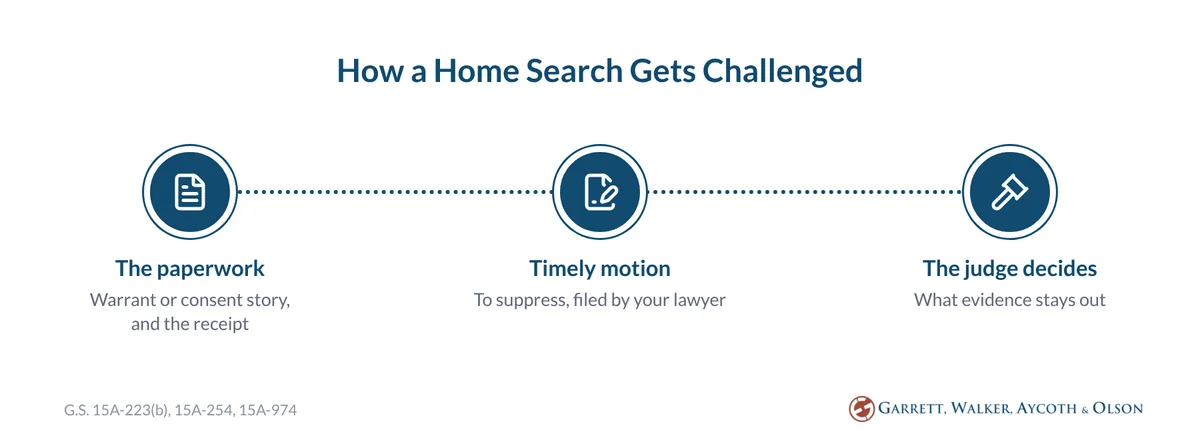
That starts with the paperwork: the warrant or the consent story, and the receipt for items taken (G.S. 15A-223(b) and G.S. 15A-254).
Next come video, reports and witness accounts, checked against the limits on consent, scope and emergencies.
Your lawyer may also look at challenging probable cause in your case.
Then your lawyer files a timely motion to suppress and argues it in Guilford County court. No lawyer can promise the result, but the challenge must be raised to count.
Call (336) 379-0539 and let our team review the search.
Frequently Asked Questions
Can police search a safe in my house?
Only if a warrant covers items that could be inside it, or your consent reaches it. A consent search cannot go beyond the area you agreed to (G.S. 15A-223(a)). A warrant search is limited to what is reasonably necessary to find the listed items (G.S. 15A-253).
Can police knock on my door to ask questions?
Yes. A knock and talk is generally a legitimate police activity, and in State v. Marrero it was not a seizure. A drug-sniffing dog on your porch is different: that is a search under Florida v. Jardines. Talking with officers is still your choice.
Can police come in if they hear a fight?
Yes, to help someone who is seriously injured or threatened with serious injury (Brigham City v. Stuart). Officers must stay within that emergency once they are inside. Whether they did is a question your lawyer can raise when challenging the search.
Can my landlord let police search my apartment?
Consent to search a home must come from someone who reasonably appears entitled to give or refuse it (G.S. 15A-222(3)). Whether a landlord fits that description depends on the facts. Call a lawyer to test whether the consent in your case was valid.
Can police search my house if they arrest me outside?
An arrest outside does not by itself give officers a warrant to search your house. Entering a home has its own rules under G.S. 15A-401(e) and Payton v. New York. If officers went inside, tell your lawyer where they went and what they opened.
What if I already said yes?
The search may not go beyond the time or physical scope of the consent you gave (G.S. 15A-223(a)). Write down exactly what you said and what officers opened or took. Then tell a lawyer, who can compare it with the receipt and the reports.
Can police come in to arrest a guest who is staying with me?
Not on an arrest warrant alone. To enter your home to look for someone else, officers generally need a search warrant, your consent or a real emergency (Steagald v. United States, 1981). G.S. 15A-401(e) adds notice rules. If officers came in for a guest, tell your lawyer exactly where they went and what they saw.
Do I have to open the door for police without a warrant?
A consent search needs your voluntary permission (G.S. 15A-221). You can speak through a closed door and say clearly that you do not consent. A warrant, a real emergency or arrest authority are different situations, so ask which one officers are relying on.
- Former President, Greensboro Criminal Defense Lawyers Association
- Elected member, Criminal Justice Section, North Carolina Bar Association
- Selected to present the Wade M. Smith Award for Top Criminal Defense Lawyer in North Carolina
Talk to a Greensboro criminal defense lawyer today
Bring the warrant, the release order and anything else they gave you.
Garrett, Walker, Aycoth & Olson, Attorneys at Law
317 South Greene St, Greensboro, NC 27401
(336) 379-0539
This article explains North Carolina law in general terms. It is not legal advice about your case, and laws, penalties and court procedures change. Contact an attorney about your specific situation.