


Short answer: No North Carolina law sets a deadline for issuing a criminal summons after a police report. Most misdemeanors must be charged within two years, and felonies have no time limit at all.
What it means for you: Once a summons is issued, the clock gets short. The court date usually cannot be more than one month away, and an officer brings the summons to you in person.
What a lawyer changes: A summons is not the end of the risk. A warrant can still be issued on the same charge, so a criminal lawyer should find out what has been filed and get ready before your date.
Think charges are coming? Call (336) 379-0539 to talk with our team today.
Waiting for a criminal summons is hard because nobody gives you a date. This guide gives you what the statutes actually say, not guesses.
If you think charges are coming, you can talk to a first appearance lawyer before anything is served. That way you hear from your own lawyer first, not from an officer at your door.
What Is a Criminal Summons?
A criminal summons is a court order to appear on a set date and answer a criminal charge. It is not an arrest, but the charge on it is real.
“A criminal summons consists of a statement of the crime or infraction of which the person to be summoned is accused, and an order directing that the person so accused appear and answer to the charges made against him.” G.S. 15A-303(a)
A summons must be based on probable cause shown under oath. Any official who can issue a warrant can issue a summons, such as a magistrate, a clerk or a judge (G.S. 15A-304(f)).
A summons is valid anywhere in North Carolina under G.S. 15A-303(f). For the parts of the form and what each line means, see how a criminal summons works in NC.
Timing: How Long Does It Take to Get a Criminal Summons?
There is no fixed number of days. No North Carolina statute says how soon a summons must be issued after an incident or a report.
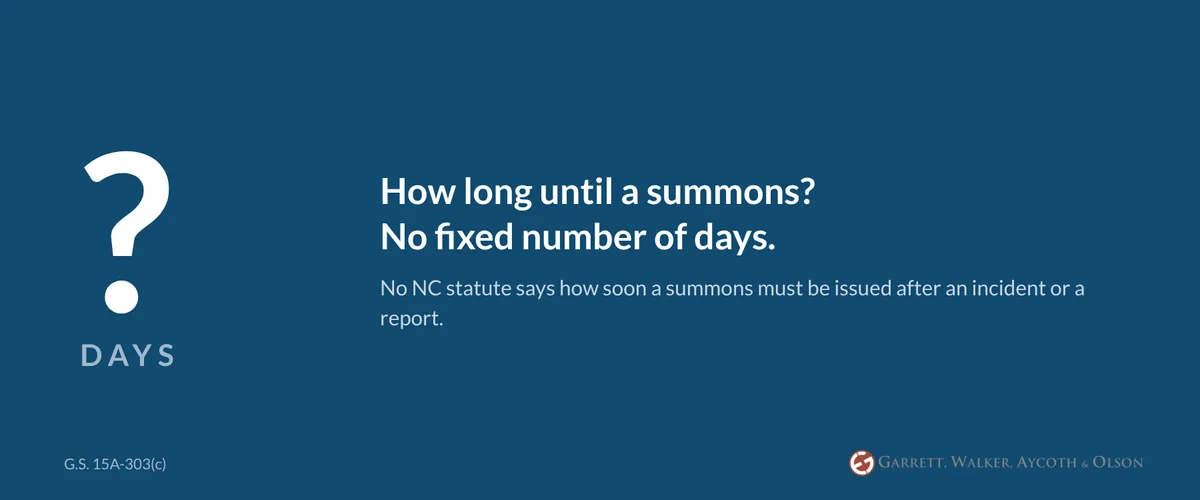
Why No One Can Give You a Number of Days
Before a summons exists, someone has to give sworn information to a magistrate or another official. That person can be an officer or a private person.
The official must then find probable cause, under the same test used for a warrant (G.S. 15A-303(c)). Nothing issues until that happens, and here is what probable cause means in court.
What Can Make It Faster or Slower
- Whether an officer investigates first, or a person goes straight to the magistrate.
- How much evidence has to be gathered before anyone asks for charges.
- Whether the official decides a warrant fits better than a summons.
- Whether officers can find you to serve the paper.
A slow case is not a dropped case. Silence for a few weeks does not mean the complaint went away.
The Outer Limits: Two Years for Most Misdemeanors, None for Felonies
Most misdemeanors “shall be charged within two years after the commission of the same” under G.S. 15-1(a). A few listed misdemeanors have a 10-year limit instead.
The two-year rule covers “all misdemeanors except malicious misdemeanors,” so misdemeanors the law treats as malicious are not covered by it. A lawyer should check which rule fits your charge.
Felonies have no time limit. The UNC School of Government quotes the NC Supreme Court in State v. Johnson: “In this State no statute of limitations bars the prosecution of a felony” (UNC School of Government).
Once It Is Issued: A Court Date Within One Month
The court date on a summons may not be set more than one month after it is issued or reissued, unless the official notes a reason (G.S. 15A-303(d)). So the wait before the summons can be long, but the time after it is short.
How Long After a Police Report Can a Summons or Warrant Be Issued?
A summons or warrant can be issued any time after an official finds probable cause, within the limits above. No statute counts days from the police report.
When an Officer Files the Charge
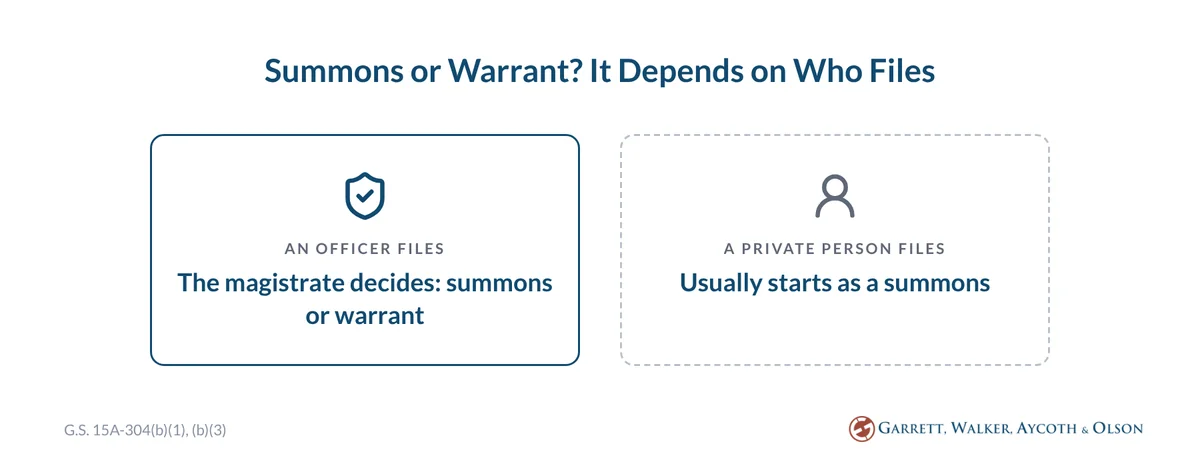
The officer gives sworn information to a magistrate, who decides between a summons and a warrant. Under G.S. 15A-304(b)(1), the official can weigh a past failure to appear, signs you will not appear, risk of escape, danger to people or property, and how serious the charge is.
When a Private Person Files Charges
A private person can also go to a magistrate, and that kind of complaint usually starts as a summons, with some exceptions (G.S. 15A-304(b)(3)). Learn how NC warrants and citizen complaints work before you assume which one you will get.
How a Criminal Summons Is Served in North Carolina
An officer serves a criminal summons in person. The statute does not list mail as a way to serve one.
Under G.S. 15A-301(b), any officer with authority for the offense may serve it. If you are called in to the agency to pick it up, a designated employee may serve it at the agency’s office.
| Rule | What It Means for You | Statute |
|---|---|---|
| Who serves it | An officer, or an agency employee when you are called in. You get a copy. | G.S. 15A-301(b), (c)(1) |
| Electronic copies | A printed copy must be served within 24 hours or destroyed. It can be printed again later. | G.S. 15A-301.1(k) |
| Paper summons not served | Goes back to the clerk after 90 days or the court date, whichever is earlier. | G.S. 15A-301(d)(2)c |
| Return to the clerk | Does not cancel the summons or later service. | G.S. 15A-301(d)(3) |
| Sent out again | The clerk can redeliver it. A reissued summons gets a new court date. | G.S. 15A-301(d)(4) |
Correction: A summons that was not served in 90 days has not expired. Under G.S. 15A-301(d)(3), a late return “does not invalidate the process.”
The Difference Between a Summons and a Warrant
A summons orders you to come to court, and a warrant orders officers to arrest you. Both need probable cause, and both can be issued by the same officials.
| Paper | Who Issues It | Are You Taken Into Custody? | Statute |
|---|---|---|---|
| Criminal Summons | Magistrate, clerk or judge | No, you are ordered to appear | G.S. 15A-303 |
| Warrant for Arrest | Magistrate, clerk or judge | Yes | G.S. 15A-304 |
| Citation | Officer | No, you are ordered to appear | G.S. 15A-302 |
| Order for Arrest | Magistrate, clerk or judge | Yes | G.S. 15A-305 |
Getting a summons does not rule out a warrant. A warrant can still be issued later on the same charge (G.S. 15A-303(e)(1)).
A ticket does not rule one out either. For a misdemeanor, a summons or warrant can issue even after a citation (G.S. 15A-302(f)).
Talk to a defense lawyer before you talk to anyone else
What you say and sign in the first days often decides what is possible later. The earlier we see your paperwork, the more options you usually have.
Call (336) 379-0539Free consultation with a Greensboro attorneyHow Are Summonses Issued in Guilford County and Greensboro?
Guilford County follows the same statewide statutes as every other county. Magistrates, the clerk and judges issue summonses here under G.S. 15A-304(f).
The summons is served by an officer with authority for the offense, such as a Greensboro, High Point or Guilford County Sheriff’s officer. Greensboro court dates are held at the Guilford County Courthouse, 201 South Eugene St, Greensboro, NC 27401.
Guilford County has used the eCourts system since April 29, 2024. A lawyer can check filed cases for you before you go near the courthouse.
What If the Summons Is Never Served, or You Miss the Court Date?
An unserved summons does not simply disappear. The clerk can send it out again with a new court date (G.S. 15A-301(d)(4)), or an official can issue a warrant instead (G.S. 15A-303(e)(1)).
Missing court after you were served is more serious. An order for arrest can issue (G.S. 15A-305(b)(3)), and a willful failure to appear can be punished as contempt (G.S. 15A-303(e)(3)).
If you already missed a date, call before you are picked up. We can ask to put the case back on the calendar, go to court for you and handle the case, depending on the facts of your case.
A missed date has its own consequences, so learn what an FTA charge means in NC.
What to Expect After Receiving a Summons
Your summons lists the court, the date and the time you must appear (G.S. 15A-303(d)). The summons itself does not arrest you, but the charge carries whatever punishment its statute authorizes.
On a felony, your first appearance is before a District Court judge under G.S. 15A-601(a). You do not have to appear personally at that hearing if your lawyer is there (G.S. 15A-601(d)).
If your summons is for a misdemeanor, see how our lawyers approach defending misdemeanor charges in Greensboro.
Proactive Steps for Those Anticipating a Summons
If you think a summons is coming, start now. These steps protect you without tipping anyone off.
- Call a criminal lawyer first. Your lawyer can find out what has been filed and plan your next move.
- Get copies of the paperwork. The clerk must give a defendant, for free, one copy of every criminal process filed against him (G.S. 15A-301(e)(3)). Your lawyer can request and read them for you.
- Know the warning signs. Read the signs you may have a warrant or a summons waiting.
- Keep your address current. Service is in person, so officers need to find you.
- Do not contact the person who made the report. Any contact can make your situation worse.
- Save your evidence. Keep texts, receipts, photos and the names of witnesses.
Think a summons or warrant is coming? Call (336) 379-0539 today, before anything is served.
Why Response Times Matter
The time to act is before the summons arrives. Once it is issued, your court date is usually about a month away (G.S. 15A-303(d)).
A summons can also be followed by a warrant (G.S. 15A-303(e)(1)). Witnesses forget details, and messages get deleted.
Early help can matter. An unserved summons must be recalled if the issuing official finds probable cause did not exist (G.S. 15A-301(g)(1)), and a lawyer can raise problems like that early, depending on the facts of your case.
How a Local Criminal Lawyer Makes a Difference
A lawyer turns a vague worry into a plan. Your lawyer finds the paperwork, reads the probable cause basis and prepares before the one-month court date.
Your lawyer can also speak with the prosecutor and stand with you in court. Call our criminal defense team in Greensboro before the court date, not after it.
Summary Table: Criminal Summons Process in NC
| Step | What Happens | Time Limit in the Statute |
|---|---|---|
| Report made | An officer or a private person reports the incident | None |
| Probable cause finding | Sworn information goes to a magistrate or other official | No deadline; most misdemeanors within 2 years, with exceptions (G.S. 15-1) |
| Summons issued | A court date is set | Within one month, unless cause is noted (G.S. 15A-303(d)) |
| Electronic copy printed | An officer tries to serve it | Serve within 24 hours or destroy (G.S. 15A-301.1(k)) |
| Paper summons unserved | Returned to the clerk | 90 days or the court date, whichever is earlier (G.S. 15A-301(d)(2)c) |
| Court date | You appear and answer the charge | As set on the summons |
Frequently Asked Questions
Can you go to jail for a criminal summons in NC?
A summons does not arrest you or take you into custody. The charge on it still carries whatever punishment its statute authorizes. If you are served and miss court, an order for arrest can issue under G.S. 15A-305(b)(3). A lawyer can explain what your specific charge carries.
Can you ignore a criminal summons?
No. A person served with a summons who willfully fails to appear may be punished for contempt under G.S. 15A-303(e)(3). An order for arrest may also issue under G.S. 15A-303(e)(2). If you cannot make the date, call a lawyer before the date, not after it.
Is a criminal summons served by mail in NC?
G.S. 15A-301(b) provides for service by a law enforcement officer. If you are called in to the agency, a designated employee may serve it there. The statute does not list mail. If someone tells you a summons came by mail, have a lawyer check the court file.
How long does it take to serve a warrant?
No statute sets a deadline to serve a warrant. A paper warrant that is not served within 180 days goes back to the clerk under G.S. 15A-301(d)(2)a. That return does not cancel the warrant. It can still be served later under G.S. 15A-301(d)(3).
Can a criminal summons turn into a warrant?
Yes. Under G.S. 15A-303(e)(1), a warrant for arrest may be issued on the same charge even after a summons was issued. Missing your court date can also lead to an order for arrest. That is why it pays to have a lawyer involved early.
Can someone file charges against me without the police?
Yes. In North Carolina, a private person can give sworn information to a magistrate, and that kind of complaint usually starts as a summons, with some exceptions (G.S. 15A-304(b)(3)). A lawyer can read what was filed and tell you which one to expect.
How do I find out if a criminal summons was issued for me?
The clerk must give a defendant, without charge, one copy of every criminal process filed against him under G.S. 15A-301(e)(3). The safest route is to have your lawyer check and request copies. That way you learn what exists before anyone serves you.
Will I be arrested at court if I show up on a summons?
The summons itself does not authorize an arrest. A separate warrant or order for arrest could, if one exists. Have your lawyer check the court records before your date. Then you walk in knowing what is on file and with someone beside you.
How long does it take to get a citation in the mail?
Under G.S. 15A-302(d), a copy of a citation is delivered to the person cited. The statute does not provide for mailing. The only other method it names is for parking tickets, which can be left on the vehicle. If you expect a citation that never came, ask a lawyer to check.
- Former President, Greensboro Criminal Defense Lawyers Association
- Elected member, Criminal Justice Section, North Carolina Bar Association
- Selected to present the Wade M. Smith Award for Top Criminal Defense Lawyer in North Carolina
Talk to a Greensboro criminal defense lawyer today
Bring the warrant, the release order and anything else they gave you.
Garrett, Walker, Aycoth & Olson, Attorneys at Law
317 South Greene St, Greensboro, NC 27401
(336) 379-0539
This article explains North Carolina law in general terms. It is not legal advice about your case, and laws, penalties and court procedures change. Contact an attorney about your specific situation.