


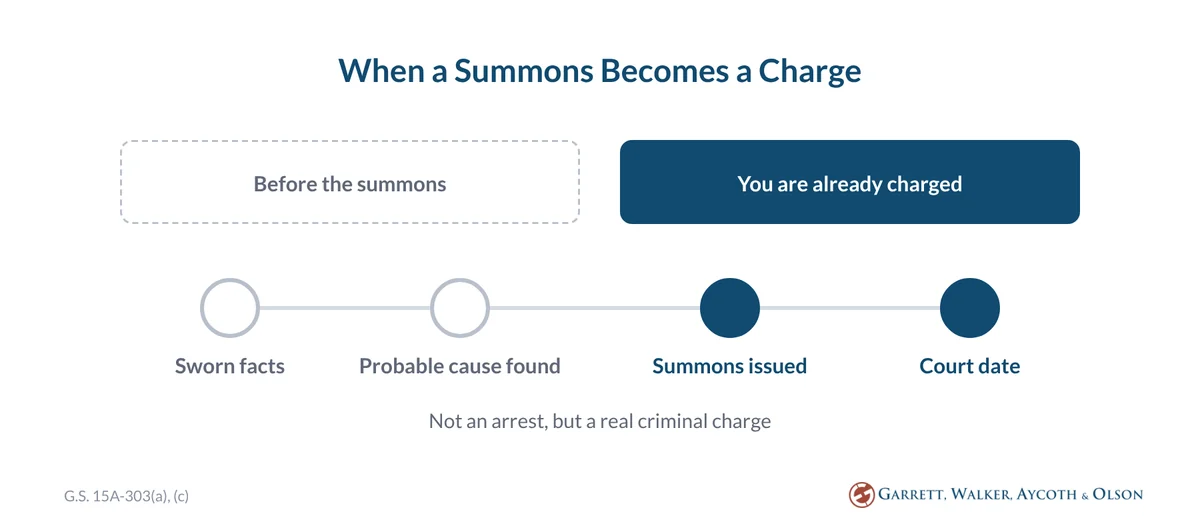
A criminal summons is a criminal charge, signed by a magistrate or other judicial official, that orders you to appear in court on a set date instead of being arrested. It is issued on sworn probable cause, the same showing a warrant needs.
So a summons is not a notice you can set aside. Treat it as a real charge from the day it reaches you.
Many people get one after a neighbor, a store or an officer goes to a magistrate. This guide explains what the paper means.
Got a summons in Greensboro or High Point? Call (336) 379-0539 before your court date.
Our misdemeanor defense lawyers in Greensboro can review the charge before you walk into court.
What a Criminal Summons Means in North Carolina
A criminal summons is a written charge plus an order to come to court. The statute says:
“A criminal summons consists of a statement of the crime or infraction of which the person to be summoned is accused, and an order directing that the person so accused appear and answer to the charges made against him.” G.S. 15A-303(a)
The showing of probable cause for a summons is the same as for a warrant for arrest (G.S. 15A-303(c)). Someone swore to facts, and a judicial official found them strong enough to charge you.
Any official who can issue arrest warrants can issue a summons, and it is valid throughout the State (G.S. 15A-303(f)).
In a misdemeanor case in district court, the summons can itself serve as the State’s charging paper, unless the prosecutor files a statement of charges (UNC School of Government).
When a private citizen is the only one swearing to the facts, the law usually calls for a summons rather than a warrant. Read when a citizen complaint leads to a summons instead of a warrant.
How to Read Your Criminal Summons
Each part of your summons has a legal job. Here is what to look for.
The Charge
The summons must state the crime or infraction you are accused of (G.S. 15A-303(b)). It tells your lawyer which law applies.
A technical wording slip does not void the summons if the statement is enough to identify the crime. Your lawyer checks whether it is.
The Court, Date and Time
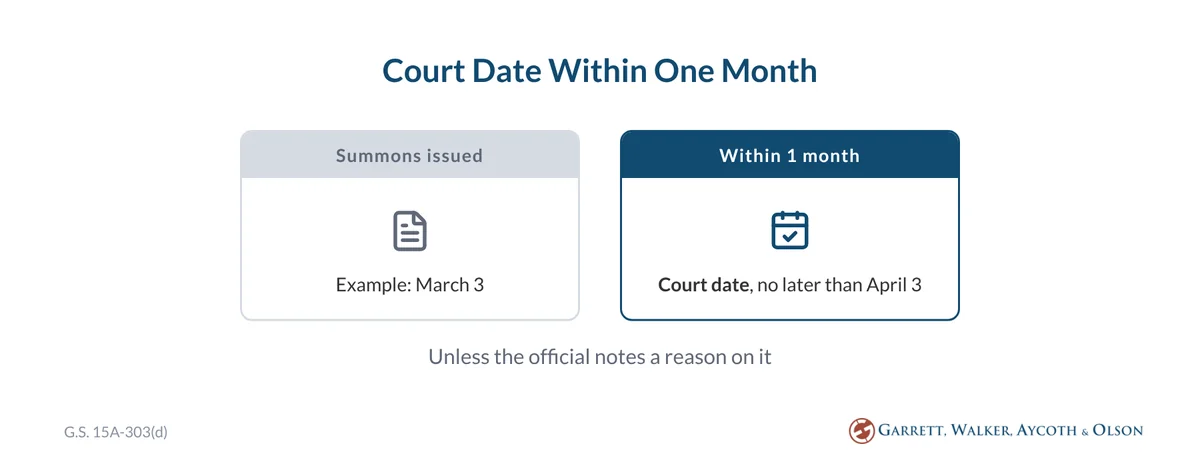
The summons must order you to appear in a named court at a set time and date (G.S. 15A-303(d)).
That date can be no more than one month after the summons is issued, unless the official notes a reason on it. A summons issued on March 3 should show a court date no later than April 3.
The Contempt Warning
The summons must also warn you that you may be held in contempt of court if you fail to appear (G.S. 15A-303(d)). Take that warning seriously.
Who Signed It
Criminal process other than a citation must be signed and dated by the judicial official who issued it (G.S. 15A-301(a)(2)). Look for that signature and date.
Lost It? Get a Free Copy
If you lost the paper, the clerk must give you one free copy of every criminal process filed against you when you ask (G.S. 15A-301(e)(3)).
Criminal Summons vs. Warrant vs. Citation vs. Magistrate’s Order
A summons is one of four papers that can start a criminal case. The biggest difference is who issues it.
| Paper | Who Issues It | What It Orders | Can It Be the Charging Paper? |
|---|---|---|---|
| Criminal Summons | A judicial official (G.S. 15A-303(f)) | Appear in court on a set date | Yes, for a misdemeanor |
| Warrant for Arrest | A judicial official (G.S. 15A-304(f)) | Arrest and hold you to answer the charge | Yes, for a misdemeanor |
| Citation | The officer (G.S. 15A-302(a)) | Appear and answer a misdemeanor or infraction | Yes, for a misdemeanor |
| Magistrate’s Order | A magistrate, after an arrest without a warrant (G.S. 15A-511(c)) | Finds probable cause for detention | Yes, for a misdemeanor |
A UNC School of Government study found that, statewide in 2018, 32.9% of misdemeanor cases begun by a summons or a warrant began with a summons. So most of those cases still started with an arrest warrant.
Each of these can be the charging paper for a misdemeanor in district court. A civil summons is different: it starts a lawsuit.
If you are not sure which paper you got, start with the legal meaning of a warrant.
Talk to a defense lawyer before you talk to anyone else
What you say and sign in the first days often decides what is possible later. The earlier we see your paperwork, the more options you usually have.
Call (336) 379-0539Free consultation with a Greensboro attorneyService, Court Date and Missing It: The Short Version
An officer serves the summons, and the court date comes fast. We explain how summonses are served and timed in a separate guide.
Missing court on a served summons can lead to an order for arrest (G.S. 15A-305(b)(3)). A willful no-show can also be punished as contempt (G.S. 15A-303(e)(3) and G.S. 5A-11).
A separate failure to appear crime covers people released on bond or other pretrial conditions (G.S. 15A-543). Learn when the separate failure to appear charge applies.
If you already missed your summons court date, a lawyer can often put the case back on the calendar before day 20, depending on the facts.
On a motor vehicle charge, a missed court date can lead DMV to revoke your license, effective on the 60th day after the order is mailed or delivered (G.S. 20-24.1(a)).
If the charge is resolved before that day, the revocation order is deleted (G.S. 20-24.1(c)). A lawyer can often resolve it before day 60, depending on the facts of your case.
Already past a date? Call (336) 379-0539 now.
Does a Criminal Summons Go on Your Record?
Yes, the summons becomes part of your court record. It is filed as criminal process in the clerk’s records, on paper or in the statewide Electronic Repository (G.S. 15A-301(a)(1)).
A charge is not a conviction. The summons shows that you were accused, not that you were found guilty.
If the charge is dismissed, you or the district attorney can petition the court to expunge it (G.S. 15A-146(a)). Ask us about getting a dismissed summons charge expunged.
A lawyer can review the evidence and talk with the prosecutor before your court date, and the result depends on the facts of your case.
First Steps After You Get a Criminal Summons
Your first steps protect your court date and your defense. Take them the day the summons arrives.
Put the date where you will see it. Add the court, date and time to your phone and your calendar.
Keep the paper. Store the summons and any copy in one safe place.
Do not contact the accuser about the case. Messages and calls can become evidence.
Write down what happened. Note names, times and witnesses while you still remember them.
Talk to a lawyer before the date. Here is what happens at your first court date in district court.
Talk to the criminal defense team at our firm before you say anything to the other side.
Call (336) 379-0539 for help with a summons in Greensboro.
Frequently Asked Questions
Is a criminal summons the same as a citation?
No. A citation is written by a law enforcement officer for a misdemeanor or infraction (G.S. 15A-302(a)). A criminal summons is issued by a judicial official, such as a magistrate, after sworn facts show probable cause (G.S. 15A-303). Both order you to court.
Does a criminal summons show up on a background check?
The summons is kept in the clerk’s records as criminal process (G.S. 15A-301(a)(1)), so it is part of the court file. If the charge is later dismissed, you can petition to expunge it (G.S. 15A-146(a)). A lawyer can explain that petition.
Is a summons the same as being charged?
Yes. A summons states the crime you are accused of (G.S. 15A-303(b)) and orders you to answer it. In a district court misdemeanor case, the summons can itself be the State’s charging paper. Treat it as a real charge from day one.
Can a criminal summons be withdrawn before it is served?
An unserved summons must be recalled by the issuing official if that official decides probable cause did not exist (G.S. 15A-301(g)(1)). That decision belongs to the official, not the person who complained. A lawyer can tell you whether to ask.
Who signs a criminal summons?
Any official allowed to issue arrest warrants, such as a magistrate, clerk or judge, may sign one (G.S. 15A-303(f)). The summons must be signed and dated by the official who issues it (G.S. 15A-301(a)(2)). An officer does not sign it.
What if my summons has a mistake in the charge?
A technicality of pleading does not make a summons invalid if the statement is enough to identify the crime (G.S. 15A-303(b)). Some mistakes matter more than others. Bring the summons to a lawyer, who can check whether the error affects your defense.
Is a criminal summons the same as a civil summons?
No. A criminal summons charges a crime or infraction and orders you to answer it in criminal court (G.S. 15A-303(a)). A civil summons starts a lawsuit between private parties, such as a debt case. Read the top of the paper carefully.
Can a criminal summons charge an infraction?
Yes. A criminal summons states the crime or infraction you are accused of (G.S. 15A-303(a)), and the same court date and contempt warning apply (G.S. 15A-303(d)). Read the charge line to see which one you face, and ask a lawyer what it can carry.
- Former President, Greensboro Criminal Defense Lawyers Association
- Elected member, Criminal Justice Section, North Carolina Bar Association
- Selected to present the Wade M. Smith Award for Top Criminal Defense Lawyer in North Carolina
Talk to a Greensboro criminal defense lawyer today
Bring the warrant, the release order and anything else they gave you.
Garrett, Walker, Aycoth & Olson, Attorneys at Law
317 South Greene St, Greensboro, NC 27401
(336) 379-0539
This article explains North Carolina law in general terms. It is not legal advice about your case, and laws, penalties and court procedures change. Contact an attorney about your specific situation.