


Maintaining a dwelling under G.S. 90-108(a)(7) is a Class 1 misdemeanor unless the charge alleges you acted intentionally and that is specifically found at trial. Only then is it a Class I felony, and it can cover a home, car, boat or any other place.
Many people see “felony” next to this charge and assume the worst. Others assume it will simply be dropped, and neither is automatic.
Whether you face felony maintaining a dwelling or the misdemeanor, and whether the State can prove you “kept” the place, is what your lawyer tests first.
Have a Greensboro drug charge lawyer read the exact charging language before your first court date. If your warrant or eCourts record shows this charge, call (336) 379-0539 today.
What Maintaining a Dwelling Means Under G.S. 90-108(a)(7)
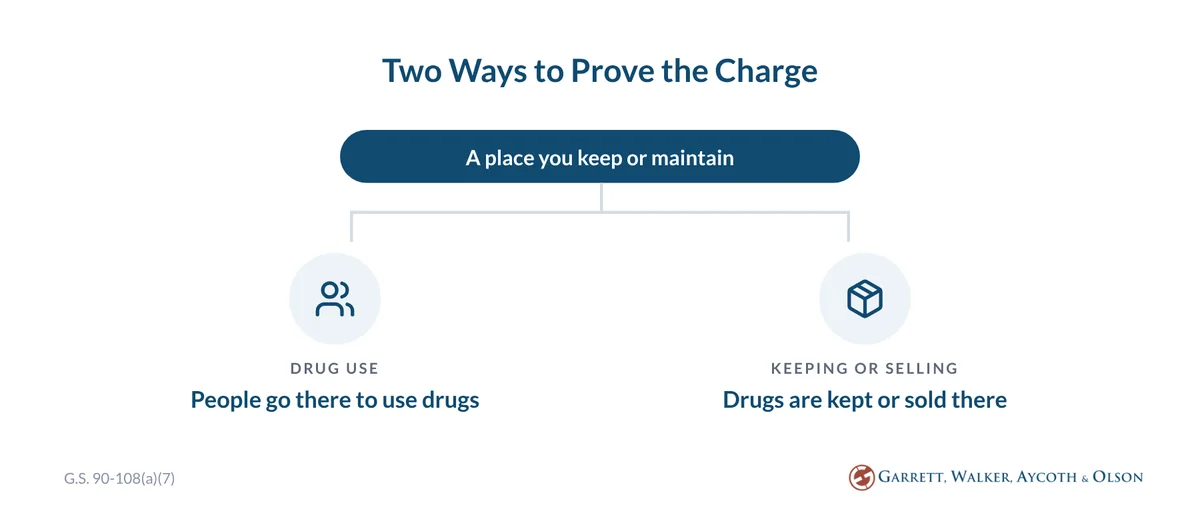
The law makes it a crime to knowingly keep or maintain a place that drug users go to in order to use drugs. It is also a crime to keep or maintain a place used for keeping or selling drugs.
“To knowingly keep or maintain any store, shop, warehouse, dwelling house, building, vehicle, boat, aircraft, or any place whatever, which is resorted to by persons using controlled substances … or which is used for the keeping or selling of the same” G.S. 90-108(a)(7)
The word “dwelling” is only one item on that list. A car, truck, boat, store, warehouse or “any place whatever” can be charged the same way.
So a charge for maintaining a vehicle is the same offense, under the same statute, with the same classes.
The charge can rest on either of two uses: people going there to use drugs, or the place being used to keep or sell them.
It is rarely charged alone. It is often filed next to a possession with intent to sell charge or a simple possession count from the same search.
Is Maintaining a Dwelling a Felony in NC?
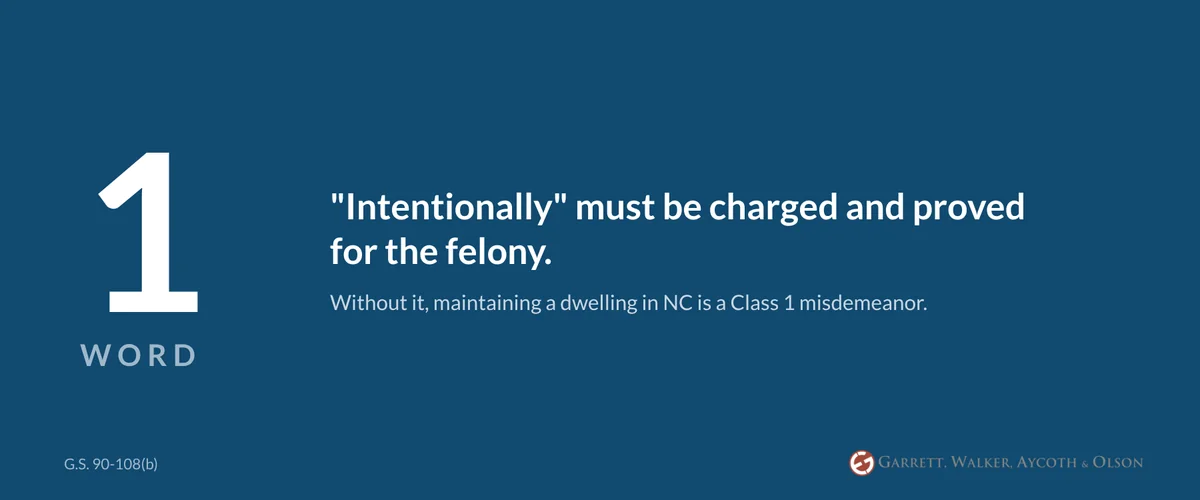
Not by default. Under G.S. 90-108(b), maintaining a dwelling is a Class 1 misdemeanor.
The statute makes it a Class I felony only on one condition:
“if the criminal pleading alleges that the violation was committed intentionally, and upon trial it is specifically found that the violation was committed intentionally” G.S. 90-108(b)
That makes the charging paper the first thing your lawyer reads. If the warrant or indictment does not allege intent, the felony is not on the table under that paper.
One word in the charge decides the class: the felony needs the State to allege, and prove, that you acted intentionally.
Fortifying the place to keep police out, by barricading windows and doors, is also punished as a Class I felony under G.S. 90-108(b)(1).
Court records shorten the charge, for example “MAINTN VEH/DWELL/PLACE CS”, sometimes followed by a letter. Do not guess from the code; your lawyer reads the warrant to confirm which version you face.
If the felony is charged, see the sentence range for a Class I felony in North Carolina.
What “Keep or Maintain” Means: Owning, Renting, Living There
The State must show you kept or maintained the place. Courts decide that from the totality of the circumstances, according to the UNC School of Government.
The facts courts weigh include:
- Owning the property or holding title to it
- Paying the rent
- Paying the utility bills
- Paying for repairs or upkeep
- Having keys, and how long you were there
- Living there as your home
Living there can be enough on its own. Simply being present, as a guest, is not.
In State v. Rogers, 371 N.C. 397 (2018), the North Carolina Supreme Court held that “keeping” drugs means storing them. The Court did not require any set length of time, which made the charge easier to prove.
The School of Government’s summary of Rogers adds a limit: merely having drugs in a car or place is not enough. The facts must show the drugs were being stored there.
Roommates, guests and family members raise the same question: who controlled the place, and who knew? Control is also how constructive possession is proved in a drug case.
If the place is shared, or the car is not yours, call (336) 379-0539 before you explain anything to police or a landlord. What you say about control can become the State’s evidence.
Talk to a defense lawyer before you talk to anyone else
What you say and sign in the first days often decides what is possible later. The earlier we see your paperwork, the more options you usually have.
Call (336) 379-0539Free consultation with a Greensboro attorneyPenalties: The Misdemeanor and the Felony Side by Side
The sentence depends on the class of the charge and your prior record level.
| Version | Class | Sentence Range | Source |
|---|---|---|---|
| Misdemeanor (no prior convictions) | Class 1 misdemeanor | 1-45 days, community punishment; fine at the court’s discretion | G.S. 15A-1340.23 |
| Felony, intent alleged and found (Level I) | Class I felony | 4-6 months presumptive minimum, community punishment | G.S. 15A-1340.17 |
| Felony at the highest record level (Level VI) | Class I felony | Aggravated minimum up to 10-12 months, maximum up to 24 months | G.S. 15A-1340.17(c), (d) |
Where the grid calls for community punishment, the court must suspend the active term under G.S. 15A-1340.20(c). Probation, fines and a drug record can still follow.
Your record level is argued by your lawyer, not assumed. A single misread conviction can move you up a level.
A felony conviction also bars you from owning or possessing a firearm under G.S. 14-415.1(a). The same record level rules apply to the other criminal charges we defend in Guilford County.
Defenses: What Your Lawyer Tests First
Your lawyer checks five things first: the first four are what the State must prove, and the fifth is how the evidence was found.
No Control of the Place
You were not on the lease, did not pay the bills and did not live there. A visitor does not keep or maintain a place.
No Knowledge
The statute says “knowingly.” The State must prove you knew what the place was being used for.
No Keeping, Selling or Using Purpose
Drugs merely being in the place are not enough. The State must show, from the totality of the circumstances, that the place was used to store, sell or use drugs.
Rogers rejected any rule that drugs must be found there more than once. One occasion can be enough, so the facts around that occasion are what your lawyer tests.
No Intent Alleged or Found
Without an intent allegation and a specific finding, the charge stays a Class 1 misdemeanor under G.S. 90-108(b).
An Unlawful Search
Evidence can be thrown out if police broke the rules on searching a home without a warrant. If a gun turned up in the same search, read about the added risk when a gun is found with drugs.
Any of these can change the charge or the outcome, depending on the facts of your case. Each one is raised and argued by your lawyer, not granted.
Reduced Charges and Conditional Discharge
A misdemeanor or Class I felony can sometimes end in a conditional discharge. That needs a joint motion of your lawyer and the prosecutor under G.S. 15A-1341(a4).
The judge must also find four facts. They include that you have no prior felony and have never been on probation.
The first-offender program in G.S. 90-96 is written for drug possession offenses. Maintaining a dwelling is not on its list, so any path to it runs through a negotiated plea.
The class is fixed by the charging language, so the sooner your lawyer reads it, the more room there is before any plea is discussed. That is why the first call should come before your first court date, not after.
Call (336) 379-0539 to talk to our drug defense team about which version you face.
Frequently Asked Questions
Is maintaining a dwelling a felony in NC?
Only in some cases. Under G.S. 90-108(b), it is a Class 1 misdemeanor unless the charge alleges you acted intentionally and that is specifically found at trial. Then it is a Class I felony. Fortifying the place against police entry is also punished as a Class I felony.
Can a car count as a “dwelling”?
Yes. The statute lists a vehicle, boat and aircraft, along with “any place whatever.” A charge for maintaining a vehicle is the same offense under G.S. 90-108(a)(7), with the same misdemeanor and felony versions. The question is still whether you kept the car and knew how it was used.
What if drugs were found in a house I share?
The State must prove you kept or maintained the house and knew how it was used. Living there can be enough, but simply being present is not. Courts look at rent, bills, keys and other facts. Call a lawyer before you explain anything to police.
Is conspiracy to maintain a dwelling a lesser charge?
No. Under G.S. 90-98, a conspiracy to commit a drug-law offense is the same class as the offense itself. The usual one-class-lower rule in G.S. 14-2.4(a) does not apply, because it yields to a different classification.
How much jail time for maintaining a dwelling?
With no prior record, the misdemeanor carries 1-45 days of community punishment. The felony carries a 4-6 month presumptive minimum, also community punishment at Level I. A higher record level raises the range and allows active time. Your lawyer argues the level.
Does the State have to show drugs were there more than once?
No. Drugs merely present are not enough, but one occasion can be. In State v. Rogers (2018), the Supreme Court said keeping means storing and required no set length of time. The facts around that one occasion are what your lawyer tests.
Can I get a conditional discharge for maintaining a dwelling?
Possibly, but only on a joint motion of your lawyer and the prosecutor under G.S. 15A-1341(a4). The judge must also find that you have no prior felony and have never been on probation. The G.S. 90-96 program does not list this offense.
Will a felony conviction affect my gun rights?
Yes. Any felony conviction, including a Class I felony for maintaining a dwelling, bars you from owning or possessing a firearm under G.S. 14-415.1(a). Keeping the case a misdemeanor, or ending it without a conviction, protects that right, depending on the facts of your case.
- Former President, Greensboro Criminal Defense Lawyers Association
- Elected member, Criminal Justice Section, North Carolina Bar Association
- Selected to present the Wade M. Smith Award for Top Criminal Defense Lawyer in North Carolina
Talk to a Greensboro criminal defense lawyer today
Bring the warrant, the release order and anything else they gave you.
Garrett, Walker, Aycoth & Olson, Attorneys at Law
317 South Greene St, Greensboro, NC 27401
(336) 379-0539
This article explains North Carolina law in general terms. It is not legal advice about your case, and laws, penalties and court procedures change. Contact an attorney about your specific situation.