


A Class I felony is the lowest of North Carolina’s ten felony classes, but it is still a felony conviction. The chart in G.S. 15A-1340.17 sets minimum terms of 3 to 12 months and maximums up to 24 months, depending on your prior record.
There is no “Class 1 felony” in North Carolina. Class 1 is a misdemeanor class, so check your papers for the letter I.
If you were charged in Greensboro or Guilford County, where your case lands on that chart is argued by your lawyer, depending on the facts of your case.
Talk with a Greensboro felony defense lawyer before your first court date. Call (336) 379-0539 today.
What a Class I Felony Means in North Carolina
North Carolina sorts felonies into ten classes, from Class A, the most serious, down to Class I. Class I is the bottom row of the felony sentencing chart.
At Prior Record Level I, the lowest record level, the chart sets these starting points:
| Felony Class | Chart at Prior Record Level I | Presumptive Minimum at Level I |
|---|---|---|
| Class A | Life with or without parole, or death, as set by statute | None |
| Class B1 | Active | 192-240 months |
| Class B2 | Active | 125-157 months |
| Class C | Active | 58-73 months |
| Class D | Active | 51-64 months |
| Class E | Intermediate or active | 20-25 months |
| Class F | Intermediate or active | 13-16 months |
| Class G | Intermediate or active | 10-13 months |
| Class H | Community, intermediate or active | 5-6 months |
| Class I | Community | 4-6 months |
If your charge is one step up, see how a Class H felony compares. For the serious end of the chart, see what a Class C felony charge means.
Is There a Class 1 Felony in NC?
No. North Carolina uses letters for felony classes and numbers for misdemeanor classes, which are A1, 1, 2 and 3 (G.S. 15A-1340.23).
For example, unauthorized use of a car is a Class 1 misdemeanor under G.S. 14-72.2(b), not a felony.
Attempting or conspiring to commit a Class I felony is a Class 1 misdemeanor, unless the statute says otherwise (G.S. 14-2.5 and G.S. 14-2.4(a)).
A Felony With No Class Is Treated as Class I
If a statute makes something a felony but gives it no class, G.S. 15A-1340.17(a) treats it as a Class I felony.
What Is the Punishment for a Class I Felony?
The judge finds your prior record level, then picks a minimum term from that box on the chart. The maximum follows from a second table.
| Prior Record Level | Points | What the Chart Authorizes | Presumptive Minimum | Lowest to Highest Minimum |
|---|---|---|---|---|
| I | 0-1 | Community | 4-6 months | 3-8 months |
| II | 2-5 | Community or intermediate | 4-6 months | 3-8 months |
| III | 6-9 | Intermediate | 5-6 months | 4-8 months |
| IV | 10-13 | Intermediate or active | 6-8 months | 4-10 months |
| V | 14-17 | Intermediate or active | 7-9 months | 5-11 months |
| VI | 18+ | Intermediate or active | 8-10 months | 6-12 months |
Each minimum has a set maximum under G.S. 15A-1340.17(d). A 4-month minimum carries a 14-month maximum, 6 carries 17, 10 carries 21, and the top minimum of 12 carries 24.
Community punishment means no active prison term and no special probation (G.S. 15A-1340.11). Intermediate punishment means supervised probation, which can include special probation.
Under special probation, the court suspends the prison term but also requires one or more periods in custody (G.S. 15A-1351(a)). Active punishment means prison time that is not suspended.
Key point: At Level I the chart authorizes community punishment only for a Class I. From Level IV up, it authorizes intermediate or active punishment, so prison becomes a real option.
Which level you are sentenced at, and which range, is argued by your lawyer, not assumed.
A fine can be added at the court’s discretion. Where community punishment is authorized, the judgment may be a fine only (G.S. 15A-1340.17(b)).
Not sure of your record level? Call (336) 379-0539 so a lawyer can count your points before you talk about any plea.
How Your Prior Record Changes a Class I Sentence
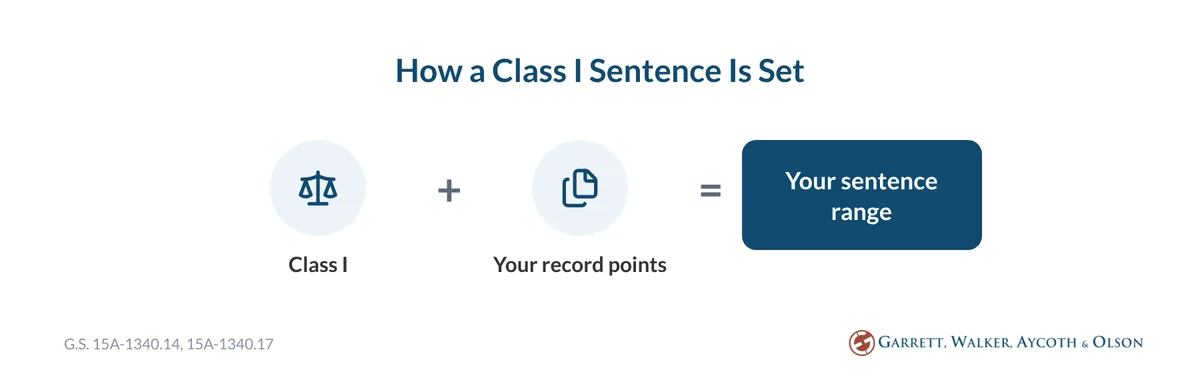
Your prior record level comes from points for past convictions, under G.S. 15A-1340.14.
Each prior Class H or I felony adds 2 points. Each prior Class A1 or Class 1 nontraffic misdemeanor, or a prior impaired driving conviction, adds 1 point.
A prior Class E, F or G felony adds 4 points, and a prior Class B2, C or D felony adds 6. One more point is added if the new offense happened while you were on probation, parole or post-release supervision.
One prior Class 1 misdemeanor is 1 point, which is Level I. A second one makes 2 points, which is Level II.
Class I plus your record points decides your box on the chart.
Errors in a criminal record printout can happen, so your lawyer checks every point.
Common Charges That Are Class I Felonies in NC
Many Class I felonies are property, fraud or drug possession charges.
| Charge | Statute | Watch For |
|---|---|---|
| Forgery of a Check or Other Instrument | G.S. 14-119(a) | Transporting or possessing five or more is Class G |
| Uttering a Forged Instrument | G.S. 14-120 | Trying to pass it counts too |
| Financial Transaction Card Theft | G.S. 14-113.9 and 14-113.17(b) | Taking or keeping a card to use it |
| Breaking or Entering a Motor Vehicle | G.S. 14-56 | Class H or higher above $1,500 taken |
| Possession of a Schedule I Drug (Such as Heroin) | G.S. 90-95(d)(1) | Heroin cases cannot be expunged later |
| Possession of Cocaine or Methamphetamine | G.S. 90-95(d)(2) | Meth cases cannot be expunged later |
| Possession of More Than 1.5 Ounces of Marijuana | G.S. 90-95(d)(4) | Over 1/2 ounce up to 1.5 is a misdemeanor |
| Making, or Possessing With Intent to Sell, a Schedule III-VI Drug | G.S. 90-95(b)(2) | Selling it is Class H |
| Maintaining a Place or Vehicle for Drugs | G.S. 90-108(a)(7), (b) | Class 1 misdemeanor unless found intentional |
| Larceny of Motor Vehicle Parts | G.S. 14-72.8 | Repair cost $1,000 or more, or any catalytic converter |
| Second Unlawful Business Entry | G.S. 14-54(b1) | First offense is a Class 1 misdemeanor |
Fentanyl possession is a Class H felony, one step higher, under G.S. 90-95(d)(2).
For a car break-in, $1,500 in goods taken is still Class I, unless it is a police or military vehicle and you knew or should have known that. $1,500.01 makes it Class H (G.S. 14-56(a2)).
Uttering has its own rules; see what counts as uttering a forged instrument. For drug cases, see drug possession charges in Greensboro.
Talk to a defense lawyer before you talk to anyone else
What you say and sign in the first days often decides what is possible later. The earlier we see your paperwork, the more options you usually have.
Call (336) 379-0539Free consultation with a Greensboro attorneyCan a Class I Felony Stay Off Your Record?
North Carolina law has three paths that can end a Class I case without a conviction, and none is automatic.
Deferred prosecution is for a person charged with a Class H or I felony who has no prior felony or moral-turpitude misdemeanor and has never been on probation (G.S. 15A-1341(a1)).
A conditional discharge comes after a guilty plea or finding. When you complete probation, the plea is withdrawn and the case is dismissed (G.S. 15A-1341(a4), (a6)).
First felony drug possession has its own rule. After a guilty plea or finding, with no prior felony or drug conviction, G.S. 90-96(a) says the court “shall” defer and place you on probation with your consent.
The exception is a written finding, with the DA’s agreement, that you are not suitable. On completion the case is dismissed, and this can happen only once.
Deferred prosecution and a conditional discharge need a joint motion by you and the prosecutor, and 90-96 has its own conditions. So your lawyer asks for the path you qualify for and argues it, depending on the facts of your case.
Collateral Consequences of a Class I Felony
A Class I conviction is still a felony record, and its effects reach past the sentence.
Any felony conviction bars you from owning or possessing a firearm under North Carolina law (G.S. 14-415.1(a)).
Voting and other citizenship rights come back automatically only at unconditional discharge, so not until any probation is over (G.S. 13-1).
A Class I conviction also adds 2 points to any later felony sentence. Every felony also counts toward a habitual felon charge; see how habitual felon status stacks felonies.
A felony record can also affect jobs, housing and licenses. If you are not a U.S. citizen, ask about immigration consequences before any plea.
Can a Class I Felony Be Expunged in NC?
Many Class I felonies can be expunged, after a long wait. Under G.S. 15A-145.5, the wait runs from the conviction, or from the end of the sentence and probation, whichever is later.
One Class I conviction means a 10-year wait; two or three mean 20.
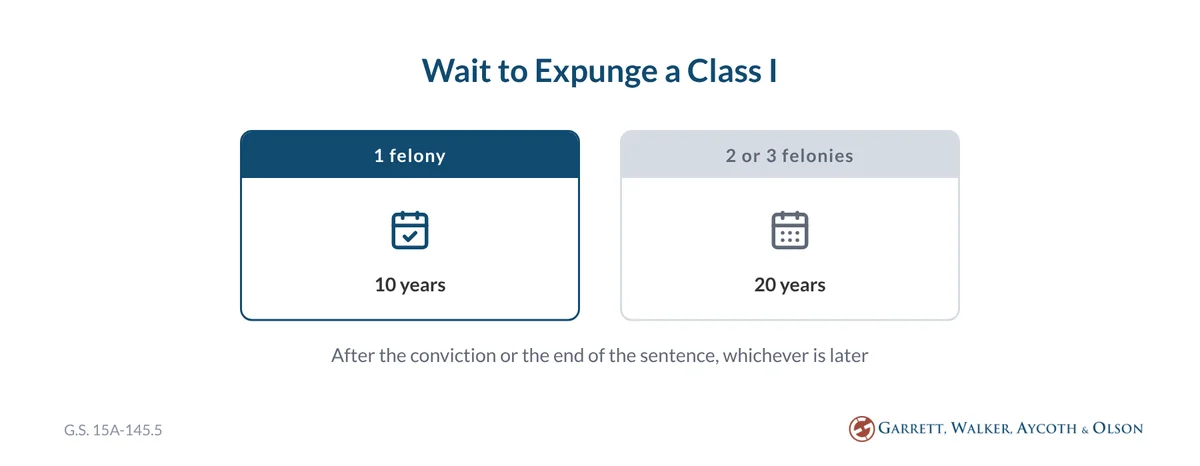
Convictions entered in the same session of court count as one (G.S. 15A-145.5(b)).
Some Class I offenses are never eligible: felony drug offenses involving methamphetamine or heroin, offenses that require sex offender registration, and a few others.
The judge “may” grant the petition, and you must swear that no restitution is owed.
A dismissed charge is different: the court “shall order” expunction on petition (G.S. 15A-146(a)).
When the wait is over, here is how expunction works for a felony in NC.
What Happens After a Class I Felony Charge in Greensboro
A Class I case starts with an arrest or a summons, then bond and a first appearance in Guilford County District Court.
A felony then moves up by indictment; see how a Superior Court indictment works.
Do not give statements to police without a lawyer. Keep texts, receipts and records that show your side.
The paths that avoid a conviction depend on your record and on what happens before a plea. Call before your first court date.
A Greensboro criminal defense attorney can look at your record before any plea talk.
Call (336) 379-0539 to talk with our felony defense team in Greensboro.
Frequently Asked Questions
Is a Class 1 felony the same as a Class I felony?
No. North Carolina has no Class 1 felony. Class 1 is a misdemeanor class under G.S. 15A-1340.23, while felony classes use the letters A through I. A Class I felony, with the letter I, is the lowest felony class, but still a felony.
Do you go to jail for a Class I felony?
It is possible. The chart authorizes community punishment at Level I, community or intermediate at Level II, intermediate at Level III, and intermediate or active from Level IV up. Intermediate punishment can include time in custody as special probation (G.S. 15A-1351(a)). Your lawyer argues the level and the range.
Can you get probation for a Class I felony?
Yes. Probation is authorized at every prior record level for a Class I, because each box allows community or intermediate punishment. From Level IV to Level VI, the judge can also choose active time instead. Your lawyer argues which one fits your case.
What is the maximum sentence for a Class I felony?
The highest maximum is 24 months. It matches the top minimum of 12 months, which applies only at Prior Record Level VI with an aggravated sentence (G.S. 15A-1340.17(d)). At Level I, the presumptive minimums of 4 to 6 months carry maximums of 14 to 17 months.
Is a Class I felony a serious charge?
Yes. It is the lowest felony class, but a conviction is still a felony record. It bars you from having a firearm under G.S. 14-415.1 and adds 2 points to any later felony sentence under G.S. 15A-1340.14, so the charge is worth fighting early.
Can a Class I felony be reduced to a misdemeanor?
A plea to a lesser misdemeanor can be negotiated with the prosecutor, depending on the facts of your case. Your lawyer looks for weak evidence first. Deferred prosecution and a conditional discharge under G.S. 15A-1341 are other paths that can avoid a felony conviction.
How long does a Class I felony stay on your record?
A conviction stays until it is expunged. For one nonviolent felony, the petition can be filed 10 years after the conviction, or after the sentence and probation end, whichever is later. The judge may grant it under G.S. 15A-145.5, and some drug offenses never qualify.
Can I own a gun with a Class I felony?
No. Under G.S. 14-415.1(a), anyone convicted of any felony, including a Class I, may not purchase, own, possess or keep custody of a firearm in North Carolina. Ask your lawyer about deferred prosecution or a conditional discharge before any plea.
How long does the State have to charge a Class I felony?
North Carolina has no statute of limitations for felonies, according to the UNC School of Government. A Class I charge, such as forgery or card theft, can be brought years after the events. If you think a charge is coming, call (336) 379-0539 first.
- Former President, Greensboro Criminal Defense Lawyers Association
- Elected member, Criminal Justice Section, North Carolina Bar Association
- Selected to present the Wade M. Smith Award for Top Criminal Defense Lawyer in North Carolina
Talk to a Greensboro criminal defense lawyer today
Bring the warrant, the release order and anything else they gave you.
Garrett, Walker, Aycoth & Olson, Attorneys at Law
317 South Greene St, Greensboro, NC 27401
(336) 379-0539
This article explains North Carolina law in general terms. It is not legal advice about your case, and laws, penalties and court procedures change. Contact an attorney about your specific situation.