



North Carolina has no single crime called simultaneous possession of drugs and firearms. A gun found with drugs can still add a separate felony, raise the sentence, block a trafficking sentence reduction, or bring a federal charge with a five-year minimum.
The label people search for comes from other states, such as Virginia and Arkansas. In North Carolina, the question is which statute the prosecutor uses.
The next question is whether the gun was really yours, and really connected to the drugs. That is what your lawyer fights first.
Have a Greensboro gun charge defense lawyer look at where the gun and the drugs were found. Call (336) 379-0539 today, before federal agents or a state detective ask to talk.
Is There an NC Law Against Having Drugs and a Gun Together?
Not as one statute. North Carolina reaches the combination through four separate tools, set out in the next section.
Some states have a crime with this exact name. North Carolina handles the same facts through its felon-in-possession law, its sentencing rules and its trafficking law.
“Possession” can be actual, on your body, or constructive, in a place you control. The fight often turns on actual versus constructive possession of the gun.
How North Carolina Charges a Gun Found With Drugs
Four state laws do the work, and each one needs different facts.
| NC Law | What Triggers It | Effect |
|---|---|---|
| G.S. 14-415.1(a1)-(a3) | A person with a prior felony has a gun during a drug felony | Class F; Class D if brandished; Class C if fired (the base charge is Class G) |
| G.S. 15A-1340.16A | The felony was committed by using, displaying or threatening use of a gun actually possessed on the person, alleged and proved | Adds 72 months (Class A-E), 36 months (Class F-G) or 12 months (Class H-I) to the minimum |
| G.S. 15A-1340.16(d)(10) | Armed with or used a deadly weapon at the time of the crime | Aggravating factor: the judge may use the aggravated range |
| G.S. 90-95(h)(5a) | Trafficking sentence | The below-minimum reduction requires a finding that no firearm was possessed |
A gun simply sitting near drugs does not trigger G.S. 15A-1340.16A. That enhancement needs use, display or a threat, plus actual possession, and it must be alleged in the charge and proved.
The enhancement also does not apply when the person is not sentenced to an active term, or when the gun evidence is needed to prove an element. A felon-in-possession charge under (a1) is the common example.
A nearby gun can still be an aggravating factor. For a person with a felony record, it can also be a separate felony.
The Class F, D and C tiers apply for offenses committed on or after December 1, 2025 (S.L. 2025-71, section 8). Older offense dates follow the earlier rules.
The trafficking finding matters most in a North Carolina trafficking charge, where the minimum term is otherwise fixed.
There is also a new gang law. For offenses on or after December 1, 2026, G.S. 14-50.32 makes it a Class G felony for a criminal gang member to use, carry or possess a gun in relation to a drug crime.
Under that law, brandishing makes it a Class F felony, and firing the gun makes it Class D.
The base charge is covered in our guide to the basic felon in possession charge. For cases with no drugs, see sentences for gun charges without drugs.
Federal Charges: 18 U.S.C. 924(c) and the Five-Year Minimum
Federal law adds at least five years when a gun is used or carried during a federal drug trafficking crime. The same floor applies when a gun is possessed in furtherance of that crime.
“any person who, during and in relation to any … drug trafficking crime … uses or carries a firearm, or who, in furtherance of any such crime, possesses a firearm, shall … be sentenced to a term of imprisonment of not less than 5 years” 18 U.S.C. 924(c)(1)(A)
A “drug trafficking crime” means any felony under the federal Controlled Substances Act. So it can include a possession with intent to distribute case, not only large trafficking cases.
The federal floor climbs with what happened to the gun: five years if possessed in furtherance, seven if brandished, ten if fired.
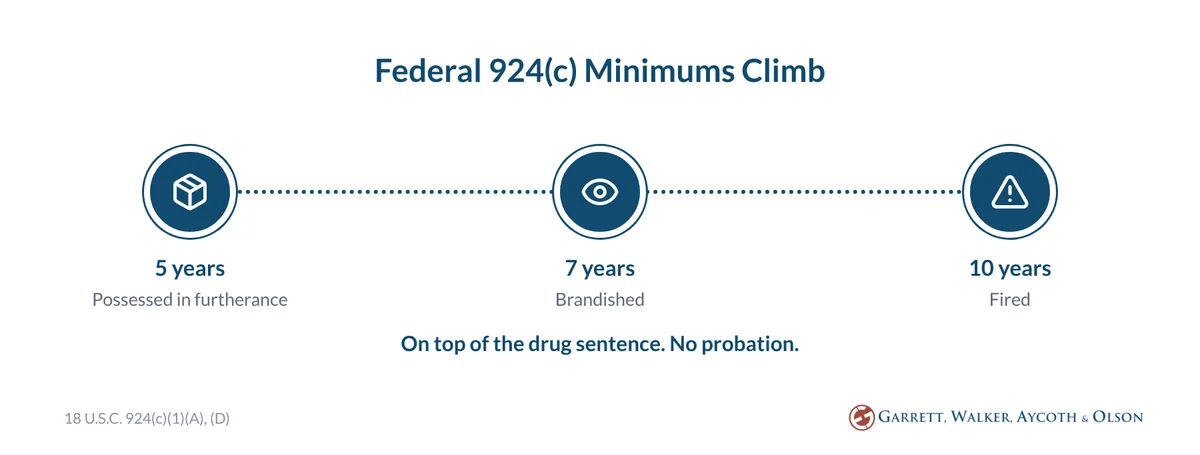
The court cannot give probation for a 924(c) conviction. The gun term cannot run at the same time as any other sentence, including the drug sentence.
A second 924(c) conviction, after a first one became final, carries at least 25 years (18 U.S.C. 924(c)(1)(C)).
Defending a federal case is different from a state case, and the work can start before an indictment. Read about defending a federal gun and drug case.
Talk to a defense lawyer before you talk to anyone else
What you say and sign in the first days often decides what is possible later. The earlier we see your paperwork, the more options you usually have.
Call (336) 379-0539Free consultation with a Greensboro attorneyDrug Users and Guns: 922(g)(3) After the 2026 Supreme Court Ruling
Federal law makes it a crime for an unlawful user of, or a person addicted to, a controlled substance to possess a gun. A violation carries up to 15 years under Title 18, section 922(g)(3) and section 924(a)(8) of the U.S. Code.
In United States v. Hemani, 608 U.S. 772 (2026), decided June 18, 2026, the Supreme Court ruled for a regular marijuana user. It held that prosecuting him under the unlawful-user part of 922(g)(3) was inconsistent with the Second Amendment.
All nine justices agreed on the result. The Court called its decision narrow, and it did not address addicts or people who are presently intoxicated.
The Court left open whether the government can prosecute with individualized proof that a person’s drug use makes them dangerous.
How far Hemani reaches in other cases is still being worked out. That makes the facts of your drug use a central fight in any 922(g)(3) case.
If you were charged federally, or a state case may be referred, call (336) 379-0539 now. Early statements about the gun and your drug use are often the evidence.
NC or Federal: Why the Court Matters
The same search can lead to state charges in Guilford County or federal charges in the Middle District of North Carolina. The rules differ in ways that change the sentence.
North Carolina uses a structured grid. Your class and prior record level set the range, and the grid says whether community, intermediate or active punishment is authorized (G.S. 15A-1340.17).
Federal 924(c) sets a floor instead, with no probation and time that must run after the drug sentence.
A gun found with drugs can take one of two roads: an NC charge under state sentencing rules, or a federal charge with a mandatory floor.
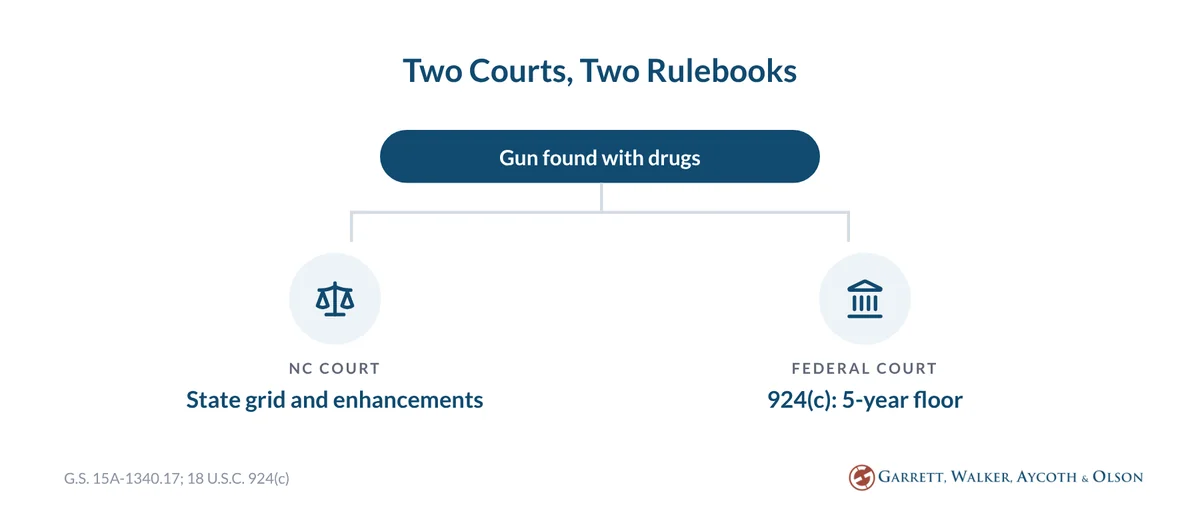
Prosecutors decide where to file. Early defense work can matter before that decision is made, and your lawyer handles state criminal cases in Guilford County as well as federal ones.
Defenses: Whose Gun, and Was It Connected to the Drugs?
Each charge in this guide needs its own link between you, the gun and the drugs. That link is where most defenses start.
The Gun Was Not Yours
The State or the federal government must prove possession, actual or constructive. A gun in a shared car or home is not automatically yours.
No Link Between the Gun and the Drugs
Section 924(c) requires use “during and in relation to” the drug crime, or possession “in furtherance” of it. G.S. 14-415.1(a1) requires the drug felony to be committed or attempted while possessing the gun.
No Use, Display or Threat
Without use, display or a threat, plus actual possession on the person, the G.S. 15A-1340.16A enhancement does not apply.
The Stop or the Search
Evidence from an unlawful stop or search can be challenged. If that challenge succeeds, the gun or the drugs may not be used.
The Drug-User Element
After Hemani, the facts of drug use matter in a 922(g)(3) case. How often, what drug and what proof of danger the government has are all questions your lawyer tests.
Which defense fits depends on the facts of your case, and each one is raised and argued by your lawyer.
Drugs in a shared home or car can also bring a separate maintaining a dwelling charge.
Call (336) 379-0539 to talk with our gun defense team about the state and federal risks.
Frequently Asked Questions
Is having weed and a gun a felony?
It can be. Federal law, 922(g)(3), makes it a felony for an unlawful drug user to have a gun, up to 15 years. In Hemani (2026) the Supreme Court ruled for one regular marijuana user, but called the ruling narrow and left open prosecutions with individualized proof of danger. Your lawyer tests the facts of your use.
Does a gun in the car with drugs add time in NC?
Not automatically. The G.S. 15A-1340.16A enhancement needs use, display or a threat, plus actual possession on the person. A nearby gun can still be an aggravating factor, and for a person with a felony record it can be a separate felony.
What is a 924(c) charge?
It is the federal gun-in-a-drug-crime law. It adds at least 5 years, 7 if the gun is brandished and 10 if it is fired. The term runs after the drug sentence, and the court cannot give probation for it.
Can a state drug case become a federal case?
It can. Prosecutors decide where to file, and both systems have laws that can apply to a gun found with drugs. Early defense work can matter before that decision is made, so talk to a lawyer before any interview.
What if the gun was not mine?
The State must prove you possessed it, either on your body or in a place you controlled and knew about. A gun in a shared car, room or bag is not automatically yours. Your lawyer tests who had control, depending on the facts of your case.
I have a felony record. What changes?
A felon with any gun commits a Class G felony under G.S. 14-415.1(a). For offenses on or after December 1, 2025, it becomes Class F during a drug felony, Class D if the gun is brandished and Class C if it is fired.
Does a gun affect a trafficking sentence reduction?
Yes. A judge can sentence below the trafficking minimum only after finding, among other things, that you did not possess a firearm in the offense or in any other violation of law. That rule is in G.S. 90-95(h)(5a).
Will I lose my gun rights after a drug felony?
Yes. Any felony conviction, including a drug felony, bars you from owning or possessing a firearm under G.S. 14-415.1(a). Keeping the case below a felony, or ending it without a conviction, protects that right, depending on the facts of your case.
Is there a new NC law on gangs and guns?
Yes. For offenses on or after December 1, 2026, G.S. 14-50.32 makes it a Class G felony for a criminal gang member to use, carry or possess a gun in relation to a drug crime. Brandishing raises it to Class F, and firing it to Class D.
- Former President, Greensboro Criminal Defense Lawyers Association
- Elected member, Criminal Justice Section, North Carolina Bar Association
- Selected to present the Wade M. Smith Award for Top Criminal Defense Lawyer in North Carolina
Talk to a Greensboro criminal defense lawyer today
Bring the warrant, the release order and anything else they gave you.
Garrett, Walker, Aycoth & Olson, Attorneys at Law
317 South Greene St, Greensboro, NC 27401
(336) 379-0539
This article explains North Carolina law in general terms. It is not legal advice about your case, and laws, penalties and court procedures change. Contact an attorney about your specific situation.