


Once a North Carolina court expunges a charge or conviction, G.S. 15A-153 lets you leave it off job applications, and employers may not require you to disclose it. The protection starts only when the expunction takes effect, and police agencies and some licensing boards can still see the record.
This guide is for you if a background check cost you a job, or an offer is waiting on one. It also helps if you have an old conviction or a dismissed charge you want off your record.
Whether you qualify, and how soon, depends on the exact charge, the dates and the rest of your record. We handle clearing a charge from your record in North Carolina courts.
Have a job offer waiting on a background check? Call (336) 379-0539 and Jason Aycoth’s team will check what you can clear.
How Hard Is It to Get a Job With a Criminal Record in NC?
A conviction can follow you on background checks for your whole working life.
Under section 1681c of the federal Fair Credit Reporting Act, background-check companies may not report an arrest more than seven years old, or until the statute of limitations expires, whichever is longer. Convictions have no time limit at all.
North Carolina has no statute of limitations for felonies, so an old felony arrest can stay reportable under that rule. Most misdemeanors must be charged within two years under G.S. 15-1(a).
The arrest limit does not apply at all to a job paying $75,000 a year or more. So a 20-year-old record can still appear when you apply for a better-paid role.
Waiting alone does not clear a record. An expunction order makes state agencies purge the entries from their files.
In 2020, then-Governor Roy Cooper signed Executive Order 158, a fair chance hiring order. It told state agencies to wait until after a first job interview before asking about criminal history or running a background check.
State HR guidance issued in July 2025 still applies the order to state agency hiring.
The order was aimed at state agencies, not private employers. Under G.S. 15A-153(a), a private employer may still ask about charges and convictions that are public and not expunged.
What Employers Can and Cannot Ask After an Expunction
An employer may not require you to disclose an expunged arrest, charge or conviction, in an application, an interview or any other way. The employer also may not knowingly ask about a record it knows was expunged.
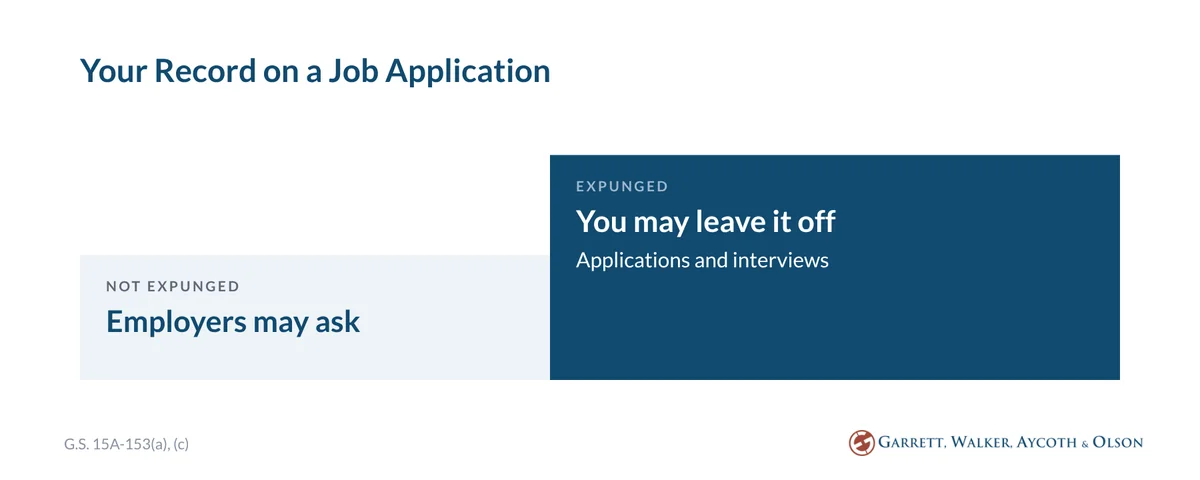
“An employer or educational institution shall not, in any application, interview, or otherwise, require an applicant for employment or admission to disclose information concerning any arrest, criminal charge, or criminal conviction of the applicant that has been expunged.” G.S. 15A-153(c)
Leaving the record off is not perjury or a false statement under G.S. 15A-153(b). The one exception is police certification, shown below.
State and local government employers must first tell you that state law lets you leave expunged records out. They cannot deny your application only because you left one out (G.S. 15A-153(d)).
What if an employer asks anyway? The Commissioner of Labor issues a written warning for a first violation, then a civil penalty of up to $500 for each later one (G.S. 15A-153(f)).
The statute does not give you a private lawsuit against the employer. A lawyer can tell you what to do if a question crosses the line.
Who Can Still See an Expunged Record
Expunction hides the record from most employers, but not from everyone. The court system keeps a confidential file, and a short list of agencies can still reach it under G.S. 15A-151.
| Who Is Asking | What They Can See or Ask | NC Law |
|---|---|---|
| Private employers | May not require it or knowingly ask about it | G.S. 15A-153(c) |
| State and local government (non-police) | Must tell you that you may leave it out | G.S. 15A-153(d) |
| Police and sheriff’s office employers | Can get it from the confidential court file (form AOC-CR-280) | G.S. 15A-151(a)(4) |
| Police officer and deputy certification | You must disclose expunged convictions | G.S. 15A-153(e) |
| Private security and protective services licensing boards | Can get it for licensing | G.S. 15A-151(a)(10) |
| Prosecutors | Can see it. For expunctions granted on or after July 1, 2018, the conviction may be considered a prior conviction if you are charged again | G.S. 15A-151.5(b) |
Note: Before you apply for police, sheriff or security work, ask a lawyer what your confidential file will show.
Background Check Companies After an Expunction
After the order, state agencies must tell the private companies that buy their criminal record data to delete the record. That duty comes from G.S. 15A-150(d).
A company that sells criminal history must then delete it within the time in its license. If no license term applies, the deadline is 10 business days after notice under G.S. 15A-152(a).
A company that keeps selling the record can owe damages, court costs and attorney fees. Companies covered by the federal Fair Credit Reporting Act fall under that law’s remedies instead (G.S. 15A-152(c)).
You can also ask the Administrative Office of the Courts for a certificate verifying the expunction (G.S. 15A-152(d)).
Tip: Keep a certified copy of your expunction order with your job papers. If an old report still shows the case, your lawyer can send the order and press for a correction.
It helps to see how Greensboro background checks read your record before you apply.
Talk to a defense lawyer before you talk to anyone else
What you say and sign in the first days often decides what is possible later. The earlier we see your paperwork, the more options you usually have.
Call (336) 379-0539Free consultation with a Greensboro attorneyExpungement and Its Employment Benefits
A granted expunction restores you, in the eyes of the law, to where you stood before the arrest. G.S. 15A-145.5 calls it being “restored, in the contemplation of the law, to the status the petitioner occupied before the arrest.”
That is why the record no longer has to be listed on most applications. For the basics, read how expungement works in North Carolina.
The job benefits are practical: a cleaner background check, the right to leave the record off, and a better shot at licensed roles. The table shows the earliest point you can ask for one.
| What Is on Your Record | Earliest You Can Ask | NC Law |
|---|---|---|
| All charges in the case dismissed or not guilty, on or after Dec. 1, 2021 | Cleared by law 180 to 210 days after the case ends, with exceptions (a felony dismissed in a plea deal; a court dismissal for incapacity to proceed on or after Dec. 1, 2025) | G.S. 15A-146(a4); S.L. 2025-93 |
| One nonviolent misdemeanor | 3 years (when the 3 years starts if you had probation or an active sentence is unsettled; see the note below) | G.S. 15A-145.5(c)(1)a |
| More than one nonviolent misdemeanor | 7 years | G.S. 15A-145.5(c)(1)b |
| One nonviolent felony | 10 years (15 for breaking or entering under G.S. 14-54(a)) | G.S. 15A-145.5(c)(2) |
| Two or three nonviolent felonies | 20 years | G.S. 15A-145.5(c)(2)b |
Older cases need a petition; see clearing dismissed and not guilty charges.
Each conviction row counts from your conviction date and the end of any sentence. That is why expunging an old conviction starts with your exact court dates.
A single Class 3 conviction is a common example; see how a Class 3 misdemeanor affects your record.
Important: The 3-year wait is new, for petitions filed on or after July 9, 2025 (S.L. 2025-71). The UNC School of Government notes that how the 3 years is measured is still an open question, so your lawyer picks the filing date with that in mind.
Warning: Some records are never eligible under this law, including Class A to G felonies, Class A1 misdemeanors, offenses with assault as an element, offenses that require sex offender registration and any impaired-driving offense (G.S. 15A-145.5(a), (a1)).
Impaired driving is never eligible, which is why how long a DWI stays on your record matters for any job. The same is true of sex offenses that can never be cleared, including the Class C statutory rape tier.
Not sure which row fits your record? Call (336) 379-0539 and we will check.
From Petition to a Clean Background Check
For a conviction, the petition is filed in the county where you were convicted. The filing fee is $175, unless you are indigent (G.S. 15A-145.5(c), (g)).
For a Guilford County conviction, that is the Guilford County court, which has courthouses in Greensboro and High Point.
Two people who are not related to you, or to each other, sign affidavits saying your character and reputation are good.
The petition is served on the district attorney’s office, which gets a 30-day window to file any objection. A judge can allow 30 more days for good cause.
If there was a victim, the victim may ask to be present and be heard. For one or more nonviolent misdemeanors, the judge must grant the petition when every requirement is met.
For felonies, the judge has discretion. After an order, the clerk sends it to state agencies, and those agencies notify their data buyers.
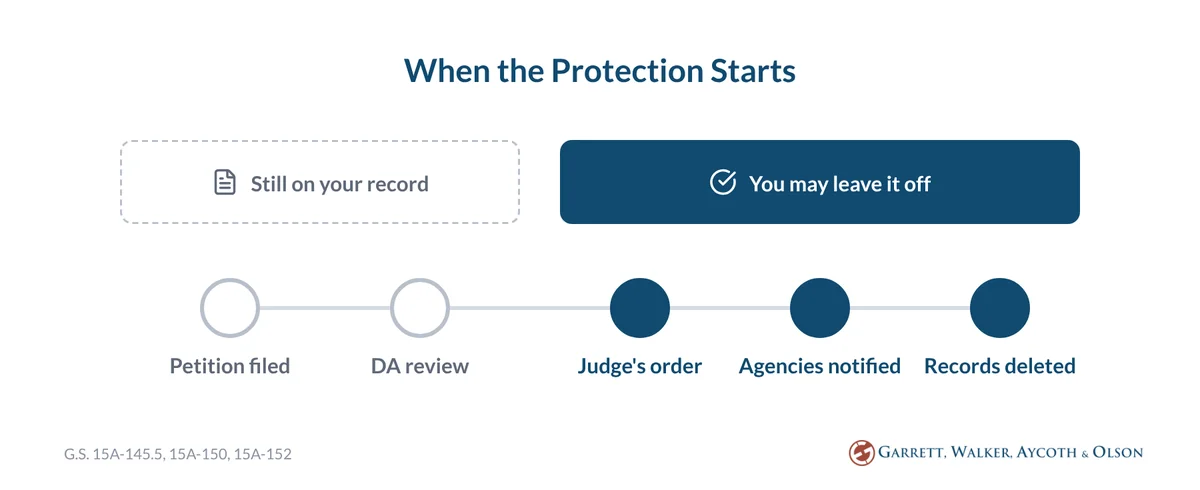
The protection on applications begins with the order, not with the filing. Until a judge signs, an employer may still ask about the public record.
If You Cannot Expunge Yet: The Certificate of Relief
A Certificate of Relief does not erase a conviction, but it can help with jobs and licenses. Under G.S. 15A-173.2, it is not a pardon either.
You may qualify with up to three Class H or I felonies plus any misdemeanors. Twelve months must have passed since you completed your sentence.
You must be working or seeking work, training or school, or have another lawful source of support. The fee is $50, and it does not apply to an indigent petitioner.
An employer who relied on the certificate is shielded from a negligent-hiring claim under G.S. 15A-173.5.
Government agencies and officials “shall consider” a certificate favorably, including licensing agencies. A later conviction for anything other than a traffic violation revokes it automatically.
A lawyer can tell you which path fits, depending on the facts of your record.
How a Lawyer Helps You Clear Your Record for a Job
The order you file in, and the date you file, can decide what you are able to clear for the rest of your life. A misdemeanor petition even asks you to sign that you understand this rule (G.S. 15A-145.5(c1)(7)).
Under that rule, a single-misdemeanor expunction granted before the seven-year mark rules out more misdemeanor expunctions.
A lawyer pulls your full record across counties and checks each waiting date. The lawyer then prepares the affidavits and petition, answers any objection, and follows up with background-check companies after the order.
Good results come from that groundwork, depending on the facts of your record. If a new charge is what stands between you and a job, our Greensboro criminal defense lawyers can help first.
Call today if a job offer is waiting on a background check, or if a 3-year or 7-year date has passed. If your case was dismissed, call and we will confirm whether the court has already cleared it.
Before your next application, talk to us about an expunction. Call (336) 379-0539 today for a record check.
Frequently Asked Questions
Is it worth expunging an old conviction for a job after 20 years?
Often, yes. Federal law lets background-check companies report convictions with no seven-year limit, so a 20-year-old conviction can still appear. Whether yours can be cleared depends on the offense class and your later record. A lawyer can check both before you pay any filing fee.
Is it lying to leave an expunged charge off a job application?
No. G.S. 15A-153(b) says leaving out an expunged arrest, charge or conviction is not perjury or a false statement. The exception is police and deputy certification, where expunged convictions must be disclosed to the certifying commission. Ask a lawyer before you apply for that kind of work.
Does North Carolina’s ban-the-box order cover private employers?
No. Executive Order 158, signed in 2020, was aimed at state agencies. Under G.S. 15A-153(a), a private employer may still ask about charges and convictions that are public and not expunged. An expunction is what takes a record out of that question.
Can I expunge a DWI to help my job search?
No. G.S. 15A-145.5(a1) says an offense involving impaired driving is not eligible for expunction. That is why fighting a DWI charge before a conviction matters so much for your career. Talk to a lawyer before you plead to any impaired-driving charge.
How much does an expunction cost in NC?
The filing fee for a conviction petition under G.S. 15A-145.5 is $175, waived for indigent petitioners. Charges dismissed on or after December 1, 2021 are cleared by law with no petition, with a few exceptions. Two are a felony dismissed in a plea deal and a court dismissal for incapacity to proceed. Lawyer fees are separate.
Can a college ask about an expunged record?
No. G.S. 15A-153(c) applies the same rule to educational institutions. They may not require you to disclose an expunged arrest, charge or conviction on an admission application, and they may not knowingly ask about one. Records that are not expunged can still come up.
My charge was dismissed before December 2021. Is it still on my record?
Yes, unless someone already petitioned to expunge it. Under G.S. 15A-146(a), you can petition in the county where the charge was brought. The court must order expunction once it finds the only charge was dismissed. Call and we will check your record.
Can an employer ask about a dismissed charge that has not been expunged yet?
Yes. G.S. 15A-153 protects only expunged records, and a dismissed charge stays public until it is expunged. For dismissals since December 1, 2021, that usually happens 180 to 210 days after the case ends. Older dismissals need a petition.
- Former President, Greensboro Criminal Defense Lawyers Association
- Elected member, Criminal Justice Section, North Carolina Bar Association
- Selected to present the Wade M. Smith Award for Top Criminal Defense Lawyer in North Carolina
Talk to a Greensboro criminal defense lawyer today
Bring the warrant, the release order and anything else they gave you.
Garrett, Walker, Aycoth & Olson, Attorneys at Law
317 South Greene St, Greensboro, NC 27401
(336) 379-0539
This article explains North Carolina law in general terms. It is not legal advice about your case, and laws, penalties and court procedures change. Contact an attorney about your specific situation.