


Knowingly having any gun on school property in North Carolina is a Class I felony under G.S. 14-269.2(b), with two narrow car exceptions. A permit holder may keep a handgun locked in the car, and some visitors face a misdemeanor instead.
Many people believe a gun is fine if it stays in the car, or that any permit makes it legal. Both beliefs are only partly true.
So can you have a gun in your car on school property in NC? The details decide it: loaded or not, locked or not, which compartment, and who you are.
Proving those details is your lawyer’s job.
If you were charged after a gun was found in your car on campus, call (336) 379-0539 today. Our Greensboro gun charges lawyers can check how the gun was stored and where the car was.
What Counts as Educational Property in NC
Educational property is any school building or bus, campus, grounds, recreational area or athletic field. It also includes other property owned, used or operated by a school board or school trustees (G.S. 14-269.2(a)(1)).
“School” means a public or private school, community college, college or university (G.S. 14-269.2(a)(1b)). In Greensboro, that reaches public school campuses, private schools, community college campuses and universities alike.
The firearm ban also reaches school-sponsored activities. Carrying a gun to a curricular or extracurricular activity sponsored by a school is covered, even off campus (G.S. 14-269.2(b)).
The statute’s word “knowingly” matters. The State must prove you knew the gun was there.
Permit Holders: The Locked-Car Rule
A person with a valid concealed handgun permit, or a person exempt from needing one, is outside G.S. 14-269.2 only in a locked vehicle. The rule covers a handgun, in one of three ways under G.S. 14-269.2(k):
- The handgun is in a closed compartment or container in the locked car, or a locked container fixed to it. The car is unlocked only to get in or out, and locked right after.
- The handgun stays concealed on you while you remain in the locked car. The car is unlocked only to let someone in or out.
- You move the handgun between your body and a compartment only while inside the locked car.
Some sites say this rule is limited to drop-off and pick-up. It is not, but it never allows carrying the handgun out of the car.
There is also an affirmative defense. It covers a permit holder who removed the handgun only in a threatening situation where deadly force was justified (G.S. 14-269.2(l)).
Senate Bill 50 has not become law; a permit is still required for the car exception. The Senate Bill 50 record on ncleg.gov shows no House override vote.
For carry rules away from schools, read about concealed carry rules off campus.
No Permit? The Misdemeanor Car Rule and Who It Excludes
Without a permit, the charge drops from a Class I felony to a Class 1 misdemeanor only if two things are true (G.S. 14-269.2(f)).
First, you are not a student or employee at that school. Second, the gun is unloaded, in a motor vehicle, and in a locked container or a locked gun rack.
A loaded gun under the seat does not meet that rule. Neither does an unlocked glove box.
From the parking lot to the stands, the gun’s status changes the charge: locked and unloaded in the car is one thing, carried onto the grounds is another.
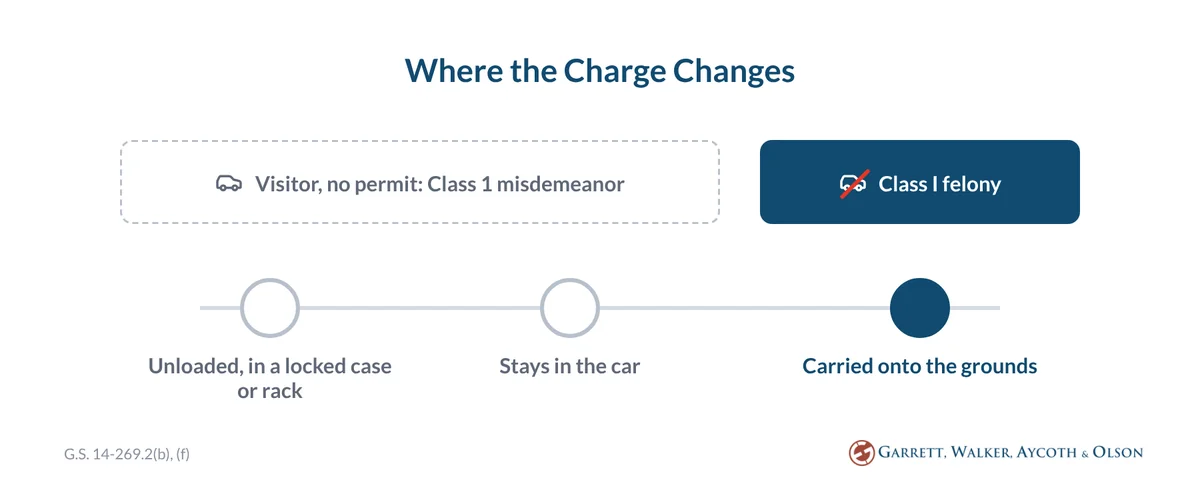
The rule also excludes people. Students and employees of that school, including at its school-sponsored activities, cannot use it.
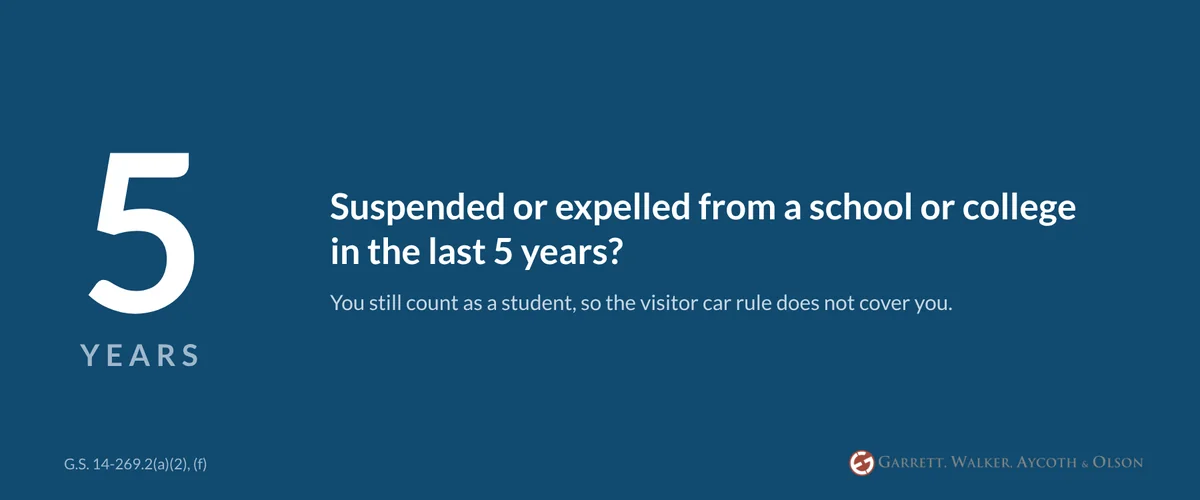
“Student” includes an adult suspended or expelled from a school or college within the last five years (G.S. 14-269.2(a)(2)).
If you were suspended or expelled from a school or college in the last five years, you still count as a student there, so the visitor car rule does not cover you.
If police said the gun was “not secured,” call (336) 379-0539. How the gun was stored is a fact your lawyer can test.
Talk to a defense lawyer before you talk to anyone else
What you say and sign in the first days often decides what is possible later. The earlier we see your paperwork, the more options you usually have.
Call (336) 379-0539Free consultation with a Greensboro attorneyOther Exceptions: Private Schools, Church Schools, Found Guns
The statute lists narrow exceptions, and most people do not fit them. Read each one exactly as written.
A private school employee or volunteer may carry with written authorization from the school, a permit, 8 hours of annual extra training and written school procedures. This exception was added for offenses on or after December 1, 2025 (S.L. 2025-81).
Some schools share property with a place of worship. There, a permit holder may carry a handgun outside school operating hours, unless the property is posted, under G.S. 14-269.2(k1).
The same subsection allows a handgun during worship services in the worship building. The same 2025 law rewrote that part, and it never applies at colleges or universities.
If you found a gun, or took one from someone, and turned it in to police as soon as practical, you are not guilty under this section (G.S. 14-269.2(h)).
Other exceptions cover law enforcement, on-duty emergency personnel, school-approved ceremonies and programs, home schools and certain employees living in campus housing (G.S. 14-269.2(g), (i)).
Penalties: Felony, Misdemeanor and What Follows
The class depends on the item, the way it was stored and what happened with it.
| Conduct | Class | Level I Sentence (No Record) | Source |
|---|---|---|---|
| Gun on educational property or at a school event | Class I felony | 4-6 months presumptive minimum, community punishment | G.S. 14-269.2(b); G.S. 15A-1340.17 |
| Willfully firing a gun on educational property | Class F felony | 13-16 months presumptive minimum, intermediate or active punishment | G.S. 14-269.2(b); G.S. 15A-1340.17 |
| Visitor without a permit, gun unloaded and locked in the car | Class 1 misdemeanor | 1-45 days, community punishment | G.S. 14-269.2(f); G.S. 15A-1340.23 |
| BB gun, stun gun, air gun or knife | Class 1 misdemeanor | 1-45 days, community punishment | G.S. 14-269.2(d) |
At those levels the court must suspend the active term under G.S. 15A-1340.20(c), except a term equal to time already served (c1). The conviction still stays on your record, and which level applies is argued by your lawyer.
A felony conviction ends the right to possess any firearm under G.S. 14-415.1(a). A pending felony indictment also blocks a new concealed handgun permit (G.S. 14-415.12(b)(2)).
The misdemeanor route has a permit cost too. A misdemeanor conviction, a PJC or a suspended sentence under G.S. 14-269.2 makes the sheriff deny a permit for three years (G.S. 14-415.12(b)(8)).
Explosives on educational property are a Class G felony (G.S. 14-269.2(b1)). Helping a person under 18 carry a weapon there is a separate crime under G.S. 14-269.2(c), (c1) and (e).
Which level applies, and where in the range a sentence falls, is argued by your lawyer. Read what a Class I felony conviction means beyond the sentence, and compare the sentences for other NC gun charges.
Defenses and What to Do After a Charge
Each defense answers one fact the State must prove or one exception the statute allows.
You Did Not Knowingly Possess It
Subsection (b) says “knowingly.” Shared cars, borrowed cars and another person’s bag raise the question of who controlled a gun in a shared car.
The Place Was Not Educational Property
The property must be owned, used or operated by a school board or school trustees. An off-campus event must be sponsored by a school.
An Exception or the Misdemeanor Route Applies
The permit holder car rule in (k), the visitor rule in (f), the exceptions in (g) and the found-gun rule in (h) can each change the charge.
The Stop or Search Was Unlawful
Evidence from an unlawful stop or search of the car can be challenged in court.
After a charge, do not explain the gun to campus police or school staff without a lawyer. Keep the permit, the lock or case, and photos of where the car was parked.
Any of these can change the charge or the outcome, depending on the facts of your case, and your lawyer raises them.
We defend criminal charges in Guilford County courts.
If drugs were found in the car too, different laws apply to a gun found together with drugs.
Call (336) 379-0539 to talk to a gun defense lawyer about the exact facts.
Frequently Asked Questions
Is it a felony to have a gun on school property in NC?
Yes. Knowingly possessing or carrying any gun on educational property, or to a school-sponsored activity, is a Class I felony under G.S. 14-269.2(b). Two car exceptions can change that: the permit holder rule in (k) and the visitor misdemeanor rule in (f).
Can I keep a gun in my car in a school parking lot?
A permit holder may keep a handgun in a closed compartment of a locked car under G.S. 14-269.2(k). Without a permit, an unloaded gun in a locked container is a Class 1 misdemeanor for a visitor who is not a student or employee there.
Does this apply to colleges and community colleges?
Yes. “School” includes public and private schools, community colleges, colleges and universities under G.S. 14-269.2(a)(1b). The same car rules apply on those campuses. The church-school rule in (k1) does not apply at colleges or universities.
Can I have a gun at a high school football game?
A school-sponsored game is covered by G.S. 14-269.2(b), even off campus. The same car rules apply in the parking lot, but carrying a gun into the stands is the Class I felony. Talk to a lawyer before you explain anything to police.
Is a BB gun, stun gun or knife on school property a crime?
Yes. Under G.S. 14-269.2(d), possessing a BB gun, stun gun, air rifle, air pistol or most knives on educational property is a Class 1 misdemeanor. Instructional supplies, unaltered nail files and clips, and food preparation tools are not covered.
What if I forgot the gun was in my car?
The State must prove you knowingly possessed the gun on school property. What you knew, and when, is a fact question your lawyer tests, depending on the facts of your case. Do not explain the gun to campus police without a lawyer.
Can private school staff carry a gun on campus?
Only with written authorization from the school, a concealed handgun permit, 8 hours of annual extra training and written school procedures. That exception was added for offenses on or after December 1, 2025, by S.L. 2025-81. It does not cover public schools.
Do I still need a permit for the car exception?
Yes. Senate Bill 50 has not become law, so North Carolina does not have permitless concealed carry. The car exception in G.S. 14-269.2(k) still requires a valid concealed handgun permit, or an exemption from needing one.
Will this charge affect my concealed carry permit?
Yes, in most cases. A misdemeanor conviction, a PJC or a suspended sentence under G.S. 14-269.2 makes the sheriff deny a permit for three years (G.S. 14-415.12(b)(8)). A pending felony blocks a new permit, and a felony conviction ends the right to possess any gun. Your lawyer weighs each outcome’s effect on your permit.
- Former President, Greensboro Criminal Defense Lawyers Association
- Elected member, Criminal Justice Section, North Carolina Bar Association
- Selected to present the Wade M. Smith Award for Top Criminal Defense Lawyer in North Carolina
Talk to a Greensboro criminal defense lawyer today
Bring the warrant, the release order and anything else they gave you.
Garrett, Walker, Aycoth & Olson, Attorneys at Law
317 South Greene St, Greensboro, NC 27401
(336) 379-0539
This article explains North Carolina law in general terms. It is not legal advice about your case, and laws, penalties and court procedures change. Contact an attorney about your specific situation.