


Do you get a bond? For charges that are not violent offenses, the law sets a minimum, not a ban: the conditions written on the order for arrest, or a secured bond at least double the last bond.
The correction: there is no “typical” FTA bond. After an arrest on the order, the old bond is not simply reinstated, and if no bond was ever set, the floor is a $1,000 secured bond.
What a lawyer changes: before an arrest, a lawyer can ask the court to strike the FTA and recall the order, which can keep the existing bond. After an arrest, a lawyer can ask a judge to change the conditions, depending on the facts of your case.
Someone you love picked up on an FTA in Guilford County? Call (336) 379-0539 before the bond is paid.
After a failure to appear in North Carolina, the law sets a minimum bond rather than a ban for most charges. The new bond must match the order for arrest, or be a secured bond at least double the last one.
This page explains who sets that bond, how much it can be, and how to get it changed. Here is how our bond motion lawyers help families in Guilford County after an FTA.
If you want to know whether missing court is its own crime, start there. This page is about the bond.
Do You Get a Bond for Failure to Appear in North Carolina?
For most charges the law sets a minimum bond after a failure to appear, not a ban, and the terms are stricter. The process starts with an order for arrest, which a judge can issue when a released defendant misses court under G.S. 15A-305(b).
The order must say so if you are to be held without bail. Otherwise, a judicial official sets new release conditions when the order is served.
Violent offenses are different. G.S. 15A-531(9) lists them: Class A through G felonies with assault or force as an element, sex-offense felonies that require registration, and several named crimes.
For a violent offense, the law presumes that no condition will assure your return and public safety. That presumption can be overcome, but release on a first violent offense must be a secured bond or house arrest.
How Much Is a Bond for Failure to Appear?
The bond after a failure to appear starts at a minimum the statute sets. For charges that are not violent offenses, follow these steps to find the floor:
- Look at the order for arrest. If the judge recommended conditions on it, those conditions are the minimum.
- No recommendation? The new bond must be secured and at least double the most recent bond, whether that bond was secured or unsecured.
- No bond ever set? The floor is a secured bond of at least $1,000.
- Extra limits. The official must add limits on travel, contacts, conduct or where you live, so you do not miss court again.
- The paperwork notes it. The release order must say you were arrested or surrendered after failing to appear, and note two or more missed dates.
“If no conditions are recommended in that order for arrest, the judicial official shall require the execution of a secured appearance bond in an amount at least double the amount of the most recent previous secured or unsecured bond for the charges.” G.S. 15A-534(d1)
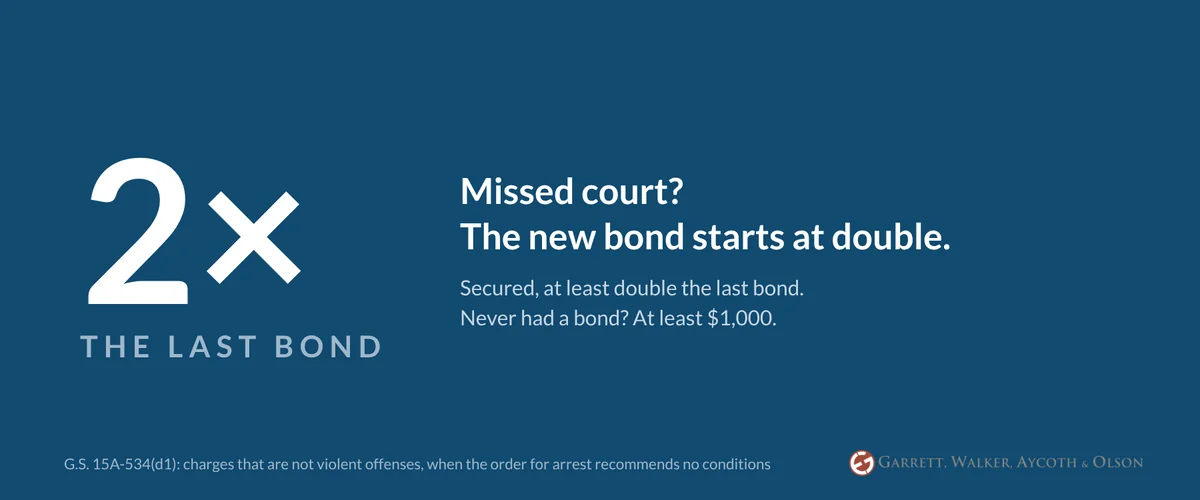
Here is the arithmetic, as an example only. If the first release was a $1,500 unsecured bond and the order recommends nothing, the new bond must be a secured bond of at least $3,000.
Violent Charges Since December 1, 2025
Session Law 2025-93 took violent offenses out of the doubling rule. The UNC School of Government explains that for a violent offense, the judge’s recommendation on the order for arrest is no longer binding, and an unsecured bond is not available.
For these charges, getting any release at all depends on rebutting the presumption. That is work for a lawyer, with proof, in front of a judge.
Is There a Typical Bond Amount for Failure to Appear?
No. No statute and no Guilford County rule sets a typical FTA bond amount, so any chart of “average” FTA bonds is a guess. What the law sets is the floor described above.
Guilford County is in the 24th Judicial District. Its pretrial release policy, filed February 13, 2026, makes a secured bond the presumptive condition after an FTA and repeats the doubling rule.
The district also publishes suggested bond ranges by offense class, and it calls them “NOT MANDATORY.” Those ranges are for the original charge, not for the FTA, so they do not replace the floor.
The floor in your case depends on the old bond and on what the order for arrest says. Call and we will check the paperwork for you.
Who Sets the Bond After an FTA, and What They Must Consider
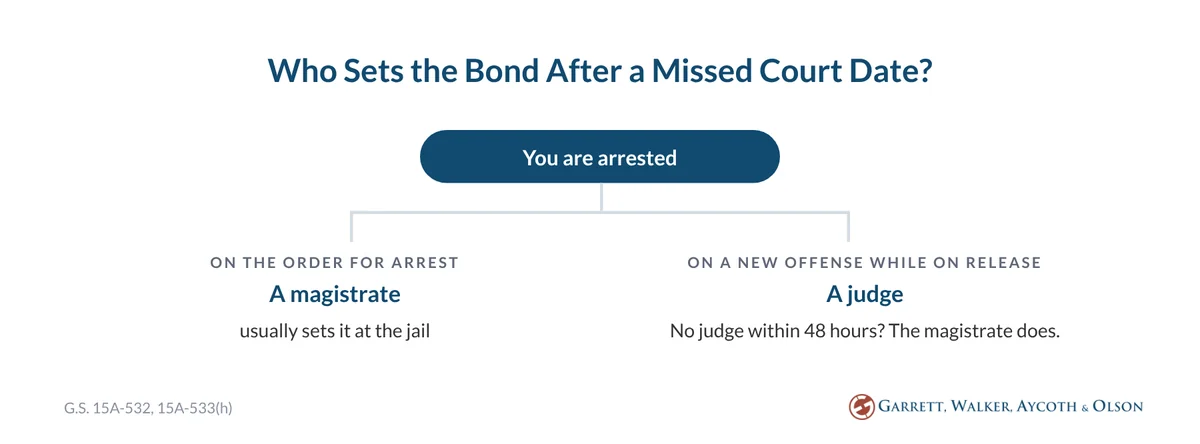
A magistrate usually sets the bond at the jail when the order for arrest is served. G.S. 15A-532 lets judicial officials set release conditions in the cases before them.
If the arrest is for a new offense while you were already on release, a judge must set the conditions under G.S. 15A-533(h). If no judge acts within 48 hours, the magistrate sets them.
| Stage of the Case | Who Can Change the Bond |
|---|---|
| Before the first appearance. | The magistrate or clerk who set it. |
| At or after the first appearance, District Court case. | A District Court judge. |
| Case now in Superior Court. | A Superior Court judge. |
That table follows G.S. 15A-534(e). Any judge may also revoke a release for good cause, and must then set new conditions if the defendant applies.
What the Judge or Magistrate Must Weigh
G.S. 15A-534(c) lists what the official must consider, starting with a criminal history report. The list includes:
- The nature of the charge and the weight of the evidence.
- Family ties, job, money, character, housing and mental condition.
- How long you have lived in the community.
- Any history of flight or of failing to appear in court.
- Any other evidence that bears on release.
The official is not bound by the strict trial rules of evidence. One hard rule: three or more convictions of a Class 1 misdemeanor or higher in 10 years, from separate court sessions, require a secured bond or house arrest.
Your lawyer brings proof for each factor: a pay stub, a lease, a letter about why the date was missed. Use this list of what to bring to the bond hearing so the judge sees each one.
Bond Types and Payment Methods
North Carolina now allows four kinds of pretrial release. The written promise to appear was repealed for release decisions made on or after December 1, 2025.
| Release Type | How It Works |
|---|---|
| Unsecured bond. | You sign for an amount and post no money, but you owe it if you miss court. |
| Custody release. | You are released to a person or group that agrees to supervise you. |
| Secured bond. | Backed by cash for the full amount, a mortgage on property, or a surety such as a bondsman. |
| House arrest with electronic monitoring. | You stay home except for approved reasons, and a secured bond is required too. |
After an FTA on a charge that is not a violent offense, the default is a secured bond. A $2,500 secured bond, for example, means $2,500 backed by cash, property or a surety.
Before your family pays a bondsman, call (336) 379-0539. If the FTA can be stricken first, the old bond may still stand.
Talk to a DWI and traffic lawyer before your court date
Deadlines in traffic and DWI cases run from the day of the charge. The earlier we see your paperwork, the more options you usually have.
Call (336) 379-0539Free consultation with a Greensboro attorneyThe Role of Bail Bondsmen
A bail bondsman posts a secured bond for a fee called the premium. Under Section 58-71-95 of the General Statutes, the premium cannot be more than 15% of the bond’s face amount.
A bondsman may also take collateral, but it must be reasonable for the bond amount. It must be returned within 15 days after the bond’s liability ends.
The same statute bars a bondsman from naming or suggesting a particular lawyer for you. For the basics of how bail bonds and bondsmen work, see our attorney’s overview.
What Happens If You Bond Someone Out and They Miss Court?
If they miss court, the court enters a forfeiture for the full bond against the defendant and every surety, under G.S. 15A-544.3. A co-signer is on the hook too.
The forfeiture can be set aside for listed reasons, such as the FTA being stricken and the order recalled, or the defendant being surrendered. Under G.S. 15A-544.5, most of those motions must be filed within 150 days of the notice.
A surety may also surrender the defendant, and after a missed date may arrest the defendant and take them to the sheriff, under G.S. 15A-540. A judicial official then decides new conditions.
Potential to Reduce an FTA Bond
A lawyer can ask to reduce an FTA bond through a bond motion that asks a judge to modify the release conditions. The motion is argued with the factors in G.S. 15A-534(c), backed by proof.
The bond can be revisited at the first appearance before a District Court judge. The 24th District also uses a local Bond Motion Request form for District Court.
Be clear about the limits. The FTA floor is written as a “shall” rule, so the strongest move is often to ask the court to strike the FTA and recall the order, depending on the facts of your case.
With a lawyer, we can ask a judge to change the bond and bring the proof the statute asks for. Nothing about the result is automatic, and every case turns on its own facts.
Steps to Resolve a Failure to Appear Before an Arrest
The cheapest time to deal with an FTA bond is before anyone is arrested. Follow these steps in order:
- Call a lawyer before going to the jail or the courthouse. Walking in with an open order can end in custody.
- Ask the court to strike the FTA and recall the order. A lawyer can put the case back on the calendar before day 20 and appear for you.
- Protect the old bond. When the court strikes the FTA and recalls the order, it must set aside the forfeiture at the same time.
- Plan any surrender with your lawyer and the bondsman. Timing affects the bond and the co-signer.
- Gather proof for the judge. Bring job, housing and family documents, plus the reason you missed court.
“When an order setting aside a forfeiture is entered, the defendant’s further appearances shall continue to be secured by that bail bond unless the court orders otherwise.” G.S. 15A-544.5(c)
Recalling the order for arrest first is often the cheapest path. Clearing the arrest warrant itself follows similar steps.
Traffic Cases in North Carolina: A Common Source of FTA
A missed date on a ticket that charges a misdemeanor can lead to an order for arrest under G.S. 15A-305(b)(3). On an infraction, G.S. 15A-1116(b) bars an order for arrest, and the court can issue a criminal summons instead.
So a missed ticket that charges only an infraction usually means license trouble rather than a bond. Your lawyer can tell you which one your ticket charges.
On any traffic case, the court reports a missed date to DMV unless you appear or resolve it within 20 days. If the date passed this week, get missed court date help in Greensboro now.
Why Hiring an Attorney Pays Off
An attorney can act before the arrest, when the old bond is still in play. Here is what Chad Garrett’s team does, depending on the facts of your case:
- Reads the order for arrest and the old bond to find the real floor.
- Asks the court to strike the FTA and recall the order before an arrest.
- Argues the G.S. 15A-534(c) factors with proof at a bond hearing.
- Works out surrender timing with the bondsman to protect the co-signer.
- Defends the case itself, not just the bond.
That last point matters, because the bond lasts only as long as the case. Our team handles defending the criminal case behind the bond from the first call.
Frequently Asked Questions
Do you get a bond for failure to appear in NC?
For most charges, yes: the law sets a floor, not a ban. For charges that are not violent offenses, the release must at least match the conditions on the order for arrest, or be a doubled secured bond, under G.S. 15A-534(d1). Violent charges start with a presumption against release.
What is the minimum bond after an FTA?
The minimum is the conditions the judge recommended on the order for arrest. If none were recommended, it is a secured bond at least double the most recent bond. If no bond was ever set, it is a secured bond of at least $1,000.
My first bond was unsecured. Does that count?
Yes. The statute doubles “the most recent previous secured or unsecured bond,” and the new bond must be secured. So a $1,000 unsecured bond becomes at least a $2,000 secured bond if the order for arrest recommends nothing else.
What happens if you bond someone out and they miss court?
The court enters a forfeiture against the defendant and each surety, including a co-signer, under G.S. 15A-544.3. It can be set aside for listed reasons, such as the FTA being stricken and the order recalled. Most of those motions must be filed within 150 days of the notice.
How much can a bail bondsman charge in NC?
A bondsman’s premium cannot be more than 15% of the bond’s face amount under Section 58-71-95 of the General Statutes. The bondsman may also take reasonable collateral. The collateral must be returned within 15 days after the bond’s liability ends.
Can a bondsman arrest me after I miss court?
Yes. After a missed court date, a surety may arrest you and surrender you to the sheriff under G.S. 15A-540. A judicial official then decides whether you can be released again and on what conditions, so call a lawyer as soon as you can.
Can I keep my old bond if I fix the FTA before I am arrested?
Possibly. If the court strikes the FTA and recalls the order for arrest, it must set aside the forfeiture at the same time. The same bond then keeps covering the case unless the court orders otherwise, under G.S. 15A-544.5(c). A lawyer can ask for this.
Who can lower a bond set after an FTA?
Before your first appearance, the magistrate or clerk who set the bond can change it. At or after the first appearance, a District Court judge can modify it on a bond motion. Whether a judge agrees depends on the facts of your case and the FTA floor.
Is there also a fee for missing court?
Yes. If you are convicted, a $200 fee is added as a court cost under G.S. 7A-304(a)(6), unless you appeared or resolved the charge within 20 days. The fee is collected only once in a criminal case, and it is waived if an official’s error caused the missed date.
Do I need a bond for a missed traffic ticket?
It depends on what the ticket charges. A misdemeanor ticket can lead to an order for arrest and a bond. A ticket that charges only an infraction cannot lead to an order for arrest under G.S. 15A-1116(b), but your license is at risk, so call before day 20.
- Continuing Legal Education Instructor of the Year, North Carolina Bar Association
- Former President, Greensboro Criminal Defense Lawyers Association
- Board Member, Criminal Justice Section, North Carolina Bar Association
Talk to a Greensboro traffic and DWI lawyer today
Bring the citation, any DMV letter and your court date.
Garrett, Walker, Aycoth & Olson, Attorneys at Law
317 South Greene St, Greensboro, NC 27401
(336) 379-0539
This article explains North Carolina law in general terms. It is not legal advice about your case, and laws, penalties and court procedures change. Contact an attorney about your specific situation.