


A Class 2 misdemeanor is North Carolina’s middle misdemeanor class, above Class 3 and below Class 1 and A1. G.S. 15A-1340.23 allows up to 30 days of community punishment with no priors, up to 60 days including active jail with five or more, and a fine up to $1,000.
Up to 60 days is the five-prior maximum, not the normal sentence. The part that lasts is the conviction: simple assault, a common Class 2, is not eligible for expunction under G.S. 15A-145.5 because assault is an element.
Which level you are sentenced at, and whether you are convicted at all, is argued by your lawyer, depending on the facts of your case.
Talk with a misdemeanor defense lawyer in Greensboro before your court date. Call (336) 379-0539 today.
What Is a Class 2 Misdemeanor in NC?
North Carolina has four misdemeanor classes: Class A1, the most serious, then Class 1, Class 2 and Class 3, the least serious. All four sit on the sentencing chart in G.S. 15A-1340.23.
A misdemeanor is any crime that is not a felony (G.S. 14-1). A felony is a crime that is or may be punished by time in the State’s prison, or one that a statute names a felony.
Some statutes set a punishment but no class. A misdemeanor with a set maximum over 30 days, up to six months, is a Class 2; one with no class and no punishment at all is a Class 1 (G.S. 14-3(a)).
Class 2 vs Level II: Not the Same Thing
The class is the offense, and the level is your record. Level I means no prior convictions, Level II means one to four, and Level III means five or more (G.S. 15A-1340.21(b)).
So someone with two old convictions who faces a Class 2 charge is at Level II.
What Does M2 Mean?
You may see M2 used as shorthand for a misdemeanor, Class 2. If your paperwork shows M2, M1 or MA1, call and we will read the charge with you.
NC Misdemeanor Sentencing Chart
The chart in G.S. 15A-1340.23(c) sets the days and the type of punishment for every misdemeanor class at each prior conviction level.
| Class | Level I (No Priors) | Level II (1 to 4 Priors) | Level III (5 or More Priors) |
|---|---|---|---|
| Class A1 | 1-60 days, community, intermediate or active | 1-75 days, community, intermediate or active | 1-150 days, community, intermediate or active |
| Class 1 | 1-45 days, community | 1-45 days, community, intermediate or active | 1-120 days, community, intermediate or active |
| Class 2 | 1-30 days, community | 1-45 days, community or intermediate | 1-60 days, community, intermediate or active |
| Class 3 | 1-10 days, community | 1-15 days, community (1 to 3 priors); community or intermediate (4 priors) | 1-20 days, community, intermediate or active |
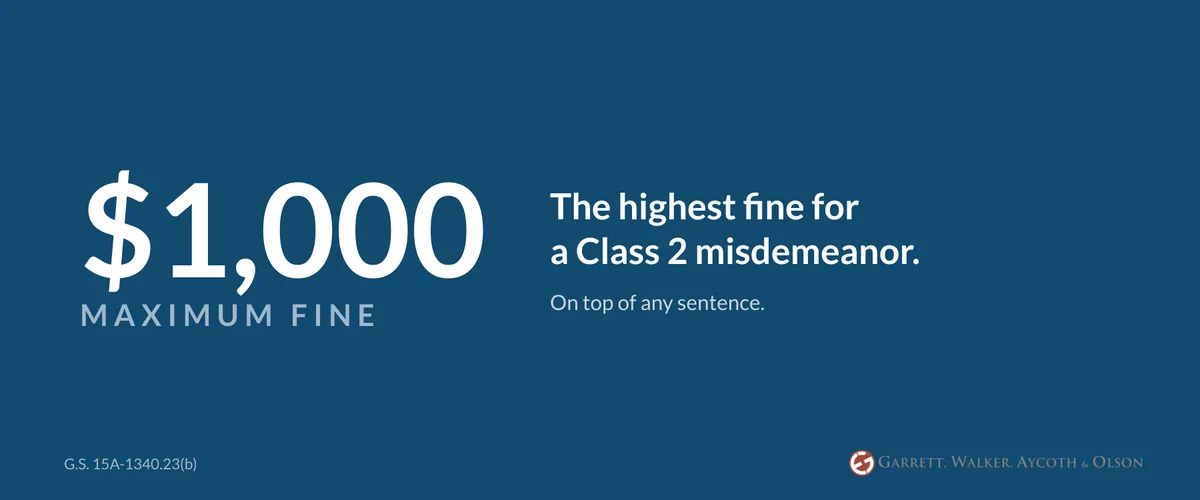
Fines are capped at $200 for Class 3 and $1,000 for Class 2, and for Class 1 and A1 the amount is up to the court (G.S. 15A-1340.23(b)). A Class 3 with three or fewer priors gets a fine only (G.S. 15A-1340.23(d)).
Any prior felony or misdemeanor counts toward your level. Several convictions from one session of District Court count as one (G.S. 15A-1340.21(d)).
Key point: Community means a sentence with no active term and no special probation, while intermediate means supervised probation, which can include short jail periods as special probation (G.S. 15A-1340.11). Active means jail time served.
“Unless otherwise provided, the court shall suspend a sentence of imprisonment if the class of offense and prior conviction level requires community or intermediate punishment as a sentence disposition.” G.S. 15A-1340.20(c)
Can You Go to Jail for a Class 2 Misdemeanor?
It depends on your prior convictions. With none, the chart authorizes community punishment only, up to 30 days, and G.S. 15A-1340.20(c) requires the court to suspend it.
With one to four priors, it allows up to 45 days of community or intermediate punishment, also suspended. With five or more, it allows up to 60 days, and active jail is authorized.
Intermediate punishment can include short jail periods as a condition of probation, and a suspended sentence can be activated if probation is revoked (G.S. 15A-1351, 15A-1344).
One exception applies at any level. A judge may order a jail term equal to or less than the time you already spent in custody on this charge (G.S. 15A-1340.20(c1)).
Four prior convictions keep you at Level II. A fifth moves you to Level III, where active time is authorized.
Which level you are sentenced at is argued by your lawyer, not assumed. Old convictions from one court session count once, and a printout can be wrong.
On top of any sentence, a Class 2 misdemeanor can carry a fine of up to $1,000.
A Class 1 misdemeanor also allows 1 to 45 days at Level I. But active jail becomes possible with one prior conviction, and its fine has no set cap.
Before you plead guilty or pay anything, call (336) 379-0539. A guilty plea is a conviction.
Common Class 2 Misdemeanors in NC
Most Class 2 charges come from fights, disorder, trespass, property damage and driving.
| Charge | Statute | Watch For |
|---|---|---|
| Simple Assault or Simple Affray | G.S. 14-33(a) | Serious injury or a weapon: Class A1 |
| Disorderly Conduct | G.S. 14-288.4(b) | Most forms |
| Resisting, Delaying or Obstructing an Officer | G.S. 14-223(a) | Officer seriously injured: Class I felony |
| First Degree Trespass | G.S. 14-159.12(b) | Some forms are felonies |
| Second Degree Trespass on a Home’s Curtilage, Midnight to 6 A.M. | G.S. 14-159.13(a)(3) | Other second degree trespass: Class 3 |
| Injury to Personal Property | G.S. 14-160(a) | Over $200 damage: Class 1 |
| Reckless Driving | G.S. 20-140(d) | Serious injury (from December 1, 2025): Class 1 |
| Carrying a Concealed Weapon (Not a Gun) | G.S. 14-269(a), (c) | A first concealed gun is also Class 2 |
| Carrying a Concealed Gun, First Offense | G.S. 14-269(a1), (c) | Second offense: Class H felony |
Communicating threats is a Class 1 misdemeanor, not Class 2 (G.S. 14-277.1). A first shoplifting by concealment is a Class 3 (G.S. 14-72.1(e)).
A Class 2 committed because of the victim’s race, color, religion, nationality or country of origin becomes a Class 1 (G.S. 14-3(c)).
For fights, see how every NC assault charge is punished. Public-disturbance cases are covered in disorderly conduct charges in Greensboro.
For driving cases, see reckless driving charges in Greensboro. A second concealed gun charge crosses into felony territory; see when a charge becomes a Class H felony.
Talk to a defense lawyer before you talk to anyone else
What you say and sign in the first days often decides what is possible later. The earlier we see your paperwork, the more options you usually have.
Call (336) 379-0539Free consultation with a Greensboro attorneyClass 1, Class A1 and Class 3 Misdemeanors in NC
The other three classes use the same chart, with different days and different rules on jail.
What Is a Class 1 Misdemeanor in NC?
A Class 1 carries 1 to 45 days of community punishment at Level I. With one to four priors it allows 1 to 45 days including active jail, and with five or more, 1 to 120 days.
The fine is at the court’s discretion. Examples include larceny of $1,000 or less (G.S. 14-72(a)), communicating threats, and breaking or entering a building without intent to steal (G.S. 14-54(b)).
What Is a Class A1 Misdemeanor in NC?
Class A1 is the most serious class, and active jail is authorized at every level: up to 60, 75 or 150 days.
Examples include assault inflicting serious injury or using a deadly weapon, and assault on a female by a male 18 or older (G.S. 14-33(c)). So are assault by pointing a gun (G.S. 14-34) and a misdemeanor crime of domestic violence (G.S. 14-32.5).
A Class A1 conviction is not “nonviolent” under G.S. 15A-145.5, so it is not eligible for expunction under that statute. For these charges, see assault and domestic charge defense in Greensboro.
Class 3: The Lowest Class
A Class 3 with three or fewer priors gets a fine only, capped at $200. For the lowest class, see how a Class 3 misdemeanor is handled.
Class 2 Misdemeanor First Offense: What Can Happen
With no prior convictions, the chart authorizes community punishment only, and the court must suspend any jail term. A conviction still goes on your record.
Deferred prosecution is open to misdemeanors, on a motion by you and the prosecutor under a written agreement (G.S. 15A-1341(a1)). You must have no prior felony or moral-turpitude misdemeanor and never have been on probation.
A conditional discharge comes after a guilty plea or finding, on a joint motion, before judgment is entered. When you complete probation, the plea is withdrawn and the case is dismissed (G.S. 15A-1341(a4), (a6)).
Neither path is available for impaired driving (G.S. 15A-1341(a)).
None of these is automatic. Each needs the prosecutor’s agreement and a judge’s finding, so your lawyer asks for the path you qualify for, depending on the facts of your case.
Dismissal is a separate question; see when a misdemeanor can be dropped in NC.
Does a Class 2 Misdemeanor Stay on Your Record?
Yes. A conviction stays until a court expunges it, and some Class 2 convictions are not eligible under G.S. 15A-145.5.
For one nonviolent misdemeanor, you can petition 3 years after the conviction or the end of the sentence and probation, whichever is later. For more than one, the wait is 7 years.
The 3-year wait applies to petitions filed on or after July 9, 2025, according to the UNC School of Government.
A nonviolent Class 2 conviction stays on your public record for at least three years before you can ask to clear it.
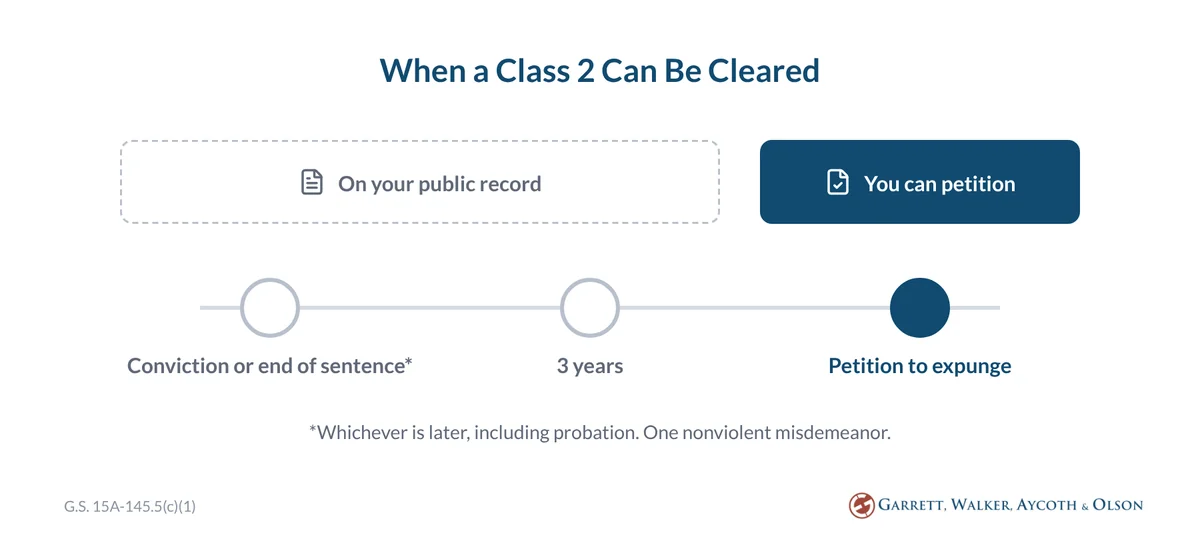
Offenses with assault as an element, like simple assault, are not “nonviolent,” so they are not eligible under G.S. 15A-145.5. Impaired driving is excluded too (G.S. 15A-145.5(a1)).
Whether a simple affray conviction can be expunged later depends on how G.S. 15A-145.5 treats it; a lawyer checks this before any plea.
If a misdemeanor petition meets the conditions, the court “shall” order expunction. A dismissed charge can be expunged on petition too, in most cases (G.S. 15A-146(a)).
When you qualify, here is how expunction clears a misdemeanor.
Because a simple assault conviction cannot be expunged under G.S. 15A-145.5, the time to protect your record is before you plead.
What Happens After a Class 2 Misdemeanor Charge in Greensboro
A Class 2 case starts with a citation, a summons or an arrest. It is heard in Guilford County District Court, which tries misdemeanors (G.S. 7A-272(a)).
Keep photos, texts and witness names. Do not post about the case on social media, and do not plead or pay before you talk to a lawyer.
Deferred prosecution is agreed before trial, and a conditional discharge must be asked for at the plea, before judgment is entered. Your level also depends on a printout that may count one session’s convictions more than once.
A Greensboro criminal defense lawyer can read your citation and your record before court.
Call (336) 379-0539 to talk with our Greensboro misdemeanor team.
Frequently Asked Questions
Is a Class 2 misdemeanor bad?
It is a criminal conviction that stays on your record. The chart allows up to 60 days with five or more priors and a fine up to $1,000. A simple assault conviction, a common Class 2, is not eligible for expunction under G.S. 15A-145.5.
Can you go to jail for a first Class 2 misdemeanor?
If you have no prior convictions at all, the chart authorizes community punishment only, and G.S. 15A-1340.20(c) requires the court to suspend any jail term. The exception is a term equal to time already spent in custody on the charge. Your lawyer argues which level applies.
What is the difference between a Class 1 and a Class 2 misdemeanor?
A Class 1 allows up to 45, 45 or 120 days by level, active jail from one prior, and a fine set by the court. A Class 2 allows up to 30, 45 or 60 days, active jail only with five or more priors, and a $1,000 fine cap.
What is the fine for a Class 2 misdemeanor?
Up to $1,000 under G.S. 15A-1340.23(b), unless the statute for that offense says otherwise. Where community punishment is authorized, the judgment can be a fine only. Court costs are a separate charge on top of any fine, so ask your lawyer before you pay.
Is a level 2 misdemeanor the same as a Class 2?
No. The class is the offense, and the level is your record. Level II means one to four prior convictions under G.S. 15A-1340.21, so a Class 2 charge can be sentenced at Level I, II or III, depending on your record.
Can a Class 2 misdemeanor be expunged in NC?
Many can. One nonviolent misdemeanor can be expunged 3 years after the conviction or the end of the sentence and probation, whichever is later. Offenses with assault as an element, such as simple assault, are not eligible under G.S. 15A-145.5.
What happens with several misdemeanor convictions at once?
If the judge runs jail terms back to back for Class A1, 1 or 2 offenses, the total cannot exceed twice the maximum for the most serious one (G.S. 15A-1340.22(a)). Consecutive sentences are not allowed if every conviction is Class 3.
How long does the State have to charge a Class 2 misdemeanor?
Most misdemeanors must be charged within two years of the offense under G.S. 15-1(a). Malicious misdemeanors and some offenses listed in the statute follow other rules. If you think a charge is coming, call (336) 379-0539 before you talk with officers.
Do I need a lawyer for a Class 2 misdemeanor?
Yes, because the conviction is what lasts. A plea to simple assault cannot be expunged under G.S. 15A-145.5, deferral needs the prosecutor’s agreement, and your level depends on a record printout. A lawyer can deal with all three before you enter any plea.
- Former President, Greensboro Criminal Defense Lawyers Association
- Elected member, Criminal Justice Section, North Carolina Bar Association
- Selected to present the Wade M. Smith Award for Top Criminal Defense Lawyer in North Carolina
Talk to a Greensboro criminal defense lawyer today
Bring the warrant, the release order and anything else they gave you.
Garrett, Walker, Aycoth & Olson, Attorneys at Law
317 South Greene St, Greensboro, NC 27401
(336) 379-0539
This article explains North Carolina law in general terms. It is not legal advice about your case, and laws, penalties and court procedures change. Contact an attorney about your specific situation.