


Yes, a misdemeanor can be dropped in North Carolina, but only the prosecutor can drop it, under G.S. 15A-931. Dismissals come from weak evidence, a winning defense motion, or a deferred prosecution or conditional discharge that a lawyer negotiates.
“It’s just a misdemeanor, it’ll get dropped” is a risky belief. The person who reported it cannot end the case, and nothing about a dismissal is automatic.
Have a misdemeanor charge in Guilford County? Call (336) 379-0539 so a lawyer can start before your first court date.
Our page on misdemeanor defense in Greensboro covers common charges and defenses.
What “Dropped” Means for a Misdemeanor in NC
“Dropped” means the prosecutor filed a voluntary dismissal under G.S. 15A-931. A judge can also dismiss a misdemeanor on legal grounds.
| Outcome | Who | What It Means |
|---|---|---|
| Voluntary dismissal | Prosecutor | Can be re-charged within the time limit from the offense date (G.S. 15-1) |
| Dismissal with leave | Prosecutor | Off the calendar, but orders for arrest stay valid and the case can be reinstated (G.S. 15A-932) |
| Court dismissal | Judge | Ends the case on a legal ground or for insufficient evidence |
| Deferred prosecution dismissal | Prosecutor | After you complete a pre-plea agreement |
| Conditional discharge | Court | Plea withdrawn and case dismissed after the terms |
Warning: a dismissal with leave after a missed court date is not a dropped charge. Under G.S. 15A-932, “all process outstanding retains its validity,” and the prosecutor can bring the case back:
“Upon apprehension of the defendant, or in the discretion of the prosecutor when he believes apprehension is imminent, the prosecutor may reinstitute the proceedings by filing written notice with the clerk.”
G.S. 15A-932(d)
If you missed court, start with recalling an order for arrest.
If the charge is a felony, the rules for dropping a felony add more steps.
Can a Class 1 Misdemeanor Be Dropped? (Class A1, 1, 2 and 3)
Yes. Every NC misdemeanor class can be dropped or dismissed; the class changes the stakes, not who decides.
North Carolina uses Classes A1, 1, 2 and 3, not “Class A” or “Class B” misdemeanors. Here is what the chart in G.S. 15A-1340.23 authorizes with no prior convictions:
| Class | No Prior Convictions (Level I) | Max Fine |
|---|---|---|
| Class A1 | 1-60 days, C/I/A | Court’s discretion |
| Class 1 | 1-45 days, C | Court’s discretion |
| Class 2 | 1-30 days, C | $1,000 |
| Class 3 | 1-10 days, C | $200 |
C means the chart authorizes community punishment, I intermediate punishment and A active punishment. Staying in that band is argued by your lawyer, not handed to you.
Prior convictions raise the ranges, up to 150, 120, 60 and 20 days at Level III. For a Class 3 with no more than three prior convictions, the judgment is a fine only, capped at $200.
The conviction on your record is the part that lasts. See how a Class 2 misdemeanor is punished, or read more on the Class 3 fine-only rule.
How to Get Misdemeanor Charges Dropped Before Your Court Date
You cannot file to drop your own charge. Your lawyer asks the prosecutor before the court date and prepares motions.
Read the charge and the court date
Check whether you have a citation, a summons or a warrant, and note the date. Missing court on a summons can lead to an order for arrest (G.S. 15A-303).
Say nothing more about the facts
Do not discuss the case with police, the other person or anyone online. What you say can be used.
Get the evidence reviewed
Your lawyer looks at what the State has, whether evidence can be suppressed and whether the time limit to charge had already run.
Ask about diversion
Deferred prosecution, conditional discharge and the 90-96 drug program are covered in the next section.
Go to court unless your lawyer says otherwise
Your lawyer will tell you whether you must appear in person. Do not assume you can skip it.
Getting a dismissal before the court date depends on the evidence and on what your lawyer can show the assistant DA.
Can a First-Time Misdemeanor Be Dismissed?
Often it can be, through diversion, but only when the prosecutor agrees and you meet the statute’s conditions.
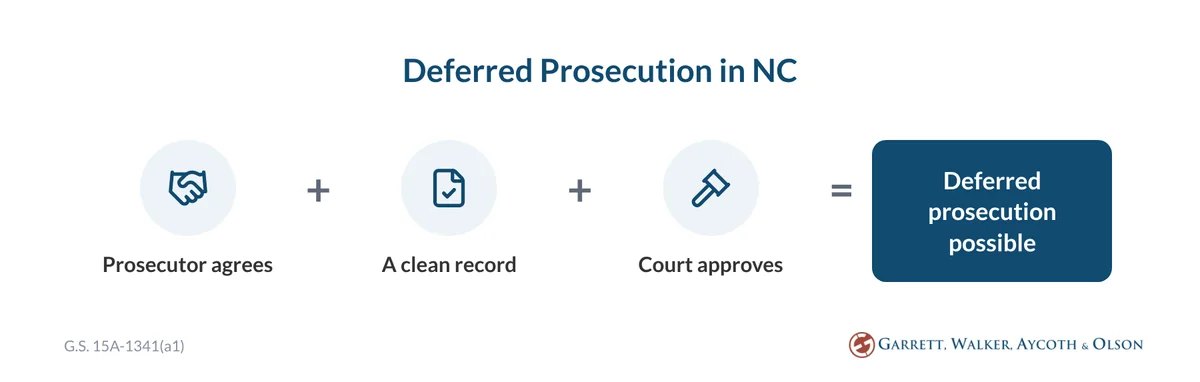
Deferred prosecution under G.S. 15A-1341(a1) comes before any plea. It needs a written agreement with the prosecutor and the court’s approval.
You must have no prior felony or misdemeanor involving moral turpitude, and you must never have been on probation. The court must also find you unlikely to offend again, and known victims must be notified and heard.
Deferred prosecution needs the prosecutor’s agreement, a clean record and the court’s approval.
A conditional discharge under G.S. 15A-1341(a4) comes after a plea or finding of guilt, before judgment is entered. When you finish the terms, the plea is withdrawn and the case is dismissed.
Prosecutors may also make nonstatutory agreements, as the UNC School of Government notes.
First-offense misdemeanor drug possession or paraphernalia has its own route under G.S. 90-96. The court “shall” defer with your consent unless it finds you inappropriate in writing, with the DA’s agreement.
That route can be used only once. It is often part of defending a drug possession charge.
DWI is different. No deferred prosecution or conditional discharge is available on a DWI probation, and a prosecutor who dismisses a DWI must state detailed reasons under G.S. 20-138.4.
Talk to a defense lawyer before you talk to anyone else
What you say and sign in the first days often decides what is possible later. The earlier we see your paperwork, the more options you usually have.
Call (336) 379-0539Free consultation with a Greensboro attorneyWhat Happens After a Misdemeanor Charge in Guilford District Court
A misdemeanor goes to District Court, where a judge, not a jury, decides any trial, as the NC Conference of District Attorneys explains.
A misdemeanor started by a private person’s sworn complaint may be sent to community mediation first, for up to 45 days, except in domestic violence cases (G.S. 7A-38.5).
The person who reported it can tell the DA’s office what they want, but cannot drop the case. Here is what a victim can and cannot do about a filed charge.
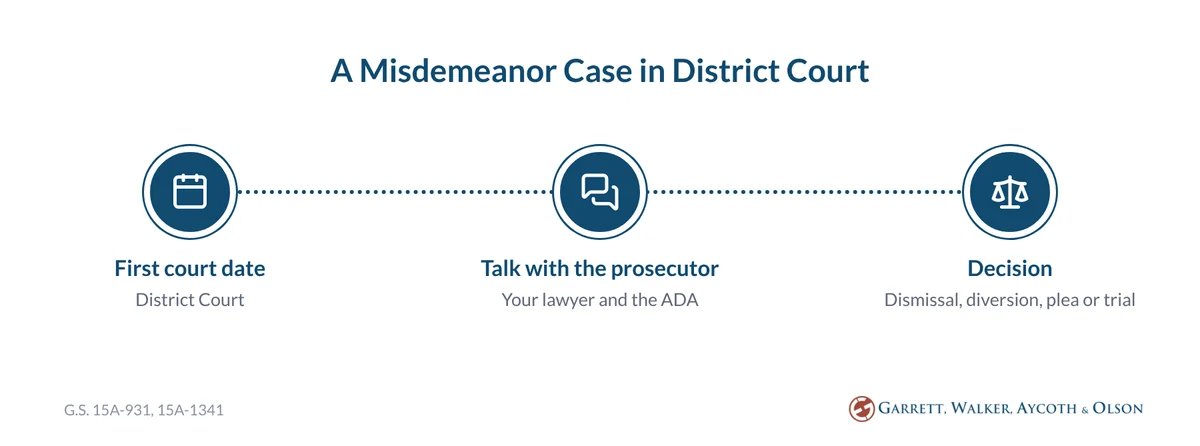
A misdemeanor case moves from the first court date to a talk with the prosecutor to a decision.
Can a Misdemeanor Be Dismissed for Procedural Errors?
Yes, when the error is one the law treats as a ground for dismissal. On a defense motion, the court must dismiss under G.S. 15A-954 if it finds one of these:
- The statute of limitations ran, two years for most misdemeanors
- You were denied a speedy trial
- Your constitutional rights were flagrantly violated and your defense cannot be repaired
- You were already placed in jeopardy for the same offense
- The court has no jurisdiction over the offense
- The charging paper fails to charge an offense
Two more tools work alongside those. Illegally obtained evidence can be suppressed under G.S. 15A-974, and the defense can move to dismiss for insufficient evidence under G.S. 15A-1227.
Does a Dropped Misdemeanor Stay on Your Record?
The charge stays in court records until it is expunged. On a petition, the court “shall” expunge a dismissed sole charge under G.S. 15A-146.
Many dismissals are now cleared automatically 180 to 210 days after the case ends, but not every type, as the UNC School of Government notes.
A dismissal with leave, or a case where any charge ended in a conviction, does not clear automatically. Call and we will check whether yours already cleared.
After a deferred prosecution or conditional discharge, the petition fee is $175 unless you are indigent. Police may keep investigative records even after an expunction.
We can help with expunging a dismissed charge that did not clear by itself.
How Prior Convictions Affect a Dismissal
Prior convictions do not stop a prosecutor from dismissing, but they can shut the diversion door. Statutory diversion requires no prior felony or moral turpitude misdemeanor and no earlier probation.
Priors also raise the sentencing level if the case ends in a conviction. With five or more, a Class 1 misdemeanor can reach 120 days, and active punishment is authorized.
How a Misdemeanor Lawyer Works Toward a Dismissal
A misdemeanor lawyer works toward a dismissal by finding the weak points before the court date:
- Reviews the evidence and the charging paper
- Talks with the assistant DA
- Asks for diversion where you qualify
- Files suppression and dismissal motions
- Prepares for a trial before a judge
Each of these is argued, depending on the facts of your case. Diversion talks happen before a plea, so timing matters.
You can also see every criminal charge we handle in Guilford County.
Want the case looked at early? Call (336) 379-0539 to speak with a Greensboro misdemeanor lawyer.
Frequently Asked Questions
Can a misdemeanor be dropped after a guilty plea?
The main route is a conditional discharge, which must be ordered before judgment is entered under G.S. 15A-1341(a4) and needs the prosecutor to join the motion. If you already pleaded, call a lawyer right away to see what options remain.
Can I get a deferred prosecution if I was on probation years ago?
Not under G.S. 15A-1341(a1), which requires that you were never placed on probation before. Your lawyer can still argue other options, such as a nonstatutory agreement or a dismissal based on the evidence.
Does paying for the damage get a misdemeanor dropped?
Not by itself. The prosecutor decides under G.S. 15A-931. Making things right can be part of what your lawyer presents to the assistant DA, depending on the facts of your case.
Who decides a misdemeanor trial in District Court?
A judge, not a jury. The NC Conference of District Attorneys notes that District Court trials are always held before a judge. So the evidence review and any motions your lawyer files carry real weight, depending on the facts of your case.
What does “dismissed with leave” mean?
The case comes off the court calendar, but it is not over. Under G.S. 15A-932, orders for arrest stay valid, and the prosecutor can reinstate the case with a written notice. It can follow a missed court date, so act on it quickly.
Does a misdemeanor dismissed with leave clear from my record automatically?
No. Automatic expunction under G.S. 15A-146 needs every charge in the case dismissed without leave, dismissed by the court or found not guilty, on or after December 1, 2021. A dismissal with leave does not qualify. Call and we will check what your record shows.
Is there a time limit to charge a misdemeanor?
Yes. Most misdemeanors must be charged within two years of the offense under G.S. 15-1. A few, such as sexual battery and misdemeanor child abuse, have 10 years.
Can a dismissed misdemeanor be brought back?
Yes, within the time limit. A voluntary dismissal does not pause the clock under G.S. 15A-931(b), so an offense from March 1, 2025, dismissed that September, can be re-charged until March 1, 2027. A dismissal with leave can be reinstated.
Can a DWI be dismissed like other misdemeanors?
Not in the same way. A prosecutor who dismisses a DWI must explain detailed reasons in writing and in open court under G.S. 20-138.4. A DWI probation also cannot come through deferred prosecution or a conditional discharge.
Can a “Class A” or “Class B” misdemeanor be dropped?
North Carolina does not use those labels for misdemeanors. Its classes are A1, 1, 2 and 3, and the prosecutor can drop a charge in any of them. If your paperwork says “Class A1,” that is the most serious misdemeanor class.
- Former President, Greensboro Criminal Defense Lawyers Association
- Elected member, Criminal Justice Section, North Carolina Bar Association
- Selected to present the Wade M. Smith Award for Top Criminal Defense Lawyer in North Carolina
Talk to a Greensboro criminal defense lawyer today
Bring the warrant, the release order and anything else they gave you.
Garrett, Walker, Aycoth & Olson, Attorneys at Law
317 South Greene St, Greensboro, NC 27401
(336) 379-0539
This article explains North Carolina law in general terms. It is not legal advice about your case, and laws, penalties and court procedures change. Contact an attorney about your specific situation.