


Police generally need a search warrant to look through your phone, and you do not have to consent. Whether they can force you to give your passcode or press your finger or face to unlock it is not settled, and courts disagree.
A warrant to search your phone is not the same as a court order making you open it. Those are two different legal questions.
This guide is for anyone stopped, arrested or questioned in Greensboro or Guilford County whose phone ended up with police.
Police took your phone? Call (336) 379-0539 before you unlock it or answer questions.
Anything you open or say now can become evidence, so talk to a criminal defense lawyer first.
Do Police Need a Warrant to Search Your Phone?
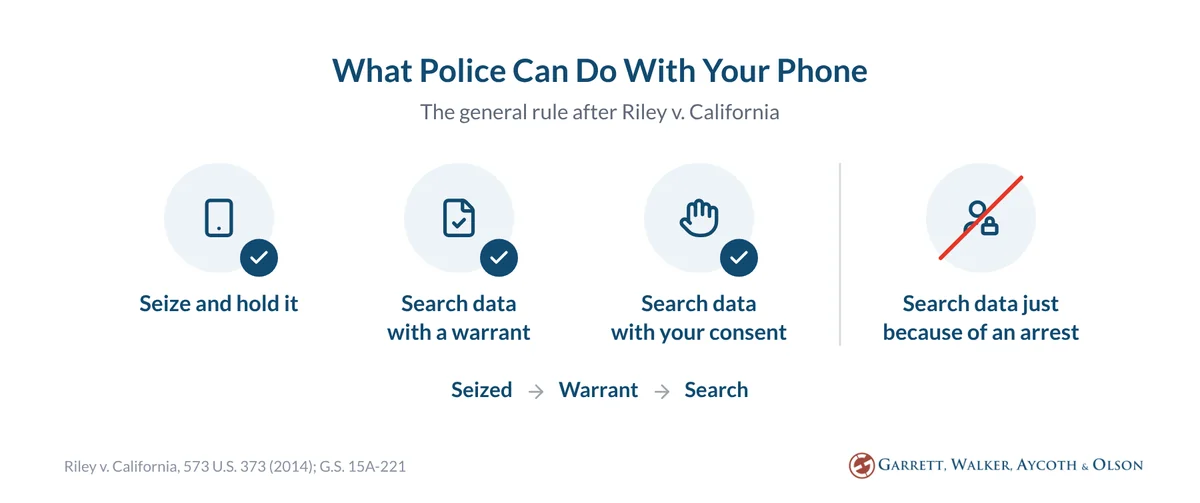
Yes, in most cases. In 2014 the U.S. Supreme Court held:
“The police generally may not, without a warrant, search digital information on a cell phone seized from an individual who has been arrested.” Riley v. California, 573 U.S. 373 (2014)
The Court summed up what police must do before searching a phone taken at arrest in three words: “get a warrant.”
Officers may still seize and secure the phone to keep evidence from being destroyed while they apply for a warrant. Taking the phone and searching its data are separate steps.
Real emergencies can still justify a warrantless search of a particular phone, such as preventing the imminent destruction of evidence, chasing a fleeing suspect or helping someone seriously hurt.
In State v. Duran-Rivas (2024), the N.C. Court of Appeals held a warrantless seizure of phones fell within the exigent circumstances exception. The search of the phone came after officers got a search warrant.
Consent is the other route. A consent search needs a statement, made voluntarily, that gives permission (G.S. 15A-221).
Your home has its own protections; see the rules for searching your home. People on probation have different rules; read about phone and home searches on probation.
What a Search Warrant for Your Phone Allows
A search warrant lets officers search the phone’s data for the items it lists. It is a court order directing an officer to search for designated items (G.S. 15A-241), and it must describe those items (G.S. 15A-246(5)).
The warrant is addressed to officers, not to you (G.S. 15A-246(2)). By its terms it tells officers to search; whether a court can also order you to open your phone is a separate question.
A search warrant must be executed within 48 hours of issue (G.S. 15A-248). Read about the 48-hour limit on search warrants.
Phones add a twist. The UNC School of Government found no North Carolina appellate case on whether lab analysis of a seized device must finish within those 48 hours.
With a warrant, officers may try to get into a locked phone lawfully. Whether they succeed is a technical question, not a legal one.
Passcode vs. Fingerprint vs. Face ID
Passcodes and biometrics are treated differently because a passcode comes from your mind. Courts ask whether unlocking is “testimonial,” which is what the protection against self-incrimination covers.
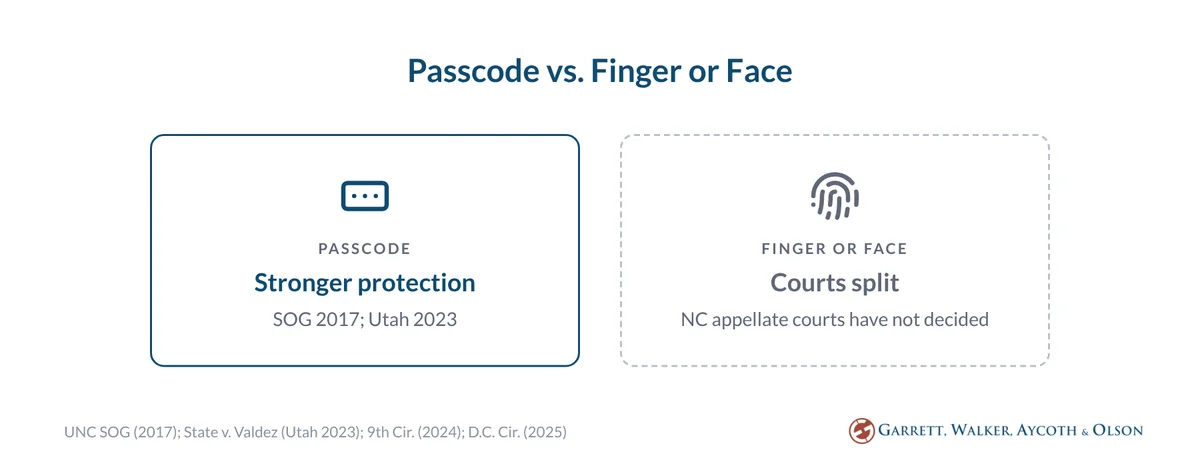
Passcode: In 2017, the UNC School of Government wrote that courts generally held a suspect cannot be required to give a passcode absent unusual circumstances. In 2023 the Utah Supreme Court called giving a passcode testimonial.
The words “absent unusual circumstances” matter. So the answer for your passcode depends on your facts.
Fingerprint or face: Many courts have treated pressing a finger to a phone like taking fingerprints, which is physical, not testimonial. The School of Government noted in 2017 that facial recognition is analytically similar.
That view is now split. In 2024 the Ninth Circuit allowed a forced thumb unlock of a parolee’s phone on its facts, but in 2025 the District of Columbia Circuit held a compelled thumb unlock testimonial.
North Carolina’s constitution also says a person charged with a crime shall not be compelled to give self-incriminating evidence (Article I, Section 23 of the North Carolina Constitution).
How these rules apply to you depends on facts your lawyer has to argue. That is why the order of events at the stop matters.
Talk to a defense lawyer before you talk to anyone else
What you say and sign in the first days often decides what is possible later. The earlier we see your paperwork, the more options you usually have.
Call (336) 379-0539Free consultation with a Greensboro attorneyWhat Recent Courts Have Said
Recent courts have not agreed, and the U.S. Supreme Court has not settled the question.
Utah Supreme Court, December 2023: In State v. Valdez, the court held that giving a passcode is testimonial, and that prosecutors violated the privilege by referring to the refusal (ABA Journal).
U.S. Supreme Court, June 24, 2024: The Court denied review in Utah v. Valdez (Supreme Court docket 23-1020).
Ninth Circuit, April 2024: In United States v. Payne, forcibly pressing a parolee’s thumb to his phone was not testimonial on those facts. The court said its opinion should not be read to cover every biometric unlock (Reason).
District of Columbia Circuit, January 2025: In United States v. Brown, compelling the defendant to open his phone with his thumb violated the Fifth Amendment (Arnold & Porter).
North Carolina’s appellate courts have not settled this question.
What to Do If Police Ask You to Unlock Your Phone
If police ask you to unlock your phone, stay calm and be clear. Ask whether they have a warrant.
You can say: “I do not consent to a search of my phone.” Unlocking it yourself or giving the passcode on your own can count as consent (G.S. 15A-221).
A consent search can go no further than the consent you gave (G.S. 15A-223(a)). Once the phone is open, it is hard to control what officers look at.
Do not lie to officers, and do not delete data or destroy the phone. That can create new problems on top of the first one.
You can ask for a lawyer before answering questions. If a judge orders you to open your phone, that is a different situation; call a lawyer before you respond.
Phone already taken? Call (336) 379-0539 before you say or open anything else.
If Police Already Searched or Unlocked Your Phone
If police already searched your phone, a lawyer can challenge it. On a timely motion, evidence must be suppressed if the Constitution requires it or if it came from a substantial violation of Chapter 15A (G.S. 15A-974).
There is a good-faith limit on the statutory ground, so details matter. Write down who touched the phone, whether you were told you had to open it, and when.
If there was a warrant, note the times. A lawyer checks whether the warrant named your phone and the data sought.
Phone warrants also come up in felony investigations in Guilford County.
With a lawyer, unlawfully obtained phone evidence can sometimes be kept out, depending on the facts of your case.
Call (336) 379-0539 and our defense team in Greensboro will review it.
Frequently Asked Questions
Can police force you to unlock your phone with a warrant?
A warrant lets officers search your phone’s data for the items it lists (G.S. 15A-246(5)). Whether you can be made to give a passcode or a fingerprint is a different, unsettled question. Courts disagree, so call a lawyer before you respond to any demand.
Can police use my fingerprint or face to unlock my phone?
Courts are split. The Ninth Circuit in 2024 allowed a forced thumb unlock of a parolee’s phone on its facts. The District of Columbia Circuit in 2025 held a compelled thumb unlock testimonial. North Carolina’s appellate courts have not decided the question.
Do I have to give police my passcode?
You can refuse consent to a search (G.S. 15A-221). In 2017, the UNC School of Government reported that courts generally protected passcodes absent unusual circumstances, and the Utah Supreme Court called a passcode testimonial in 2023. Courts still differ, and a court order changes the picture.
Can police take my phone without a warrant?
Yes, in some cases. Officers may seize and secure a phone to prevent destruction of evidence while they seek a warrant (Riley v. California). In State v. Duran-Rivas, an emergency justified the seizure, and the phone was searched only after a warrant.
Can police search my phone during a traffic stop?
As a rule, not the data, without a warrant, your consent or a real emergency (Riley v. California). Officers may still hold the phone while they seek a warrant. Say clearly that you do not consent, and do not hand over your passcode on your own.
Can I say no when police ask me to unlock my phone?
Yes. A consent search needs your voluntary permission (G.S. 15A-221), and you can say no. A judge’s order to open your phone is a different situation. If you receive one, call a lawyer before you respond, because how you respond can matter.
Can police get into a locked phone without my code?
With a valid warrant, officers may try to access the phone’s data lawfully. Whether they get in is a technical question, not a legal one. What matters legally is whether the warrant and the search followed the rules, which your lawyer can test.
What if I already unlocked it for them?
That may count as consent, but the search may not go beyond the consent you gave (G.S. 15A-223(a)). Tell a lawyer exactly what you said, what you opened and what officers looked at. Those details shape any challenge to the search.
- Former President, Greensboro Criminal Defense Lawyers Association
- Elected member, Criminal Justice Section, North Carolina Bar Association
- Selected to present the Wade M. Smith Award for Top Criminal Defense Lawyer in North Carolina
Talk to a Greensboro criminal defense lawyer today
Bring the warrant, the release order and anything else they gave you.
Garrett, Walker, Aycoth & Olson, Attorneys at Law
317 South Greene St, Greensboro, NC 27401
(336) 379-0539
This article explains North Carolina law in general terms. It is not legal advice about your case, and laws, penalties and court procedures change. Contact an attorney about your specific situation.