



48 hours is the longest you can be held without a judge, not a required stay. In North Carolina, an assault on a female arrest triggers the domestic hold only when the alleged victim is a current or former spouse, live-in partner or dating partner.
In those cases, only a judge can set release conditions under G.S. 15A-534.1. If no judge acts within 48 hours, the magistrate must.
Release then depends on meeting the conditions, such as posting bond.
Our lawyers can often get the case before a District Court judge early. Release can then come before the 48 hours are up, depending on the facts of your case.
Someone you love just arrested in Greensboro or High Point? Call (336) 379-0539 now, because the judge’s conditions start the day of release.
Talk to an assault on a female defense lawyer before the first hearing.
What Is the Assault on a Female NC 48-Hour Rule?
The 48-hour rule says that in covered domestic cases, only a judge can set release conditions. A person can be held up to 48 hours from arrest while waiting for that judge.
The key words are in subsection (b) of the statute:
“A defendant may be retained in custody not more than 48 hours from the time of arrest without a determination being made under this section by a judge.
If a judge has not acted pursuant to this section within 48 hours of arrest, the magistrate shall act under the provisions of this section.” (G.S. 15A-534.1(b))
“Not more than 48 hours” is a ceiling. It sets the longest wait for a judge, not a stay everyone must serve.
The judge must order a criminal history report and consider it before setting conditions. The statute also says no judge shall unreasonably delay release to review that report.
The UNC School of Government reads the rule as allowing a hold only while no judge is available. That reading fits State v. Thompson, a North Carolina Supreme Court case covered below.
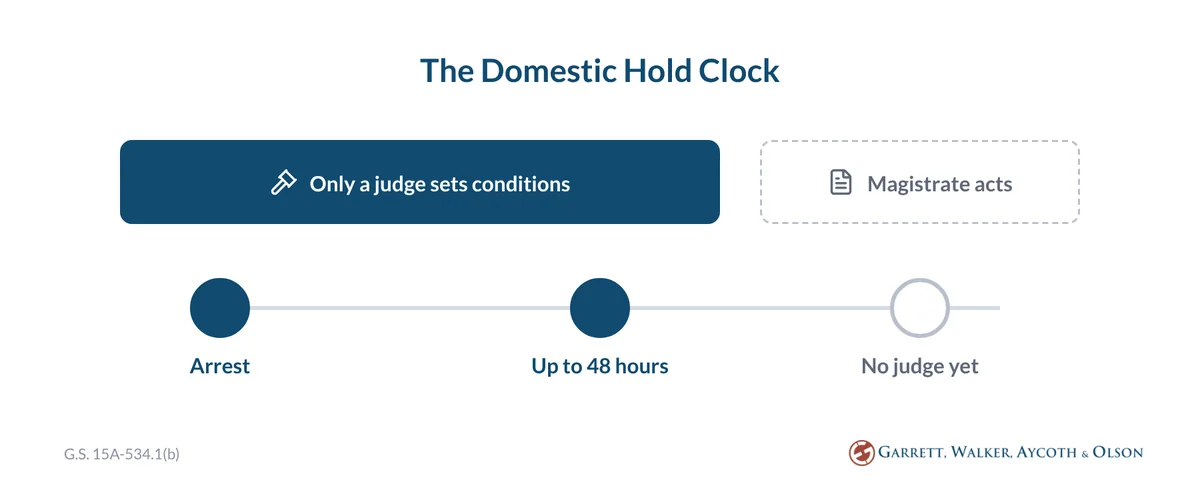
Weekends still matter. A Friday evening arrest with no judge available can mean waiting until a magistrate acts about 48 hours later, on Sunday evening.
So a family should not assume the person must sit in jail for two full days. For the local steps, read how Greensboro domestic holds work.
Does Every Assault on a Female Arrest Get a 48-Hour Hold?
No. Assault on a female triggers the hold only when the alleged victim has a covered relationship with the accused.
The charge is defined in G.S. 14-33(c)(2) as an assault on a female by “a male person at least 18 years of age.” The relationship decides whether the hold applies.
A newer charge, misdemeanor crime of domestic violence (MCDV) under G.S. 14-32.5, works differently. MCDV triggers the hold by itself.
| Alleged Victim Is | Assault on a Female Charge | MCDV Charge |
|---|---|---|
| Spouse or former spouse | Hold applies | Hold applies |
| Lives or lived with the defendant as if married | Hold applies | Hold applies |
| Current or former dating partner | Hold applies | Hold applies |
| Co-parent who was never a spouse, live-in partner or date | No hold for this charge alone | Hold applies |
| Coworker, neighbor or stranger | No hold | Not an MCDV case |
Note: The MCDV column covers offenses on or after December 1, 2025. That is when MCDV began triggering the hold.
The same relationship test applies to stalking, communicating a threat and some felonies. Domestic criminal trespass and violating a Chapter 50B protective order trigger the hold by the offense alone.
Without the hold, a magistrate sets conditions the normal way. Other charges can count as domestic too, so see when a domestic charge becomes a felony.
How Long Do You Stay in Jail for Assault on a Female?
There are two answers. One is how long you can be held before release, and the other is the jail the law allows after a conviction.
Before release, a covered case can mean up to 48 hours waiting for a judge. In narrow cases, a judge may also hold someone “for a reasonable period of time” while setting conditions.
That longer hold needs two findings. Release must risk danger or intimidation to the alleged victim, and a bond must not reasonably prevent it.
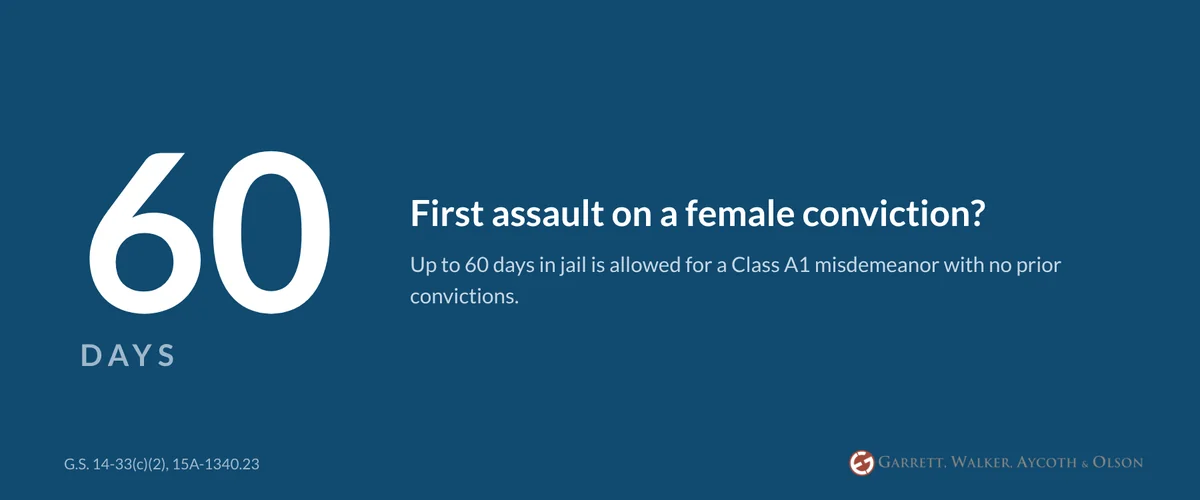
After a conviction, assault on a female is a Class A1 misdemeanor. The sentence depends on prior convictions under G.S. 15A-1340.23.
The grid authorizes 1-60 days with no prior convictions, 1-75 days with one to four, and 1-150 days with five or more. Active jail is allowed at every level, and the fine amount is up to the court.
Where you fall on that grid, and which punishment to ask for, is argued by your lawyer, not assumed.
So how long can a man go to jail for hitting a woman in NC? On this charge, which covers a male at least 18, the grid tops out at 150 days.
Assault on a female is a misdemeanor on its own, but prior domestic convictions can turn a later charge into a felony, as covered below.
Talk to a defense lawyer before you talk to anyone else
What you say and sign in the first days often decides what is possible later. The earlier we see your paperwork, the more options you usually have.
Call (336) 379-0539Free consultation with a Greensboro attorneyHow a Lawyer Can Get You Out Before the 48 Hours Are Up
The fastest way out of a domestic hold is an early hearing before a District Court judge. A lawyer can push for one.
We can often get your case in front of a judge early and get you released before the 48 hours are up. That depends on the facts of your case.
At that hearing, the judge weighs the factors in G.S. 15A-534(c). These include family ties, job, housing situation, character, length of residence, court history and the evidence.
A family can help by gathering these items now:
- Proof of a job, such as a recent pay stub or a letter from a supervisor
- An address where the person can stay away from the alleged victim
- Names and phone numbers of people who can speak to the person’s character
- How long the person has lived in the area
- Any court paperwork already received, such as the release order
Someone still in custody right now? Call (336) 379-0539 while the person is still held, so we can ask for the hearing sooner.
In Guilford County, a person may be held at the Greensboro Detention Center, 201 South Edgeworth St. The other jail is the High Point Detention Center, 507 East Green Drive.
Cases are heard at the Guilford County Courthouse, 201 South Eugene St.
Release Conditions the Judge Can Set
In covered domestic cases, the judge can add conditions on top of a secured bond. G.S. 15A-534.1 lists these:
- Stay away from the alleged victim’s home, school, business or workplace
- Do not assault, beat, molest or wound the alleged victim
- Do not remove or damage specifically identified property
- Visit your children only at the times and places an existing court order allows
- No alcohol, checked with a continuous alcohol monitoring system
Note: Child visits follow any existing court order, whether or not the parents were married. No alcohol is a condition the judge may set, not an automatic one.
Under G.S. 15A-534(d), the release order warns that your arrest will be ordered immediately upon any violation.
Since December 1, 2025, a written promise to appear is no longer a release option. Iryna’s Law (S.L. 2025-93) removed it.
Important: If you live with the alleged victim, a stay-away condition can mean you cannot go home. Plan where you will stay before the hearing.
If the bond is set too high to post, read about asking a judge to lower your bond.
What If You Are Held Longer Than 48 Hours?
If no judge has acted within 48 hours of arrest, the law requires the magistrate to set conditions.
A hold can also run too long when a judge was available. In State v. Thompson, 349 N.C. 483 (1998), that delay violated due process, and the North Carolina Supreme Court affirmed the dismissal.
In State v. Jenkins, 137 N.C. App. 367 (2000), a wait of about seven hours for a 1:30 p.m. bond session was “reasonably feasible.” The Court of Appeals reversed the dismissal.
So a delay can be grounds to ask for dismissal. Whether it works depends on whether a judge was actually available.
Jail records and the court calendar show when a judge was available. Those records are easiest to gather right away, which is one more reason to call today.
Other Consequences of an Assault on a Female Conviction
An assault on a female conviction reaches past the sentence, into your record and your gun rights.
If the judge finds a personal relationship with the alleged victim, G.S. 15A-1382.1 requires the judgment to say the case involved domestic violence.
The conviction also blocks a concealed handgun permit under G.S. 14-415.12.
Some relationships also raise federal law. With a spouse, ex, co-parent, live-in or dating partner, a conviction may bring the federal domestic violence gun ban.
Whether that ban applies to your conviction is a question to ask before any plea. Gun owners should also read about buying a gun while a charge is pending.
An assault on a female conviction against a spouse, ex-spouse, co-parent, live-in or dating partner can also count as a prior for the new habitual domestic violence felony in G.S. 14-32.6, which applies to new offenses on or after December 1, 2025.
Your lawyer starts with the elements the State must prove under the statute. Then look at common routes to dismissing this charge.
Our firm handles Guilford County domestic case defense from the first hearing on. The sooner a lawyer is involved, the sooner someone can ask a judge to hear the case.
Waiting on a hearing or just released? Call our assault on a female defense lawyers at (336) 379-0539.
Frequently Asked Questions
Can a magistrate set bond in a domestic assault case?
In a covered domestic case, a magistrate can set conditions only if 48 hours pass with no judge acting. Before that, only a judge can set them. In a case outside the hold, such as an assault on a stranger, the magistrate sets conditions as usual.
Can I go home if I live with the alleged victim?
Maybe not. A judge can order you to stay away from the alleged victim’s home, even when it is also your home. The judge must weigh your housing situation. Your lawyer can say where you will stay and ask for terms you can follow.
Will I have to wear an alcohol monitor?
Only if the judge orders it. One condition the judge may set is no alcohol, checked with a continuous alcohol monitoring system approved by the state. The monitoring provider reports any violation to the district attorney. If this condition would affect your job, tell your lawyer before the hearing.
What happens if I break a release condition?
The release order warns that your arrest will be ordered immediately upon any violation. That means you can go back to jail before your case is decided. If the alleged victim contacts you, do not respond until you talk with your lawyer about what your order allows.
Can the judge keep me in jail past the hearing?
Yes, but only in narrow cases and only for a reasonable period while the judge sets conditions. The judge must find a danger or likely intimidation to the alleged victim that a bond will not prevent. Your lawyer can answer those concerns with a safe place to stay and clear conditions.
Is a written promise to appear still possible?
No. Since December 1, 2025, it is no longer a release option in North Carolina. The options left are an unsecured bond, release to a supervising person or group, a secured bond, and house arrest with electronic monitoring. House arrest also requires a secured bond.
How is bond set for assault on a female?
In a covered case, a judge sets the type of release and any bond amount. Outside the hold, a magistrate does. The domestic conditions can be added on top of a secured bond. For amounts and practice, read about how bond is set for this charge.
Will an assault on a female conviction stop me from getting a concealed carry permit?
Yes. The sheriff must deny a concealed handgun permit to anyone found guilty of assault on a female under G.S. 14-33(c)(2). The same bar applies after a prayer for judgment continued or a suspended sentence. Talk with your lawyer about this before you accept any plea.
- Former President, Greensboro Criminal Defense Lawyers Association
- Elected member, Criminal Justice Section, North Carolina Bar Association
- Selected to present the Wade M. Smith Award for Top Criminal Defense Lawyer in North Carolina
Talk to a Greensboro criminal defense lawyer today
Bring the warrant, the release order and anything else they gave you.
Garrett, Walker, Aycoth & Olson, Attorneys at Law
317 South Greene St, Greensboro, NC 27401
(336) 379-0539
This article explains North Carolina law in general terms. It is not legal advice about your case, and laws, penalties and court procedures change. Contact an attorney about your specific situation.