


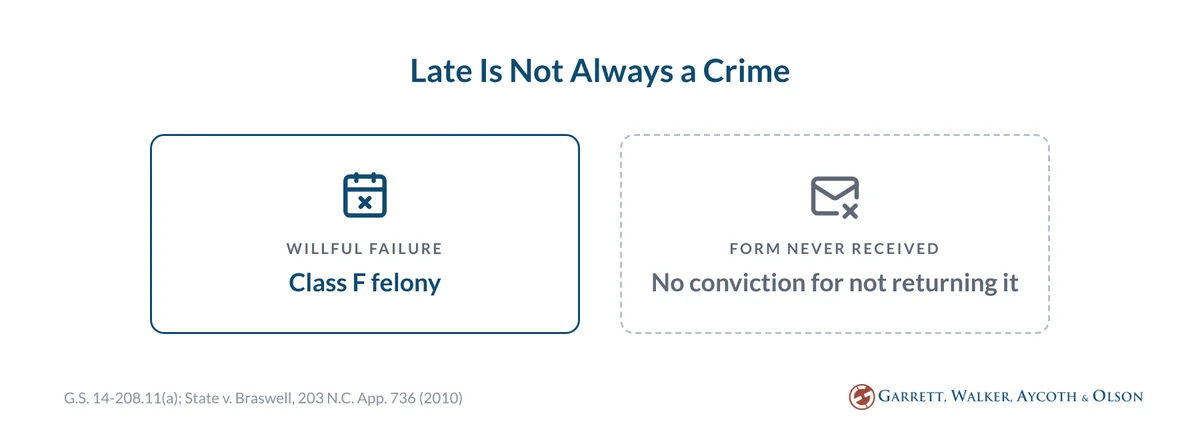
Failure to register is a Class F felony in North Carolina, but only if the State proves you failed willfully (G.S. 14-208.11(a)). A missed letter, a jail stay or a records error is not the same as a willful failure.
Many people think any missed deadline means a conviction. It does not: the statute and the jury instruction both require “willfully” for each act.
Knowing how to beat a failure to register charge starts there. Proving or disproving willfulness is the case, and it is argued by your lawyer.
Talk to a Greensboro sex offense defense lawyer before you report anything new to the sheriff. If an officer has called you about your registration, call (336) 379-0539 today.
What Counts as Failure to Register Under G.S. 14-208.11
A person required to register commits this crime by willfully doing any of ten things. Each one is a Class F felony.
“A person required by this Article to register who willfully does any of the following is guilty of a Class F felony” G.S. 14-208.11(a)
The ten acts, in plain words:
- Not registering when required
- Not reporting a change of address
- Not returning a verification form
- Forging or giving false registration information
- Not reporting starting or leaving school as a student
- Not reporting a job at a college or university
- Not reporting in person when required
- Saying you are moving out of state, then staying
- Not reporting out-of-county work with a temporary residence
- Not reporting new or changed online identifiers
Who must register in the first place is a separate question. For that, see how the NC sex offender registry works.
Registration Deadlines in North Carolina
Most changes must be reported in person within three business days. A few deadlines are shorter or longer.
| Event | Deadline | Source |
|---|---|---|
| Release from prison or jail | Within 3 business days | G.S. 14-208.7(a) |
| Conviction where prison time was not imposed | Immediately on conviction | G.S. 14-208.7(a) |
| Moving to NC from another state | 3 business days after setting up residence, or after 15 days in the State | G.S. 14-208.7(a) |
| Change of address | In person, in writing, by the 3rd business day, to the last registering sheriff | G.S. 14-208.9(a) |
| Moving to a new county | Also report to the new county’s sheriff by the 10th day | G.S. 14-208.9(a) |
| Moving out of state | In person, at least 3 business days before you leave | G.S. 14-208.9(b) |
| New or changed online identifier | In person, within 10 days | G.S. 14-208.9(e) |
| Name change, or student or college job change | In person, within 3 business days | G.S. 14-208.9(c), (d), (f) |
| Verification form (twice a year) | Return it in person within 3 business days after you receive it | G.S. 14-208.9A(a) |
The sheriff must give you written proof of registration when you register (G.S. 14-208.7(d)). Keep every copy, because it is evidence.
Is Failure to Register a Felony? Penalties in NC
Yes. Every act listed in G.S. 14-208.11(a) is a Class F felony, and the sentence depends on your prior record level.
| Prior Record Level | What the Chart Authorizes | Presumptive Minimum |
|---|---|---|
| Level I (0-1 point) | Intermediate or active punishment | 13-16 months |
| Level VI (18+ points) | Active punishment | 26-33 months |
Across all levels, minimums run from 10 months (mitigated, Level I) to 41 months (aggravated, Level VI). The highest maximum is 59 months (G.S. 15A-1340.17(c), (d)).
Some sites say a second violation is a Class C felony. The current statute has no such step; every violation in subsection (a) is Class F.
A separate rule covers photos. Willfully refusing a sheriff’s request for a new photograph is a Class 1 misdemeanor under G.S. 14-208.9A(c).
For the wider effect on your record, read what a Class F felony carries in North Carolina.
Talk to a defense lawyer before you talk to anyone else
What you say and sign in the first days often decides what is possible later. The earlier we see your paperwork, the more options you usually have.
Call (336) 379-0539Free consultation with a Greensboro attorneyHow to Beat a Failure to Register Charge: Defenses That Fit NC Law
The defense starts with the three things the State must prove. You had to register, you had a reportable conviction, and you willfully failed to comply.
Those three elements come from the North Carolina pattern jury instruction for this offense, N.C.P.I.-Crim. 207.75.
The Failure Was Not Willful
“Willfully” is in the statute, and the jury instruction includes it for each possible violation. A hospital stay, a sheriff’s office error or conflicting instructions are facts that bear on willfulness.
Those facts are not separate defenses. They are evidence that the failure was not willful.
A missed deadline is a fact; a willful failure is a crime, and only the second is a Class F felony.
The Verification Letter Never Arrived
In State v. Braswell, 203 N.C. App. 736 (2010), the Court of Appeals held that a person must have actually received the verification form. Without receipt, there is no conviction for failing to return it.
The statute points the same way. You return the form in person “within three business days after the receipt of the form” (G.S. 14-208.9A(a)(2)), so proof of mail problems matters.
You Were in Custody
You are treated as compliant if you were in jail or prison and told the official in charge there. You must then meet the requirement no later than 10 days after release (G.S. 14-208.11(c)).
You Did Not Change Your Address
“Address” means where you actually live, whether permanent or temporary (State v. Abshire, 363 N.C. 322 (2009)). If the sheriff could not find you there, you can report in person and prove you did not move (G.S. 14-208.9A(a)(4)).
Being homeless does not end the duty (State v. Worley, 198 N.C. App. 329 (2009)), but your lawyer can help you report where you actually stay.
You Were Not Required to Register
An out-of-state conviction counts only if it is substantially similar to an NC reportable offense, or required registration in that state (G.S. 14-208.6(4)b).
Do not rely on “nobody told me.” People who move here need no actual notice of the NC duty (State v. Bryant, 359 N.C. 554 (2005)).
The Records Are Wrong
Dates, addresses and the wrong county all appear in registration files. Your written proof of registration can show the sheriff’s record is wrong.
Which of these fits is a question for your lawyer. Any result depends on the facts of your case.
What Happens After a Failure to Register Charge
An officer who knows of a violation must immediately arrest you or seek an order for your arrest (G.S. 14-208.11(a1)). The officer can instead ask for a magistrate’s order for your arrest.
The case is handled in the county where you failed to register, even if you are arrested somewhere else (G.S. 14-208.11(a2)).
If you are on probation, the same facts can lead to a probation violation report as well. That is a second case with its own hearing.
Registration charges are among the criminal cases our firm defends in Guilford County.
If you think a warrant may be out, call (336) 379-0539 now. Going in with a lawyer and your proof of registration is different from being picked up on an order.
Registration Length and Getting Off the Registry
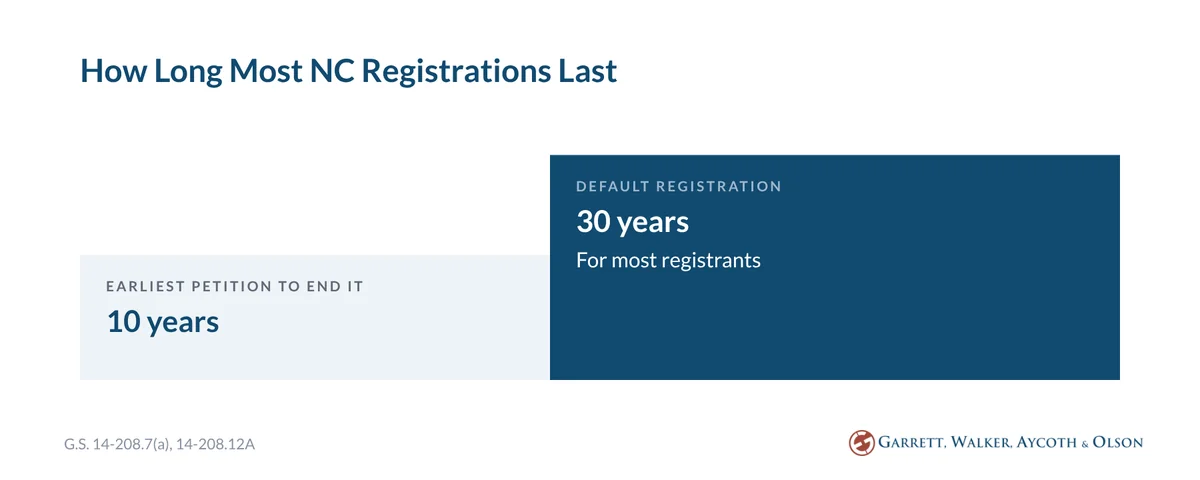
For most registrants, registration lasts at least 30 years. A petition to superior court is possible after 10 years if there is no later reportable conviction (G.S. 14-208.7(a); G.S. 14-208.12A(a)).
For most registrants, thirty years is the default and ten years is the earliest a judge can be asked to end it.
That petition is not open to everyone. A recidivist, a person convicted of an aggravated offense, and a sexually violent predator register for life (G.S. 14-208.23).
A recidivist is a person with a prior reportable conviction (G.S. 14-208.6(2b)). Those registrants are in a separate program under G.S. 14-208.6A.
For a petition, the judge must find you have not been arrested for a registrable crime since your sentence ended. The judge must also be satisfied you are not a threat to public safety (G.S. 14-208.12A(a1)).
The relief must also meet federal registration standards (G.S. 14-208.12A(a1)(2)), which your lawyer checks before filing.
A denied petition can be filed again after one year (G.S. 14-208.12A(a3)). For petitions filed on or after December 1, 2025, the clerk places the petition on the criminal docket for the district attorney to calendar (S.L. 2025-70).
A failure to register conviction is the record a judge will see at that hearing. That is a reason to fight the charge now.
If the conviction was a misdemeanor, see why sexual battery requires registration at all.
Call (336) 379-0539 for help with a failure to register charge in Guilford County.
Frequently Asked Questions
Is failure to register a felony in NC?
Yes. Under G.S. 14-208.11(a), each listed failure is a Class F felony, but only if the State proves you acted willfully. A failure caused by something outside your control is a different matter. Your lawyer tests the evidence of willfulness first.
How much jail time for failure to register?
At Level I, the chart authorizes intermediate or active punishment, with a presumptive minimum of 13-16 months. A higher record level raises the range, up to a 41-month minimum. Your record level and the range are argued by your lawyer, not assumed.
What if I never got the verification letter?
In State v. Braswell (2010), the Court of Appeals held a person must actually receive the form to be convicted for not returning it. Keep any proof of mail problems, such as returned mail or a change of address request, and show it to your lawyer.
I was in jail when my registration was due. Am I in trouble?
Possibly not. Under G.S. 14-208.11(c), you are treated as compliant if you were in custody, told the official in charge of the facility, and met the requirement within 10 days after release. Your lawyer proves the custody dates and the notice, depending on the facts of your case.
I am homeless. Do I still have to register?
Yes. “Address” means where you actually stay, even if it is temporary, and homelessness does not end the duty. Your lawyer can help you report where you are staying in a way the sheriff will accept, before a missed report becomes a charge.
I moved here from another state. Do I have to register?
If your conviction is reportable here, yes. You must register within 3 business days of setting up residence, or after 15 days in North Carolina, whichever comes first. You do not need to be told about the NC duty for it to apply.
Will I be arrested for failure to register?
Possibly. Under G.S. 14-208.11(a1), an officer who knows of a violation must immediately arrest you or seek an order for your arrest. Calling a lawyer first lets you plan how to go in, with your proof of registration in hand.
Can a failure to register charge be dismissed?
It depends on the evidence. Your lawyer tests whether the State can prove willfulness, a reportable conviction and the exact duty you missed. Records errors, custody and mail problems can all matter, depending on the facts of your case.
Can I get off the NC sex offender registry?
Most registrants can petition superior court after 10 years if there is no later reportable conviction, and a judge decides. Recidivists, people convicted of an aggravated offense and sexually violent predators register for life, with no petition (G.S. 14-208.23).
- Former President, Greensboro Criminal Defense Lawyers Association
- Elected member, Criminal Justice Section, North Carolina Bar Association
- Selected to present the Wade M. Smith Award for Top Criminal Defense Lawyer in North Carolina
Talk to a Greensboro criminal defense lawyer today
Bring the warrant, the release order and anything else they gave you.
Garrett, Walker, Aycoth & Olson, Attorneys at Law
317 South Greene St, Greensboro, NC 27401
(336) 379-0539
This article explains North Carolina law in general terms. It is not legal advice about your case, and laws, penalties and court procedures change. Contact an attorney about your specific situation.