


Defensive asylum is asylum you ask for in immigration court after the government starts removal proceedings against you. You file Form I-589 with the court by the judge’s deadline, with your evidence, certified translations and proof that any required fee was paid.
A filing that misses the judge’s deadline is treated as waived (8 CFR 1003.31(h)), and skipping biometrics counts as abandoning it (8 CFR 1003.47).
Many sites still say asylum is free.
Since July 2025, federal law charges an asylum application fee of at least $100 and a yearly fee while the case is pending, and neither can be waived (8 U.S.C. 1802 and 1808, as of November 2026).
Immigration attorney Sean Jeffcoat prepares the I-589 and the evidence, and stands with you before the judge. Call (336) 379-0539 the day you get a Notice to Appear, and learn how removal defense works in our office.
What Defensive Asylum Means
You can ask for asylum if you are physically present in the US, whatever your immigration status (8 U.S.C. 1158(a)(1)).
Defensive means you ask the immigration judge for asylum as a defense to removal. You file it with the Immigration Court during removal proceedings (8 CFR 1208.4(b)(3)).
To qualify, you must meet the statute’s refugee definition. You must be unable or unwilling to return home:
“because of persecution or a well-founded fear of persecution on account of race, religion, nationality, membership in a particular social group, or political opinion” 8 U.S.C. 1101(a)(42)(A)
The protected reason must be at least one central reason for the harm you fear (8 U.S.C. 1158(b)(1)(B)(i)).
Affirmative asylum is filed with USCIS when you are not in court. Defensive asylum is filed with the Immigration Court once removal proceedings have started.
If you are not in court yet, read how an affirmative asylum case works.
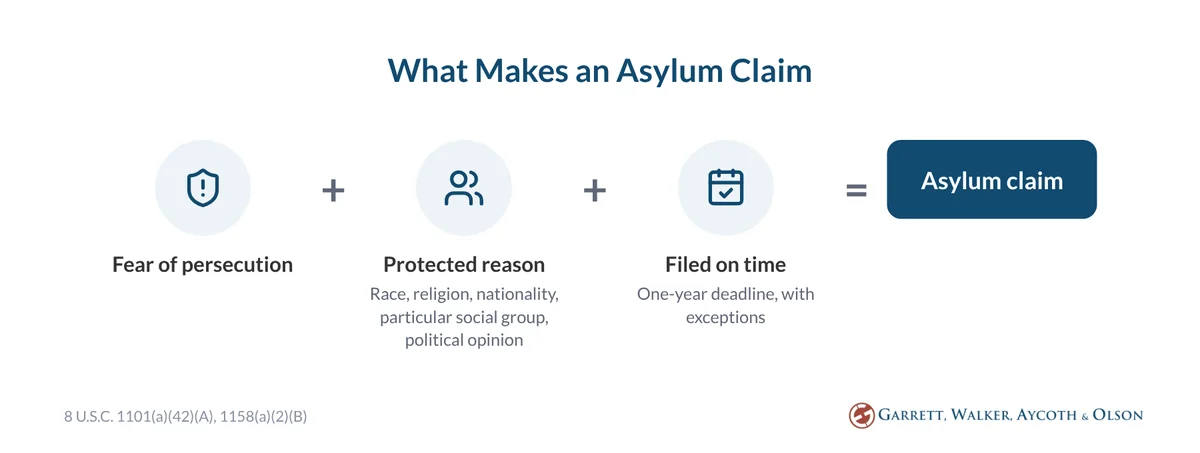
In short: a fear of persecution, plus a protected reason, plus a timely filing, makes an asylum claim.
The One-Year Deadline in Immigration Court
You must prove by clear and convincing evidence that you filed within one year after your arrival in the US (8 U.S.C. 1158(a)(2)(B)).
The year runs from your last arrival. In court, the filing date is the day the Immigration Court receives your I-589 (8 CFR 1208.4(a)(2)(ii)).
Two exceptions exist. Changed circumstances that materially affect your eligibility, or extraordinary circumstances related to the delay, may excuse a late filing.
Extraordinary circumstances include serious illness, the effects of past persecution and legal disability. You must then file within a reasonable period (8 CFR 1208.4(a)(4)-(5)).
The one-year rule does not apply to an unaccompanied child.
Warning: the one-year rule applies to asylum. The same Form I-589 also covers withholding of removal and Convention Against Torture protection, so ask your lawyer about them if you are past the year.
After the one-year mark, the delay needs a recognized exception and a filing within a reasonable period. Call (336) 379-0539 now.
Your Asylum Documentation Checklist
Build the file in this order, so nothing is missing.
Forms
- Form I-589, complete and signed as the form instructions require (a form that requires an ink signature is not complete if signed electronically, EOIR Practice Manual 11.3)
- Papers for each family member you include on the application
- The DHS fee receipt for the asylum fee
- Form EOIR-33 if your address has changed
Identity and Entry
- Passport or national ID card
- Birth certificate
- Any I-94 or other entry record
- Your Notice to Appear
Your Story
- Your personal declaration (see the next section)
- Letters from witnesses
- Police, medical or court records from your home country
- Membership cards or other proof of the protected reason
Country Evidence
- State Department country reports
- News and human rights reports about your home country
Translations
- An English translation of every foreign-language page, with a signed translator certification (8 CFR 1003.33)
The asylum fees below are set by federal law, as of November 2026.
| Fee | Amount | Source |
|---|---|---|
| Asylum application fee | At least $100, adjusted each year for inflation; no waiver | 8 U.S.C. 1802 |
| Annual asylum fee | At least $100 for each calendar year the case is pending; no waiver | 8 U.S.C. 1808 |
| First work permit (asylum) | At least $550; no waiver | 8 U.S.C. 1803(a) |
| Work permit renewal | At least $275; no waiver | 8 U.S.C. 1810 |
Note: exact current amounts change each year, and your lawyer confirms them before filing. The court needs the DHS fee receipt with the I-589 (8 CFR 1208.4(d)).
Key point: one older line in 8 CFR 106.2 still reads “No fee” for Form I-589, but 8 CFR 106.2(c)(14) and (c)(15) now require the asylum fee and the annual fee set by 8 U.S.C. 1802 and 1808.
Pages that call asylum free are out of date.
Writing Your Asylum Narrative
Your written statement and your testimony carry the case, and the judge compares them.
Your testimony alone can be enough only if it is credible, persuasive and specific.
The judge may also ask for corroborating evidence you can reasonably get (8 U.S.C. 1158(b)(1)(B)(ii)).
The judge weighs whether your written and spoken statements match, whenever they were made. Inconsistencies can count even when they do not go to the heart of the claim.
Tip: write the dates, places and names you are sure of, and say plainly when you are not sure.
Warning: a knowingly frivolous application, after notice of the consequences, brings a permanent bar from all immigration benefits (8 U.S.C. 1158(d)(6)).
Medical or psychological evaluations can also support the harm you describe.
Talk to an attorney about your situation
A short call is often enough to understand your options.
Call (336) 379-0539Free consultation with a Greensboro attorneyHow to File in Immigration Court
Court filing has its own rules, and each one matters.
File With the Immigration Court
During removal proceedings, the I-589 goes to the Immigration Court that has your case. Filings that require a fee need proof of payment (8 CFR 1003.31(g)).
Serve the Government
On paper, serve DHS and attach a certificate of service, or the judge will not consider the filing (8 CFR 1003.32(c)).
E-filing serves the other side automatically when all parties use it.
Do Your Biometrics
DHS sends a biometrics notice. Missing biometrics within the judge’s time counts as abandoning the application (8 CFR 1003.47).
Meet Every Judge Deadline
An application filed after the judge’s deadline is treated as waived (8 CFR 1003.31(h)).
Keep Your Address Current
File Form EOIR-33 with the court within five days of any move (8 CFR 1003.15(d)(2)).
The Charlotte Immigration Court is at 5701 Executive Center Drive, Suite 400, Charlotte, NC 28212. Public hours are 7:30 a.m. to 4 p.m., Monday to Friday, except federal holidays.
Work Permits and Fees While You Wait
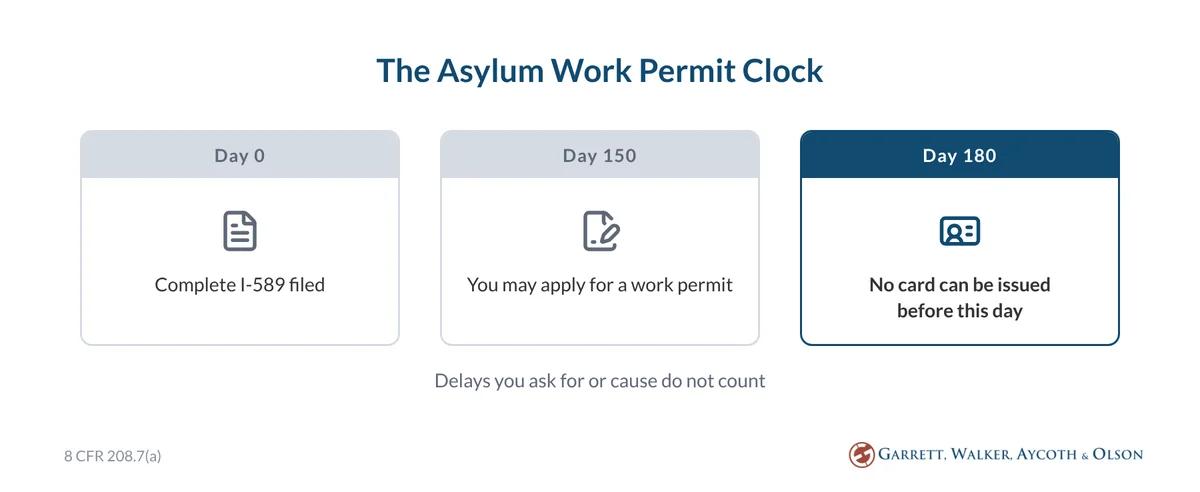
You may apply for a work permit 150 days after a complete asylum application is filed, but no card can be issued before day 180 (8 CFR 208.7(a)).
Delays you ask for or cause do not count. Missing a hearing without exceptional circumstances ends eligibility for the asylum work permit.
The first card costs at least $550 and each renewal at least $275, with no waiver (8 U.S.C. 1803 and 1810, as of November 2026).
The card ends 30 days after a judge denies asylum, unless you appeal to the Board of Immigration Appeals (8 U.S.C. 1810(b)(2)).
Federal law also charges at least $100 a year while an asylum case is pending, and it cannot be waived (8 U.S.C. 1808, added by Public Law 119-21 on July 4, 2025, as of November 2026).
As of January 2026, EOIR says it will not collect the annual fee until a judge sets a payment deadline, and only for applications pending one year or more as of October 1, 2025 (EOIR Policy Memorandum 26-01). Your lawyer checks the current rule.
Put simply: day 150 you can apply, day 180 is the earliest a card can arrive.
Master Calendar and Individual Hearings
The master calendar hearing is for pleadings and scheduling. The individual hearing is where the judge hears your application and decides it.
At the master calendar hearing, you answer the charges, name or decline a country of removal and say which relief you will seek.
The judge then sets filing deadlines and a date for the individual hearing (EOIR Practice Manual 4.15).
If you say you fear harm in the country of removal, the judge must tell you that you may apply for asylum or withholding of removal.
The judge must also explain your right to a lawyer at no cost to the government, and what a frivolous filing means (8 CFR 1240.11(c)(1)).
Warning: missing any hearing after written notice leads to a removal order in absentia (8 U.S.C. 1229a(b)(5)(A)).
If ICE later arrests someone with that order, a fee of at least $5,000 applies unless the order is rescinded (8 U.S.C. 1814, as of November 2026).
Your family’s other cases fit under one immigration team in Greensboro.
Withholding, CAT and Other Ways to Stay
The same Form I-589 is also your application for withholding of removal and for protection under the Convention Against Torture (8 CFR 1208.4(d)(1)).
Your lawyer explains how those protections differ from asylum in your case.
A conviction by final judgment for a “particularly serious crime” bars asylum, and every aggravated felony counts as one (8 U.S.C. 1158(b)(2)).
If a charge is still open, defending the criminal charge first can matter, depending on the facts of your case.
A lawyer also checks other paths. A crime victim may meet the U visa requirements for crime victims.
Some people can seek a green card before the immigration judge.
A marriage entered during removal proceedings needs clear and convincing proof of good faith before a green card (8 U.S.C. 1255(e)).
For the general rules, see how a spouse in the US applies.
Mistakes That Can End an Asylum Case
Each of these mistakes can end or weaken an asylum case.
- Filing the I-589 after the judge’s deadline
- Filing on paper without a certificate of service
- Untranslated pages, or translations without a signed certification
- Skipping biometrics
- Moving without filing Form EOIR-33
- Missing a hearing
- Written and spoken statements that do not match
- Waiting past one year after your last arrival without a recognized exception
If your next hearing is set, the checklist starts today. Call (336) 379-0539 and Sean Jeffcoat will review your deadlines, or read more about defending against removal in Charlotte.
Frequently Asked Questions
What is the difference between affirmative and defensive asylum?
Affirmative asylum is filed with USCIS by someone who is not in removal proceedings. Defensive asylum is filed with the Immigration Court after the government starts removal proceedings, and an immigration judge decides it. Both rely on the same refugee definition; the forum, the deadlines and the court rules differ.
Do I have to pay to apply for asylum in immigration court?
Since July 2025, federal law charges an asylum application fee of at least $100, with no waiver (8 U.S.C. 1802, as of November 2026). The DHS fee receipt goes with the I-589, and a yearly fee applies while the case is pending. Your lawyer checks EOIR’s current collection rule.
When can I apply for a work permit after filing for asylum?
You may apply 150 days after a complete asylum application is filed, and no card can be issued before day 180 (8 CFR 208.7). Delays you cause stop the clock. The first card costs at least $550, with no waiver (8 U.S.C. 1803, as of November 2026).
What happens if I miss my immigration court hearing?
If you received written notice, the judge can order you removed in absentia. A later ICE arrest with that order brings a fee of at least $5,000 unless the order is rescinded (8 U.S.C. 1814, as of November 2026). Call a lawyer the same day.
Can I apply for asylum after one year in the US?
Only if an exception applies. Changed circumstances that affect your eligibility, or extraordinary circumstances such as serious illness, can excuse a late filing, and you must then file within a reasonable period. The same form also covers withholding of removal and torture protection, so a lawyer reviews every option.
How long do I have to appeal an asylum denial?
An appeal of the immigration judge’s decision goes to the Board of Immigration Appeals within 30 calendar days of the decision (8 CFR 1003.38(b)). Your asylum work permit ends 30 days after a denial unless you file a timely appeal. Call a lawyer right away, because the deadline is short.
Do I need a lawyer for defensive asylum?
You may have a lawyer in immigration court, but not at government expense (8 U.S.C. 1229a(b)(4)(A)). The case turns on deadlines, evidence rules and your testimony, and a lawyer prepares all three with you. Sean Jeffcoat reviews your notice, your deadlines and your story before the next hearing.
Can I file my asylum application online with the court?
Attorneys must file through EOIR’s electronic filing system. A person without a lawyer may choose e-filing after registering, but must then e-file everything in that case unless the judge allows an opt-out (8 CFR 1003.31(a)). Paper filings must be served on DHS with a certificate of service.
What if I move while my case is pending?
File Form EOIR-33 with the Immigration Court within five days of any change of address (8 CFR 1003.15(d)(2)). Hearing notices go to the address the court has, so a missed update can lead to a missed hearing. Your lawyer can file the change for you.
Talk to our team today
Tell us where things stand and we will explain the next steps.
Garrett, Walker, Aycoth & Olson, Attorneys at Law
317 South Greene St, Greensboro, NC 27401
(336) 379-0539
This article explains North Carolina law in general terms. It is not legal advice about your case, and laws, penalties and court procedures change. Contact an attorney about your specific situation.