


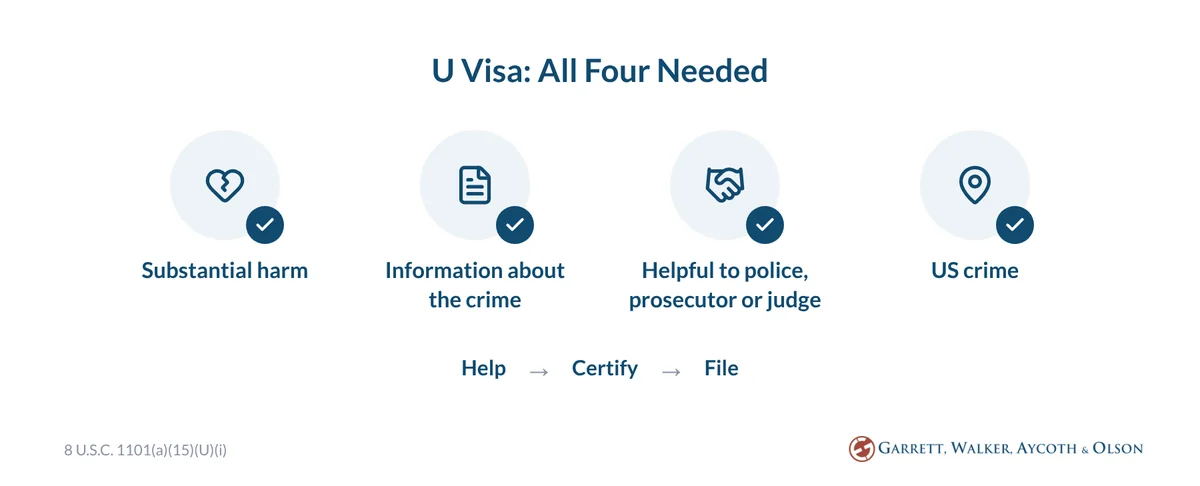
To meet the U visa requirements, you must have suffered substantial physical or mental abuse from a qualifying crime and have information about it. You must also have helped, or be likely to help, police, a prosecutor or a judge, and the crime must be a US crime.
You do not need a conviction, and USCIS charges no fee for the U visa petition itself (8 CFR 106.2, as of November 2026).
What you cannot skip is a signed law enforcement certification, and it must be signed within the six months before you file.
Immigration attorney Sean Jeffcoat requests the certification, builds the evidence and handles any waiver. Call (336) 379-0539 to talk about humanitarian immigration options in Greensboro.
The Four U Visa Requirements
USCIS, part of the Department of Homeland Security, must find all four requirements in the statute:
“(I) the alien has suffered substantial physical or mental abuse as a result of having been a victim of criminal activity described in clause (iii);
(II) the alien … possesses information concerning criminal activity described in clause (iii);
(III) the alien … has been helpful, is being helpful, or is likely to be helpful to a Federal, State, or local law enforcement official, to a Federal, State, or local prosecutor, to a Federal or State judge … investigating or prosecuting criminal activity described in clause (iii); and
(IV) the criminal activity described in clause (iii) violated the laws of the United States or occurred in the United States …” 8 U.S.C. 1101(a)(15)(U)(i)
Substantial Physical or Mental Abuse
The harm must come from being the victim of a qualifying crime. The sections below explain which crimes count and what “substantial” means.
Information About the Crime
You must have information about the crime, such as what happened and who did it.
Helpful to Police, Prosecutors or a Judge
You have been, are being or are likely to be helpful to the officials investigating or prosecuting the crime.
A Crime in the US or Under US Law
The crime happened in the US, including Indian country and military installations, or it violated US law.
For a child under 16, a parent, guardian or next friend can hold the information and give the help.
Admissibility is a separate question. Problems such as a past record may be waived, as explained below.
In short: harm, information, help and a US crime. Miss one and the petition fails.
Which Crimes Qualify for a U Visa
The statute lists the qualifying crimes by name and then adds “any similar activity.”
| Group | Crimes Listed in 8 U.S.C. 1101(a)(15)(U)(iii) |
|---|---|
| Violence | Domestic violence, felonious assault, manslaughter, murder, torture |
| Sexual crimes | Rape, sexual assault, abusive sexual contact, incest, sexual exploitation, prostitution, female genital mutilation |
| Loss of freedom | Kidnapping, abduction, being held hostage, false imprisonment, unlawful criminal restraint, trafficking, peonage, involuntary servitude, slave trade |
| Threats and justice crimes | Stalking, blackmail, extortion, witness tampering, obstruction of justice, perjury |
| Work fraud | Fraud in foreign labor contracting |
| Attempts | Attempt, conspiracy or solicitation to commit any of these crimes |
Note: the regulation’s list in 8 CFR 214.14(a)(9) leaves out stalking and fraud in foreign labor contracting. The statute names both.
North Carolina charges often carry different names. Under 8 CFR 214.14(a)(9), “any similar activity” means an offense whose nature and elements are substantially similar to a listed crime.
A lawyer compares your North Carolina charge papers with the federal list.
The Certification: Form I-918 Supplement B
Every U visa petition must include a certification from a federal, state or local law enforcement official, prosecutor, judge or other authority investigating the crime (8 U.S.C. 1184(p)(1)).
The certification states that you have been, are being or are likely to be helpful in the investigation or prosecution.
In Greensboro, the certifying agency is the one that handled the case, such as the police department, the sheriff’s office or the district attorney.
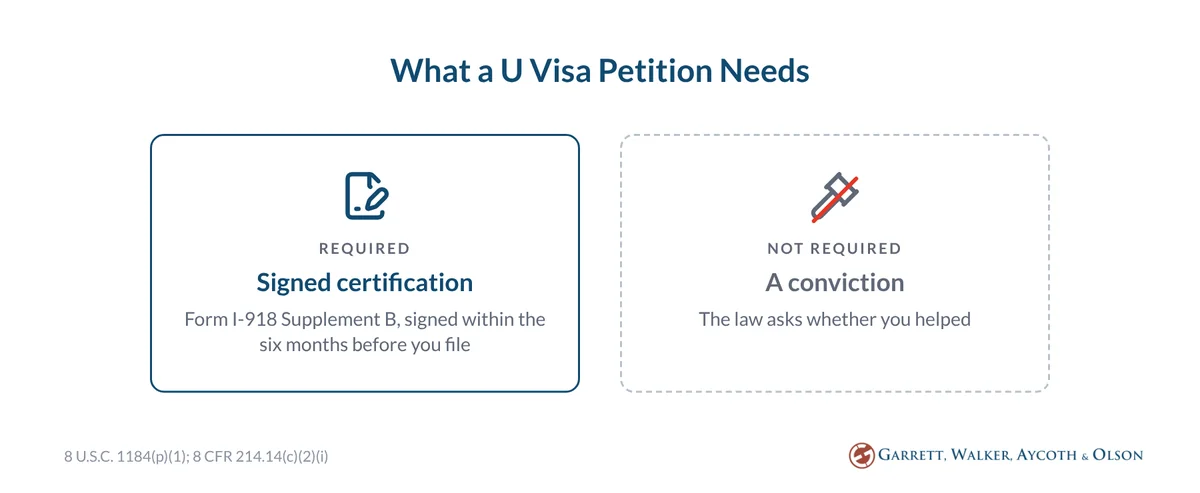
Warning: USCIS needs a Supplement B signed within the six months before the petition is filed (8 CFR 214.14(c)(2)(i)). An older signature means asking again.
You do not need a conviction. The law asks whether you helped the investigation or prosecution, not whether anyone was convicted.
Put simply: the certification is required; a conviction is not.
The six-month window starts the day the official signs. Call (336) 379-0539 before you request it, so the petition is ready to file.
What “Substantial” Abuse Means
USCIS looks at several factors, and no single factor is required (8 CFR 214.14(b)(1)).
The factors include the nature of the injury, how severe the conduct and the harm were, and how long the harm lasted.
USCIS also weighs lasting harm to your appearance, health, or physical or mental soundness, including a worsened earlier condition.
Mental harm counts. The regulation defines abuse to include harm to your emotional or psychological soundness.
A series of acts can add up to substantial abuse, even when no single act would.
Evidence that can help show the harm includes medical records, counseling or therapy letters, photos, protective orders and statements from people who saw the effects.
Forms, Evidence and Cost
A U visa petition is a package of forms and proof, filed together with USCIS.
Get the Certification (Supplement B)
Ask the certifying agency for a signed Supplement B, then file within six months of the signature.
Write Your Personal Statement
Describe what happened and how it affected you; USCIS must consider any credible evidence relevant to the petition (8 U.S.C. 1184(p)(4)).
File Form I-918 With Your Evidence
Add police reports, court records, and medical and counseling records.
Add Form I-192 if You Are Inadmissible
A waiver request goes in with the petition when a ground of inadmissibility applies (8 CFR 214.14(c)(2)(iv)).
Add Family Members on Supplement A
Qualifying family members can be added now or later, as explained below.
The USCIS fees below are as of November 2026, from 8 CFR 106.2.
| Form | USCIS Fee | Source |
|---|---|---|
| Form I-918 petition | No fee | 8 CFR 106.2 |
| Supplement A (family member) | No fee | 8 CFR 106.2 |
| Supplement B (certification) | No fee | 8 CFR 106.2 |
| Form I-192 waiver | $1,100 | 8 CFR 106.2 |
Note: fees change. Confirm the USCIS fee schedule (Form G-1055) before filing.
Talk to an attorney about your situation
A short call is often enough to understand your options.
Call (336) 379-0539Free consultation with a Greensboro attorneyThe 10,000 Cap, the Waiting List and Work Permits
Only 10,000 principal U visas can be granted each fiscal year, and family members do not count against that cap (8 U.S.C. 1184(p)(2)).
Eligible petitioners held back only by the cap go on a waiting list. While on it, they receive deferred action or parole (8 CFR 214.14(d)(2)).
Time on the waiting list does not count as unlawful presence.
Homeland Security may grant work authorization to anyone with a pending, bona fide U visa petition.
The law caps U visas at 10,000 a year and sets no deadline for USCIS to decide. Your lawyer checks the current USCIS processing times for your filing.
Some families need more than one case; see every immigration service we offer in Greensboro.
Waivers When You Have a Record or Immigration Problems
Homeland Security can waive almost every ground of inadmissibility for a U visa petitioner if it finds a waiver is in the public or national interest (8 U.S.C. 1182(d)(14)).
The waiver request is filed on Form I-192.
One ground cannot be waived this way: participation in Nazi persecution, genocide, torture or extrajudicial killing (8 U.S.C. 1182(a)(3)(E)).
A past arrest or conviction must be disclosed, and it is weighed. The firm’s criminal defense team can pull your court records, and the result depends on the facts of your case.
Homeland Security may not find you inadmissible or deportable based only on information from the abuser (8 CFR 214.14(e)(3)).
If you are already in court, read how removal defense works in Charlotte.
Family Members Who Can Be Included
Some family members can get derivative U status with you, depending on your age when you file.
| Victim’s Age When Filing | Family Members Who Can Be Added |
|---|---|
| Under 21 | Spouse, children, unmarried siblings under 18, and parents |
| 21 or older | Spouse and children |
Each family member is added on Form I-918 Supplement A, either with your petition or later (8 CFR 214.14(f)(2)).
A child who was under 21 when you filed stays a “child” even after turning 21 while the petition is pending (8 U.S.C. 1184(p)(7)).
From U Visa to Green Card
After three years of continuous physical presence in U status, you may apply for a green card (8 U.S.C. 1255(m)).
Homeland Security must also find that your stay is justified on humanitarian grounds, for family unity or in the public interest.
Warning: one trip of more than 90 days, or trips over 180 days in total, can break the three years. The exception is a trip for the case, or one an official certifies as justified.
You must also not have unreasonably refused to help with the investigation or prosecution.
U status lasts up to four years, and it can be extended in some cases (8 U.S.C. 1184(p)(6)).
Is a U Visa the Right Path for You?
A U visa is one of several protections for crime victims. The right one depends on who hurt you and how.
If a US citizen or green card holder spouse or parent abused you, look at the VAWA self-petition for abused spouses.
If you were trafficked, read how a T visa protects trafficking survivors.
If you fear harm in your home country and are already in court, learn what a defensive asylum case requires.
Evidence is easiest to gather while the criminal case is still open. Sean Jeffcoat compares the options before anything is filed.
Call (336) 379-0539 or read more about a U visa lawyer in Greensboro.
Frequently Asked Questions
Do I need a police report to get a U visa?
The law requires a signed certification and proof that you helped, not one specific report (8 U.S.C. 1184(p)(1)). A report can help, because it gives the certifying official a record to review. Your lawyer gathers the records that already exist and requests the certification.
Can I apply if I am undocumented or in removal proceedings?
Yes. Lawful status is not one of the four U visa requirements, and most grounds of inadmissibility can be waived through Form I-192. If you are in removal proceedings, tell your lawyer at once, so the court case and the petition can be planned together.
Is a car accident a qualifying crime for a U visa?
A crash by itself is not on the list. If the driver’s conduct was a listed crime, such as felonious assault or manslaughter, or something substantially similar, it may qualify. Your lawyer reviews the charges and the police reports to see whether the facts fit.
What if the police will not sign the certification?
The statute lets other officials sign, including a prosecutor, a judge or another authority investigating the crime (8 U.S.C. 1184(p)(1)). Your lawyer can send the request to the right office and explain what the form asks. Ask early, because the six-month window starts at signing.
How long does a U visa take?
The law caps U visas at 10,000 a year and sets no deadline for USCIS to decide. Your lawyer checks the current USCIS processing times. While a bona fide petition is pending, Homeland Security may grant work authorization, and people on the waiting list receive deferred action or parole.
Will my abuser find out about my U visa petition?
Federal rules bar Homeland Security from sharing information about a U visa petitioner, except in limited cases such as legitimate law enforcement use or court review (8 CFR 214.14(e)(1)). Homeland Security also cannot rule against you based only on the abuser’s information. Your lawyer sets up a safe mailing address.
Does the crime have to be recent?
The U visa statute and regulation do not set a cut-off date for when the crime happened. The certification must be recent, though: it must be signed within the six months before you file. Older crimes raise evidence questions, so talk to a lawyer about the records that exist.
Can my children get U visas too?
Yes. Children can be added on Form I-918 Supplement A, with your petition or later. A child who was under 21 when you filed keeps that status after a birthday. A victim under 21 can also add parents and unmarried siblings under 18.
Can I travel outside the US with a U visa?
Be careful. For the green card, one trip over 90 days, or trips over 180 days in total, can break the three years of continuous presence, unless the trip was for the case or certified as justified. Talk to your lawyer before you book any trip.
Talk to our team today
Tell us where things stand and we will explain the next steps.
Garrett, Walker, Aycoth & Olson, Attorneys at Law
317 South Greene St, Greensboro, NC 27401
(336) 379-0539
This article explains North Carolina law in general terms. It is not legal advice about your case, and laws, penalties and court procedures change. Contact an attorney about your specific situation.