


A K2 visa lets the unmarried child under 21 of a K-1 fiancé(e) come to the US on the parent’s approved Form I-129F. The child’s green card depends on the K-1 parent marrying the US citizen who filed that petition within 90 days of arrival.
Many guides say the only age rule is “under 21 when the visa is issued.” That is not the whole picture.
The Board of Immigration Appeals looks at age on entry to the US. The State Department adds a line at 18 for stepchildren.
If your child is 18, 19 or 20, those two lines are where K-2 cases go wrong.
Immigration attorney Sean Jeffcoat plans the child’s K-2 file together with how the K-1 fiancé visa process works, so no clock runs out. Call (336) 379-0539 before the petition is filed or the visa interview is set.
What Is a K2 Visa?
A K2 visa is a nonimmigrant visa for the minor child of a K-1 fiancé(e) who comes with the parent or follows later. The statute describes the child this way:
“is the minor child of an alien described in clause (i) or (ii) and is accompanying, or following to join, the alien” 8 U.S.C. 1101(a)(15)(K)(iii)
The child does not need a separate petition. Under 8 CFR 214.2(k)(3), a child of the K-1 beneficiary may get the same classification when accompanying or following to join the parent.
The US citizen does not need to be the child’s parent. Sean also handles other family cases, listed on our Greensboro immigration law page.
Who Qualifies for a K2 Visa?
The child must be the K-1 parent’s “child” under immigration law: unmarried and under 21 (8 U.S.C. 1101(b)(1)).
Stepchildren, adopted children and children born outside marriage each have their own condition.
| Child Type | The Rule in 8 U.S.C. 1101(b)(1) |
|---|---|
| Born to married parents | Unmarried and under 21 |
| Stepchild of the K-1 parent | The marriage that created the stepchild tie happened before the child turned 18 |
| Legitimated child | Legitimated before 18 and in the legitimating parent’s legal custody at that time |
| Child born outside marriage | Qualifies through the mother, or through the father if he has or had a bona fide parent-child relationship |
| Adopted child | In most cases, adopted before 16 with at least two years of legal custody and living together |
The child must also stay unmarried. A child who marries is no longer a “child” under the statute and cannot use K-2 status.
Turning 18 or 21: The Age Lines in a K-2 Case
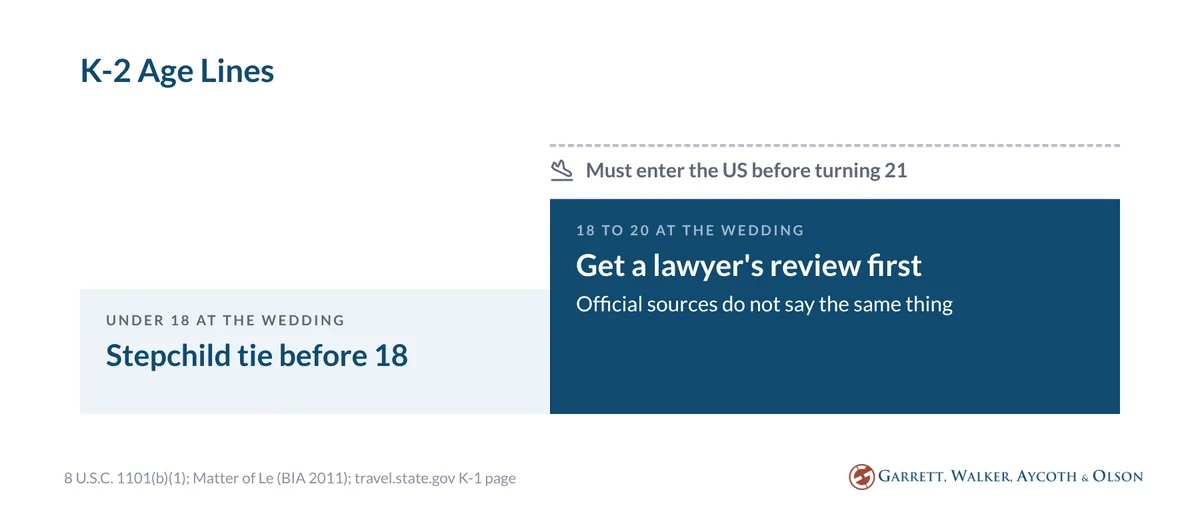
Two ages matter in a K-2 case: 21 for being a “child,” and 18 for stepchild ties.
In Matter of Le (2011), the Board of Immigration Appeals held that, to adjust status, a K-2 child must have been under 21 when admitted to the US.
Turning 21 after entry does not by itself end the right to adjust. The Board also held that a K-2 child does not need to qualify as the US citizen’s stepchild.
The State Department’s K-1 fiancé(e) visa page reads differently. It says that, for the child to adjust status, the stepchild relationship with your spouse must be created before the child turns 18.
Important: these two official sources do not say the same thing for a child aged 18 to 20. Do not guess; have a lawyer check before the child travels.
In short: the child must enter the US before turning 21, and a child who is 18 or older at the wedding needs a lawyer’s review first.
Birthdays do not wait for consulates. Call (336) 379-0539 as soon as the I-129F is approved if a child is close to 18 or 21.
The K-2 Process Step by Step
A K-2 case follows the parent’s K-1 case from the petition to entry.
The US Citizen Files Form I-129F
List every child of the fiancé(e) on the petition.
The couple must have met in person within two years before filing, unless that rule is waived (8 U.S.C. 1184(d)(1)).
USCIS approval of the I-129F is valid for four months, and it can be revalidated (8 CFR 214.2(k)(5)).
The Case Moves to the Consulate
After USCIS approves the petition, it goes to the National Visa Center and then to the US embassy or consulate.
Each Child Applies Separately
Each child completes their own Form DS-160, the State Department’s online nonimmigrant visa application, and pays the K visa application fee. The I-129F itself is filed once, by the US citizen.
Every K applicant, at any age, has a medical exam with an authorized panel physician.
The Interview and the Visa
The consulate schedules the visa interview. The consular officer may ask the US citizen for Form I-134, an affidavit of support.
Travel With the Parent or Within One Year
The child travels with the K-1 parent or later, inside the limits in the next section.
The government fees below are as of November 2026, from 8 CFR 106.2 and the State Department.
| Fee | Amount | Source |
|---|---|---|
| Form I-129F (paid once by the citizen) | $675 | 8 CFR 106.2 |
| K visa application fee | Set by the State Department for each K-2 applicant; your lawyer confirms the current amount | State Department K-1 page |
| Medical exam | Set by the panel physician | State Department K-1 page |
| Form I-485 for the child, after the wedding | $1,440 (14 or older); $950 (under 14, filed with a parent’s I-485) | 8 CFR 106.2 |
Note: fees change. Confirm the USCIS fee schedule (Form G-1055) and the State Department fee page before you pay.
No law sets a K-2 processing time, so your lawyer checks the current USCIS and consulate times.
Two Deadlines: One Year to Travel, 90 Days to Marry
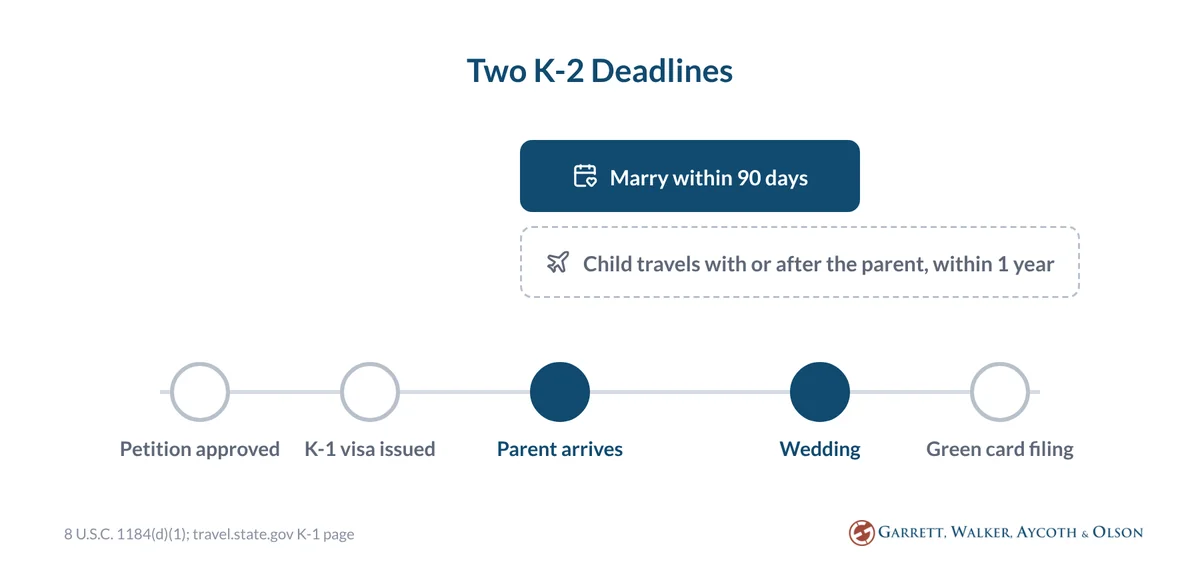
Two clocks run in every K-2 case.
The first clock is travel. The State Department says no separate petition is needed if the child accompanies or follows the parent within one year.
After that year, the child cannot get a K-2 visa and needs a separate immigrant petition. The child must also travel while the K-2 visa is still valid.
Children never go first. The K-1 parent must enter the US before or at the same time as any child holding a K-2 visa.
The second clock is the wedding, which must happen within 90 days of the K-1 parent’s arrival. If it does not happen, the statute is direct:
“In the event the marriage with the petitioner does not occur within three months after the admission of the said alien and minor children, they shall be required to depart from the United States and upon failure to do so shall be removed …” 8 U.S.C. 1184(d)(1)
If that deadline has already passed, learn what happens in removal proceedings before a notice arrives.
Put simply: the child travels within one year, and the wedding happens within 90 days of the parent’s arrival.
Talk to an attorney about your situation
A short call is often enough to understand your options.
Call (336) 379-0539Free consultation with a Greensboro attorneyMoney: Form I-134 Now, Form I-864 Later
Two support forms apply, at two different stages.
At the visa interview, the consular officer may ask the US citizen for Form I-134. The State Department says the sponsor’s income must reach 100 percent of the federal poverty guideline.
At the green card stage, the citizen signs Form I-864 and must show income of at least 125 percent of the poverty line (8 U.S.C. 1183a(f)(1)(E)).
The sponsor must also be domiciled in the US. If income falls short, a qualifying joint sponsor can help.
Tip: start collecting tax returns and pay records before the wedding, because the I-864 goes in with the child’s I-485.
After Arrival: Green Card, Work and Travel
After the wedding, each child files their own Form I-485. A child cannot be included on the parent’s application.
A K-2 child can adjust status only through the parent’s marriage to the citizen who filed the I-129F (8 U.S.C. 1255(d)).
If the marriage is under two years old when residence is granted, the child’s green card is conditional. Form I-751 to remove the conditions is filed in the 90 days before the second anniversary of residence (8 CFR 216.4).
Parents face the same rule, explained in every step of a marriage-based green card.
A K-2 child may work, but must first apply, with a fee, for a work permit (8 CFR 214.2(k)(9)).
Form I-765 costs $520, or $260 while a fee-paid I-485 filed after April 1, 2024 is pending (8 CFR 106.2, as of November 2026).
Warning: leaving the US while the I-485 is pending, without advance parole, counts as abandoning the application (8 CFR 245.2(a)(4)). Advance parole on Form I-131 costs $630 (8 CFR 106.2, as of November 2026).
For the full filing package, see how adjustment of status works inside the US.
Planning the child’s I-485 with the parent’s? Call (336) 379-0539 and Sean Jeffcoat will set the filing order.
Documents for Each Child’s Interview
Each child applies separately, so each child needs a separate file.
- Completed Form DS-160 and a passport valid for travel
- Birth certificate showing the K-1 parent
- English translations of foreign-language documents, in the format the consulate asks for
- Adoption decree or legitimation papers, if they apply
- Medical exam results from the panel physician
- Police certificates for an accompanying child age 16 or older
- Custody papers or the other parent’s consent, if another parent has rights (your lawyer checks what your consulate asks for)
Special Cases: Adoption, Health and Past Problems
Most adopted children qualify only if adopted before 16, after two years of legal custody and living with the adoptive parent (8 U.S.C. 1101(b)(1)(E)).
A health issue, a past immigration violation or a criminal record can make a child inadmissible. Some grounds can be waived, and your lawyer checks which form applies.
The citizen’s own record matters too: the I-129F must list the petitioner’s convictions for certain crimes and related permanent protection orders (8 U.S.C. 1184(d)(1)).
The K-1 page explains what a petitioner’s criminal record changes. Because the firm also defends criminal cases, Sean can review the court file with you.
Mistakes That Delay or Sink a K-2 Case
Most K-2 problems come from timing and paperwork.
- Leaving a child off the I-129F
- Planning the child’s trip after the one-year window
- Sending the child before the K-1 parent
- Holding the wedding after day 90
- Skipping a legal review for a child aged 18 to 20
- Leaving the US with a pending I-485 and no advance parole
- A child marrying before entry
If marrying first and applying from abroad fits better, compare the spouse visa route from abroad.
If the petition is not filed yet, now is the time to plan the children’s cases. Call (336) 379-0539 to talk with Sean Jeffcoat.
Frequently Asked Questions
What is the difference between a K-2 and a K-4 visa?
A K-2 is the child of a K-1 fiancé(e). A K-4 is the child of a K-3 spouse, who married the citizen before coming. In Matter of Akram (2012), the Board held that a K-4 child who was 18 or older at the marriage could not adjust status.
How long does a K2 visa take?
No law sets a fixed time. The K-2 case moves with the parent’s I-129F and the consulate’s schedule, and both change. Your lawyer checks the current USCIS and consulate times for your case and plans around the four-month petition validity and the one-year travel window.
What happens to my child if we do not marry within 90 days?
The statute says the K-1 parent and the minor children must leave the US, or face removal, if the marriage does not happen within three months of admission (8 U.S.C. 1184(d)(1)). A K-2 child cannot adjust through any other marriage. Call a lawyer before day 90 if the wedding is in doubt.
Can my child come to the US before me?
No. The State Department says the K-1 parent must enter the US before or at the same time as any child holding a K-2 visa. The child may travel with you or follow you later, within one year and while the K-2 visa is still valid.
Can a K-2 child work in the US?
Yes, but the child must first apply for a work permit with a fee (8 CFR 214.2(k)(9)). The fee depends on whether a fee-paid I-485 is pending, as shown above. Your lawyer can file it with the green card papers.
Will my child get a conditional green card?
Yes, if the parent’s marriage is less than two years old when the child becomes a resident. Form I-751 is filed in the window explained above. Your lawyer tracks that window for the whole family, so each child’s filing lines up with the parent’s.
Can the US citizen file a separate petition for my child instead?
A US citizen can file Form I-130 for a stepchild only if the marriage happened before the child turned 18 (8 U.S.C. 1101(b)(1)(B)). After the one-year K-2 window, a separate immigrant petition is needed in any case. Your lawyer explains the options for filing a separate family-based petition.
Can a K-2 child travel abroad before the green card arrives?
Only with care. Without advance parole, the pending green card application is treated as abandoned, even after a short trip. Get advance parole on Form I-131 first, and talk to your lawyer before booking, because each family member’s papers must be in order.
Talk to our team today
Tell us where things stand and we will explain the next steps.
Garrett, Walker, Aycoth & Olson, Attorneys at Law
317 South Greene St, Greensboro, NC 27401
(336) 379-0539
This article explains North Carolina law in general terms. It is not legal advice about your case, and laws, penalties and court procedures change. Contact an attorney about your specific situation.