


The marriage-based green card process starts when the US citizen or green card holder files Form I-130. The spouse then applies inside the US or through a consulate abroad, proves the marriage is real, and gets a two-year conditional card if married under two years.
Being married is not enough. USCIS approves the petition only when the marriage is real and the sponsor qualifies.
A past sham-marriage finding, or certain criminal convictions of the citizen or green card holder sponsor, can stop the case.
Immigration attorney Sean Jeffcoat checks both spouses’ history before anything is filed. Call (336) 379-0539 or see how our family-based immigration cases work.
Who Qualifies and Which Path Fits
The sponsor must be a US citizen or a green card holder who is legally married to the foreign spouse.
The spouse of a US citizen is an “immediate relative” under the statute.
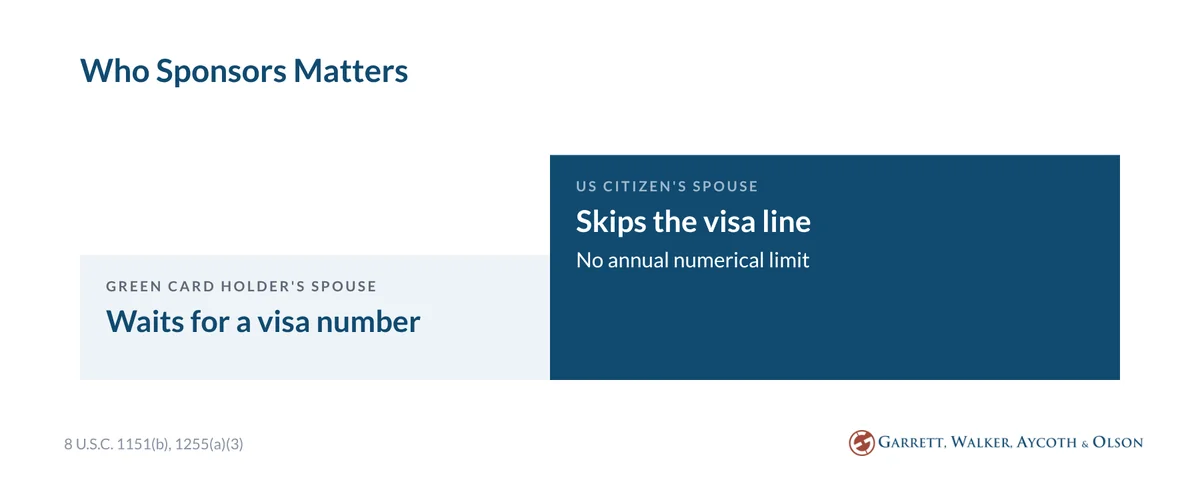
Immediate relatives are not subject to the annual numerical limits, so there is no waiting line for a visa number (8 U.S.C. 1151(b)).
The spouse of a green card holder is in a preference category. That spouse can file for the green card only when a visa number is available.
The State Department’s monthly Visa Bulletin shows when that happens, and your lawyer checks it for you.
While waiting, a green card holder’s spouse who lives in the US must keep lawful status.
The overstay exemption covers only a citizen’s spouse and other immediate relatives (8 U.S.C. 1255(c)(2)).
If you are still engaged, compare the K-1 fiancé visa route.
In short: a citizen’s spouse skips the visa line; a green card holder’s spouse waits for a visa number.
Four Common Situations and the Path Each One Takes
Where the spouse lives today, and how they entered the US, decide the path.
| Situation | Usual Path |
|---|---|
| Citizen’s spouse in the US after a lawful entry (visa or parole) | Form I-130 and Form I-485 can be filed together |
| Citizen’s spouse living abroad | Form I-130, then an immigrant visa through the US consulate |
| Green card holder’s spouse | Form I-130 first; the green card application waits until a visa is available |
| Spouse who entered without inspection | Adjustment usually not allowed unless section 245(i) applies; otherwise consular processing, which may need an unlawful-presence waiver |
For a spouse already here, see applying from inside the US. For a spouse overseas, read the spouse abroad green card guide.
Talk to a lawyer before anyone leaves the US, because leaving can trigger the bars explained below.
The Marriage-Based Green Card Process in 7 Steps
Every marriage case moves through the same seven steps, whichever path it takes.
File Form I-130
The sponsor files Form I-130 with the marriage certificate, proof that all earlier marriages ended, and proof of the sponsor’s status (8 CFR 204.2(a)(2)).
Foreign-language documents need a certified English translation (8 CFR 204.1(f)(3)).
Apply for the Green Card
A citizen’s spouse in the US can file Form I-485 together with the I-130 (8 CFR 245.2(a)(2)). A spouse abroad applies for an immigrant visa through the consulate instead.
Prove the Sponsor’s Income (Form I-864)
The sponsor promises income of at least 125 percent of the federal poverty line and must be domiciled in the US (8 U.S.C. 1183a(f)).
A sponsor living abroad can often still meet this; the spouse abroad guide linked above explains how (8 CFR 213a.2(c)(1)(ii)).
If income falls short, a qualifying joint sponsor can share the promise.
Biometrics
USCIS schedules an appointment for fingerprints and a photo.
Answer Any Request for Evidence
If USCIS asks for more proof, answer fully by the deadline in the notice.
The Interview
USCIS or the consulate may interview you both, as explained below.
Decision and Conditions
If you were married under two years when residence is granted, the first card is conditional.
The government fees below are as of November 2026, from 8 CFR 106.2 and the State Department fee page.
| Fee | Amount | Source |
|---|---|---|
| Form I-130 | $675 on paper, $625 online | 8 CFR 106.2 and 106.1(g) |
| Form I-485 (14 or older) | $1,440 | 8 CFR 106.2 |
| Form I-765 work permit | $260 with a fee-paid I-485 filed after April 1, 2024 that is still pending (otherwise $520) | 8 CFR 106.2 |
| Form I-131 advance parole | $630 | 8 CFR 106.2 |
| Form I-864 | No fee | 8 CFR 106.2 |
| Immigrant visa (consulate) | $325 | State Department fee page |
| Affidavit of Support review (domestic) | $120 | State Department fee page |
Note: fees change. Confirm the USCIS fee schedule (Form G-1055) and the State Department fee page before you pay.
How to Prove Your Marriage Is Real
You prove a real marriage with records of a shared life, not with one document.
The basics come first: a marriage certificate issued by a civil authority, and divorce or death records ending every earlier marriage of both spouses.
The regulations list the kinds of records that show a genuine marriage (8 CFR 204.2(a)(1)(i)(B) and (c)(2)(vii)). They are examples, not a required set:
- Joint ownership of property, or a lease in both names
- Joint bank accounts and other shared finances
- Insurance policies that list the spouse
- Income tax forms, such as joint returns
- Birth certificates of children born to you both
- Sworn statements from people who know you as a couple
Warning: if the government finds a marriage was entered to get around immigration law, no later petition for that spouse can be approved (8 U.S.C. 1154(c)).
Talk to an attorney about your situation
A short call is often enough to understand your options.
Call (336) 379-0539Free consultation with a Greensboro attorneyWhat to Expect at the Interview
If USCIS or the consulate interviews you, bring the originals of every document you filed (8 CFR 204.1(f)(2)).
Also bring passports, the appointment notice and updated proof of your shared life, such as new bank statements or a current lease.
If anything has changed since filing, such as an address, a job or a new child, bring proof of the change.
The officer decides whether the marriage is real and whether the spouse qualifies. Answer honestly, and say so when you do not know.
Nervous about the interview? Call (336) 379-0539 and Sean Jeffcoat will prepare you both.
The Two-Year Conditional Green Card
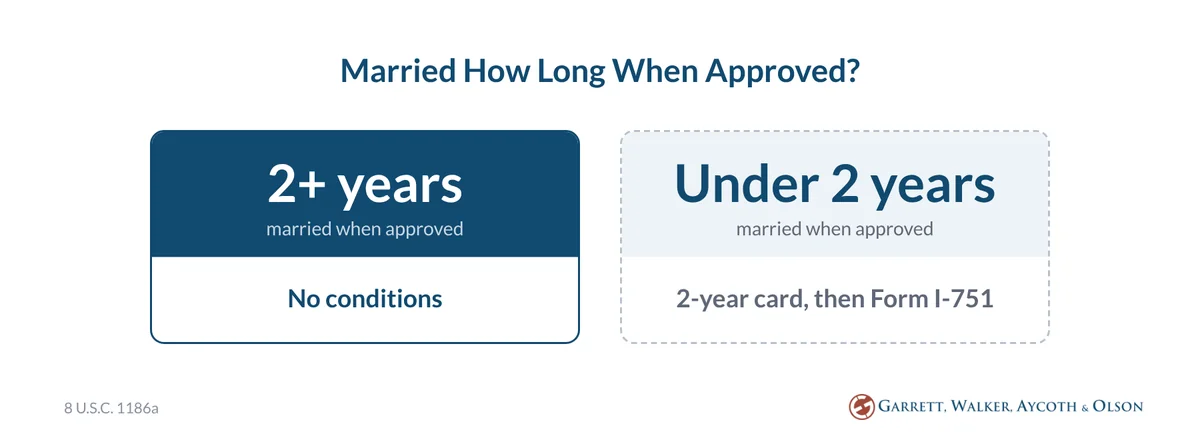
If you were married less than two years when residence was granted, the green card is conditional (8 U.S.C. 1186a).
You do not “renew” a conditional card. Both spouses file Form I-751 jointly in the 90 days before the second anniversary of residence.
Form I-751 costs $750 (8 CFR 106.2, as of November 2026).
If the marriage ended or there was abuse, DHS may waive the joint filing. The grounds include extreme hardship, a good-faith marriage that has ended, and battery or extreme cruelty.
Children who got residence through the marriage are conditional too. See how K-2 children get green cards.
Put simply: married two years or more when approved means no conditions; under two years means a two-year card and an I-751.
Some families need several cases at once: see all of our Greensboro immigration services.
Problems That Can Stop or Slow a Case
Most problems can be spotted before filing, which is why both spouses’ history is checked first.
A Request for Evidence (RFE)
USCIS sends a Request for Evidence when it needs more proof. Answer fully, with every item asked for, by the deadline in the notice.
The Sponsor’s Criminal Record
A US citizen or green card holder convicted of a “specified offense against a minor” cannot petition unless DHS, in its sole and unreviewable discretion, finds no risk (8 U.S.C. 1154(a)(1)(A)(viii) and (B)(i)(II)).
“Clause (i) shall not apply to a citizen of the United States who has been convicted of a specified offense against a minor, unless the Secretary of Homeland Security, in the Secretary’s sole and unreviewable discretion, determines that the citizen poses no risk to the alien …” 8 U.S.C. 1154(a)(1)(A)(viii)(I)
A pending charge is a reason to talk with our criminal defense attorneys first.
Marriage During Removal Proceedings
If you married while removal proceedings were pending, the spouse can adjust only with clear and convincing proof of a good-faith marriage (8 U.S.C. 1255(e)).
If a court case is open, read how removal defense works.
Past Immigration Violations
More than 180 days but less than one year of unlawful presence, followed by leaving the US, brings a 3-year bar; one year or more brings a 10-year bar (8 U.S.C. 1182(a)(9)(B)(i)).
A waiver needs extreme hardship to the US citizen or green card holder spouse or parent (1182(a)(9)(B)(v)): Form I-601A ($795), filed before leaving the US, or Form I-601 ($1,050) when applying for the immigrant visa (8 CFR 106.2, as of November 2026).
Your lawyer checks every past entry and exit before anyone travels.
After the Green Card: Travel and Citizenship
A green card holder married to and living with a US citizen can apply for citizenship after three years of continuous residence (8 U.S.C. 1430(a)).
Keep collecting proof of your shared life, because a conditional card needs it again for the I-751.
Before long trips abroad, ask your lawyer how the travel affects the I-751 and citizenship timing.
The first filing decides how smooth the rest is. Call (336) 379-0539 to plan your case with Sean Jeffcoat, or read about a marriage green card lawyer in Greensboro.
Frequently Asked Questions
How soon after marriage can we apply for a green card?
Once you are legally married, the citizen or green card holder can file Form I-130 for the spouse. A citizen’s spouse who is already in the US after a lawful entry may be able to file Form I-485 at the same time. Your lawyer confirms the right path before anything is filed.
How long does the marriage-based green card process take?
No official figure applies to every case. The time depends on the path, the USCIS office or the consulate, and whether more evidence is requested. Your lawyer checks the current USCIS and consulate processing times for your case and keeps the file complete to avoid extra requests.
What tax documents do we need?
The sponsor’s Form I-864 needs a complete federal tax return for the most recent tax year, as a copy or an IRS transcript, with all schedules and W-2s if a copy is used (8 CFR 213a.2(c)(2)(i)(A)). The three most recent years may be added. Your lawyer checks whether more years help.
Can a green card holder sponsor a spouse?
Yes. A green card holder can file Form I-130 for a spouse, but the spouse is in a preference category and must wait until a visa number is available to apply for the green card. Your lawyer checks the Visa Bulletin and advises on keeping lawful status while you wait.
What if the sponsor’s income is too low?
A joint sponsor can help. A joint sponsor with income of at least 125 percent of the federal poverty line accepts joint and several liability with the sponsor (8 U.S.C. 1183a(f)(5)(A)). The support promise is legally enforceable, so every sponsor should understand it before signing.
Can I apply for citizenship through marriage?
Yes, after three years as a green card holder, if you have lived in marital union with your US citizen spouse during those three years (8 U.S.C. 1430(a)). Other naturalization rules also apply. Your lawyer checks your dates and travel before you file.
Do I need a lawyer for a marriage-based green card?
A lawyer checks the risks before anything is filed: a sponsor’s criminal record, a past sham-marriage finding, an unlawful entry or a past overstay. Each one can block the case or trigger a bar. Sean Jeffcoat reviews both spouses’ history and plans the right path for your family.
Can I work or travel while the case is pending?
With a pending Form I-485, you may ask for a work permit and for advance parole to travel; the fees are in the table above. Leaving the US without advance parole abandons the application. The full rules are in the guide for spouses applying from inside the US, linked above.
What happens if we divorce before the conditions are removed?
DHS may waive the joint I-751 filing if the marriage was entered in good faith and has ended (8 U.S.C. 1186a(c)(4)). Extreme hardship and abuse are separate grounds. Your lawyer gathers proof that the marriage was real when it began.
Talk to our team today
Tell us where things stand and we will explain the next steps.
Garrett, Walker, Aycoth & Olson, Attorneys at Law
317 South Greene St, Greensboro, NC 27401
(336) 379-0539
This article explains North Carolina law in general terms. It is not legal advice about your case, and laws, penalties and court procedures change. Contact an attorney about your specific situation.