


Under NC’s open container law, G.S. 20-138.7, an open drink in a car’s passenger area on a highway is an infraction for whoever holds it, but a driver with alcohol in the body faces a Class 3 misdemeanor. A second conviction brings a license revocation.
For a passenger it is an infraction, but a responsible finding still goes on your driving record and counts as a conviction under insurance law. For a driver who has been drinking it is a misdemeanor, and the same stop can turn into a DWI investigation.
A lawyer checks where the container was and what the officer can prove, depending on the facts of your case. Start with our defense for an open container charge.
Ticketed for an open container in Guilford County? Call (336) 379-0539 before you pay or go to court.
Understanding Open Container Law in NC: Two Different Offenses
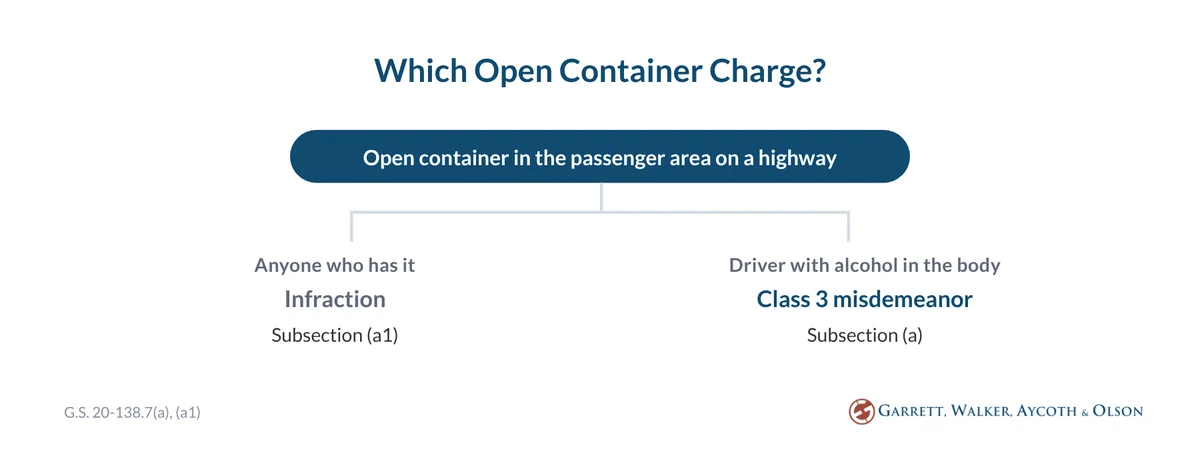
North Carolina has two open container offenses in G.S. 20-138.7. One is a possession infraction for anyone in the car, and the other is a misdemeanor for a driver who has been drinking.
The driver offense, subsection (a), reads:
“No person shall drive a motor vehicle on a highway or the right-of-way of a highway while both of the following conditions are met:
(1) There is an alcoholic beverage in the passenger area in other than the unopened manufacturer’s original container. (2) The driver is consuming alcohol or while alcohol remains in the driver’s body.”
Subsection (a1) covers anyone with an open container, or drinking, in the passenger area on a highway, and only that person is charged. It is an infraction, not punishable by imprisonment (G.S. 14-3.1).
Neither offense is a felony.
What Counts as an Open Container and the Passenger Area
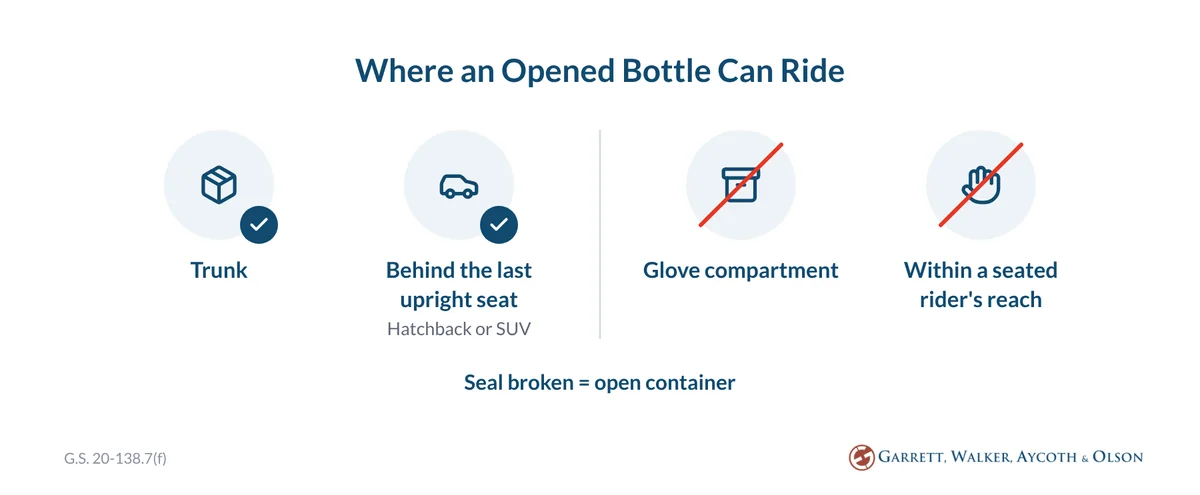
A container is “open” once its seal is broken. The passenger area is everything a seated driver or passenger can reach, including the glove compartment (G.S. 20-138.7(f)).
The trunk is not part of the passenger area. Neither is the area behind the last upright seat of a hatchback, station wagon or similar vehicle, such as an SUV.
An “alcoholic beverage” is any drink with at least 0.5% alcohol by volume (G.S. 18B-101(4)). Mopeds count as motor vehicles under this law (G.S. 20-138.7(a3)).
A to-go mixed drink may ride in the unopened original container, a locked container, the trunk, or behind the last upright seat if there is no trunk (G.S. 18B-1001).
Who Gets the Ticket When a Passenger Is Drinking?
Only the person who possessed or drank the alcohol is charged under (a1). The driver faces the (a) misdemeanor only if alcohol was in the driver’s own body.
Passengers have three exceptions under G.S. 20-138.7(a2): a vehicle used mainly to carry people for pay, a motor home’s living quarters, and a house trailer. They protect passengers, not the driver.
Highways, Parking Lots and Private Driveways
The statute applies on a “highway or the right-of-way of a highway.” It does not use “public vehicular area,” the term other Chapter 20 laws use for places like parking lots (G.S. 20-4.01(13), (32)).
For the possession offense the car does not have to be moving, so a vehicle parked on a street is covered. Do not assume a lot or driveway is outside the law; your lawyer checks.
Commercial Vehicles
In a commercial motor vehicle, any alcoholic beverage in the passenger area, open or closed, is a separate offense (G.S. 20-138.2C). It carries 4 points on the commercial schedule (G.S. 20-16(c)).
Penalties, Points and License Consequences
The passenger-area infraction carries up to $100 (G.S. 14-3.1), or $25 plus court costs on the statewide waiver list. The driver offense is a Class 3 misdemeanor on the mandatory court appearance list.
| Charge | Ticket Line May Read | Class | What the Law Authorizes | DMV Points | Court Date |
|---|---|---|---|---|---|
| Passenger-area possession, (a1) | POSS OPN CNT/CONS ALC PSG AREA | Infraction | Up to $100; $25 plus costs on the waiver list | 0 (not a moving violation) | Not required (payable) |
| Driver after drinking, (a), first | OPEN CONT AFTER CONS ALC 1ST | Class 3 misdemeanor | 1-10 days of community punishment with no record, 1-20 days with 5 or more priors; fine only with 3 or fewer priors, $200 cap | 2 (moving violation) | Required |
| Driver after drinking, (a), second or later | Check your citation | Class 2 misdemeanor | 1-30 days of community punishment with no record, 1-60 days with 5 or more priors; fine up to $1,000 | Revocation instead: 6 months (second), 1 year (third or later) | Required |
Key point: Your lawyer argues which sentencing level applies (G.S. 15A-1340.23). See how a Class 3 misdemeanor is punished.
Some driver-test questions and out-of-state websites mention 3 points. In NC it is 2 DMV points for the driver offense and 0 for the infraction (G.S. 20-138.7(e)).
A second or later conviction means a mandatory revocation, with no points added (G.S. 20-17(a)(12), G.S. 20-19(g1), G.S. 20-16(c)). Whether an earlier (a1) ticket counts is not spelled out, so your lawyer checks.
After an (a) conviction that alone causes the revocation, you may apply for a privilege under G.S. 20-179.3; see driving privileges after a revocation.
Important: The implied-consent law applies to this charge (G.S. 20-16.2). Ask your lawyer before you decide anything about testing.
Talk to a DWI and traffic lawyer before your court date
Deadlines in traffic and DWI cases run from the day of the charge. The earlier we see your paperwork, the more options you usually have.
Call (336) 379-0539Free consultation with a Greensboro attorneyDoes an Open Container Go on Your Record?
An (a1) infraction is a responsible finding on your driving record, not a crime. An (a) conviction is a misdemeanor on your criminal and driving records.
Charges dismissed or found not responsible since December 1, 2021 are expunged automatically 180 to 210 days later, but only if every charge in the case ends that way (G.S. 15A-146(a4)).
A reduction to the infraction is a responsible finding, so it is not expunged automatically, a trade-off your lawyer weighs.
An (a) conviction may later qualify as one nonviolent misdemeanor after three years (G.S. 15A-145.5). It is not on the impaired-driving list that bars expunction, but eligibility depends on your whole record.
Even an infraction counts as a “conviction” for insurance law (G.S. 58-36-65(i)). See clearing a dismissed open container charge.
How an Open Container Ticket Can Get Dismissed or Reduced
A dismissal or reduction comes from what the State cannot prove, and your lawyer finds it and asks for it. Nothing here is automatic.
Where Was the Container?
The trunk and the area behind the last upright seat are outside the passenger area. Anything within reach of a seat, including the glove compartment, is inside it.
Was It Really Open?
An unbroken seal is not open, and a to-go drink carried the way G.S. 18B-1001 allows is lawful.
Was the Car on a Highway?
Where the car was stopped or parked is compared with the statute’s highway wording.
Can the State Prove Alcohol in the Driver’s Body?
Odor alone does not prove alcohol in the driver’s body unless a test was refused (G.S. 20-138.7(c)). And because (a1) by the driver is a lesser-included offense of (a), a reduction can be negotiated.
In an (a) case, test results need early review, and each result depends on the facts of your case.
This is one of the other alcohol and traffic-stop charges we defend in Guilford County.
Walking With an Open Container in Greensboro or High Point
Walking with a beer is not a G.S. 20-138.7 offense. Cities and counties may ban drinking or open containers of beer and unfortified wine on public streets by ordinance (G.S. 18B-300(c)).
Drinking liquor, fortified wine or mixed drinks on a public road, street or sidewalk is unlawful under state law, no ordinance needed (G.S. 18B-301(f)). That is a Class 1 misdemeanor unless another punishment is stated (G.S. 18B-102(b)).
A local ordinance violation is a Class 3 misdemeanor with a fine up to $50 unless the ordinance sets more, never over $500 (G.S. 14-4(a)). G.S. 14-4(c) gives a defense to some of these charges, but its reach is not settled.
When an Open Container Stop Turns Into a DWI or Underage Case
The bigger risk at an open container stop can be a DWI charge; see what a DWI charge in Greensboro involves.
If you are under 21, possession is its own offense (G.S. 18B-302). See underage possession of beer or wine and the under-21 driving after drinking charge.
Charged after a traffic stop with alcohol in the car? Call (336) 379-0539 before your court date.
Paying the infraction is a responsible plea, and a driver charged under (a) must go to court. Before either, talk with our alcohol ticket team.
Frequently Asked Questions
Does an open container go on your record in NC?
Yes, in some form. The infraction is a responsible finding on your driving record, while the driver offense is also a misdemeanor on your criminal record. A fully dismissed case is expunged automatically, so the outcome your lawyer negotiates decides what stays.
How much is an open container ticket in NC?
The waiver list sets $25 plus court costs for the passenger-area infraction, and the legal maximum is $100. Costs start with the $147.50 General Court of Justice fee, $177.50 from December 1, 2026 (G.S. 7A-304(a)(4)). The driver misdemeanor needs a court date.
If a passenger is drinking, who gets the ticket?
The passenger does. Only the person who possesses or drinks the alcohol is charged with the (a1) infraction. The driver faces the misdemeanor only if alcohol is in the driver’s own body, and odor alone does not prove that.
Can a passenger drink in a car in North Carolina?
Generally not on a highway. A passenger may drink in a vehicle used mainly to carry people for pay, such as a hired limousine, in a motor home’s living quarters, or in a house trailer. The driver never gets these exceptions.
Is an open container a misdemeanor or a felony?
For a passenger, neither: the possession charge is an infraction. For a driver with alcohol in the body, it is a Class 3 misdemeanor, or Class 2 for a second or later offense. No open container offense under G.S. 20-138.7 is a felony.
Can you be arrested for an open container in NC?
The UNC School of Government notes that a person may not be arrested for an infraction, a noncriminal violation. The driver offense is a misdemeanor, so criminal charge rules apply. A DWI investigation at the same stop is a separate question.
How many points is an open container in NC?
Two DMV points for the driver misdemeanor, because the statute makes it a moving violation. The passenger-area infraction carries none. A second or later conviction brings a revocation instead, and in a commercial vehicle the separate alcohol offense carries 4 points.
Is it legal to drink in a parked car?
Not on a street. The possession offense applies whenever the car is on a highway or its right-of-way, moving or parked (G.S. 20-138.7(a1)). The statute does not mention parking lots, so whether a lot counts is a fact your lawyer checks; do not assume any spot is safe.
Can I drive home with a to-go cocktail?
Yes, if it rides the way G.S. 18B-1001 allows: in the unopened original container, a locked container, the trunk, or behind the last upright seat in a car with no trunk. Within reach of a seat, it risks an open container charge.
Does a second open container conviction take my license?
Yes. A second conviction under G.S. 20-138.7 means a mandatory 6-month revocation, and a third or later means one year. After a driver-offense conviction, a limited privilege may be possible. Your lawyer checks how earlier tickets are counted.
- Continuing Legal Education Instructor of the Year, North Carolina Bar Association
- Former President, Greensboro Criminal Defense Lawyers Association
- Board Member, Criminal Justice Section, North Carolina Bar Association
Talk to a Greensboro traffic and DWI lawyer today
Bring the citation, any DMV letter and your court date.
Garrett, Walker, Aycoth & Olson, Attorneys at Law
317 South Greene St, Greensboro, NC 27401
(336) 379-0539
This article explains North Carolina law in general terms. It is not legal advice about your case, and laws, penalties and court procedures change. Contact an attorney about your specific situation.