



A search warrant is a court order that lets officers search a specific place, vehicle or person for specific items. In North Carolina it must be signed by a judicial official on sworn probable cause and used within 48 hours.
It is not a license to search everything: the search is limited to what the warrant names.
This guide is for anyone whose home, car or family member was just searched, or who expects officers with a warrant.
Police came with a warrant? Call (336) 379-0539 before you answer questions about what they found.
If officers found drugs, see how we defend a drug charge after a search.
What Is a Search Warrant?
A search warrant is a court order, and North Carolina’s statute says so in plain terms:
“A search warrant is a court order and process directing a law-enforcement officer to search designated premises, vehicles, or persons for the purpose of seizing designated items and accounting for any items so obtained to the court which issued the warrant.” G.S. 15A-241
It can target items that are stolen, contraband, used to commit or hide a crime, or evidence of a crime or of who took part (G.S. 15A-242).
The Fourth Amendment adds that a warrant must particularly describe the place to be searched and the persons or things to be seized. That is why vague warrants draw challenges.
Who Can Issue a Search Warrant in North Carolina?
A search warrant valid anywhere in North Carolina can be issued by a Supreme Court justice, a Court of Appeals judge or a superior court judge (G.S. 15A-243).
Other search warrants can be issued by a district court judge, a clerk or a magistrate. Police officers cannot sign their own.
The official has a duty both ways. If the application shows probable cause, the official must issue the warrant; if not, the official must deny it (G.S. 15A-245(b)).
The official must also keep a copy of the warrant and application and promptly file them with the clerk. That filing creates a record your lawyer can request.
How Police Get a Search Warrant
Police get a search warrant by applying in writing, under oath, to a judicial official (G.S. 15A-244).
The application must give the applicant’s name and title and state that there is probable cause to believe seizable items are in the place, vehicle or person described.
The facts must be set out in one or more affidavits. The official may weigh other information only if it is recorded or summarized in the record or on the warrant (G.S. 15A-245(a)).
Probable cause is the heart of it. Read what probable cause really requires before you assume the warrant is solid.
The finished warrant must also list specific details, from the official’s signature to the items sought. Check the five things an NC warrant must contain.
How Long Does a Search Warrant Last?
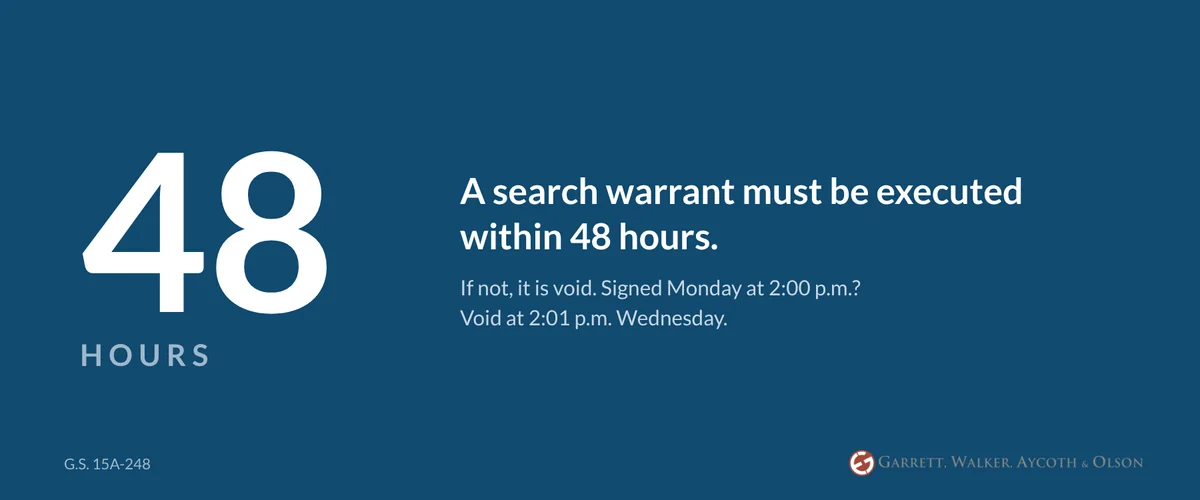
A search warrant lasts 48 hours. It must be executed within 48 hours from the time it was issued (G.S. 15A-248).
If it is not executed in time, it is void. It must be marked “not executed” and returned to the clerk of the issuing court without unnecessary delay.
Here is how the clock works. A warrant signed Monday at 2:00 p.m. can be used until Wednesday at 2:00 p.m., and at 2:01 p.m. Wednesday it is void.
Phones and computers raise a harder question. The UNC School of Government found no North Carolina appellate case on whether lab analysis of a seized device must finish within 48 hours.
In State v. Davidson (1998), bank records that arrived about two weeks after the warrant was delivered to the bank were held not a substantial violation of the 48-hour rule.
The device question is unsettled, so your lawyer argues it case by case.
Phones follow their own rules; see the rules for searching your phone.
Talk to a defense lawyer before you talk to anyone else
What you say and sign in the first days often decides what is possible later. The earlier we see your paperwork, the more options you usually have.
Call (336) 379-0539Free consultation with a Greensboro attorneyWhat Happens When Officers Carry Out a Search Warrant
North Carolina law sets the steps officers must follow.
Knock and Announce
Before entering, the officer must give notice of his identity and purpose to the person to be searched or in apparent control of the premises (G.S. 15A-249).
After announcing, officers may force entry if they reasonably believe entry is being denied or unreasonably delayed, or that the place is empty (G.S. 15A-251).
They may also force entry if they have probable cause to believe giving notice would endanger someone’s life or safety.
Reading the Warrant and Giving You a Copy
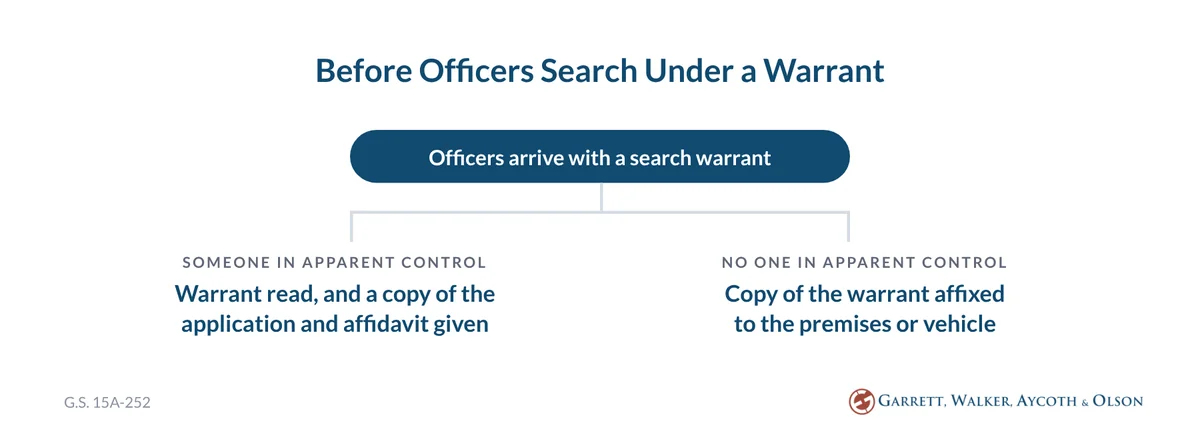
Before searching, the officer must read the warrant and give a copy of the warrant application and affidavit to the person to be searched or in apparent control (G.S. 15A-252).
If no one is in apparent control, the officer must leave a copy of the warrant affixed to the premises or vehicle. Keep every page you are given.
How Far the Search Can Go
The search may go only as far as the warrant authorizes and as is reasonably necessary to find the listed items (G.S. 15A-253).
If officers inadvertently find other items that can lawfully be seized, they may take those too.
People Who Are There During the Search
If an officer reasonably believes safety requires it, he may pat down the outer clothing of people present for weapons (G.S. 15A-255).
In a private home or vehicle, officers may detain people present for as long as reasonably needed to carry out the warrant (G.S. 15A-256).
If the listed items are not found, officers may then search people present, but only for the property the warrant describes. For this rule, all controlled substances count as the same type of property.
What to Do If Police Arrive With a Search Warrant
Your goal is to stay safe and keep the paper trail.
Do Not Block the Door
Do not resist or block officers, even if you think the warrant is wrong. A lawyer challenges it later in court.
Ask to See the Warrant
Ask to see the warrant and keep the copy of the application and affidavit. Those pages show what officers swore to.
Stay Quiet About the Case
You can decline to answer questions about the case and ask for a lawyer. Say nothing more about it.
Keep the Receipt
Watch what is taken if you can, and keep the itemized receipt the officer must give you (G.S. 15A-254).
Officers just left? Call (336) 379-0539 while the details are fresh.
Search Warrant vs. Arrest Warrant
A search warrant lets officers look for things; an arrest warrant lets them take a person into custody.
| Question | Search Warrant | Arrest Warrant |
|---|---|---|
| What It Authorizes | Search a place, vehicle or person for listed items (G.S. 15A-241) | Arrest a named person to answer the charge (G.S. 15A-304(a)) |
| Who Signs It | A judicial official (G.S. 15A-243) | A judicial official (G.S. 15A-304(f)) |
| Time Limit | Executed within 48 hours (G.S. 15A-248) | No 48-hour limit; an unserved paper warrant goes back to the clerk after 180 days but is not voided (G.S. 15A-301(d)) |
| Copy for You | Warrant read, plus a copy of the application and affidavit (G.S. 15A-252) | A copy delivered at arrest (G.S. 15A-301(c)(1)) |
Officers sometimes search with no warrant at all. Here is when police can search without one.
What Happens After the Search
After the search, officers must give you a receipt and file a sworn record with the court. The receipt itemizes what was taken and names the issuing court (G.S. 15A-254).
The officer must also return the warrant to the clerk without unnecessary delay, with a written inventory of items seized, signed and sworn (G.S. 15A-257).
Seized property is held by the applicant, the officer, the agency or a lab, subject to court order (G.S. 15A-258). Ask about getting seized property back from Greensboro police.
If the warrant or the search broke the rules, your lawyer can file a timely motion to suppress (G.S. 15A-974).
Evidence must be suppressed when the Constitution requires it or after a substantial statutory violation. Whether that happens depends on the facts of your case and how early your lawyer gets the papers.
When to Talk With a Lawyer About a Search Warrant
Talk with a lawyer as soon as you have the affidavit copy, before you talk to investigators and before your first court date.
The affidavit is the roadmap for any challenge, because it shows what officers swore to. Your lawyer compares it with the receipt and the inventory.
Call (336) 379-0539 and have our criminal defense attorneys review it.
If the search led to charges, read how we approach defending drug charges in Guilford County.
Frequently Asked Questions
Is a search warrant a court order?
Yes. North Carolina law defines a search warrant as “a court order and process” directing an officer to search designated places, vehicles or persons for designated items (G.S. 15A-241). The officer must account to the issuing court for anything seized.
Who signs a search warrant in NC?
A Supreme Court justice, Court of Appeals judge or superior court judge can sign one valid statewide. A district court judge, clerk or magistrate can sign others (G.S. 15A-243). The warrant must show the signer’s name and signature, with the time and date of issue (G.S. 15A-246(1)).
Do police have to show me the search warrant?
Yes, in effect. Before searching, the officer must read the warrant to the person to be searched or in apparent control, and give that person a copy of the application and affidavit (G.S. 15A-252). If no one is there, a copy of the warrant must be affixed to the premises.
Can police search my car with a house search warrant?
Only if the car itself is designated in the warrant with reasonable certainty (G.S. 15A-246(4)). A warrant for a house does not automatically cover every vehicle parked nearby. Your lawyer compares the warrant’s exact wording with what officers actually searched.
Can police search me if I am at a house they have a warrant for?
They may pat you down for weapons if they reasonably believe safety requires it (G.S. 15A-255) and detain you while they search (G.S. 15A-256). If the listed items are not found, they may search you, but only for the property the warrant describes.
Can officers break the door?
Only in set situations. After announcing, officers may force entry if they reasonably believe entry is being denied or unreasonably delayed, or the home appears empty (G.S. 15A-251). They may also force entry if they have probable cause to believe notice would endanger someone.
What if the search warrant was executed after 48 hours?
A search warrant not executed within 48 hours is void and must be returned marked “not executed” (G.S. 15A-248). A search on a void warrant can be challenged with a timely motion to suppress (G.S. 15A-974). Your lawyer checks the times on the warrant and the reports.
Can police search a house if no one is home?
Yes, with a valid warrant. After announcing, officers may force entry if they reasonably believe the place is empty (G.S. 15A-251), and they must leave a copy of the warrant affixed to the premises (G.S. 15A-252). Your lawyer checks the times and the paperwork.
Can a search warrant be used to arrest me?
A search warrant authorizes a search, not an arrest. An arrest needs a warrant for arrest (G.S. 15A-304) or probable cause under the arrest rules (G.S. 15A-401(b)). If officers find evidence during the search, they may then have grounds to arrest.
- Former President, Greensboro Criminal Defense Lawyers Association
- Elected member, Criminal Justice Section, North Carolina Bar Association
- Selected to present the Wade M. Smith Award for Top Criminal Defense Lawyer in North Carolina
Talk to a Greensboro criminal defense lawyer today
Bring the warrant, the release order and anything else they gave you.
Garrett, Walker, Aycoth & Olson, Attorneys at Law
317 South Greene St, Greensboro, NC 27401
(336) 379-0539
This article explains North Carolina law in general terms. It is not legal advice about your case, and laws, penalties and court procedures change. Contact an attorney about your specific situation.