


Yes, North Carolina treats a bicycle as a vehicle, so riding impaired is a full DWI under G.S. 20-138.1. A conviction revokes your driver’s license for at least one year, even though you were on a bike.
Many riders think a bike cannot touch their car license. That belief is wrong.
The charge, the jail range and the revocation all match a car DWI. Where you rode, why you were stopped and how you were tested are what a DWI lawyer examines.
Charged after riding a bike? Call (336) 379-0539 today, before the license deadlines run.
North Carolina DUI Laws and Bicycles: Why a Bike Counts as a Vehicle
Yes, you can get a DUI on a bicycle in North Carolina. The DWI statute covers anyone who drives “any vehicle” on a highway, street or public vehicular area.
North Carolina calls the charge impaired driving, or DWI. DUI is the everyday word for it.
Devices moved by human power are normally not vehicles. The definition singles out bikes:
“…bicycles and electric assisted bicycles shall be deemed vehicles and every rider of a bicycle … shall be subject to the provisions of this Chapter applicable to the driver of a vehicle…” G.S. 20-4.01(49)
A 1989 law exempted bicycles, and the legislature removed that exception in 2006, as the UNC School of Government explains. That is why some older sources still say no.
The charge is the one a driver faces, so it gets the same defense. See how our Greensboro DWI lawyers defend you.
Pedal Bikes, E-Bikes, Mopeds and Horses: Which Rides Can Bring a DWI
Anything with a motor counts, and so do bicycles and e-bikes. The DWI statute leaves out horses, the definition of vehicle leaves out mobility and self-balancing devices, and skateboards and other human-powered devices are not vehicles at all.
| Ride | Can It Bring a DWI? | NC Statute |
|---|---|---|
| Pedal bicycle | Yes | G.S. 20-4.01(49) |
| E-bike (up to 750 watts, 20 mph on motor) | Yes | G.S. 20-4.01(7a), (49) |
| Moped | Yes | G.S. 20-4.01(27)j |
| Golf cart | Yes | G.S. 20-4.01(12b) |
| Riding lawn mower | Yes, since 2006 | G.S. 20-4.01(49) |
| Horse | No | G.S. 20-138.1(e) |
| Mobility or self-balancing device | No | G.S. 20-4.01(49), (7b) |
Pedal Bike or E-Bike: The Same DWI
E-bikes and mopeds are not “motor vehicles” under G.S. 20-4.01(23), which matters for driving while revoked. The DWI statute says “vehicle,” so the charge is the same.
A bike over the 750-watt or 20 mph limit is not an e-bike under the statute. It may be treated as a motor vehicle instead.
Horses: The One Ride the DWI Statute Leaves Out
Under G.S. 20-138.1(e), “vehicle” in the DWI statute “does not include a horse.” Other traffic laws can still apply, and the School of Government says reckless driving on a horse is apparently possible.
What Constitutes a DUI on a Bicycle?
The State must prove you rode on a highway, street or public vehicular area while impaired. The statute gives three ways:
- Under the influence of an impairing substance.
- An alcohol concentration of 0.08 or more at any relevant time after riding.
- Any amount of a Schedule I controlled substance in your blood or urine.
A prescription is no defense. Being legally entitled to use a drug does not change the charge.
Where You Were Riding Matters
A highway is the whole width between right-of-way lines. A public vehicular area includes drives and parking lots at stores, schools, churches and parks, plus subdivision roads.
A sidewalk beside a road may fall inside that width, and greenways are not named in the list. We found no NC case on either, so location is a point your lawyer tests, never a safe zone.
Riding Versus Walking the Bike
A driver is a person “in actual physical control of a vehicle which is in motion.” Walking a bike home is a different fact pattern, and we found no NC case deciding it.
Your lawyer looks at exactly what you were doing. Parked cars are a separate question, covered in our guide to DWI charges without driving a car.
Why Officers Stop Bike Riders
At night a bike needs a front lamp visible from 300 feet, a rear reflector, and a red rear lamp or bright vest under G.S. 20-129(e). A missing light is a reason to stop you.
If the officer believes you drank and sees a moving violation or a crash, or reasonably suspects impaired riding after a lawful stop, G.S. 20-16.3 allows a roadside screening test.
What Happens to Your Driver’s License After a Bike DWI
The license rules match a car DWI. They turn on the DWI charge, not on the motor.
At the Magistrate: A 30-Day Civil Revocation
Refuse a chemical analysis or test 0.08 or more, and your license is revoked for at least 30 days. Under G.S. 20-16.5, that applies “whatever the source” of your privilege to drive.
After 10 days you may apply for a limited privilege if you held a valid license. See how the 30-day civil revocation works.
Refusing a Test: Roadside Device Versus the Test After Arrest
Refusing the roadside device before arrest can be used as evidence of reasonable grounds to arrest, under G.S. 20-16.3(d). Refusing the chemical analysis after arrest costs more.
Implied consent under G.S. 20-16.2 covers anyone who “drives a vehicle.” A willful refusal adds a 12-month DMV revocation to the 30-day one.
Warning: The 12-month revocation starts on the 30th day after DMV mails the order. Only a written hearing request before that date holds it off.
If You Are Convicted: One Year or Longer
DMV must revoke your license on a DWI conviction under G.S. 20-17(a)(2). A first conviction revokes your driver’s license for one year, even if you were on a bike.
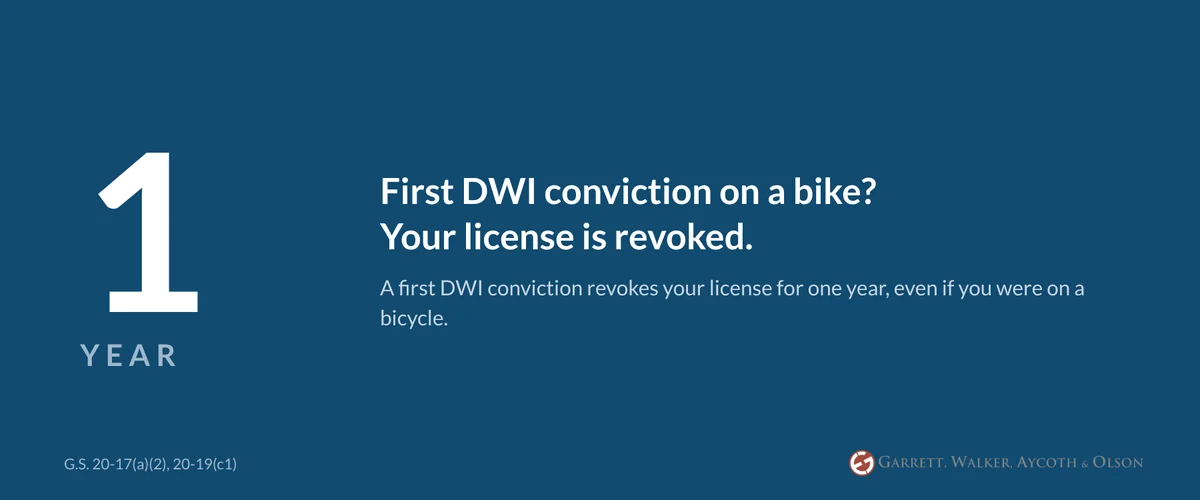
Under G.S. 20-19, a prior within three years makes it four years. Two or more priors with the latest within five years, or an Aggravated Level One sentence, make it permanent.
No license points are added on top, under G.S. 20-16(c).
Getting a Limited Driving Privilege After Conviction
Under G.S. 20-179.3(b), you need a valid license at the offense, a filed substance abuse assessment and, usually, a Level Three, Four or Five sentence. One prior DWI in seven years may not bar it if your alcohol concentration was under 0.15, and some Level Two cases qualify.
Your lawyer prepares and argues the petition, and a judge decides. Our guide covers the steps for a limited driving privilege.
Can You Still Ride a Bike While Your License Is Revoked?
Driving while revoked under G.S. 20-28 covers a “motor vehicle,” and the School of Government says it does not apply to bicycles. Riding impaired again, though, is a new DWI.
Your license clock starts at the magistrate’s office. Call (336) 379-0539 so we can act before the deadlines pass.
Talk to a DWI and traffic lawyer before your court date
Deadlines in traffic and DWI cases run from the day of the charge. The earlier we see your paperwork, the more options you usually have.
Call (336) 379-0539Free consultation with a Greensboro attorneyPenalties for a DUI on a Bicycle in North Carolina
A bike DWI is the same misdemeanor as a car DWI. The judge sentences it at a hearing under the same levels in G.S. 20-179.
| Level | Jail Range | Minimum If Suspended | Maximum Fine |
|---|---|---|---|
| Aggravated Level One | 12 to 36 months | 120 days | $10,000 |
| Level One | 30 days to 24 months | 30 days (10 with alcohol monitoring) | $4,000 |
| Level Two | 7 days to 12 months | 7 days or 90 days alcohol monitoring | $2,000 |
| Level Three | 72 hours to 6 months | 72 hours jail or community service | $1,000 |
| Level Four | 48 hours to 120 days | 48 hours jail or community service | $500 |
| Level Five | 24 hours to 60 days | 24 hours jail or community service | $200 |
Which level applies turns on factors found at the sentencing hearing. That level is argued by your lawyer, not assumed.
On probation at Levels Three to Five, the judge must also require a substance abuse assessment.
When a Bike DWI Becomes a Felony
A DWI plus three or more impaired driving convictions in 10 years is a Class F felony under G.S. 20-138.5, with at least 12 months active. Bike DWIs count as priors.
With prior DWIs, read about defending a habitual DWI felony charge before court.
Other Charges a Drunk Bike Rider Can Face in NC
Being drunk in public is not a crime by itself. G.S. 14-447(a) says “No person may be prosecuted solely for being intoxicated in a public place.”
Intoxicated and Disruptive in Public
Under G.S. 14-444, being intoxicated and disruptive in five listed ways, such as blocking traffic, is a Class 3 misdemeanor. Alcoholism is a defense under G.S. 14-445.
The fine can reach $200 under G.S. 15A-1340.23(b), and a conviction goes on your record. See the fines and record risks of Class 3 charges.
Reckless Driving on a Bicycle
Reckless driving under G.S. 20-140 covers “any vehicle.” It is a Class 2 misdemeanor.
Open Containers on a Bike
The state open container law in G.S. 20-138.7 is written for motor vehicles, mopeds included. City rules can say more, so do not read this as permission.
These charges often come with a DWI, and our full Greensboro criminal defense practice handles each one.
Why You Should Avoid Cycling Under the Influence
Switching from the car to the bike does not avoid a DWI; it only changes the vehicle.
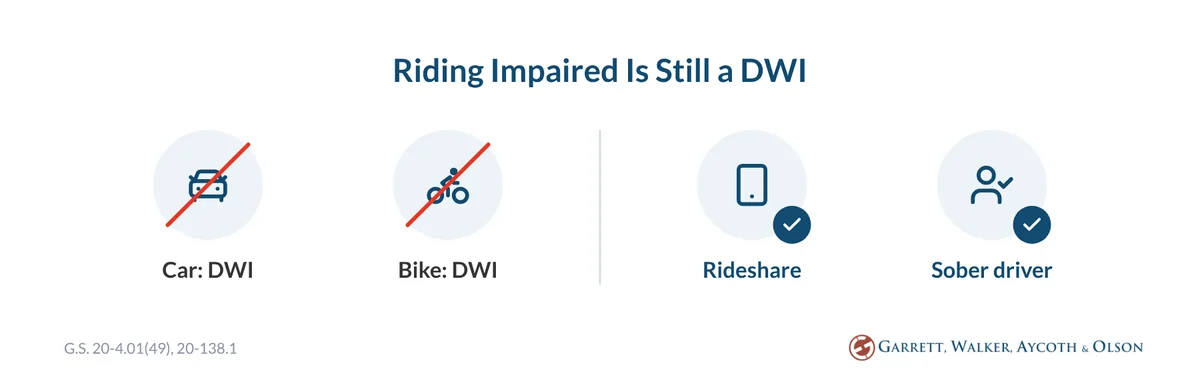
The plans that work are a sober driver, a rideshare, or leaving the bike and walking home. Walking on foot is not a DWI, and being drunk in public alone is not a crime.
A rider also has no seat belt and no airbag in a crash.
Legal Defenses for a DUI on a Bicycle
Defenses come from the facts the State must prove.
The Stop
Was there a lawful reason to stop you, such as a missing light, a moving violation or a crash?
Riding, Location and the Bike Itself
Was the bike in motion and under your control, on a highway or public vehicular area? Is the machine an e-bike, a moped or something else?
Impairment and the Test
Each way of proving impairment can be tested. The rights notice, including 30 minutes to call a lawyer or witness, must be followed, and G.S. 20-138.1(b1) lets you challenge a chemical analysis as inadmissible.
See field sobriety tests and breath tests compared, and where each goes wrong.
The License Hearing
A refusal revocation gets its own DMV hearing on five issues. They include reasonable grounds and whether you willfully refused.
Whether any of these applies depends on the facts of your case. Finding it is your lawyer’s job.
What to Do Today After a Bike DWI Charge
Write Down Where You Rode and When
Note your route, your lights and who saw you. Details like these fade fast.
Check the Dates on Your Paperwork
Find the civil revocation date and any refusal hearing deadline. Each runs on its own clock.
Call a DWI Lawyer Before You Talk About the Case
Before you discuss the ride with anyone, talk to a Greensboro DWI defense lawyer. Call (336) 379-0539 today.
Frequently Asked Questions
Can you get a DUI on a horse in North Carolina?
Not a DWI. G.S. 20-138.1(e) says “vehicle” in the DWI statute does not include a horse, an exception that dates to 1989. Other traffic laws can still apply to a rider on a road, so an impaired ride can still bring a charge.
Does a bike DWI go on my driving record?
Yes. When DMV receives the conviction, it must revoke your license under G.S. 20-17, for one year on a first conviction. No license points are added on top. The conviction also counts as a prior if you are charged with DWI again.
Can I refuse a breath test if I was on a bike?
You can, but it costs you. Refusing the roadside device can be used as evidence for the arrest. Refusing the chemical analysis after arrest brings a 30-day civil revocation and a 12-month DMV revocation, because implied consent covers bike riders.
What if I do not have a driver’s license?
You can still be charged, and the civil revocation reaches your privilege to drive whatever its source. You cannot get a limited driving privilege, because both kinds require a valid license, or one expired under a year, at the offense. Ask your lawyer about later effects.
Can you get a DWI for walking your bike home?
It depends on the facts. The law looks at actual physical control of a vehicle in motion, and we found no NC case on walking a bicycle. Your lawyer tests what you were doing when the officer saw you, so call before you assume.
Is a bike DWI a misdemeanor or a felony?
A misdemeanor, sentenced under the same six levels as a car DWI, with fines up to $10,000. It becomes a Class F felony, habitual impaired driving, when you have three or more impaired driving convictions in the past 10 years.
Does a DWI on a bicycle count against me if I get a DWI in a car later?
Yes. A bike DWI counts as a prior. A prior within three years makes a later revocation four years, and a prior within seven years is a grossly aggravating factor at sentencing. Priors also count toward habitual impaired driving.
Do I need a lawyer for a DWI on a bike?
Yes. It is the same charge, jail range and license revocation as a car DWI. A lawyer tests the stop, where you rode and the test, and handles the DMV hearing. Depending on the facts of your case, that work can change the result.
- Continuing Legal Education Instructor of the Year, North Carolina Bar Association
- Former President, Greensboro Criminal Defense Lawyers Association
- Board Member, Criminal Justice Section, North Carolina Bar Association
Talk to a Greensboro traffic and DWI lawyer today
Bring the citation, any DMV letter and your court date.
Garrett, Walker, Aycoth & Olson, Attorneys at Law
317 South Greene St, Greensboro, NC 27401
(336) 379-0539
This article explains North Carolina law in general terms. It is not legal advice about your case, and laws, penalties and court procedures change. Contact an attorney about your specific situation.