


The most common misdemeanors in North Carolina, by convictions, are driving while license revoked, larceny of $1,000 or less, drug paraphernalia, speeding and reckless driving. Almost every NC misdemeanor falls into four classes, A1, 1, 2 or 3; DWI is the main exception, with its own sentencing scale.
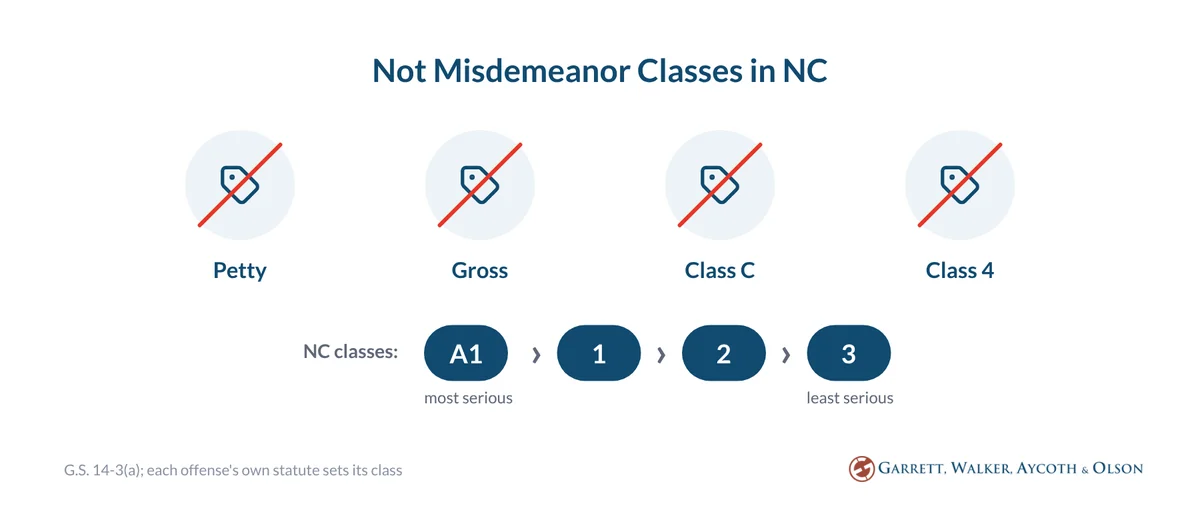
There is no petty, gross, Class A, B or C, or Class 4 misdemeanor in North Carolina. Even a Class 3 is a criminal conviction that stays on your record until a court expunges it.
Which class you face, and whether it can be lowered or dismissed, is argued by your lawyer, depending on the facts of your case. Talk to a Greensboro lawyer who defends misdemeanors before you plead to anything.
Charged with a misdemeanor in Guilford County? Call (336) 379-0539 to talk with our team today.
The Most Common Misdemeanors in North Carolina
The five most common misdemeanor convictions in North Carolina are mostly traffic and theft charges. The Sentencing and Policy Advisory Commission’s FY 2024 statistical report counted 99,088 misdemeanor convictions from July 2023 to June 2024.
| Rank | Charge | Class | Convictions in FY 2024 |
|---|---|---|---|
| 1 | Driving while license revoked (not for DWI) | Class 3 | 13,687 |
| 2 | Larceny of property worth $1,000 or less | Class 1 | 7,922 |
| 3 | Possession of drug paraphernalia | Class 1 | 6,825 |
| 4 | Speeding | Class 3 | 4,672 |
| 5 | Reckless driving to endanger | Class 2 | 4,033 |
By class, 38% of those convictions were Class 3, 35% Class 1, 19% Class 2 and 8% Class A1. Traffic offenses made up 43% of all misdemeanor convictions.
The report leaves out DWI, cases a magistrate decides and local ordinance offenses. That is why DWI does not appear in this list.
Twenty-nine percent of misdemeanor convictions that year ended in an active sentence, meaning time in jail. Whether yours could be one depends on the class, your record and the argument made for you.
What Types of Misdemeanors Are There in NC? The Four Classes
Each offense’s own statute sets its class, from Class A1, the most serious, to Class 3.
A misdemeanor is any crime that is not a felony under G.S. 14-1. For the full definition and how jail limits change with prior convictions, see our misdemeanor guide.
Some statutes call an act a misdemeanor without naming a class or a punishment. G.S. 14-3(a) then makes it a Class 1 misdemeanor.
DWI is the main exception to the four classes. G.S. 20-138.1(d) calls impaired driving a misdemeanor, but it is sentenced under its own levels in G.S. 20-179.
North Carolina uses only four misdemeanor classes: A1, 1, 2 and 3. Labels like petty, gross, Class C or Class 4 are not North Carolina classes.
Petty Misdemeanors, Infractions and Minor Crimes in North Carolina
North Carolina has no separate petty misdemeanor class. The phrase shows up in a court statute, and there it covers every misdemeanor.
“…below the grade of felony, and the same are hereby declared to be petty misdemeanors.” (G.S. 7A-272(a), on District Court jurisdiction)
In plain English, “petty misdemeanor” is a court label for any misdemeanor District Court tries. It is not a lighter class.
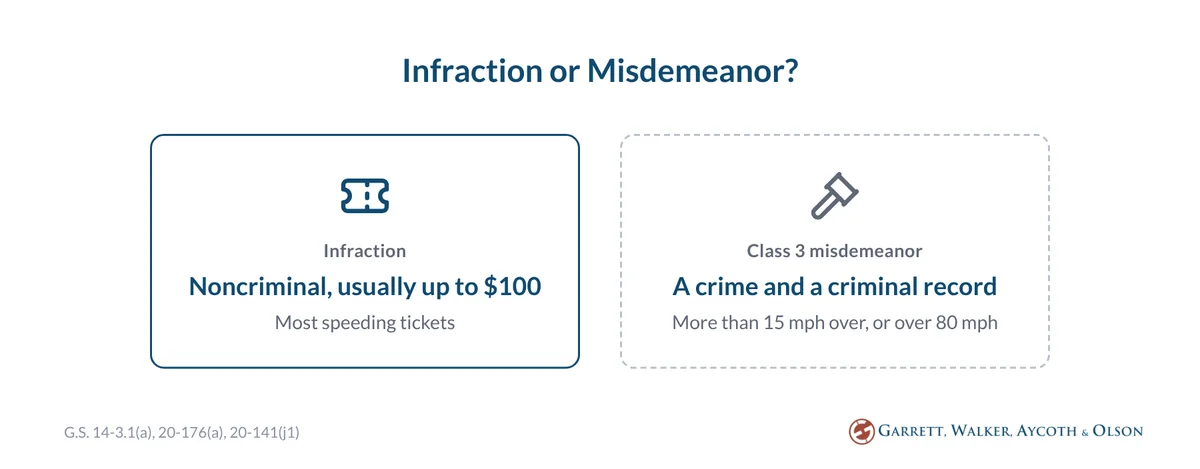
People who search for a “minor crime” often mean an infraction. Under G.S. 14-3.1(a), an infraction is “a noncriminal violation of law not punishable by imprisonment.”
The penalty for an infraction is up to $100, unless another law sets a different amount. Most rules-of-the-road violations are infractions under G.S. 20-176(a), unless a statute makes them a crime.
Speed can cross that line. Driving more than 15 mph over the limit, or over 80 mph, is a Class 3 misdemeanor under G.S. 20-141(j1).
An infraction is a noncriminal violation, usually with a penalty of up to $100. A Class 3 misdemeanor is still a crime and a criminal record.
Talk to a defense lawyer before you talk to anyone else
What you say and sign in the first days often decides what is possible later. The earlier we see your paperwork, the more options you usually have.
Call (336) 379-0539Free consultation with a Greensboro attorneyCommon Misdemeanor Examples by Class
Here are common misdemeanor examples in each NC class, with the statute that sets the class. Some of them move up a class, or become felonies, because of value, injury or prior convictions.
Class A1 Misdemeanor Examples
These Class A1 examples involve an injury, a weapon, a vulnerable victim or a court order.
| Charge | Statute |
|---|---|
| Assault inflicting serious injury or using a deadly weapon | G.S. 14-33(c)(1) |
| Assault on a female by a male 18 or older | G.S. 14-33(c)(2) |
| Assault on a child under 12 | G.S. 14-33(c)(3) |
| Pointing a gun at someone | G.S. 14-34 |
| Violating a domestic violence protective order | G.S. 50B-4.1 |
| Sexual battery | G.S. 14-27.33 |
Class 1 Misdemeanor Examples
Class 1 covers many theft, property and drug paraphernalia charges.
| Charge | Statute |
|---|---|
| Larceny of $1,000 or less (most cases) | G.S. 14-72(a) |
| Communicating threats | G.S. 14-277.1 |
| Breaking or entering a building | G.S. 14-54(b) |
| Injury to real property | G.S. 14-127 |
| Possession of drug paraphernalia (not marijuana) | G.S. 90-113.22 |
| Marijuana over one-half ounce, up to one and one-half ounces | G.S. 90-95(d)(4) |
Class 2 Misdemeanor Examples
Class 2 charges often grow out of arguments, fights or encounters with police.
| Charge | Statute |
|---|---|
| Simple assault or simple affray | G.S. 14-33(a) |
| Resisting, delaying or obstructing an officer | G.S. 14-223(a) |
| Disorderly conduct | G.S. 14-288.4 |
| First-degree trespass | G.S. 14-159.12 |
| Injury to personal property ($200 or less) | G.S. 14-160(a) |
| Carrying a concealed weapon, first offense | G.S. 14-269 |
| Reckless driving | G.S. 20-140 |
Here is what a Class 2 charge can mean in more detail.
Class 3 Misdemeanor Examples
Class 3 is the lowest class and the largest share of convictions. Many Class 3 charges start at a traffic stop.
| Charge | Statute |
|---|---|
| Driving while license revoked (not for DWI) | G.S. 20-28(a) |
| Speeding more than 15 over or over 80 | G.S. 20-141(j1) |
| Marijuana, one-half ounce or less | G.S. 90-95(d)(4) |
| Shoplifting by concealment, first offense | G.S. 14-72.1 |
| Second-degree trespass | G.S. 14-159.13 |
| Intoxicated and disruptive in public | G.S. 14-444 |
| Open container while driving after drinking, first offense | G.S. 20-138.7(a) |
| Underage beer or wine possession, or drinking (age 19 or 20) | G.S. 18B-302(i) |
Note: Being drunk in public is not, by itself, the offense in NC. G.S. 14-444 requires being intoxicated and disruptive, such as blocking a sidewalk or fighting.
Before you pay or plead, see how Class 3 charges are sentenced and cleared.
Traffic Misdemeanors in North Carolina
Most traffic tickets in North Carolina are infractions, but some driving charges are crimes. DWI is one of them, with its own sentencing scale.
Driving while license revoked is Class 3. It becomes Class 1 under G.S. 20-28(a1) if the license was revoked for impaired driving.
Reckless driving is Class 2. It rises to Class 1 if it causes serious injury, and to Class A1 if it causes serious bodily injury.
An open container while driving after drinking is Class 3 for a first offense and Class 2 after that. A plain open container in the passenger area, with no drinking by the driver, is an infraction under G.S. 20-138.7(a1).
Here is how a traffic lawyer handles these charges in Guilford County.
When a Misdemeanor Becomes a More Serious Charge
The same act can climb to a higher class, or cross into a felony, because of value, injury, weapons or prior convictions.
Shoplifting by concealment is Class 3 for a first conviction. A second within three years is Class 2, and a third within five years is Class 1.
Larceny of $1,000 or less is usually Class 1, and more than $1,000 is a Class H felony under G.S. 14-72(a). Larceny from the person, during a breaking or entering, or of a firearm is a Class H felony at any value.
So is larceny after four or more prior larceny convictions. Here is how a habitual larceny charge works.
A concealed pistol or gun is Class 2 for a first offense and a Class H felony for a second. Damage to personal property is Class 2, or Class 1 if the damage is over $200.
An assault causing physical injury, by someone with two prior assault convictions within 15 years, is a Class H felony under G.S. 14-33.2.
Value, weight, injury and prior convictions are facts, and facts can be challenged. That is where a lawyer starts.
See how North Carolina ranks every crime by class.
Which of These Misdemeanors Can Be Cleared or Count Later
The examples above do not all clear the same way. Every Class A1 example, and simple assault in Class 2, is not eligible for nonviolent misdemeanor expunction under G.S. 15A-145.5.
Most of the Class 1, 2 and 3 examples are eligible. For one such conviction, you can petition 3 years after the conviction, or when the sentence is served if that is later.
Important: A DWI conviction is not eligible for expunction under G.S. 15A-145.5(a1).
Here is how misdemeanor expunction works in NC.
The Class A1 and Class 1 nontraffic examples add 1 point to any later felony sentence under G.S. 15A-1340.14(b)(5). The Class 2 and 3 examples and most traffic misdemeanors do not, though DWI does.
Some of these charges can end in deferred prosecution or a conditional discharge under G.S. 15A-1341. Both need the prosecutor’s agreement before judgment, so talk to a lawyer before your first court date.
Here is when misdemeanor charges can be dropped in NC.
Not sure which class your paperwork shows? Call (336) 379-0539 and we will read it with you.
Our criminal defense practice in Guilford County handles every misdemeanor class. Talk with our Greensboro misdemeanor lawyers about the facts of your case.
Frequently Asked Questions
What is the most common misdemeanor in North Carolina?
Driving while license revoked, for a revocation not based on DWI, was the most common misdemeanor conviction in FY 2024, with 13,687 convictions. It is a Class 3 misdemeanor under G.S. 20-28(a). Talk to a lawyer before you plead, because the charge is tied to your license.
What are examples of petty misdemeanors in NC?
North Carolina has no petty misdemeanor class. G.S. 7A-272(a) uses “petty misdemeanors” as a label for every misdemeanor District Court tries. The least serious class is Class 3, which includes second-degree trespass, a first shoplifting by concealment and marijuana of one-half ounce or less.
What is a gross misdemeanor in NC?
Gross misdemeanor is not a North Carolina term, and neither is a Class 4 or Class C misdemeanor. The most serious class here is Class A1. It covers charges such as assault inflicting serious injury, assault on a female and violating a domestic violence protective order.
Is speeding a misdemeanor in NC?
Usually not. Most speeding tickets are infractions under G.S. 20-176. But driving more than 15 mph over the limit, or over 80 mph, is a Class 3 misdemeanor under G.S. 20-141(j1). Speeding was the fourth most common misdemeanor conviction in FY 2024.
Is DWI a misdemeanor in North Carolina?
Yes. G.S. 20-138.1(d) calls impaired driving a misdemeanor. It is not sentenced as Class A1, 1, 2 or 3; the judge holds a sentencing hearing and uses the levels in G.S. 20-179. The Sentencing Commission’s misdemeanor statistics leave DWI out for that reason.
Is shoplifting a misdemeanor in NC?
Usually. Shoplifting by concealment is Class 3 for a first conviction, Class 2 for a second within three years and Class 1 for a third within five years under G.S. 14-72.1. Using an aluminum-lined bag to beat store alarms is a Class H felony.
Is resisting arrest a misdemeanor in NC?
Yes, in most cases. Resisting, delaying or obstructing an officer is a Class 2 misdemeanor under G.S. 14-223(a). It becomes a Class I felony if it causes an officer serious injury, and a Class F felony if it causes serious bodily injury.
Is breaking and entering a misdemeanor in NC?
It can be. Wrongfully breaking or entering a building is a Class 1 misdemeanor under G.S. 14-54(b). If the State says you meant to commit a felony or larceny inside, the charge is a Class H felony under G.S. 14-54(a). That intent has to be proved.
- Former President, Greensboro Criminal Defense Lawyers Association
- Elected member, Criminal Justice Section, North Carolina Bar Association
- Selected to present the Wade M. Smith Award for Top Criminal Defense Lawyer in North Carolina
Talk to a Greensboro criminal defense lawyer today
Bring the warrant, the release order and anything else they gave you.
Garrett, Walker, Aycoth & Olson, Attorneys at Law
317 South Greene St, Greensboro, NC 27401
(336) 379-0539
This article explains North Carolina law in general terms. It is not legal advice about your case, and laws, penalties and court procedures change. Contact an attorney about your specific situation.