



North Carolina has no single crime called illegal gun possession. A gun possession charge depends on who you are, where you were and how you carried the gun, and the class runs from a Class 2 misdemeanor to a Class C felony.
The same pistol can be legal at home and a crime carried hidden without a permit. On school property, or in the hands of someone with a felony record, it is a felony.
Two beliefs trip people up. North Carolina repealed its pistol purchase permit law in 2023 under G.S. 14-402, but permitless concealed carry is not the law.
Charged with a gun possession offense in Greensboro or High Point? Call (336) 379-0539 today, before your first court date.
The class on the warrant decides whether the case stays in District Court or goes to Superior Court. See how our lawyers defend gun charges in Guilford County.
What Counts as Illegal Gun Possession in North Carolina
Illegal gun possession in North Carolina means breaking one of several separate laws. Each one is about who has the gun, where it is, how it is carried, or what kind of weapon it is.
The statute number on your warrant tells you which law the State is using.
Possession is also broader than ownership. The felon statute reaches any gun in your “custody, care, or control.”
“It is unlawful for any person who has been convicted of a felony to purchase, own, possess, or have in the person’s custody, care, or control any firearm or any weapon of mass death and destruction …” G.S. 14-415.1(a)
So a gun under a car seat can lead to a charge. A shared car or home raises constructive possession of a gun or drugs, which is often the whole fight.
Who You Are: People Who Cannot Have a Gun
Some people commit a crime just by having a gun, wherever it is. The two main groups are people with a felony record and people under a protective order that bars guns.
Possession of a firearm by a felon is a Class G felony under G.S. 14-415.1. It covers buying, owning, possessing or controlling any firearm.
Similar felony convictions from other states and federal court count too.
For offenses on or after December 1, 2025, the class goes up when the gun shows up during another felony under Chapter 14 or the drug laws. It becomes Class F, then Class D if the gun is brandished, and Class C if it is fired.
The statute has narrow exceptions: antique firearms, antitrust-type felonies, and a pardon or restoration of rights that North Carolina law would also allow. Our guide explains whether a felon can own a gun and how rights come back.
A domestic violence protective order under Chapter 50B can also order you not to have guns. Having a firearm while that order is in effect is a Class H felony under G.S. 14-269.8.
A conviction for a domestic violence misdemeanor brings a separate federal ban. Learn about the domestic violence misdemeanor gun ban before you plead to any domestic charge.
Where You Are: Places Where Having a Gun Is a Crime
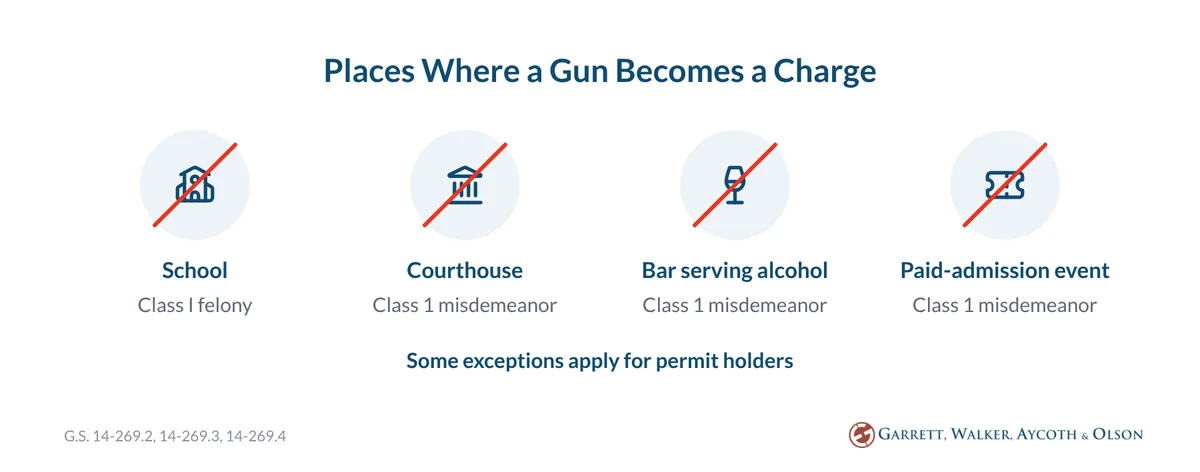
Some places turn a lawful gun into a crime the moment you walk in: schools, courthouses, bars and events that charge admission.
Having any firearm on educational property, or at a school-sponsored activity, is a Class I felony under G.S. 14-269.2(b). Firing one there is a Class F felony.
Two rules matter most to parents at pickup. A concealed handgun permit holder may keep a handgun in a closed compartment or container inside a locked vehicle under G.S. 14-269.2(k)(1).
The handgun stays in that compartment, and the vehicle is locked again right after the driver gets in or out.
Without a permit, the charge drops to a Class 1 misdemeanor only if every condition in subsection (f) is met. You are not a student or employee there, and the gun is unloaded, in a vehicle, and in a locked container or locked rack.
Miss one condition and the charge stays a felony. Read the rules for guns on school property first.
Any deadly weapon in a building housing a court is a Class 1 misdemeanor under G.S. 14-269.4. That includes the Guilford County courthouse in Greensboro.
Carrying a gun into a paid-admission event, or a place where alcohol is sold and consumed, is a Class 1 misdemeanor under G.S. 14-269.3. A permit holder carrying a handgun is exempt unless the owner posts a notice banning concealed handguns.
In each of these places, the location itself is part of the crime.
How You Carry: Concealed Carry Without a Permit
Carrying a hidden pistol is legal only on your own property, with a valid concealed handgun permit, or in a few listed situations. That rule is in G.S. 14-269(a1).
A first offense is a Class 2 misdemeanor. A second or later offense is a Class H felony under G.S. 14-269(c).
A second unpermitted concealed carry is no longer a misdemeanor.

Permitless carry has not become law. Senate Bill 50 was vetoed on June 20, 2025, and the Senate voted to override the veto on July 29, 2025.
The House has not taken an override vote; its last action, on April 6, 2026, placed the bill on the calendar for April 21, 2026. With no session law, the current G.S. 14-269 still requires a permit to carry hidden off your own property.
The same statute covers other hidden weapons, such as a bowie knife, dagger, metallic knuckles or stun gun. Carrying one concealed off your own property is also a Class 2 misdemeanor.
An ordinary pocket knife carried closed is not covered by that rule.
Note: Cars and parking lots have their own permit rules. See where permit holders can and cannot carry in North Carolina.
If you were charged with carrying a concealed gun, start with our concealed carry defense page.
Talk to a defense lawyer before you talk to anyone else
What you say and sign in the first days often decides what is possible later. The earlier we see your paperwork, the more options you usually have.
Call (336) 379-0539Free consultation with a Greensboro attorneyWhat the Gun Is: Stolen Guns and Banned Weapons
A gun can make the charge a felony because of what it is or where it came from.
Possessing a firearm you know, or have reasonable grounds to believe, is stolen is a Class H felony under G.S. 14-72. The value of the gun does not matter.
Stealing a firearm is also a felony at any value. Here is how a possession of a stolen firearm charge is handled.
Some weapons are banned for most people anywhere. Under G.S. 14-288.8, possessing a weapon of mass death and destruction is a Class F felony.
That list includes machine guns, short-barreled rifles and shotguns, silencers, and devices such as bombs and grenades.
Pointing a gun at someone is a different crime, about use rather than possession. It is a Class A1 misdemeanor under G.S. 14-34.
State vs. Federal Gun Possession Charges
The same gun can lead to a North Carolina charge and a federal charge. Federal law keeps its own list of people who may not possess guns or ammunition.
Under 18 U.S.C. 922(g), that list includes:
- People convicted of a crime punishable by more than one year in prison
- Fugitives from justice
- Unlawful users of, or people addicted to, controlled substances
- People adjudicated as a mental defective or committed to a mental institution
- Certain noncitizens
- People dishonorably discharged from the Armed Forces
- People who renounced U.S. citizenship
- People under certain protective orders
- People convicted of a misdemeanor crime of domestic violence
A knowing violation carries up to 15 years in federal prison under 18 U.S.C. 924(a)(8).
A federal case runs in a different court, under different rules, so have a lawyer look at your case early.
Gun charges often come with other counts. See all the criminal charges we defend in Greensboro and High Point.
Read what happens with guns found with drugs, state or federal.
Penalties for Gun Possession in NC: Misdemeanor vs Felony
The class on the charge sets the range, and your prior record picks where you fall in it. Here is how the gun possession charges above sort by class:
- Class 2 misdemeanor: concealed gun without a permit, first offense
- Class 1 misdemeanor: gun in a courthouse, bar or paid event, or the school-property exception
- Class I felony: gun on school property
- Class H felony: second concealed carry, gun under a 50B order, or possessing a stolen firearm
- Class G felony: felon with a firearm
- Class F felony: felon with a gun during a Chapter 14 or drug felony, firing a gun on school property, or a weapon of mass death and destruction
- Class D and Class C felonies: felon who brandishes or fires a gun during such a felony
For a Class 2 with no prior convictions, the grid authorizes community punishment only, up to 30 days. For a Class 1 it is up to 45 days, under G.S. 15A-1340.23.
Where the grid calls for community punishment, G.S. 15A-1340.20(c) requires the court to suspend the sentence. A Class 2 fine can still reach $1,000.
Which record level applies, and whether you stay at the low end, is argued by your lawyer.
Important: A misdemeanor conviction under the school, bar or courthouse laws, or a prayer for judgment continued, bars a concealed carry permit for three years under G.S. 14-415.12(b)(8).
For felony months, see jail time for each gun charge at every record level.
Defending a Gun Possession Charge
Most gun possession defenses start with three questions: was it yours to control, does a legal exception fit, and was the search lawful.
Was it in your control? The State has to tie the gun to you, not just to the car or room where it was found.
Does an exception fit? Your own property, a valid permit, and the school, bar and courthouse exceptions can change the charge.
For a knife or other non-gun weapon, G.S. 14-269(b1) allows a legitimate-use defense, which you must prove.
Was the stop and search lawful? Your lawyer checks how police found the gun and whether the search followed the law.
A pending felony also costs you now. The sheriff must deny a concealed carry permit to anyone under felony indictment or with a felony probable-cause finding, under G.S. 14-415.12(b)(2).
Tip: Video, witnesses and proof of who used the car or room are easiest to gather early. Depending on the facts of your case, that early work can shape how the charge is handled.
Talk with a Greensboro gun charges lawyer today. Call (336) 379-0539 before you answer questions about the gun.
Frequently Asked Questions
What is considered possession of a firearm in NC?
Possession is more than ownership. The felon statute, G.S. 14-415.1(a), covers buying, owning, possessing, or having a gun in your custody, care, or control. A gun in your car, bag or bedroom can count, even when someone else owns it.
What happens if you get caught with a concealed gun without a permit in NC?
Carrying a hidden pistol off your own property without a valid permit is a Class 2 misdemeanor the first time. A second or later offense is a Class H felony under G.S. 14-269(c). Call a lawyer before your first court date.
Can I have a gun at school pickup if it stays in my car?
With a concealed handgun permit, yes, if the handgun stays in a closed compartment or container in your locked vehicle. Without a permit, it is a Class 1 misdemeanor only if you are not a student or employee there and the gun is unloaded and in a locked container or rack. Otherwise it is a Class I felony.
Is a closed pocket knife a concealed weapon in NC?
No. G.S. 14-269(d) excludes an ordinary pocket knife carried closed: a small knife made for a pocket or purse, with the blade fully inside the handle. A knife that opens by throwing, explosive or spring action does not qualify as one. School property is different: any knife there can be a Class 1 misdemeanor under G.S. 14-269.2(d).
Can I carry a gun into a bar if I have a permit?
Yes, a permit holder carrying a handgun is exempt from G.S. 14-269.3, unless the owner posts a notice banning concealed handguns. But you may not carry concealed while drinking, or with alcohol in your body, under G.S. 14-415.11(c2). Without a permit, it is a Class 1 misdemeanor.
Can I leave my gun in the car at the Guilford County courthouse?
G.S. 14-269.4 bans deadly weapons in the building that houses a court, so never carry the gun inside. A permit holder may keep a firearm in a closed compartment or container in a locked vehicle (exception 6). Without a permit, a hidden handgun in the car raises the concealed carry rule in G.S. 14-269, so ask a lawyer first.
Is it a felony to have a stolen gun if I did not steal it?
It can be. Under G.S. 14-72, possessing a firearm you know, or have reasonable grounds to believe, is stolen is a Class H felony at any value. What you knew about the gun is a key question your lawyer tests.
What is a weapon of mass death and destruction?
It is the statute’s term for weapons such as machine guns, short-barreled rifles and shotguns, silencers, bombs and grenades. Possessing one is a Class F felony under G.S. 14-288.8, unless you possess it in compliance with federal registration law. If one was found in your home, call a lawyer first.
- Former President, Greensboro Criminal Defense Lawyers Association
- Elected member, Criminal Justice Section, North Carolina Bar Association
- Selected to present the Wade M. Smith Award for Top Criminal Defense Lawyer in North Carolina
Talk to a Greensboro criminal defense lawyer today
Bring the warrant, the release order and anything else they gave you.
Garrett, Walker, Aycoth & Olson, Attorneys at Law
317 South Greene St, Greensboro, NC 27401
(336) 379-0539
This article explains North Carolina law in general terms. It is not legal advice about your case, and laws, penalties and court procedures change. Contact an attorney about your specific situation.