


Janet Danahey was convicted in 2002 of four counts of first-degree murder for the Campus Walk Apartments fire in Greensboro. Two governors later commuted her life without parole sentence, and parole was denied in 2023.
The state prison record still listed her in custody in November 2026. This page lays out the public record on the Janet Danahey case, with a source for each fact.
It then explains how sentence relief works in North Carolina: clemency, parole and court motions.
Facing a homicide charge in Guilford County? Call (336) 379-0539 before any plea talks, and ask how our team defends a murder charge in Guilford County.
What Happened in the Janet Danahey Case
WFMY News 2 reported a fire at the Campus Walk Apartments in Greensboro on February 15, 2002. Four people died.
WXII 12 named the victims: Ryan Bek, 25; Elizabeth Harris, 20; Donna Llewellyn, 24; and Rachel Llewellyn, 21.
WFMY reported that Danahey set fire to a couch, which she said was a prank on an ex-boyfriend. WCNC reported that she admitted setting the fire but said “her intention was never to hurt anyone.”
The NC Department of Adult Correction record shows a Guilford County conviction on July 29, 2002. It lists four counts of first-degree murder, each a Class A felony.
FOX8 reported that she accepted a plea deal to those four counts. That way, FOX8 said, she avoided the death penalty.
James Bek, the father of Ryan Bek, spoke to WXII 12 in December 2023. He said: “We’re happy that the parole board decided to keep her in jail.”
Why a Fire Can Lead to a First-Degree Murder Charge in NC
North Carolina’s murder statute lists arson among the felonies that can make a killing first-degree murder.
“…committed in the perpetration or attempted perpetration of any arson, rape or a sex offense, robbery, kidnapping, burglary, or other felony committed or attempted with the use of a deadly weapon shall be deemed to be murder in the first degree…” G.S. 14-17(a)
The same subsection makes first-degree murder a Class A felony. For an adult, the punishment is death or life in prison without parole.
The news reports and state record do not say which theory of first-degree murder her plea rested on.
Read more on how arson can become first-degree murder under the felony murder rule.
Timeline: From Life Without Parole to Parole Review
Two commutations changed when Danahey could be considered for parole. Neither one released her.
| Date | What Happened | Source |
|---|---|---|
| Feb 15, 2002 | Fire at the Campus Walk Apartments; four people die | WFMY News 2, WXII 12 |
| Jul 29, 2002 | Convicted in Guilford County of four counts of first-degree murder; life sentence | NC Department of Adult Correction |
| Jan 2017 | Governor Pat McCrory signs a commutation order; parole eligibility set for 2029 | Associated Press, WCNC |
| Dec 20, 2022 | Governor Roy Cooper commutes the sentence; parole eligible Jan 1, 2023 | NC Governor’s Office |
| 2023 | Parole Commission denies parole; next eligibility reported as 2026 | WXII 12, WFMY News 2, FOX8 |
| Nov 2026 | State record lists her as an active inmate in minimum custody | NC Department of Adult Correction |
As of November 2026, the state prison record still lists her in custody.
Talk to a defense lawyer before you talk to anyone else
What you say and sign in the first days often decides what is possible later. The earlier we see your paperwork, the more options you usually have.
Call (336) 379-0539Free consultation with a Greensboro attorneyWhat a Commutation Does, and What It Does Not Do
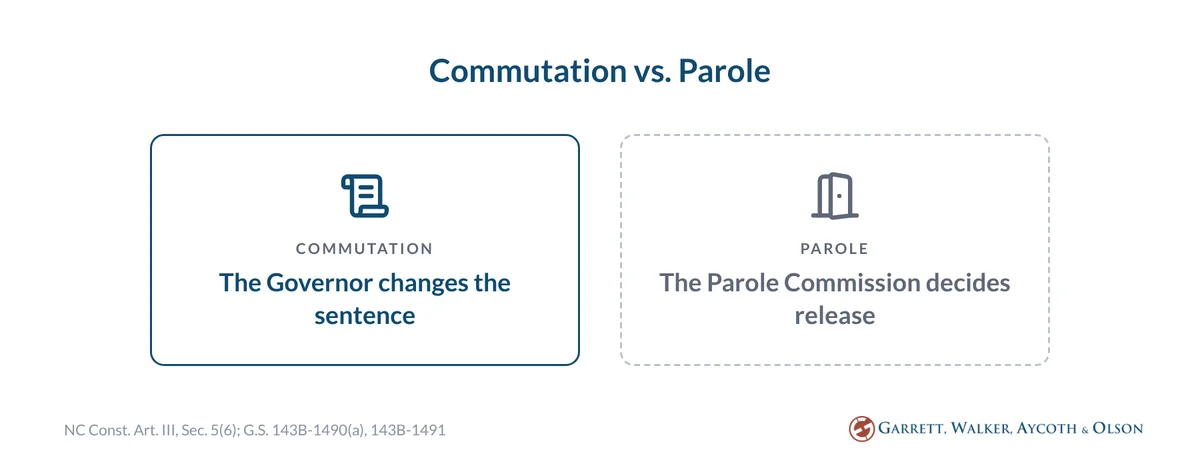
A commutation changes a sentence. It does not release anyone, and it is not a pardon.
The North Carolina Constitution, Article III, Section 5(6), lets the Governor grant “reprieves, commutations, and pardons” after conviction. The same section adds: “The terms reprieves, commutations, and pardons shall not include paroles.”
The Governor’s clemency office says a commutation alters a sentence in one of two ways. It works “by either reducing the amount of time” or “changing the type of sentence to be served.”
Parole belongs to a different body, the Post-Release Supervision and Parole Commission, under G.S. 143B-1490(a).
Its four full-time members decide parole by majority vote of the full Commission, under G.S. 143B-1491. On a tie, the chair casts an added vote.
Before her hearing, WFMY News 2 reported that she needed two of the four votes.
Key point: A life without parole sentence has no parole in it. Parole comes into play only after the sentence is changed.
Two different bodies decide. The Governor can change the sentence, but the Parole Commission decides whether a person is released.
Three Ways to Seek Sentence Relief in North Carolina
Relief after a conviction can come from three places. They are a court, the Governor and, where the sentence allows it, the Parole Commission.
Motion for Appropriate Relief
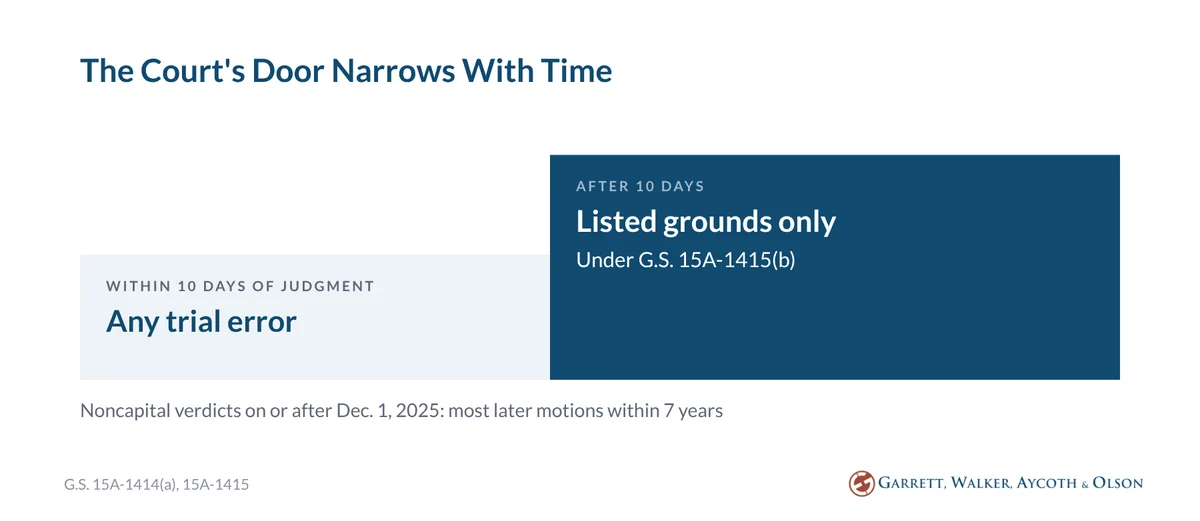
A motion for appropriate relief asks the court to correct an error. Within 10 days after judgment, it can raise any error made during or before trial, under G.S. 15A-1414(a).
After 10 days, only the grounds listed in G.S. 15A-1415(b) remain. One example is a conviction obtained in violation of the state or federal Constitution.
Some claims, such as newly discovered evidence, can be raised at any time after the verdict. That motion must still be filed within a reasonable time of the discovery.
With the district attorney’s consent, a motion can be filed at any time, under G.S. 15A-1415(c1).
Clemency From the Governor
The Governor’s clemency office lists three types: Pardon of Forgiveness, Pardon of Innocence and Commutation. The Office of Executive Clemency in Raleigh reviews the applications.
Under G.S. 147-21, a pardon application must be in writing and state its grounds. It must include a certified copy of the indictment, verdict and judgment.
For a commutation, Class A and B1 felons must serve at least five years before applying, the clemency office says. After a denial, they must wait at least five years to reapply.
Parole Where the Sentence Allows It
People sentenced under Structured Sentencing are not eligible for parole, under G.S. 143B-1490(a). A Governor’s commutation can change that, as both commutations in the Danahey case did.
Parole is often confused with probation. Here is parole compared with probation in NC.
Note: Relief from a conviction’s other penalties, such as limits on jobs, is a separate process.
When to Talk to a Lawyer About Sentence Relief
Talk to a lawyer early, because court relief runs on clocks. The shortest clock is 10 days after judgment.
New cases have a newer limit, under G.S. 15A-1415(a1). For noncapital verdicts on or after December 1, 2025, most later motions must come within seven years.
The UNC School of Government notes open questions about when that clock starts and how strict it is. The point is unsettled.
Clemency has no court deadline, but it has waiting periods and paperwork.
The court’s door narrows with time. Within 10 days of judgment a motion can raise any trial error, but after that only the listed grounds remain.
A lawyer can read the judgment to see which route is still open, depending on the facts of the case.
If a charge is still pending, ask about homicide defense before any plea. Then learn what a plea offer can trade away.
Charged with murder or another homicide in Guilford County? Call (336) 379-0539 today, and see the full range of criminal cases we take.
Frequently Asked Questions
Is Janet Danahey still in prison?
Yes. The NC Department of Adult Correction keeps a public offender record. Read in November 2026, it lists her as an active inmate in minimum custody. Her sentence type shows as a life sentence with a commutation.
When was Janet Danahey up for parole?
Governor Roy Cooper’s December 2022 commutation made her parole eligible on January 1, 2023. Parole was denied in 2023. WXII 12 reported, citing the Parole Commission, that she would be eligible again in 2026.
What did Governor McCrory do in the Danahey case?
In January 2017, Governor Pat McCrory signed a commutation order for Janet Danahey, the Associated Press reported. The order made her eligible for parole in 2029. WCNC reported that her sentence changed from life without parole to life with the possibility of parole.
What did Governor Cooper do in the Danahey case?
Governor Roy Cooper commuted her sentence on December 20, 2022, his office announced. The change made her parole eligible on January 1, 2023. The release said she had served 20 years. It also said she had been “consistently employed” and had “successfully participated in educational programs.”
What is the difference between a pardon and a commutation?
A commutation changes a sentence by reducing the time or changing the type of sentence, the Governor’s clemency office says. A Pardon of Forgiveness and a Pardon of Innocence are separate types of clemency with their own rules. The NC Constitution says none of them include parole.
Who decides parole in North Carolina?
The Post-Release Supervision and Parole Commission decides parole. It has four full-time members. Parole is decided by majority vote of the full Commission, under G.S. 143B-1491. If the vote is tied, the chair casts an added vote to break the tie.
Can someone serving life without parole ever get parole in NC?
Only if the sentence changes first. G.S. 14-17(a) sets life without parole or death for first-degree murder by an adult. A Governor’s commutation can change the sentence to allow parole. Then the Parole Commission decides whether to release the person.
How long must a Class A prisoner wait to apply for a commutation?
The Governor’s clemency office says Class A and B1 felons must serve at least five years before applying for a commutation. If the request is denied, they must wait at least five years to reapply. No one can petition within one year of a projected release date.
Is there a deadline for a motion for appropriate relief?
Yes. Within 10 days after judgment, a motion can raise any error made during or before trial. After that, only the grounds listed in G.S. 15A-1415(b) remain. For noncapital verdicts on or after December 1, 2025, most later motions face a seven-year limit, with open questions flagged by the UNC School of Government.
- Former President, Greensboro Criminal Defense Lawyers Association
- Elected member, Criminal Justice Section, North Carolina Bar Association
- Selected to present the Wade M. Smith Award for Top Criminal Defense Lawyer in North Carolina
Talk to a Greensboro criminal defense lawyer today
Bring the warrant, the release order and anything else they gave you.
Garrett, Walker, Aycoth & Olson, Attorneys at Law
317 South Greene St, Greensboro, NC 27401
(336) 379-0539
This article explains North Carolina law in general terms. It is not legal advice about your case, and laws, penalties and court procedures change. Contact an attorney about your specific situation.