


A better plea bargain in North Carolina comes from leverage: problems in the State’s evidence, mitigation you can prove, and timing. Your lawyer negotiates it with the prosecutor, and in superior court you do not have to be in the room under G.S. 15A-1021(a).
Many people think a plea offer is fixed once it is made, or locked in once you agree. In superior court, a judge can reject a deal that includes a sentence recommendation, and then neither side is bound.
So how to get a better plea bargain comes down to the work your lawyer does before the deadline. Before you answer any offer, have a Greensboro lawyer who negotiates felony pleas read it.
Have an offer on the table? Call (336) 379-0539 before you answer it.
What a Plea Bargain Is Under North Carolina Law
In superior court, G.S. 15A-1021 describes a plea arrangement: you plead guilty or no contest, and the prosecutor gives something in return.
“In superior court, the prosecution and the defense may discuss the possibility that … the prosecutor will not charge, will dismiss, or will move for the dismissal of other charges, or will recommend or not oppose a particular sentence.” G.S. 15A-1021(a)
That gives two kinds of deals. A charge deal reduces what you plead to, and a sentence deal adds a recommendation the prosecutor makes or does not oppose.
If your lawyer is in the talks, you need not be present, and the trial judge may take part.
No one representing the State may bring improper pressure on you to plead, under G.S. 15A-1021(b). Under G.S. 15A-1025, the fact that plea talks happened cannot be used as evidence against you, or for you.
These rules govern guilty pleas in superior court; district court is covered below.
The choice to plead is yours. Under NC Rule of Professional Conduct 1.2(a), your lawyer must follow your decision on a plea after advising you.
What Prosecutors Weigh Before Making an Offer
An offer reflects how strong the State’s case is and what the law lets a judge impose. These factors tend to shape it:
- How strong the evidence and the witnesses are.
- The offense class and your prior record level, which set the sentencing range.
- The victim’s input, since deferred prosecution and conditional discharge require notice to each known victim.
- Restitution paid or offered, which can be written into the arrangement.
- Whether you have been on probation before, which affects eligibility for a deferral.
Policies differ between prosecutors. Your lawyer learns what the assigned prosecutor needs to see.
We negotiate offers across the criminal charges our firm handles in Guilford County.
Building Leverage Before Negotiations
Leverage is anything that makes a trial riskier for the State or a lighter outcome easier to justify.
Find the Weak Points in the Evidence
In felony cases, G.S. 15A-903 requires the State to make its complete files available to the defense.
Under G.S. 15A-974, evidence must be suppressed when the U.S. or NC Constitution requires it. A strong suppression issue can change what the State is willing to offer.
The same work shows the ways a criminal case falls apart before trial.
Build Mitigation the Judge Can Use
In felony sentencing, G.S. 15A-1340.16(e) lists mitigating factors. They include:
- Substantial or full restitution to the victim.
- Accepting responsibility for your conduct.
- A drug, alcohol or mental health treatment program started after arrest and before trial.
- Supporting your family.
- A support system in the community.
- A positive employment history or steady work.
You must prove a mitigating factor by a preponderance of the evidence. Whether to go below the presumptive range is still the judge’s call.
In misdemeanor cases, the same proof still helps the negotiation. Gather pay stubs, treatment records and letters early.
Pay or Plan Restitution
A plea arrangement may include restitution to the person harmed, under G.S. 15A-1021(c). Paying some or all of it can also count as a mitigating factor.
Ask your lawyer about a payment plan for restitution you cannot pay at once.
Talk to a defense lawyer before you talk to anyone else
What you say and sign in the first days often decides what is possible later. The earlier we see your paperwork, the more options you usually have.
Call (336) 379-0539Free consultation with a Greensboro attorneyHow to Get a Better Plea Bargain: Timing Matters
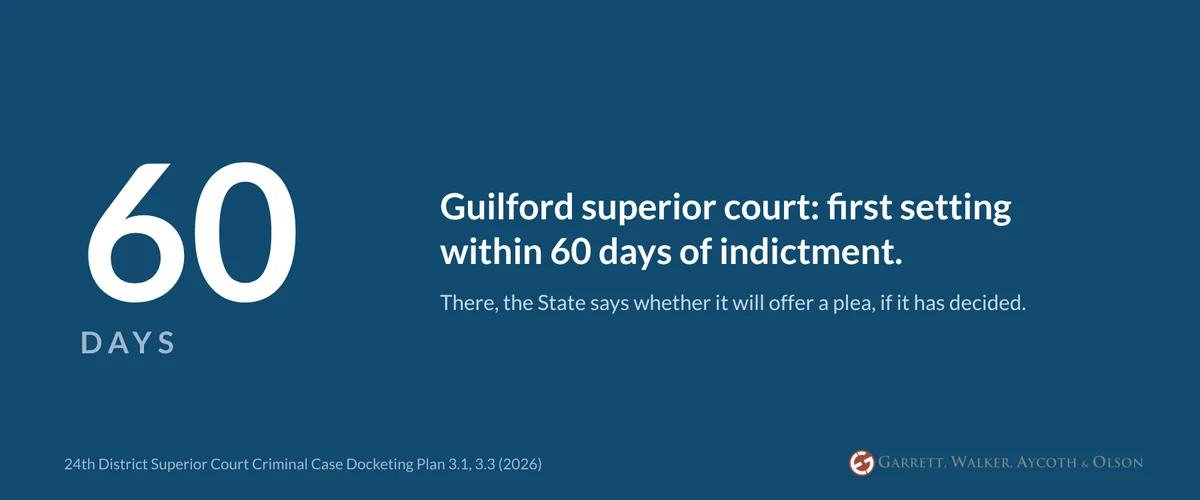
In Guilford superior court, every case is set for an Administrative Setting three to six weeks after indictment, and no later than 60 days. There, the State says whether it will offer a plea, if it has decided.
In Guilford superior court, the offer conversation starts within 60 days of indictment, so mitigation has to be ready before then.
Deadlines for discovery and motions are also set at that setting. Trial comes no sooner than 30 days after the final setting, unless both sides agree.
District court has its own pace for plea offers in misdemeanor cases. The schedule comes from Guilford County’s local court rules for criminal cases.
For a felony still in district court, the defense must answer a plea or deferral offer within 90 days. The prosecutor can set another time, or the lawyers can agree otherwise.
You must come to court in person to accept or reject a plea offer.
Indicted in Guilford County? Call (336) 379-0539 now so your mitigation is ready for the first setting.
When a Judge Can Reject a Plea Deal
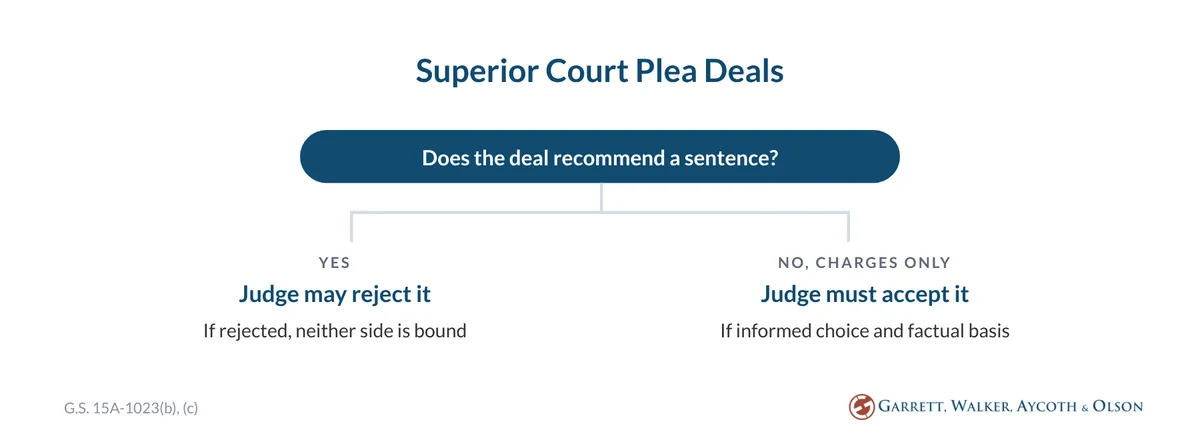
In superior court, G.S. 15A-1023 sets two rules. A judge may approve or reject a deal that includes a sentence recommendation.
A deal on charges only is different. The judge must accept it if the plea is your informed choice and there is a factual basis for it.
In superior court, whether a judge can refuse your deal depends on one thing: does it include a sentence recommendation?
If the judge rejects a sentence deal, the judge must tell you that neither you nor the State is bound. You are entitled to a continuance to the next session, and the judge must give reasons and a chance to modify the deal.
In State v. Chandler (2020), the NC Supreme Court held that a judge wrongly rejected a charge-only plea. As the UNC School of Government explains, the remedy was an order for the prosecutor to renew the offer.
If the judge decides to give a different sentence than the deal provides, you may withdraw your plea under G.S. 15A-1024. You are then entitled to a continuance.
Before accepting your plea, a superior court judge must tell you the maximum sentence and any mandatory minimum. G.S. 15A-1022(a) also requires a warning that non-citizens may face deportation.
Note: In district court, these sections do not apply. Your lawyer tells you how the judge in your courtroom handles an agreed sentence.
Outcomes Worth Negotiating For
A better deal is often about what is left on your record, not only the sentence. These are the main outcomes a lawyer can ask for, depending on the facts of your case.
| Outcome | What It Means | What It Takes |
|---|---|---|
| Dismissal of other charges | You plead to fewer offenses | The prosecutor agrees |
| Plea to a lesser offense | A lower class and a lower sentencing range | The prosecutor agrees |
| Deferred prosecution | Probation before any plea; charges dismissed when you finish | Motion by you and the prosecutor; Class H or I felony or a misdemeanor; court findings |
| Conditional discharge | Plea entered, probation before judgment is entered; dismissed when you finish | Joint motion; Class H or I felony or a misdemeanor; court findings |
| First drug offense discharge | Probation before judgment; dismissed when you finish | A qualifying first possession charge |
Deferred prosecution and conditional discharge come from G.S. 15A-1341. The court must find no prior felony or moral turpitude misdemeanor, no past probation, a low risk of reoffending, and notice to each known victim.
Completing deferred prosecution ends the charge for good under G.S. 15A-1342(i). Neither option is available for impaired driving.
Drug possession cases may fit the first-time drug offender program under G.S. 90-96.
Read what a felony reduced to a misdemeanor means for your record.
Questions to Ask Before You Accept
Ask your lawyer these questions before you say yes:
- What is the most I face if I go to trial instead?
- What record does this plea leave behind?
- Could I get deferred prosecution or a conditional discharge?
- Does the offer include a sentence recommendation the judge could reject?
- When does the offer expire?
- What happens to my license, my job or my immigration status?
Have an offer with a deadline? Call (336) 379-0539 to talk through your plea offer before it runs out.
Frequently Asked Questions
Can a judge reject a plea deal in NC?
In superior court, yes, if the deal includes a sentence recommendation. A deal on charges only must be accepted if the plea is informed and has a factual basis. In district court these rules do not apply, so ask your lawyer how your judge handles an agreed sentence.
Can I take back a guilty plea in NC?
In superior court, if the judge decides to give a different sentence than your plea deal provides, you may withdraw the plea and get a continuance. Other situations, and district court cases, depend on the facts. Talk to your lawyer before you plead, not after.
Do I have to be there when my lawyer negotiates a plea?
No, not in superior court. G.S. 15A-1021(a) says that if you are represented by counsel in plea discussions, you need not be present. You still decide whether to accept, and the judge generally must address you personally before accepting the plea.
Can what I say in plea talks be used against me?
In superior court, G.S. 15A-1025 bars using the fact of plea discussions or an arrangement as evidence against you, or for you, in any criminal or civil case. Even so, talk through your lawyer and not directly with officers or the prosecutor about the case.
What is a no contest plea in NC?
A no contest plea lets you resolve the charge without admitting guilt. In superior court, the judge still needs a factual basis for the plea. The judge must also tell you that you will be treated as guilty whether or not you admit it.
Does a plea deal mean I will have a record?
Usually a guilty or no contest plea leads to a conviction on your record. Deferred prosecution and conditional discharge are different: when you complete them, the case is dismissed. Whether you qualify depends on your record, the charge and the prosecutor’s agreement.
Should I take the first plea offer?
It depends on the evidence, your mitigation and what you face at trial. A first offer can sometimes improve once a lawyer has reviewed discovery and presented mitigation. No one can promise that, so weigh it with your lawyer before the deadline.
Will a plea deal affect my immigration status?
It can. If you are not a U.S. citizen, a guilty or no contest plea may lead to deportation, exclusion or denial of naturalization. A superior court judge must warn you of this. Get advice on your status before you enter any plea.
What is a conditional discharge in NC?
A conditional discharge lets you plead guilty while the court holds off on judgment and places you on probation. It needs a joint motion by you and the prosecutor. When you complete probation, the plea is withdrawn and the case is dismissed.
- Former President, Greensboro Criminal Defense Lawyers Association
- Elected member, Criminal Justice Section, North Carolina Bar Association
- Selected to present the Wade M. Smith Award for Top Criminal Defense Lawyer in North Carolina
Talk to a Greensboro criminal defense lawyer today
Bring the warrant, the release order and anything else they gave you.
Garrett, Walker, Aycoth & Olson, Attorneys at Law
317 South Greene St, Greensboro, NC 27401
(336) 379-0539
This article explains North Carolina law in general terms. It is not legal advice about your case, and laws, penalties and court procedures change. Contact an attorney about your specific situation.