



Embezzlement is both a crime and a civil wrong in North Carolina. Misusing money you were trusted with is a felony at any amount under G.S. 14-90, and the owner can also sue you for the loss, punitive damages and attorney fees under G.S. 1-538.2.
So is embezzlement criminal or civil? It is both, and paying the money back does not, by law, end either case.
If you are a bookkeeper, manager, treasurer or agent who just heard from HR or a detective, the lawyer you call now shapes both cases, depending on the facts of your case. Before any meeting, talk with an embezzlement defense lawyer in Greensboro.
Accused after an audit? Call (336) 379-0539 and talk with Jason Aycoth’s team before you talk to your employer or the police.
What Is Embezzlement?
Embezzlement is taking or misusing money or property that came to you lawfully through your job or a position of trust. Under G.S. 14-90(b), it covers anyone who embezzles, or knowingly and willfully misapplies, property placed in their care.
It reaches employees, agents, clerks, officers, trustees, executors and guardians, and anyone holding a public office or trust.
To convict, the State must prove three things. First, you held a position of trust, such as employee or agent.
Second, you received the property lawfully in that role. Third, you intentionally and fraudulently used it for some other purpose.
That first lawful possession is what separates embezzlement from ordinary theft. Intent is usually where the defense starts.
Lack of intent is one of the defenses that fit embezzlement charges, and it depends on your records.
Is Embezzlement a Criminal or Civil Crime?
Embezzlement is both a criminal offense and a civil wrong. The criminal case and the civil case are separate, and they can run at the same time.
Criminal Nature of Embezzlement
Under G.S. 14-90(b), embezzlement is a felony. The State prosecutes the case through the district attorney, not your employer.
Civil Actions for Embezzlement
Embezzlement is also a civil wrong, and the owner can sue you. G.S. 1-538.2(a) lets the owner recover the money lost, consequential damages, punitive damages and reasonable attorneys’ fees.
For embezzlement under G.S. 14-90, those consequential damages have no maximum. They can include the salary the employer paid staff to investigate and testify, under G.S. 1-538.2(c1)(1).
The statute also says the civil case does not wait for the criminal one:
“An action may be brought under this section regardless of whether a criminal action is brought or a criminal conviction is obtained for the act alleged in the civil action.” G.S. 1-538.2(c)
So the defense of both cases has to be planned together.
Comparing Criminal and Civil Procedures
The two cases differ in who brings them, what is at stake and the proof needed.
| Question | Criminal Case | Civil Case |
|---|---|---|
| Who Brings It | The State, through the district attorney | The owner: the employer, business or organization |
| What It Can Lead To | A felony conviction, a sentence under G.S. 15A-1340.17 and restitution | A money judgment: the loss, damages and attorneys’ fees (G.S. 1-538.2) |
| Proof Needed | Beyond a reasonable doubt | The greater weight of the evidence; punitive damages need clear and convincing evidence (G.S. 1D-15(b)) |
| Time Limit | No statute of limitations for felonies | Generally 3 years; for fraud, counted from discovery (G.S. 1-52(9)) |
| Can Both Happen? | Yes | Yes, whatever the criminal result (G.S. 1-538.2(c)) |
Because the civil case is separate under G.S. 1-538.2(c) and needs less proof, it can go forward and still be won after a dismissal or a not guilty verdict.
North Carolina’s Approach to Embezzlement: Felony Classes by Value
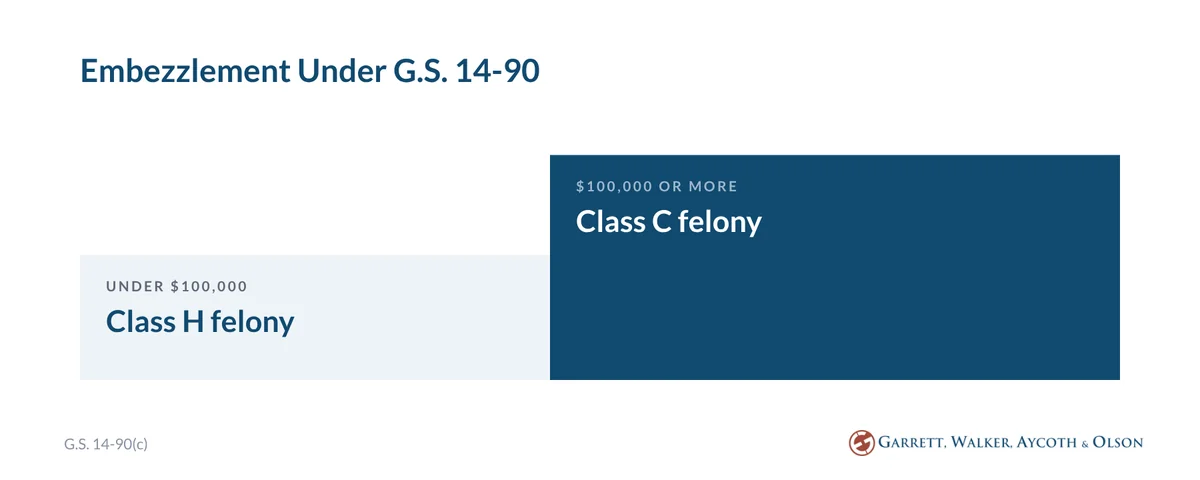
Every embezzlement under G.S. 14-90 is a felony, and the class depends on the value. That statute has no misdemeanor version, even for a small amount.
Under G.S. 14-90(c), $99,999 is a Class H felony and $100,000 is a Class C felony.
Public and charity money is treated more harshly below $100,000. It is a Class F felony for State property under G.S. 14-91, and for county, city, school board, church or charity money under G.S. 14-92.
At $100,000 or more, both statutes make it Class C. So a church or charity treasurer can be charged with a Class F felony, not Class H.
With no prior record (Level I), the grid in G.S. 15A-1340.17 authorizes community, intermediate or active punishment for Class H, with a presumptive minimum of 5 to 6 months. Class F authorizes intermediate or active punishment, with a presumptive minimum of 13 to 16 months.
Class C is active only, with a presumptive minimum of 58 to 73 months. Where your case lands on that grid, and which statute and value are charged, is argued by your lawyer, not assumed.
The State may also argue you took advantage of a position of trust, an aggravating factor in G.S. 15A-1340.16(d)(15). Whether that factor can apply when trust is already part of the charge is something your lawyer challenges.
Embezzlement sits next to other theft charges in Guilford County, and the class can change with the charge.
Talk to a defense lawyer before you talk to anyone else
What you say and sign in the first days often decides what is possible later. The earlier we see your paperwork, the more options you usually have.
Call (336) 379-0539Free consultation with a Greensboro attorneyWhat Happens During a Criminal Embezzlement Case?
A criminal embezzlement case often moves from an audit to a charge, then to Superior Court and sentencing.
The Audit and the Investigation
Many cases start with the employer’s own audit, then a report to the police. Anything you say during that audit can reach the detective, so call a lawyer before the interview.
The Charge and Your First Appearance
The charge may come as an arrest warrant or a criminal summons. If you are arrested, release conditions can include a secured bond.
If bond is set high, your lawyer can start by asking the court to lower your bond.
Indictment and Superior Court
A felony case goes forward in Superior Court on a grand jury indictment, unless you and your lawyer waive it. Here is how a felony indictment moves your case.
North Carolina has no statute of limitations for felonies, as the UNC School of Government explains.
Plea Talks, Trial and Sentencing
For a felony like embezzlement, the judge is required to order restitution under G.S. 15A-1340.34(b) and G.S. 15A-830. The amount looks at what you can pay, and it can be partial or in installments under G.S. 15A-1340.36.
How much, and on what schedule, is what your lawyer argues, depending on the facts of your case.
Already got a call from a detective or a letter from your employer’s lawyer? Call (336) 379-0539 before you answer either one.
How Civil Suits May Proceed
A civil embezzlement case starts when the owner files a lawsuit for money, often under G.S. 1-538.2.
The usual time limit is three years under G.S. 1-52. For a claim based on fraud, the clock starts only when the owner discovers the facts, under G.S. 1-52(9).
Statements, repayment promises and signed agreements in the civil case can affect the criminal case. Your criminal lawyer should see them before you sign.
Can Criminal and Civil Actions Happen Together?
Yes, criminal and civil embezzlement actions can happen together. G.S. 1-538.2(c) allows the civil suit whether or not there is a criminal case or a conviction.
So will you pay twice for the same money? Restitution paid in the criminal case is credited against a civil judgment the same victim wins for the same act (G.S. 15A-1340.37(a)).
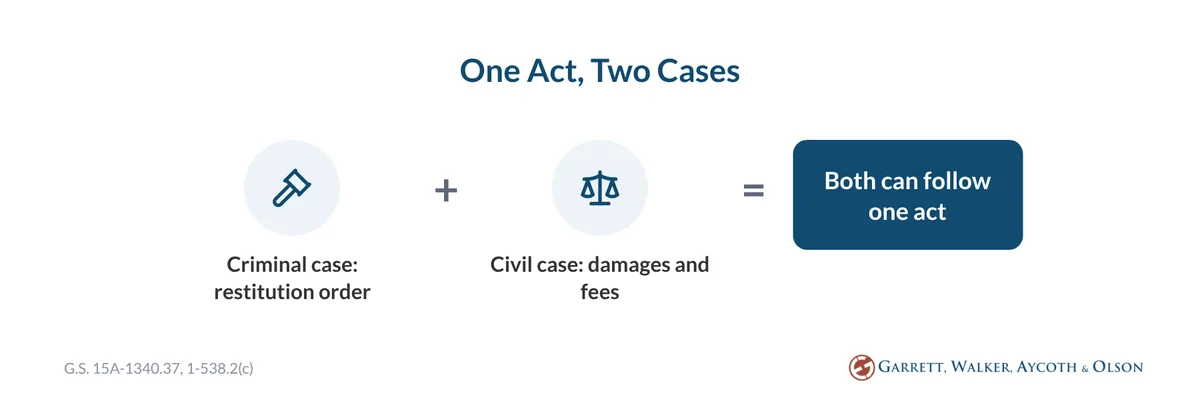
Restitution does not stop the civil suit either, under the same subsection.
A restitution order of more than $250 can also be docketed and collected like a civil judgment under G.S. 15A-1340.38(a), but collection waits while restitution is a condition of probation (G.S. 15A-1340.38(c)).
Important: Repayment is not a defense written into G.S. 14-90, so talk with your lawyer before you offer any.
Examples: Is Embezzlement a Criminal or Civil Crime?
A store bookkeeper: moving $8,000 of store money into a personal account can be charged as Class H embezzlement under G.S. 14-90. The store can also sue for the money under G.S. 1-538.2.
A church or charity treasurer: the same $8,000 taken from a church account can be charged under G.S. 14-92 as a Class F felony. The district attorney picks the statute.
Embezzlement vs Larceny by Employee and False Pretenses
The district attorney may choose a different charge. Larceny by employee under G.S. 14-74 fits goods an employer hands to an employee to keep, with the same $100,000 line between Class C and Class H.
Here is how larceny by employee charges work in North Carolina.
Obtaining property by false pretenses under G.S. 14-100 fits money obtained by a lie. Under G.S. 14-100(b), a broken contract alone does not prove intent to defraud.
Defending an obtaining property by false pretenses charge starts with that intent. All three charges can also lead to a civil suit under G.S. 1-538.2.
Is Embezzlement a Federal Crime?
Some cases are federal. A bank officer or employee who embezzles bank funds can face up to 30 years in prison, a fine of up to $1,000,000, or both, under 18 U.S.C. § 656.
If the amount is $1,000 or less, the limit is one year.
If federal agents are involved, learn what happens in a federal white collar investigation.
Why Immediate Legal Representation Matters
Early help matters because both cases are often built from the same audit. Our Greensboro criminal defense attorneys handle felony theft and fraud cases in Guilford County courts.
Say Nothing and Sign Nothing Until You Get Advice
Do not give a statement to HR, the employer’s lawyer or a detective, and do not sign a confession or repayment agreement first.
Keep Every Record
Do not delete or change files, emails or texts. Your lawyer uses them to show what was authorized pay, a reimbursement or a loan.
Make the State Prove the Amount and the Statute
The $100,000 line decides Class H or Class C, and the statute chosen can make it Class F. Your lawyer tests the numbers and whether each payment was really unauthorized.
Plan the Criminal and Civil Cases Together
A Class H conviction can qualify as one nonviolent felony for expunction 10 years after the conviction or after the sentence and probation end, whichever is later, under G.S. 15A-145.5.
Class C and Class F convictions are excluded. We also help with clearing an old felony from your record once the wait is over.
Facing an embezzlement accusation at work? Call (336) 379-0539 to talk with our embezzlement defense team in Greensboro before the case is charged or the first court date.
Frequently Asked Questions
Can you go to jail for embezzlement in NC?
Yes. Embezzlement is a felony, and at Level I the grid in G.S. 15A-1340.17 authorizes community, intermediate or active punishment for Class H. Class C is active only, with a presumptive minimum of 58 to 73 months at Level I. Which applies to you is argued by your lawyer.
How much money is considered embezzlement in North Carolina?
Any amount. Under G.S. 14-90, every embezzlement is a felony: Class H below $100,000 and Class C at $100,000 or more. Public or charity money under G.S. 14-91 or 14-92 is Class F below $100,000. Your lawyer can test the value charged.
If I pay the money back, will the charges be dropped?
Not automatically. Repayment is not a defense written into G.S. 14-90, and for a felony the judge must order restitution at sentencing under G.S. 15A-1340.34(b). Your lawyer can raise repayment with the prosecutor, depending on the facts of your case.
Can my employer sue me and press charges at the same time?
Yes. G.S. 1-538.2(c) allows the civil suit whether or not a criminal case is brought or ends in a conviction. Your employer can report the case, but the district attorney decides the criminal charge.
How long does the State have to charge embezzlement?
No time limit applies to felonies in North Carolina, so an old audit can still lead to a charge. The civil suit generally has three years under G.S. 1-52, counted from discovery for fraud.
Is embezzlement a federal crime?
It can be. A bank officer or employee accused of embezzling bank funds can be charged under 18 U.S.C. § 656, with up to 30 years in prison. G.S. 14-90 covers embezzlement by any employee or agent in North Carolina, so most questions start with state law.
Is misappropriation of funds the same as embezzlement?
It can be. G.S. 14-90 covers knowingly and willfully misapplying money or property you were trusted with. So misappropriation by an employee, agent or fiduciary can be charged as felony embezzlement.
Can an embezzlement conviction be expunged in NC?
Sometimes. A Class H conviction can qualify as one nonviolent felony, 10 years after the conviction or after the sentence and probation end, whichever is later. Class C and Class F convictions are excluded under G.S. 15A-145.5.
What should I do if I am accused of embezzlement at work?
Talk with a lawyer before any HR or police interview, and keep every record. Call (336) 379-0539 so a lawyer can step in before the interview or the first court date.
- Former President, Greensboro Criminal Defense Lawyers Association
- Elected member, Criminal Justice Section, North Carolina Bar Association
- Selected to present the Wade M. Smith Award for Top Criminal Defense Lawyer in North Carolina
Talk to a Greensboro criminal defense lawyer today
Bring the warrant, the release order and anything else they gave you.
Garrett, Walker, Aycoth & Olson, Attorneys at Law
317 South Greene St, Greensboro, NC 27401
(336) 379-0539
This article explains North Carolina law in general terms. It is not legal advice about your case, and laws, penalties and court procedures change. Contact an attorney about your specific situation.