



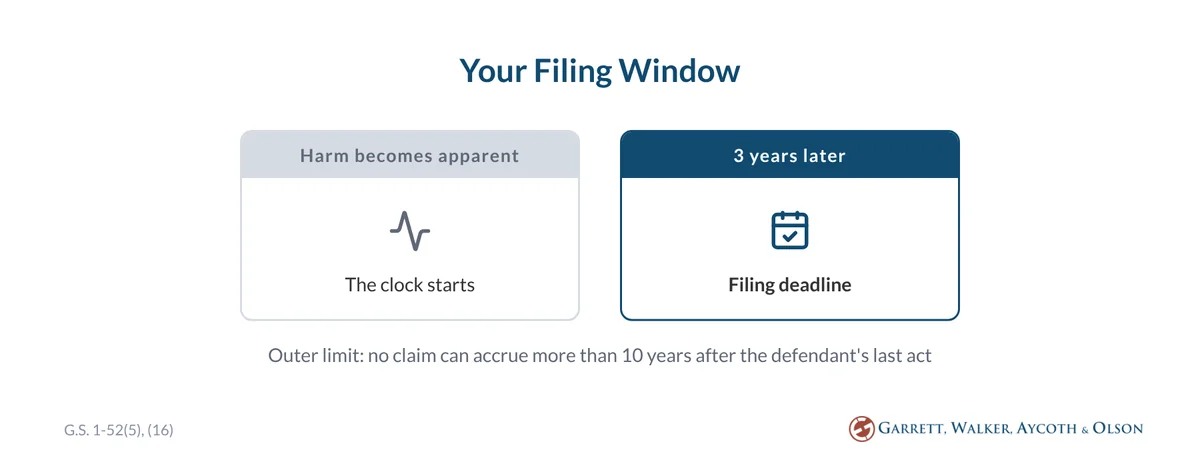
In North Carolina, most personal injury lawsuits must be filed within three years, counted from when the injury became apparent or reasonably should have. Wrongful death claims have two years from the date of death.
The North Carolina statute of limitations for personal injury applies to anyone hurt in a crash or fall in Greensboro or elsewhere in the state. Families who lost someone face a shorter deadline.
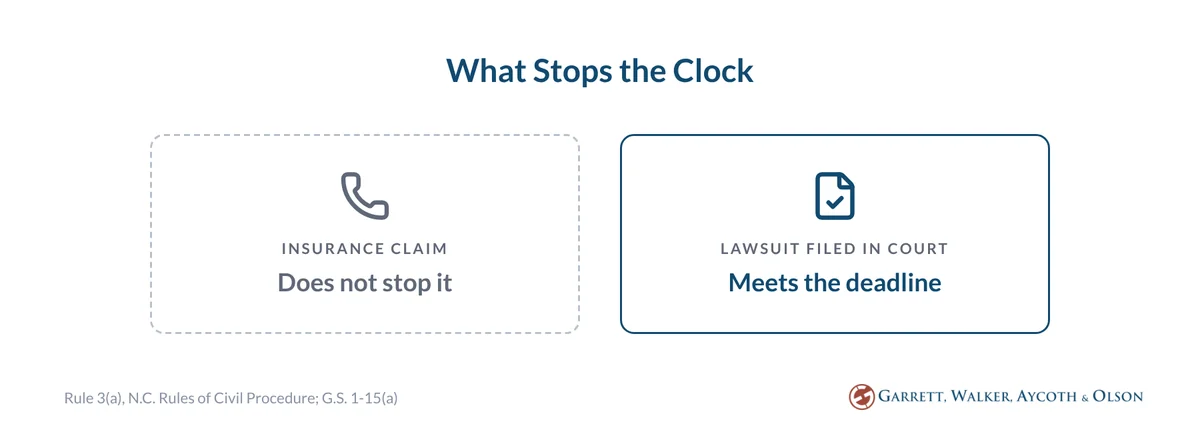
Many people think an insurance claim stops the clock. It does not, because only a lawsuit filed with the court meets the deadline.
A Greensboro personal injury lawyer can calculate your exact date and file before it passes.
Not sure how much time you have left? Call (336) 379-0539 and we will check your date with you.
What Is the Statute of Limitations for Personal Injury in NC?
The statute of limitations is the time limit to start a lawsuit. Under G.S. 1-15(a), civil actions “can only be commenced within the periods prescribed” in Chapter 1, after the claim accrues.
For injuries, the main period is three years. G.S. 1-52(5) sets three years for “any other injury to the person or rights of another, not arising on contract.”
The same three years covers assault and battery under G.S. 1-52(19), and damage to your car under G.S. 1-52(4). The start date comes from G.S. 1-52(16).
“…shall not accrue until bodily harm to the claimant or physical damage to his property becomes apparent or ought reasonably to have become apparent to the claimant, whichever event first occurs.” G.S. 1-52(16)
In plain words, the clock starts when you knew, or should have known, that you were hurt.
When the Three-Year Clock Starts
For most crashes and falls, the clock starts on the day of the injury, because that is when the harm becomes apparent. If harm from a hidden defect shows up later, the clock waits until then.
There is also an outer limit. Under G.S. 1-52(16), a claim cannot accrue more than 10 years after the defendant’s last act or omission, with limited exceptions, such as childhood sexual abuse claims.
For example, if your injury became apparent in October 2026, the three-year deadline generally falls in October 2029.
Your lawyer calculates the exact last day from your records, so do not count it alone.
North Carolina Personal Injury Deadlines by Type of Claim
Most injury claims have three years, but several common claims do not.
| Type of Claim | Deadline | When the Clock Starts | Statute |
|---|---|---|---|
| Personal injury (car, truck, slip and fall, dog bite) | 3 years | When harm becomes apparent; a claim cannot accrue more than 10 years after the last act | G.S. 1-52(5), (16) |
| Assault, battery or false imprisonment | 3 years | When the claim accrues | G.S. 1-52(19) |
| Wrongful death | 2 years | Date of death | G.S. 1-53(4) |
| Medical malpractice | 3 years from the last act; if found 2+ years later, 1 year from discovery; never more than 4 years (foreign object: 10) | Last act of the defendant | G.S. 1-15(c), 1-52(5) |
| Defective product | 3 years, and no action more than 12 years after initial purchase | When harm becomes apparent; purchase date for the 12 years | G.S. 1-52(16), 1-46.1(1) |
| Childhood sexual abuse | Until age 28, or 2 years after a related felony conviction | Abuse suffered before age 18 | G.S. 1-17(d), (e) |
| Libel or slander | 1 year | When the claim accrues | G.S. 1-54(3) |
| Claim against a State agency | 3 years, filed with the Industrial Commission (2 years for a death) | When the claim accrues, or the date of death | G.S. 143-299 |
Crash claims follow the three-year rule, so learn what to do after a Greensboro car crash. The same three years applies to claims after a commercial truck crash.
Falls and other injuries on someone else’s property follow the same rule.
Wrongful Death: A Shorter Timeline
A wrongful death lawsuit in North Carolina must be filed within two years. Under G.S. 1-53(4), the claim “shall not accrue until the date of death.”
The case is brought by the personal representative or collector of the estate, under G.S. 28A-18-2(a).
There is also a hidden bar. If the person would have been barred from suing for the injury had they lived, because of G.S. 1-15(c) or 1-52(16), no death claim may be brought.
If the injured person dies before the injury deadline, the personal representative can still file after the deadline passes, as long as it is within one year of the death under G.S. 1-22.
Grieving families should learn early how a wrongful death claim is handled.
Talk to an attorney about your situation
A short call is often enough to understand your options.
Call (336) 379-0539Free consultation with a Greensboro attorneyMedical Malpractice and the Statute of Repose
Medical malpractice claims start from the last act of the doctor or other professional. G.S. 1-15(c) says the claim accrues “at the time of the occurrence of the last act of the defendant.”
The normal period is three years from that last act. If the harm is found two or more years later, you have one year from discovery, but never more than four years from the last act.
Say surgery was on January 1, 2026, and the harm was found June 1, 2027. That is under two years, so the three years runs to January 1, 2029.
If the harm was found March 1, 2029, one year from discovery is March 1, 2030. The four-year cap ends the time sooner, on January 1, 2030.
For a foreign object left in the body, you get the normal three years or one year after discovery, whichever is later. The action can never start more than 10 years after the last act.
What Is a Statute of Repose?
A statute of repose is an outer cap that runs no matter when you learn of the harm. The four-year malpractice cap is one.
Another is G.S. 1-46.1(1): no product defect claim “shall be brought more than 12 years after the date of initial purchase for use or consumption.”
G.S. 1-52(16) adds its own outer limit: a claim cannot accrue more than 10 years after the last act. Which date controls in your case is a legal question your lawyer answers from the records.
Special Cases: Minors, Incompetence and Other Tolling Rules
Tolling means the clock pauses or waits to start.
Minors and People Under a Legal Disability
Under G.S. 1-17(a), a person who is under 18, insane or incompetent when the claim accrues may sue within the normal period after the disability is removed.
So a teen hurt at 15 generally has three years after turning 18, until age 21.
Medical malpractice works differently for children. The normal G.S. 1-15(c) limits apply, but if they run out before age 10, the claim can still be brought before the child turns 10 under G.S. 1-17(c).
Other professional malpractice uses age 19 under G.S. 1-17(b). Have a lawyer check which rule applies.
When the Person at Fault Leaves or Dies
If the person who hurt you moves out of state, or stays away for a year or more, the time away may not count under G.S. 1-21. That pause does not apply when a North Carolina court can still reach the person.
If the at-fault person dies before the deadline, the claim may be brought against the estate’s personal representative under G.S. 1-22. The lawsuit must be filed, or the claim presented to the estate, within the time set for estate claims, so act quickly.
What Happens if the Deadline Passes and How to Protect It
If the deadline passes, the claim is generally barred. G.S. 1-15(a) allows civil actions only within the periods the law sets.
Talking with an insurance adjuster does not stop the clock. Under Rule 3(a) of the North Carolina Rules of Civil Procedure, “A civil action is commenced by filing a complaint with the court.”
If a case filed on time is voluntarily dismissed without prejudice, it can usually be refiled within one year under Rule 41(a)(1).
Warning: Evidence and witnesses fade long before the deadline. Call (336) 379-0539 so the claim is investigated while it is fresh.
Getting the Timing Right With a Personal Injury Lawyer
A personal injury lawyer finds the right deadline for your claim and files before it passes. Your lawyer also checks whether a State agency, an out-of-state driver or a death changes the timeline.
Your lawyer also reviews what UM and UIM coverage can add when the at-fault driver has little or no coverage.
Brian Walker, who leads our injury practice, handles personal injury cases for the firm. What can be recovered depends on the facts of your case and the evidence gathered early.
If your date is close, talk with our personal injury team this week. Call (336) 379-0539 to have your deadline checked.
Frequently Asked Questions
How long do I have to file a personal injury lawsuit in NC?
Most people have three years to file a personal injury lawsuit in North Carolina, under G.S. 1-52(5). The clock usually starts when the injury becomes apparent, and wrongful death claims have two years. A lawyer can confirm the exact last day for your claim.
What is the deadline for a car or truck accident claim in NC?
An injury claim from a car or truck crash generally has three years under G.S. 1-52. If a State vehicle was involved, the claim goes to the Industrial Commission. Ask a lawyer early, because crash evidence fades.
What does tolling the statute of limitations mean?
Tolling means the deadline pauses or waits to start. In North Carolina, it can apply when the injured person is under 18 or incompetent, or when the at-fault person leaves the state. The rules have conditions, so have a lawyer confirm them.
Does talking to the insurance company stop the clock?
No. Calls, letters and claim numbers with an insurer do not stop the statute of limitations. Only filing a complaint with the court starts a lawsuit. If talks drag on near your deadline, a lawyer can file the case to protect your claim.
What if the person who caused the crash has died?
You may still have a claim against the at-fault person’s estate. The action is brought against the estate’s personal representative. The lawsuit must be filed, or the claim presented to the estate, within the time set for estate claims. Those steps move quickly, so talk with a lawyer soon.
Is there a deadline for claims against a State agency in NC?
Yes. Claims against State departments, institutions and agencies must be filed with the Industrial Commission within three years after the claim accrues, under G.S. 143-299. If the accident caused a death, the personal representative has two years. City and county claims may follow different rules.
Can a case be refiled after it is dismissed?
Sometimes. If a case filed on time is voluntarily dismissed without prejudice, Rule 41(a)(1) allows a new case on the same claim within one year. A filed agreement between the parties can set a shorter time. Take that step only on a lawyer’s advice.
What is the statute of repose in North Carolina?
A statute of repose is an outer cap that applies even if you did not know about the harm. Examples are the four-year malpractice cap in G.S. 1-15(c) and the 12-year product rule in G.S. 1-46.1. A lawyer can tell you whether one applies to your claim.
Talk to our team today
Tell us where things stand and we will explain the next steps.
Garrett, Walker, Aycoth & Olson, Attorneys at Law
317 South Greene St, Greensboro, NC 27401
(336) 379-0539
This article explains North Carolina law in general terms. It is not legal advice about your case, and laws, penalties and court procedures change. Contact an attorney about your specific situation.