


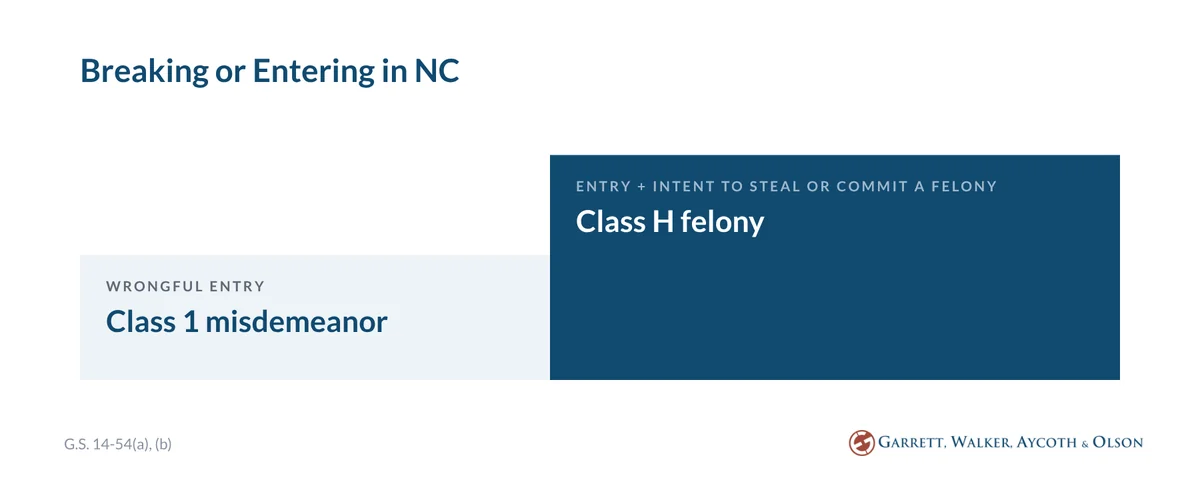
In North Carolina, breaking or entering a building with intent to steal or commit a felony inside is a Class H felony under G.S. 14-54(a); doing it without that intent is a Class 1 misdemeanor under G.S. 14-54(b).
You do not have to both break and enter; either one is enough. For offenses on or after December 1, 2025, a gun can raise the class and a home entry may be charged as burglary.
This guide is for adults charged in Greensboro, High Point or anywhere in Guilford County, and for their families.
Intent is the line between a misdemeanor and a felony, and intent is argued, depending on the facts of your case. That is why it helps to have a Greensboro theft and property crime lawyer test the intent evidence early.
Charged with breaking and entering? Call (336) 379-0539 before your first court date.
Breaking and Entering in North Carolina: What G.S. 14-54 Covers
G.S. 14-54 makes it a crime to break or enter any building. The misdemeanor covers anyone who “wrongfully breaks or enters,” and what the State says you intended inside decides the felony.
The statute defines “building” broadly in G.S. 14-54(c). It includes:
- Any dwelling or dwelling house
- An uninhabited house or a building under construction
- A building within the curtilage of a home, such as a detached garage or shed
- Any other structure designed to house or secure an activity or property
“Any person who breaks or enters any building with intent to commit any felony or larceny therein shall be punished as a Class H felon.” G.S. 14-54(a)
Cars, trailers and boats fall under a different statute, G.S. 14-56.
Is Breaking and Entering a Felony or a Misdemeanor in NC?
It is a Class H felony when the State proves you broke or entered “with intent to commit any felony or larceny therein.” It is a Class 1 misdemeanor when it can only prove a wrongful entry.
Breaking or entering with intent to terrorize or injure someone inside is also a Class H felony under G.S. 14-54(a1).
A newer crime covers unlawful business entry, for offenses on or after December 1, 2025. It applies to entering a staff-only area where money or property is kept, or a posted no-entry area, intending an unlawful act.
That business-entry offense is a Class 1 misdemeanor for a first offense and a Class I felony for a second, under G.S. 14-54(b1).
Breaking or entering a place of religious worship with intent to commit a felony or larceny is a Class G felony under G.S. 14-54.1.
Your lawyer tests the intent evidence, depending on the facts of your case.
Penalties for Breaking and Entering in NC
Felony breaking and entering is sentenced as a Class H felony. The presumptive minimum runs from 5-6 months with no prior record to 16-20 months at the highest level, under G.S. 15A-1340.17(c).
| Prior Record Level | Presumptive Minimum (Class H) | Disposition |
|---|---|---|
| Level I | 5-6 months | Community, intermediate or active |
| Level II | 6-8 months | Intermediate or active |
| Level III | 8-10 months | Intermediate or active |
| Level IV | 9-11 months | Intermediate or active |
| Level V | 12-15 months | Intermediate or active |
| Level VI | 16-20 months | Active |
Note: A 6-month minimum carries a 17-month maximum. The highest Class H minimum, 25 months at aggravated Level VI, carries a 39-month maximum under G.S. 15A-1340.17(d).
Misdemeanor breaking and entering is a Class 1 misdemeanor. With no prior convictions, G.S. 15A-1340.23(c) authorizes 1-45 days of community punishment.
With 1 to 4 priors, it is 1-45 days of community, intermediate or active punishment. With 5 or more priors, it is 1-120 days.
At any level, the fine for a Class 1 misdemeanor is in the court’s discretion under G.S. 15A-1340.23(b).
Where the grid calls for community or intermediate punishment, G.S. 15A-1340.20(c) requires the court to suspend the sentence. The exception is time already served on the charge, under G.S. 15A-1340.20(c1).
For the full chart, see how Class H felonies are sentenced. Which level applies is argued by your lawyer, not assumed.
When a Gun Is Involved
For offenses on or after December 1, 2025, G.S. 14-54(b2) raises the sentence one class if you had a firearm about your person. The indictment must allege the facts for that increase.
The UNC School of Government summary of the 2025 gun law changes says felony breaking and entering goes from Class H to Class G with a gun. Misdemeanor breaking and entering goes from Class 1 to Class A1.
Larceny, Restitution and Repeat Charges
Taking something inside adds its own charge. Larceny after breaking or entering is a felony at any value under G.S. 14-72(b)(2); see how larceny charges work in NC.
Felony breaking and entering is a “felony property crime” under G.S. 15A-830(a)(3b). For those crimes, G.S. 15A-1340.34(b) requires the court to order restitution to the victim.
A second felony breaking and entering, committed after a first felony conviction for it, can be charged as habitual breaking and entering under G.S. 14-7.26. It is sentenced as a Class E felony.
That sentence runs after any sentence you are already serving, under G.S. 14-7.31(b). The prior must be a felony listed in G.S. 14-7.25, so a misdemeanor under 14-54(b) does not count.
Felony breaking and entering offenses committed before age 18 count as only one.
Warning: A second felony breaking and entering after a first felony conviction can be charged as habitual breaking and entering. Call (336) 379-0539 now.
Talk to a defense lawyer before you talk to anyone else
What you say and sign in the first days often decides what is possible later. The earlier we see your paperwork, the more options you usually have.
Call (336) 379-0539Free consultation with a Greensboro attorneyCan a Breaking and Entering Lawyer Help Me?
Yes. The class, the plea and the record all turn on facts a lawyer tests: what the State can prove about intent, whether the entry was wrongful, and how the evidence was gathered.
Deferred prosecution and conditional discharge exist for Class H felonies and misdemeanors under G.S. 15A-1341(a1) and (a4). Both need a motion the prosecutor joins, and any known victim must be notified and given a chance to be heard.
Felony cases belong to Superior Court under G.S. 7A-271(a). With consent from both sides, and if the statute’s conditions are met, a District Court judge can accept a plea to a Class H felony under G.S. 7A-272(c).
Here is how we defend felony charges in Guilford County.
Breaking and Entering vs. Burglary and Trespass
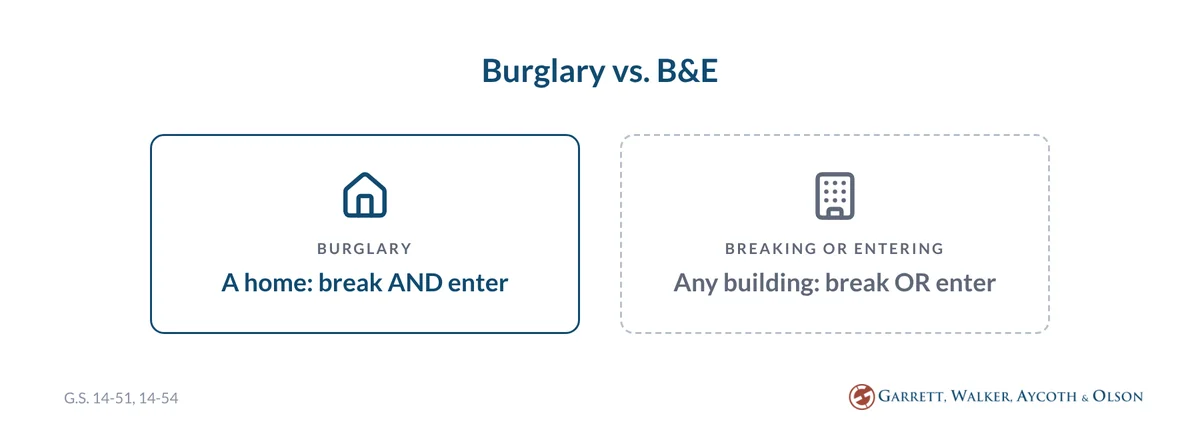
Burglary needs a breaking and an entry into a home or sleeping room of another, with intent to commit a felony or larceny, under G.S. 14-51. Breaking and entering covers any building and needs only one of the two.
First-degree burglary, with someone inside, is a Class D felony. Second-degree burglary, with no one inside, is a Class G felony under G.S. 14-52.
For offenses on or after December 1, 2025, burglary no longer requires that it happen at night, under Session Law 2025-71, section 10.
The UNC School of Government reads the nighttime element as removed. Its analysis of the nighttime change says home breaking and entering cases “probably will be eligible to be charged as burglaries.”
That makes the charging decision matter more, and your lawyer watches it closely.
If force against a person is alleged, read how burglary differs from robbery.
Without proof of intent, the State may charge misdemeanor breaking and entering (Class 1) or first-degree trespass (Class 2, G.S. 14-159.12). Which one is charged matters, and your lawyer can argue for the lesser charge.
Second-degree trespass, after notice or posted signs, is a Class 3 misdemeanor under G.S. 14-159.13. Learn how trespass charges work in Greensboro.
How to Defend Against Breaking and Entering Charges
Most defenses attack intent, the wrongful entry itself, or identity.
Available Legal Defenses
- No intent to steal or commit a felony inside, which turns a felony question into a misdemeanor one
- Whether the entry was wrongful at all, for example if you had a right to be there
- Identity: video, witnesses and alibi
- How the evidence was collected and whether any search was lawful
Can Breaking and Entering Charges Be Dropped?
A prosecutor can dismiss them, and a deferral is possible by statute, but neither is automatic. Your lawyer makes the case for either one, depending on the facts.
Can a Breaking and Entering Conviction Be Expunged?
A dismissed charge can be expunged under G.S. 15A-146. A felony conviction under G.S. 14-54(a) has a 15-year wait under G.S. 15A-145.5(c)(2).
Intent to terrorize or injure under 14-54(a1) is not eligible as a “nonviolent” offense under G.S. 15A-145.5(a)(7a). Worship breaking and entering is a Class G felony, which is also not eligible under (a)(1).
A gun enhancement may also affect eligibility; your lawyer checks this. One misdemeanor breaking and entering conviction has a 3-year wait under G.S. 15A-145.5(c)(1).
The gap between a misdemeanor and a felony result is years on your record. Ask early about how a North Carolina expunction works, because the waits are long.
Before your first court date, talk with our theft defense team. Our Greensboro criminal defense attorneys handle these cases in Guilford County courts.
Video and witness memories fade. Call (336) 379-0539 today.
Frequently Asked Questions
What class felony is breaking and entering in NC?
Felony breaking and entering under G.S. 14-54(a) or (a1) is a Class H felony. For offenses on or after December 1, 2025, having a gun about your person raises it to Class G. Breaking or entering a place of worship with intent is a Class G felony under G.S. 14-54.1.
How many years can you get for breaking and entering in NC?
It depends on your prior record. A Class H minimum runs from 5-6 months at Level I to 16-20 months at Level VI. The longest aggravated minimum is 25 months, with a 39-month maximum. Your lawyer argues the level and the punishment that apply.
Is breaking into a house a felony in NC?
It is a Class H felony if the State proves you meant to steal or commit a felony inside. For offenses on or after December 1, 2025, a home entry may also be charged as burglary, which carries a higher class. Without that intent, it is a Class 1 misdemeanor.
Do you have to break something to be charged?
No. G.S. 14-54 uses the words “breaks or enters,” so either one can be enough. An entry alone, with the required intent, can support the felony charge. Burglary is different: it needs both a breaking and an entry into a home.
What is breaking and entering with intent to terrorize?
It is breaking or entering a building with intent to terrorize or injure someone inside, a Class H felony under G.S. 14-54(a1). A conviction under that subsection is not eligible for the nonviolent felony expunction under G.S. 15A-145.5, so the record impact is serious.
Is breaking into a car breaking and entering?
It is a different crime. Breaking or entering a motor vehicle, trailer or boat falls under G.S. 14-56. The default is a Class I felony under G.S. 14-56(a2)(5), and the class rises with the value taken. Your lawyer checks which subsection is charged.
What is the difference between breaking and entering and trespassing?
First-degree trespass is entering or staying in a building of another without authorization, a Class 2 misdemeanor. Breaking and entering covers a wrongful breaking or entry, and with intent to steal or commit a felony inside, it is a Class H felony. Your lawyer can argue which charge fits.
Can I be charged with both breaking and entering and larceny?
Yes. Larceny committed after breaking or entering is a felony no matter the value of the property, under G.S. 14-72(b)(2). It is a Class H felony, charged in addition to the breaking and entering. Your lawyer looks at both charges together.
Will I have to pay the victim back?
For felony breaking and entering, yes. The court must order restitution to the victim under G.S. 15A-1340.34(b), because it is a felony property crime. For misdemeanor breaking and entering, the court may order restitution but is not required to. Your lawyer can address the amount claimed.
- Former President, Greensboro Criminal Defense Lawyers Association
- Elected member, Criminal Justice Section, North Carolina Bar Association
- Selected to present the Wade M. Smith Award for Top Criminal Defense Lawyer in North Carolina
Talk to a Greensboro criminal defense lawyer today
Bring the warrant, the release order and anything else they gave you.
Garrett, Walker, Aycoth & Olson, Attorneys at Law
317 South Greene St, Greensboro, NC 27401
(336) 379-0539
This article explains North Carolina law in general terms. It is not legal advice about your case, and laws, penalties and court procedures change. Contact an attorney about your specific situation.