


You get a limited driving privilege in North Carolina from a judge, and after a DWI the route depends on where your case stands. Since December 2024, one prior DWI in seven years no longer rules you out if your alcohol level was under 0.15, but an interlock is required.
This guide is for Greensboro and Guilford County drivers whose license was taken after a DWI. People also call it a limited license, restricted license, hardship license or work permit.
Your sentencing level often decides whether you are eligible, and that level is argued by your lawyer. See how our Greensboro DWI lawyers protect your license.
Need to drive to work after a DWI? Call (336) 379-0539 today so the paperwork is ready by your court date.
What Is a Limited Driving Privilege in North Carolina?
A limited driving privilege is a court order that lets a person with a revoked license drive only for essential purposes. It is not your full license back.
The definition is in G.S. 20-179.3(a):
“A limited driving privilege is a judgment issued in the discretion of a court for good cause shown authorizing a person with a revoked driver’s license to drive for essential purposes…” (G.S. 20-179.3(a))
The essential purposes are work, household upkeep, school, court-ordered treatment or assessment, probation community service, emergency medical care and religious worship. Any other driving is unlawful, even inside the hours the order allows.
Separate privileges exist for excessive speeding under G.S. 20-16.1 and for some non-DWI revocations under G.S. 20-20.1. This guide covers only DWI-related revocations.
Which Limited Driving Privilege Fits Your Situation?
After a DWI there are four routes to a limited driving privilege, and each one covers only its own revocation.
The pretrial privilege comes from G.S. 20-16.5(p), and the refusal privilege from G.S. 20-16.2(e1).
| Your Situation | Privilege | Earliest You Can Apply | Statute |
|---|---|---|---|
| Charged, license taken for 30 days | Pretrial privilege | After 10 days (after 30 days if the revocation is 45 days) | G.S. 20-16.5(p) |
| Convicted, no impaired driving conviction in the prior 7 years, Level Three, Four or Five | Post-conviction privilege | When judgment is entered | G.S. 20-179.3(b)(1), (c) |
| Convicted, one prior in 7 years, under 0.15, Level Three to Five or Level Two based only on the prior | Interlock privilege (since Dec 1, 2024) | When judgment is entered | G.S. 20-179.3(b)(3), (g5) |
| Refused the chemical test | Refusal privilege | After 6 months of the 12-month revocation, once the charge is resolved | G.S. 20-16.2(e1) |
A pretrial privilege ends with the civil revocation. It does not carry over after a conviction, so you apply again at judgment.
Who Qualifies for a Limited Driving Privilege?
Every DWI privilege needs a valid license at the time (or one expired less than a year), no new impaired driving charge, and a substance abuse assessment.
No DWI conviction in the past seven years (the first path)
This path covers a first DWI and a prior conviction older than seven years. G.S. 20-179.3(b)(1) adds no impaired driving conviction in the seven years before, and Punishment Level Three, Four or Five.
The assessment must be the type G.S. 20-17.6 requires, filed with the court.
Key point: The level decides eligibility, so the sentencing hearing matters most. That level is argued by your lawyer, not assumed.
With one prior DWI in seven years (the second path, since December 2024)
Since December 1, 2024, G.S. 20-179.3(b)(3) allows a privilege with one prior impaired driving conviction in seven years. The UNC School of Government summary of the 2024 changes explains Session Law 2024-43.
Your alcohol concentration must have been under 0.15. The level must be Three to Five, or Level Two only because of the prior under G.S. 20-179(c)(1).
A privilege on this path must require an ignition interlock.
Alcohol level 0.14: the (b)(3) path is open. 0.15: it is closed.
Prior conviction 6 years 11 months before the new offense: (b)(3) only. 7 years 1 month: (b)(1).
If this is your second DWI, see what a second DWI offense can bring.
While your DWI is still pending
A pretrial privilege under G.S. 20-16.5(p) covers only the civil revocation, usually 30 or 45 days. You must also have no other pending impaired driving charge and register for any recommended treatment.
Learn what the magistrate’s 30-day revocation means. If you gave blood, see when a blood result triggers the revocation, since that order may come by mail.
After refusing a breath or blood test
A refusal brings a 12-month revocation, and G.S. 20-16.2(e1) allows a privilege after at least six months. You need no impaired driving conviction or willful refusal in the seven years before.
The DWI charge must be finished, either without a conviction or with one at a level that allows a privilege and one probation condition met. Any recommended treatment must also be completed.
Warning: No refusal privilege may be issued if the case involved death or critical injury to another person.
How to Get a Limited Driving Privilege in NC: Documents and Steps
Come to court with a substance abuse assessment, an insurance certificate, proof of any weekend work or work outside 6 a.m. to 8 p.m., and be ready to pay the $100 fee.
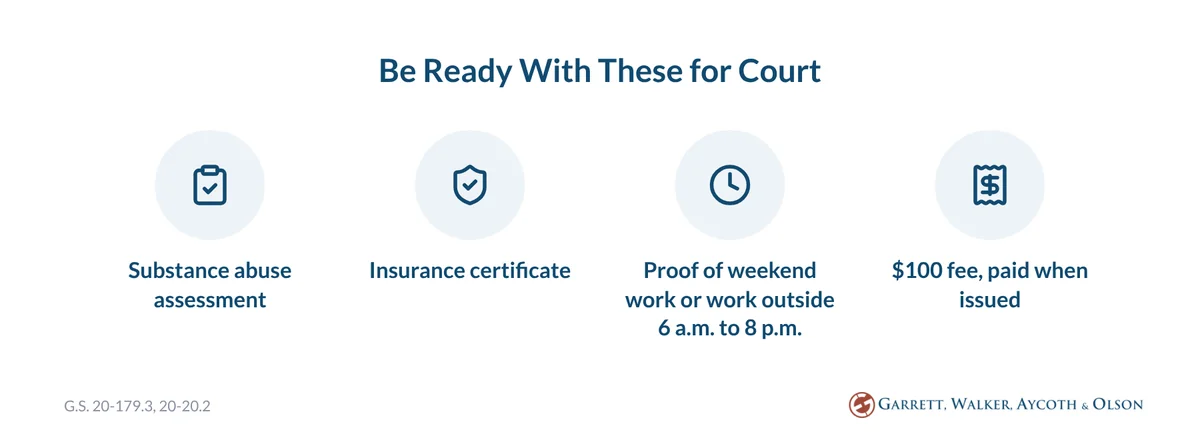
The assessment must be the type G.S. 20-17.6 requires, and it must be filed with the court.
Your insurance company’s certificate stays valid for 30 days from its issue date. If you own no registered vehicle, you sign a DMV certificate instead.
Work outside standard hours needs documentation before the judge can allow it. If you are self-employed, that documentation is attached to the privilege.
The $100 processing fee under G.S. 20-20.2 is paid to the clerk when the privilege is issued. If it is not paid, the privilege is invalid.
You may ask for the privilege at sentencing, when judgment is entered, so have the documents ready that day. Later, the application is filed with the clerk, who sends a copy to the district attorney.
The law sends it to the judge who heard your case if that judge is available in the district, otherwise to the chief district court judge (G.S. 20-179.3(d)).
A judge decides. Your lawyer makes sure nothing is missing on the day.
Talk to a DWI and traffic lawyer before your court date
Deadlines in traffic and DWI cases run from the day of the charge. The earlier we see your paperwork, the more options you usually have.
Call (336) 379-0539Free consultation with a Greensboro attorneyWhich Court Forms Are Used for a Limited Driving Privilege in NC?
The court uses official AOC forms, and the right one depends on which privilege you are asking for. The titles below come from the North Carolina Judicial Branch forms pages.
| Form | What It Is | Used For |
|---|---|---|
| AOC-CVR-9 | Petition | Pretrial privilege (civil revocation) |
| AOC-CVR-10 | Privilege order | Pretrial 30-day revocation |
| AOC-CVR-11 | Privilege order | Indefinite pretrial revocation |
| AOC-CR-312 | Privilege order | After a NC impaired driving conviction |
| AOC-CR-340 | Interlock privilege order | After a NC impaired driving conviction, with interlock |
| AOC-CR-313A | Privilege order | Willful refusal revocation |
Out-of-state or federal DWI convictions use AOC-CV-350 and AOC-CV-352A or 352B.
Important: A privilege the statute does not authorize, or one missing a required limit, is invalid. DMV must tell the court and the holder that it treats the privilege as void.
What Driving Privileges Can You Actually Get?
You may drive only for the purposes in the order, inside the hours the order sets. Emergency medical care is the one exception, allowed at any time and on any route.
| Purpose | When You May Drive | Statute |
|---|---|---|
| Work in standard hours | 6 a.m. to 8 p.m., Monday to Friday | G.S. 20-179.3(f1), (g) |
| Work outside those hours | Only with documentation, on set times, routes or areas | G.S. 20-179.3(g1) |
| Household errands | Standard hours only | G.S. 20-179.3(g2) |
| School and religious worship | Same limits as work | G.S. 20-179.3(g2) |
| Court-ordered treatment, ADETS, community service | Must be authorized in the order | G.S. 20-179.3(g2) |
| Emergency medical care | Any time, any route | G.S. 20-179.3(f) |
When an ignition interlock is required
An interlock is required at 0.15 or more and on the second path. It is set to block driving above 0.02, on one designated vehicle.
With a working interlock on that vehicle, the hour and purpose limits above do not apply. Removing the interlock before the revocation ends voids the privilege.
A judge may also add an interlock in other cases, with the same effect on the limits.
When Each Privilege Starts and Ends
A DWI license case moves through stages, and a privilege is possible only inside some of them.
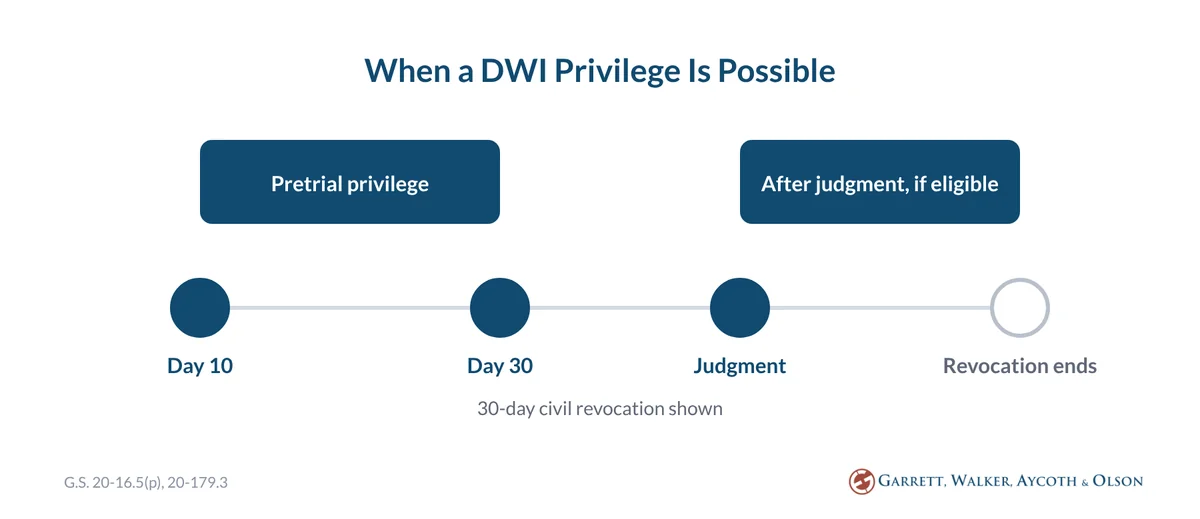
From arrest to the end of the civil revocation
A 30-day civil revocation opens the pretrial privilege on day 10. For a 45-day revocation, it opens on day 30.
Before the license comes back after the civil revocation, you pay $100 in costs under G.S. 20-16.5(j).
From conviction to the end of the revocation
A first DWI conviction brings a one-year revocation under G.S. 20-19. A prior offense within three years makes it four years.
Time under the civil revocation gives no credit against the conviction revocation (G.S. 20-16.5(i)).
The trap after the revocation ends
Warning: If the revocation period is over but DMV still has no certificate of completion, no privilege can be issued. G.S. 20-17.6(e) bars it.
The certificate shows you finished the assessment and then the ADET school or treatment. Until DMV receives it, your revocation is extended.
So finish those steps before the period ends. Getting the full license back is a separate step, covered in our guide to restoring your NC driver’s license.
Do not let the certificate become the reason you cannot drive. Call (336) 379-0539 and we will check where your case stands.
Common Pitfalls and How to Avoid Them
Most privileges are lost for reasons the order spells out.
Driving outside the order
Breaking any restriction is driving while license revoked for impaired driving under G.S. 20-28(a1). Once probable cause is found, the privilege is suspended while that case is pending.
Read about the charge for violating a DWI revocation before you take a chance.
Any alcohol in your body
The order bars driving with any alcohol remaining in your body. It also bars any controlled substance, unless it was lawfully obtained and taken in proper amounts.
Paperwork that lapses
The insurance certificate counts as proof for only 30 days from its issue date. An unpaid $100 fee makes the privilege invalid.
Changing jobs or hours
Only the court can modify the privilege, and only when circumstances have changed enough. A new job does not change the order by itself.
Assuming one privilege covers everything
A post-conviction privilege is valid only if the license is revoked solely for the DWI conviction (G.S. 20-179.3(e)).
The Role of an Attorney
An attorney’s biggest effect comes before the privilege, at the sentencing hearing. The punishment level set there decides whether a privilege is possible at all.
Your lawyer picks the right route, prepares the assessment, insurance and work documents, and asks at judgment. That can keep you from going without a license longer than the law requires, depending on the facts of your case.
The privilege runs alongside the DWI case itself. See how our Greensboro criminal defense lawyers handle the charge at the same time.
Talk with a Greensboro DWI lawyer for your license before your sentencing date.
Frequently Asked Questions
Can I get a limited driving privilege if I have a prior DWI?
Often, yes. If the prior conviction is more than seven years before the new offense, the regular path in G.S. 20-179.3(b)(1) applies. If it is within seven years, the 2024 path in (b)(3) can apply: under 0.15, the right punishment level, and an interlock. Even when you qualify, a judge decides, so your lawyer presents the case for it.
Do I need an ignition interlock for a limited driving privilege?
You do if your alcohol concentration was 0.15 or more, or if you qualify through the 2024 second path. The device is set at 0.02 and goes on one designated vehicle. In other cases, a judge may still add one.
How much does a limited driving privilege cost in NC?
The statute sets a $100 processing fee, paid to the clerk when the privilege is issued under G.S. 20-20.2. A pretrial case also carries $100 in costs before the license returns. Other court costs and legal fees depend on the case.
Can I drive on weekends with a limited driving privilege?
Only for what the order allows. Household errands are limited to 6 a.m. to 8 p.m., Monday through Friday. Weekend work, school or worship needs documentation and specific terms in the order. Emergency medical care is allowed at any time.
What happens if I drive outside my privilege?
You commit driving while license revoked for impaired driving under G.S. 20-28(a1). Once probable cause is found, your privilege is suspended until that new case is resolved. That can leave you with no legal way to drive, so call a lawyer right away.
Can I apply for a limited driving privilege online?
Not as a do-it-yourself online form. A judge must issue the privilege, either at sentencing when judgment is entered or after an application filed with the clerk. The district attorney gets a copy before any hearing. Your lawyer files the application and presents your documents to the judge.
Can I change my hours after I get the privilege?
Only through the court. The judge who issued the privilege may modify it if your circumstances have changed enough, such as a new job or a new shift. Until the court changes the order, you must follow the hours and routes it already sets.
Does my pretrial privilege still work after I am convicted?
No. A pretrial privilege covers only the civil revocation under G.S. 20-16.5. After a conviction, a new revocation begins, and you need a new privilege under G.S. 20-179.3. You may ask for it when judgment is entered, so bring your documents.
Can I get a limited driving privilege if I refused the breath test?
Possibly, after at least six months of the 12-month refusal revocation. The DWI charge must be resolved, you need an assessment and finished treatment, and you cannot have a prior conviction or refusal in seven years. No privilege is allowed if the case involved death or critical injury.
- Continuing Legal Education Instructor of the Year, North Carolina Bar Association
- Former President, Greensboro Criminal Defense Lawyers Association
- Board Member, Criminal Justice Section, North Carolina Bar Association
Talk to a Greensboro traffic and DWI lawyer today
Bring the citation, any DMV letter and your court date.
Garrett, Walker, Aycoth & Olson, Attorneys at Law
317 South Greene St, Greensboro, NC 27401
(336) 379-0539
This article explains North Carolina law in general terms. It is not legal advice about your case, and laws, penalties and court procedures change. Contact an attorney about your specific situation.